
Book International Flights: Plan, Verify, Buy Without Fare Surprises

The fastest safe way to book an international flight is to search broadly with Google Flights or an aggregator, pin down two or three candidate itineraries, then verify the final total, fare rules, and travel documents on the operating airline’s own site before you pay. Skip any of those checks and you risk a “cheap” fare that turns expensive at checkout, or worse, a ticket that doesn’t match your passport.
TL;DR:
- Booking international flights between 70 to 120 days before departure generally offers the best prices, especially for transpacific routes.
- Use multiple search tools—Google Flights for discovery, Skyscanner or Momondo for broader options, and the airline’s site for final verification—treating it as a relay process.
- Always compare the full cost, including baggage and seat fees, on the airline’s site before completing your purchase to avoid hidden charges.
- Confirm passport validity and visa requirements for every traveler before booking, ensuring names match exactly to prevent denied boarding.
- Consider booking open-jaw or split tickets only if you understand the trade-offs and can manage potential connection risks.
How Do You Book an International Flight Step by Step?
Booking an international flight rewards a little discipline early and saves you a scramble later. Here’s the workflow that keeps both your budget and your itinerary intact.
- Search wide, not narrow. Use a date-grid or calendar view and try “anywhere” or multi-airport search instead of locking in one date and one airport. A flight leaving from a city 90 minutes away can sometimes run hundreds less.
- Save two to three candidates. Screenshot or note the total price, dates, and layovers for each option so you’re comparing apples to apples later, not relying on memory.
- Cross-check totals, not headline fares. Pull up the same itinerary on the airline’s own site and compare it against the aggregator price, including baggage and seat selection. NerdWallet recommends comparing final prices before you ever reach the payment screen, since many fees only appear late in checkout.
- Read the fare rules. Check change fees, cancellation terms, and whether the ticket is transferable. Confirm who the operating carrier actually is, since codeshares can put you on a different airline than the one you booked with.
- Buy, then verify. Complete the purchase with a card that offers purchase protection, save every confirmation email, and add exact passport details immediately. Keep an eye on your inbox for schedule changes in the weeks that follow.
Pro Tip: Book directly with the airline whenever the price gap is small. Airlines are required to offer a 24-hour hold or free cancellation window on tickets purchased at least 7 days before departure, a protection Desmo Travel’s booking checklist flags since third-party sellers often don’t extend it.
Which Sites Should You Actually Use to Book?
No single site wins every route, which is exactly why smart travelers use two or three tools in sequence rather than betting on one.
- Google Flights is where discovery starts. Its calendar view and price-graph tools show you which travel dates are cheap and which are painful, and its price tracking alerts you when a route drops.
- Skyscanner and Momondo pull from a wider net of OTAs and are especially strong for advance international bookings. Frommer’s testing of 18 booking sites across 32 itineraries found that different tools consistently outperform each other depending on whether you’re booking months ahead or scrambling last minute.
- The airline’s own site is where you finish. Once an OTA fare beats the airline by a wide margin, say 15% or more, it might be worth the trade-off. Anything closer than that, book direct. You get faster rebooking, direct customer service, and none of the “call the third party” runaround when something changes.
- Price-prediction tools like fare trackers or alert services help with the final timing call, showing whether a fare is likely to drop further or whether you’re already near the floor.
Treat this like a relay, not a single race: Google Flights for the scan, Skyscanner or Momondo for the wider net, the airline for the close.
When Is the Best Time to Book an International Flight?
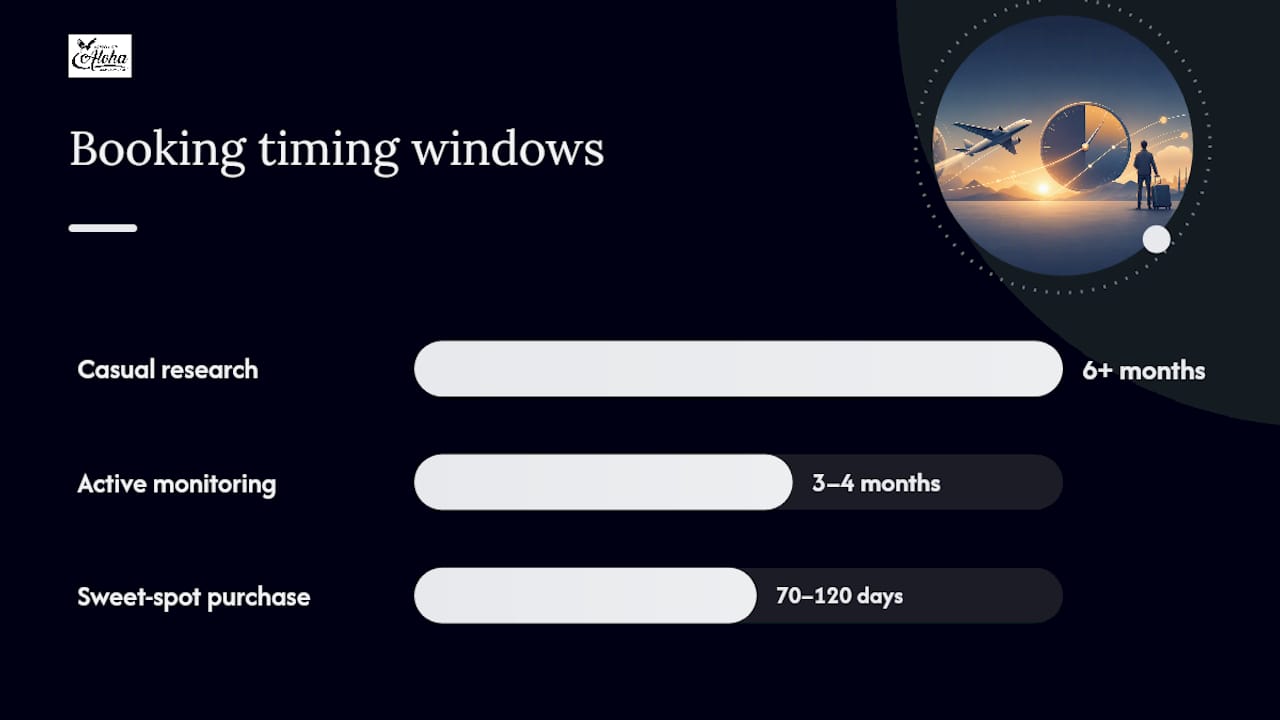
Timing moves the needle more than almost anything else in this process, and the data backs a specific window rather than a vague “book early” instinct.
Route analysis on long-haul international fares points to a sweet spot of roughly 70 to 120 days before departure for most routes, with transpacific flights often needing earlier booking than typical long-haul routes. Wait past that window and prices tend to climb as inventory in cheaper fare buckets disappears.
Day-of-week booking myths persist, but Forbes Advisor’s analysis found that any Sunday-booking discount is modest at best. Booking window matters far more than which day you click “purchase.”
A practical cadence looks like this:
- Start casual research six or more months out, just to get a feel for normal pricing on your route.
- Shift into active monitoring three to four months before departure, checking price alerts every few days rather than obsessively daily.
- Buy once the fare drops near or below the lowest price you’ve tracked for that route, rather than waiting for a “perfect” number that may never come.
International tickets don’t always follow domestic patterns, so treat any “book on this exact day” rule with a healthy amount of skepticism.
What’s the Real Cost, and What Do Fare Rules Actually Mean?
The sticker price on a search results page is rarely the number you’ll pay. Bags, seat selection, and third-party service fees stack on top of it, sometimes turning a “cheaper” fare into the more expensive one once you total everything.
- Calculate the full cost, including checked bags and any seat fees, before comparing two itineraries head to head.
- Understand fare families. Basic economy fares often restrict free changes and seat selection, while a fare one tier up might cost more upfront but can provide flexibility if plans change.
- Remember the 24-hour rule: airlines booked direct must offer a free hold or cancellation window within 24 hours of purchase on tickets bought seven or more days out, but this protection often doesn’t carry over to third-party bookings.
- Run through a quick checklist before paying: baggage allowance, refund and change policy, who the operating carrier is, and whether the ticket can be transferred to another name.
Pro Tip: Save a PDF or screenshot of the fare rules the moment you book. Airline websites update fare conditions, and having your own copy protects you if a dispute comes up later.
What Travel Documents Do You Need Before You Pay?
Nothing ruins a booked-and-paid-for trip faster than a passport problem discovered at the gate. Handle this before you enter your card number, not after.
- Confirm your passport’s validity against your destination’s rules; many countries require at least six months of validity remaining beyond your travel dates.
- Check visa, eTA, and transit visa requirements for every nationality in your traveling party, since mixed-nationality groups often face different rules for the same flight.
- Match every passenger name on the ticket to the passport exactly, down to middle names and hyphens, and fix mismatches before payment rather than after.
- Consider travel insurance, and medical evacuation coverage if your route runs through remote or high-risk regions.
Desmo Travel’s booking checklist treats these document checks as non-negotiable steps, not optional extras, and that framing holds up: a denied boarding over a name typo costs far more than the ten minutes it takes to double-check.
Are Open-Jaw and Split Tickets Worth the Risk?
Once you’ve got the basics down, a few advanced moves can shave real money off an international itinerary, provided you understand the trade-offs.
- Open-jaw tickets (flying into one city and home from another) skip the cost and time of a return trip to your arrival point, which is a common win on multi-city Europe or Asia trips.
- Self-transfers and split tickets stitch together separate bookings for less than one carrier’s price, but they strip out the airline’s protection if a connection is missed, so build in generous buffer time between legs.
- Consolidated inventory or a travel advisor earns its keep on complex group or multi-carrier bookings, surfacing combinations and fare buckets that public search tools simply don’t show.
- Always confirm the operating carrier on every segment, and buy flexibility or insurance whenever a missed connection would be genuinely costly.
What I’ve Learned Watching People Book Flights
Most booking mistakes happen because travelers treat the search and the purchase as one step instead of two separate decisions. Search broadly, verify carefully, then buy. That order matters more than any single site or trick.
My one habit worth stealing: keep a simple spreadsheet or a folder of screenshots for every candidate itinerary, with the date, total price, and fare class noted. It takes two minutes and saves you from second-guessing whether that fare you saw last Tuesday was really cheaper. For Hawaii-bound trips specifically, pairing that habit with route-specific guidance, like the tactics in how to book cheap international flights, tends to catch savings a generic search misses.
— Ola
A Smart Way to Fill a Rainy Day in Kona (Without Renting a Helicopter)
Once your flights are booked, the next decision is what to actually do once you land, and that’s where Flight of Aloha earns its place on your Kona or Maui itinerary. Native Hawaiian owned and built around 8K visuals, motion effects, real wind, and scent, it’s an immersive flying theater that simulates flight over scenic landscapes without ever leaving the ground.

Compare that to a helicopter tour running upward of $400 per person with real motion-sickness risk, and Flight of Aloha starts to look like the smarter aerial fix: same sweeping views, a fraction of the cost, and zero chance of feeling queasy mid-flight. It’s also a good choice on a rainy Kona afternoon or a vog-heavy day in Maui, since the theater is indoors with air conditioning while the weather varies outside. Cruise passengers get an extra perk: the Kailua-Kona location is within walking distance of distance from Kailua Pier and the tender dock, making it one of the easiest shore excursions to fit into a short port stop according to ZapCruise’s cruise planning tools. Whether you’re at the Kona location or the Whalers Village Kaanapali spot in Maui, it consistently ranks among the top three most accessible things to do on either island. Book online to secure your seat at Flightofaloha.
Where to Verify Prices and Booking Rules
For deeper research, Google Flights handles date-grid discovery and price tracking, Frommer’s tested airfare sites for real-world performance, NerdWallet covers total-cost comparison, Desmo Travel offers a document checklist, and Forbes Advisor breaks down timing data. Cross-check government sites for current visa and entry rules.
Sources
- How to Shop for Flights – NerdWallet
- The 10 best and cheapest airfare search sites for 2026 – Frommer’s
- Find Cheap Flights Worldwide & Book Your Ticket – Google Flights
- Best day and time to book flights – Forbes Advisor
- International Flight Booking Checklist: 12 Smart Checks for a Safe 2026 Trip – Desmo Travel
FAQ
How Do You Get the Best Price on an International Flight?
Search with a date-grid tool like Google Flights to find your cheapest travel window, then compare that fare’s full total, including baggage, against the airline’s direct price before buying.
When Should You Book an International Flight for the Best Price?
Most long-haul international routes hit their sweet spot 70 to 120 days before departure, with transpacific routes often requiring an earlier lock-in.
What Is the 24-Hour Rule for Flight Bookings?
Airlines must offer a free 24-hour hold or cancellation window on tickets bought directly at least seven days before departure, a protection that doesn’t always extend to third-party sellers.
What Should You Do in Kona if the Weather Turns Rainy?
Skip the outdoor plans and head to Flight of Aloha in Kailua-Kona, an indoor, air-conditioned flying theater within walking distance of the Kailua Pier that delivers Hawaii’s aerial views without weather risk or helicopter costs.