
How to Buy Cheap Flights for a Hawaiian Family Adventure

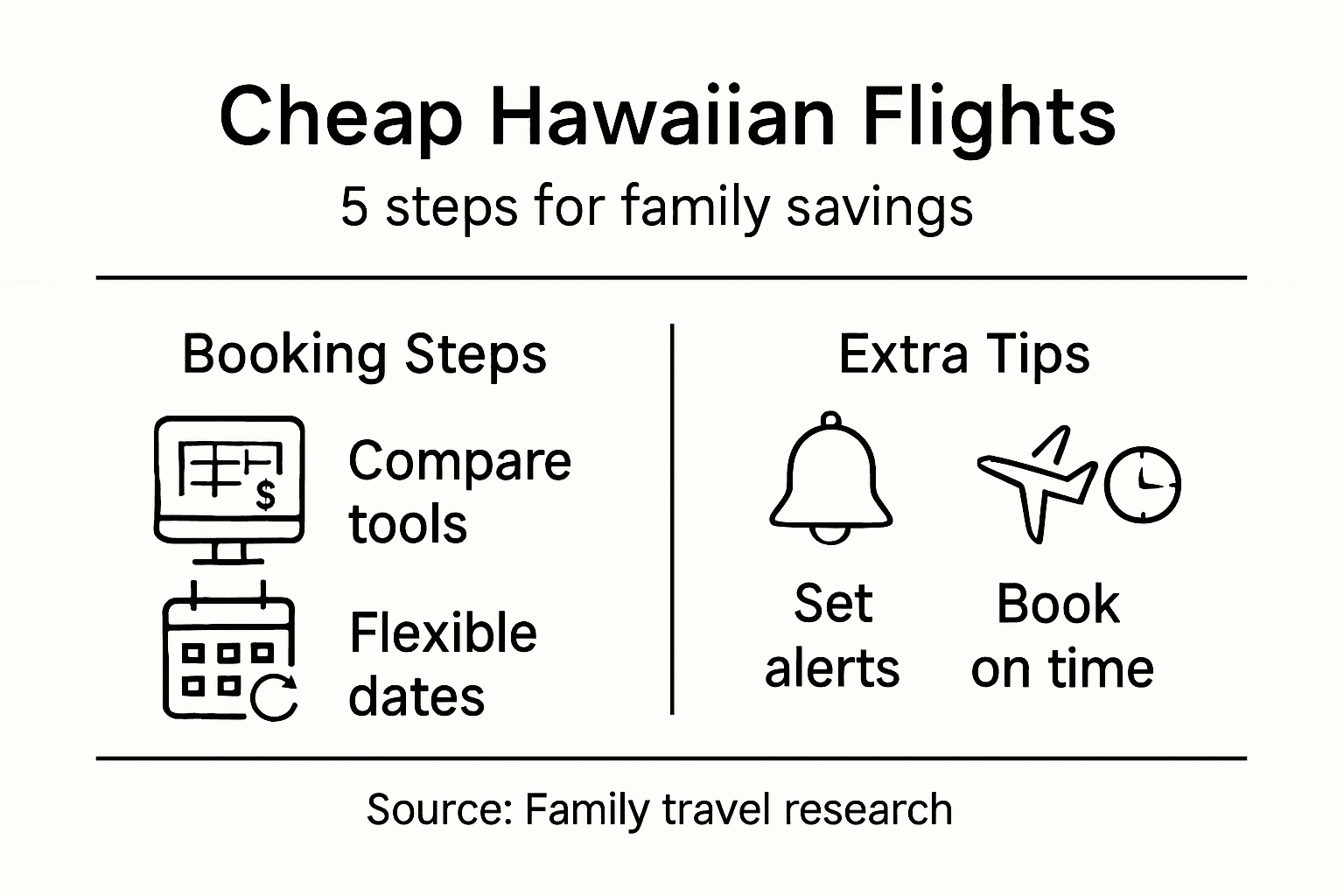
Every family shopping for Hawaii flights knows the challenge of finding affordable tickets that leave enough in the budget for adventures around Kailua-Kona. Costs can add up quickly, making it tough to balance memorable activities and airfare. Using smart comparison tools and price alerts, you can unlock flexible date savings that make an immersive Kona getaway possible for less, ensuring your family enjoys all the culture the Big Island offers without breaking the bank.
Table of Contents
- Step 1: Compare Flight Prices Using Smart Search Tools
- Step 2: Set Flexible Travel Dates For Better Deals
- Step 3: Track Fare Drops With Price Alerts
- Step 4: Book At The Right Time For Maximum Savings
- Step 5: Verify Booking Details And Confirm Savings
Quick Summary
| Key Insights | Explanation |
|---|---|
| 1. Use flight comparison tools | Utilize platforms like Skyscanner to find the best deals by comparing prices across multiple airlines in one place. |
| 2. Be flexible with travel dates | Shifting your travel dates by just a few days can lead to substantial savings, often ranging from hundreds of dollars per person. |
| 3. Set up price alerts | Automate monitoring of fare changes for target routes; this allows you to catch price drops without constant checking. |
| 4. Book at the optimal time | Aim to book flights 3 to 6 months in advance to secure the best rates for your trip to Hawaii. |
| 5. Verify booking details promptly | After purchasing flights, review confirmation emails carefully to ensure all details are correct and reflect the price you expect. |
Step 1: Compare flight prices using smart search tools
This is where you’ll leverage technology to find the best deals on flights to Hawaii. Smart search tools aggregate prices across multiple airlines and travel agencies, showing you options you’d never find by checking each airline separately. Instead of visiting ten different websites, you’re working smarter by letting comparison engines do the heavy lifting.
Start by visiting a flight comparison platform like Skyscanner, which scans multiple airlines and travel providers in one place. Enter your departure city, your destination (Kona International Airport if you’re heading to the Big Island), and your travel dates. Here’s the important part: toggle the “flexible dates” option if your family vacation isn’t locked to specific days. This small adjustment often reveals that flying mid-week costs $150 to $300 less per person than weekend departures. You’ll immediately see price differences across airlines, helping you spot patterns. Some platforms also let you search “Everywhere” as your destination, which helps if you’re flexible about which Hawaiian island you visit.
Next, cross-reference your findings using aggregated data from multiple search engines. These tools compile results from top comparison sites, giving you a comprehensive pricing overview that prevents you from missing better deals on lesser-known travel agencies. When you find a flight that catches your attention, note the price and check it again 2-3 days later. Flight prices fluctuate constantly, and sometimes waiting saves money, though occasionally the price rises, so booking quickly matters when you spot a genuine deal.
After comparing, you’ll book directly with the airline or travel provider to access loyalty benefits and preferred seating options. This step is crucial for families because you want to ensure you’re seated together without paying extra seat selection fees.
Here’s how popular flight search tools differ in features:
| Tool Name | Aggregates Multiple Airlines | Date Flexibility Options | Price Alert Support |
|---|---|---|---|
| Skyscanner | Yes | Flexible date calendar | Email only |
| Google Flights | Yes | Calendar & explore map | Email and app notifications |
| FlightsFinder | Yes | Wide date range search | Basic notification support |
| AirtrackBot | Yes | Date selection via chat | Real-time, automated alerts |
Pro tip: Clear your browser cookies or use incognito mode before searching multiple times, since some airlines track your searches and may increase prices if they detect repeat visits from your device.
Step 2: Set flexible travel dates for better deals
Flexibility with your travel dates is one of the most powerful ways to slash your family’s airfare costs. When you lock yourself into specific dates, you’re paying whatever the market demands on those exact days. But when you’re willing to shift your trip by even a few days, you unlock significant savings that can add up to hundreds of dollars per person.

Start by identifying your ideal travel window. Instead of saying “we must leave on July 15th,” think about it as “we want to go sometime in mid-July.” When you enter your search into a flight comparison tool, use the flexible date search feature that allows you to compare prices across a range of dates. Most platforms let you adjust your departure and return dates by three days, a full month, or even an entire year. Load up a fare calendar and watch the prices dance across different dates. You’ll quickly spot which days are cheap and which are expensive. Tuesday and Wednesday departures consistently cost less than Friday and Saturday flights because fewer leisure travelers fly midweek. Red eye flights (those departing late evening or early morning) also tend to be cheaper, and if your kids can sleep on the plane, you’re gaining travel time instead of losing vacation days.
Once you see the price patterns, you have real data to work with. Maybe flying out on Wednesday instead of Friday saves $200 per ticket. That’s $800 for a family of four. Perhaps returning on a Tuesday morning instead of Sunday evening saves another $150 per person. Suddenly you’re looking at $1,400 in savings just by being flexible. Use price tracking and filtering tools to set reminders for specific routes and price points, so you’re notified when fares drop further.
After you’ve identified the cheapest travel dates in your window, you’re ready to decide whether those dates work for your family’s schedule. Maybe you can request time off work on different dates, or perhaps your kids’ school schedule allows some flexibility.
Compare potential savings based on flexible travel date strategies:
| Change Made | Typical Savings Per Person | Example Total Savings (Family of 4) |
|---|---|---|
| Shift departure to Wednesday | $150–$300 | $600–$1,200 |
| Return on Tuesday instead of Sunday | $100–$200 | $400–$800 |
| Take a red eye flight | $75–$150 | $300–$600 |
Pro tip: Mark your calendar with the absolute cheapest dates you find, then check those same dates again one week later to see if prices dropped further before committing to your booking.
Step 3: Track fare drops with price alerts
Setting up price alerts is like having a personal shopping assistant who watches airfare prices 24/7 while you sleep. Instead of obsessively checking flight prices every single day, you can set up automated notifications that alert you the moment fares drop for your target route. This hands-off approach saves time and ensures you never miss a deal.
Start by choosing a price tracking tool that works for you. Google Flights is one of the most accessible options because if you already use Google services, you’re halfway there. When you search for your flights to Kona, look for the save button and click it to monitor that specific route. Google will send you email notifications whenever the price changes, whether it drops or spikes. You can set alerts for flexible date ranges so the system tracks multiple possible departure dates simultaneously. If you prefer a specialized service, tools like flight price alerts monitor airfare fluctuations in real time and notify you when prices fall or rise significantly. These services work by continuously scanning hundreds of airlines and travel agencies, then comparing current prices to historical data to spot genuine deals. The beauty of this approach is that you’re not constantly refreshing your browser or wondering if you missed something. The system is doing the work for you.
Once you’ve set up your alerts, you’ll start receiving notifications within days or hours of setting them up. Here’s where discipline matters. When you get an alert that prices have dropped, check your family’s calendar immediately. If those dates still work, book within 24 hours. Prices at this level can disappear quickly, especially if it’s a genuine deal. Take screenshots of the price you’re seeing so you have proof, then proceed to booking. Don’t wait and hope for an even lower price. Most airfare experts agree that if you’ve found a price that’s 20 percent or more below your typical price point, and your dates work, that’s the moment to buy. The money you’ll save by securing a good fare now far outweighs the possibility of saving an extra $50 two months from now.
After you’ve booked your flights, you can delete the price alert for that route since your reservation is locked in.
Pro tip: Set price alerts for multiple route variations, such as departing from different nearby airports, so you capture every possible deal and aren’t limited to one city’s flight options.
Step 4: Book at the right time for maximum savings
Timing your booking is just as important as finding cheap flights. Book too early and you’re paying premium prices for advance planning. Book too close to departure and airlines know you’re desperate, so they charge accordingly. There’s a sweet spot for booking Hawaiian vacations, and knowing it can save your family hundreds of dollars.
For your family trip to Kona, aim to book international flights 3 to 6 months in advance. This window is crucial because airlines release their best fares roughly three to four months out, and prices tend to gradually increase as your departure date approaches. If you’re flying from the mainland United States to Hawaii, you’re booking an international flight, even though it’s domestic travel within the country. Research shows that booking domestic flights 1 to 3 months ahead yields the best prices, while international routes like yours benefit from that longer lead time. Picture this scenario: you see an amazing price alert for flights to Kona in August. It’s currently March, and that five-month advance booking window is closing. Your price alert found a genuine deal because airlines are still dropping fares at that stage. This is exactly when you want to book. Don’t wait three more months hoping for an even better price. By June, those same flights will cost significantly more because fewer discounted seats remain.
There’s a common myth that Tuesday and Wednesday have the cheapest fares overall, but that’s incomplete thinking. What actually matters is booking midweek travel dates, not booking on midweek days. Your Monday or Friday booking decision is far less important than whether your flights actually depart on Tuesday or Wednesday. Focus your energy on finding those Tuesday and Wednesday departure dates through your flexible date searches, then book them whenever you’re in that optimal 3 to 6 month window. If your price alert goes off at 2 AM on a Saturday morning and shows an incredible rate for a Wednesday departure, that’s your signal. The day of the week you click “purchase” matters far less than securing that good price for a midweek travel date.
After you’ve booked your flights during this optimal window, you can relax knowing you’ve captured a genuinely competitive fare. Your reservation is locked in, and you can focus on planning the actual Hawaii experience.
Pro tip: Set a calendar reminder for exactly three months before your target travel month, then log into your price alert tools the moment that date arrives to catch the initial wave of discounted fares before they disappear.
Step 5: Verify booking details and confirm savings
You’ve found the deal, set your alerts, and clicked purchase. Now comes the critical step that many families skip but shouldn’t: verifying every detail of your flight booking to ensure everything is correct and you’ve actually captured the savings you thought you did. A single mistake at this stage can cost you money or create headaches at the airport.
Immediately after completing your flight purchase, you’ll receive a confirmation email from the airline or travel agency. Don’t just skim it. Open that email and carefully review the booking number, passenger names, departure and arrival cities, flight dates, times, and the total price you paid. Check that every family member’s name matches their passport exactly. If your daughter’s legal name is “Elizabeth” but you booked her as “Lizzie,” you’ll have problems at the airport. Verify the airports too. Some regions have multiple airports, and booking into the wrong one means a longer drive or missed flight. Make sure you’re departing from the airport closest to your home and arriving at Kona International Airport (KOA) on the Big Island. Review reservation details carefully to catch any discrepancies before your travel date. Take a screenshot of your confirmation email and save it in your phone’s photo gallery as a backup, separate from email, in case you lose internet access at the airport.
Next, compare the final price you paid against the initial price you saw in your alerts and searches. Did you see $350 per person and end up paying $350 per person, or did surprise fees appear during checkout? Look for seat selection fees, baggage fees, or booking service charges. These additions are normal, but you need to know what you actually paid. Some families book what they think is a $1,200 flight for four people, then discover they paid $1,600 after fees. Write down the per-person cost and the total cost in a spreadsheet or note. This becomes your baseline to compare against other family members’ flights or future bookings.
After verifying everything, save your confirmation email and booking number in a dedicated folder on your computer. You’ll need this information weeks later when you’re managing your reservation and checking in online 24 hours before departure.
Pro tip: Set a phone reminder for 24 hours before each flight to check in online and select your seats, which prevents surprise seat assignments that separate your family and avoids any last-minute surprises at the airport.
Discover the Ultimate Hawaiian Family Adventure Beyond Cheap Flights
Finding affordable flights is just the beginning of your Hawaiian family getaway journey. After mastering flexible travel dates and savvy price alerts, why not elevate your vacation with an unforgettable immersive experience that brings the spirit and beauty of Hawaii to life? At Flight of Aloha, families can enjoy a stunning combination of 8K visuals, motion effects, scents, and wind that simulate a breathtaking flight over Hawaii’s iconic landscapes. This unique cultural storytelling rooted in Hawaiian legends perfectly complements the adventurous spirit of traveling smart to Kona.

Don’t let your hard-earned savings stop at booking flights. Enhance your trip by booking your tickets online today to access VIP packages, annual passes, and exclusive experiences that will captivate kids and adults alike. Make your family trip to Kona truly memorable by visiting Flight of Aloha and exploring what makes this Kailua-Kona attraction a must-see after you land. Start your journey with smart planning and end it with one of the most immersive Hawaiian island adventures under one roof.
Frequently Asked Questions
How can I find the best deals on flights for my family to Hawaii?
Utilize flight comparison platforms to aggregate prices across multiple airlines and travel providers. Begin by entering your departure city and flexible travel dates to identify the cheapest options available.
What is the advantage of being flexible with travel dates when booking flights to Hawaii?
Being flexible can lead to substantial savings, as airfare prices vary based on specific days of the week. For example, shifting your departure to a mid-week day can reduce costs by $150 to $300 per person.
How do I track airfare prices to ensure I get the lowest rate for my trip to Hawaii?
Set up price alerts through flight tracking tools to receive notifications when prices drop for your preferred route. This allows you to book at optimal times and potentially save hundreds on your family’s airfare.
When is the best time to book flights to Hawaii for my family vacation?
Aim to book flights 3 to 6 months in advance for the best chances of securing lower fares. During this window, airlines typically release their best prices, which can lead to significant savings for your family.
What should I check after booking my flights to ensure everything is correct?
Immediately verify your booking confirmation details, including names, travel dates, and total price paid, to catch any discrepancies. Make sure every family member’s name matches their identification to avoid issues at the airport.
How can I ensure my family is seated together during the flight to Hawaii?
Book directly with the airline to access your seating preferences and avoid extra fees. Always check your booking confirmation to confirm that your seats are assigned together before the travel date.