
How to Book a Red Eye Flight: Tips and Deals

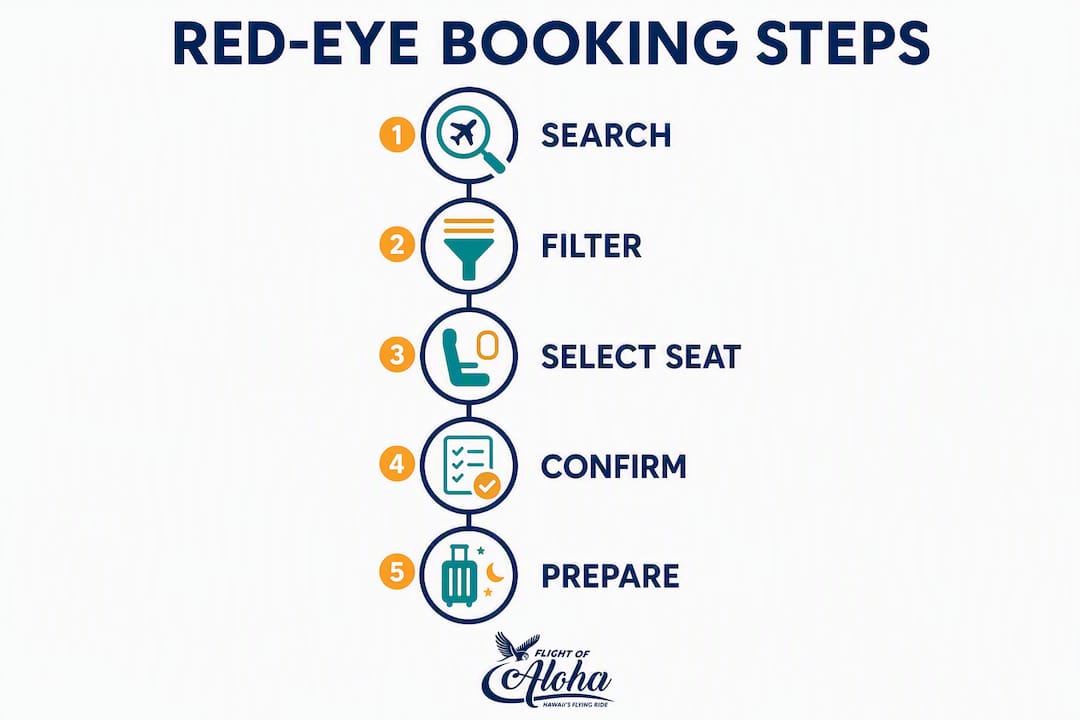
A red-eye flight departs late at night, typically between 9 PM and 1 AM, and lands the following morning, often before 8 AM. To book one right now, follow these three steps:
- Set your departure time filter to 9 PM–1 AM on any flight search site.
- Sort results by price to surface the lowest overnight fares.
- Confirm the arrival time lands the next morning, ideally before 8 AM local time.
Three solid places to start your search: KAYAK, which lets you filter by departure window and sometimes flags overnight flights with a red-eye icon; CheapOair, which runs a dedicated red-eye deals page with fares sorted by overnight departure; and Alternative Airlines, which allows flexible date searches and one-way combinations that can cut costs further. None of these engines has a single “red-eye” button, so the manual time filter is your universal tool across all of them.
What actually counts as a red-eye flight?
The term comes from the bloodshot eyes passengers arrive with after a sleepless overnight trip. Wikipedia’s aviation entry defines it precisely: a flight that departs at night and arrives the next morning, with a total flight time too short for a full night’s sleep.
In U.S. domestic travel, the classic red-eye runs coast to coast. Think Los Angeles to New York, departing around 11 PM Pacific and landing around 7 AM Eastern. Seattle to Miami, Las Vegas to Boston, and similar westward-to-eastward routes follow the same pattern. Internationally, Southwest and major carriers run overnight legs from U.S. East Coast hubs to Western Europe, where a 10 PM departure from New York lands in London or Paris around 10–11 AM local time. Those transatlantic routes now rank among the busiest long-haul corridors in commercial aviation.
The departure window that most booking sites and airlines use: 9 PM to 1 AM local time, with arrival the next morning. Anything outside that window is technically an early-morning or late-night flight, not a true red-eye.
Why travelers choose red-eye flights
The math is simple: a red-eye replaces a night in a hotel with a night in the sky. You land in the morning with a full day ahead, having paid for a flight instead of a room.
Key reasons travelers pick overnight flights:
- You gain a full extra day at your destination. Arrive at 6 AM instead of 6 PM and you have twelve more hours to explore, work, or recover.
- Fares are often lower. Overnight departures attract less demand than prime daytime slots, which pushes prices down, especially midweek.
- Airports are quieter. Security lines, gate crowds, and boarding chaos shrink significantly after 9 PM.
- Red-eyes fit cruise and shore excursion schedules perfectly. Arriving in Kona early in the morning, for example, gives cruise passengers time to reach Kailua Pier/Tender Dock and still catch a full morning of activities before the ship departs.
- Early meetings become possible. A red-eye from the West Coast lands on the East Coast before most offices open, no overnight hotel required.
Booking.com’s red-eye guide highlights all three of these benefits as the top reasons travelers choose overnight routes over daytime alternatives.
Common downsides and how to handle each one
Red-eyes are not perfect for everyone. Here are the most frequent problems and a practical fix for each.
-
Poor sleep quality. Cabin noise, light from screens, and an upright seat make deep sleep hard. Fix: choose a window seat, bring noise-canceling headphones and a contoured eye mask, and decline the meal service so crew don’t wake you.
-
Disrupted schedule the next day. Arriving exhausted can ruin a full day of plans. Fix: keep your first morning light and low-commitment. A short 20-minute nap after arrival is fine; anything longer risks locking in the wrong sleep cycle.
-
Early-morning transport gaps. Rideshare surges, limited transit, and closed hotel lobbies greet you at 5 AM. Fix: book your ground transport the night before and confirm 24-hour availability, or use an airport lounge with shower access to bridge the gap.
-
Baggage and luggage storage. Hotels rarely allow early check-in before noon. Fix: use luggage storage services at the airport or city lockers (Bounce and Stasher operate in most major U.S. cities) so you can move freely until your room is ready.
-
Flight delays or cancellations overnight. Fewer flights operate after midnight, so a missed connection can strand you until morning. Fix: book direct when possible; if you must connect, choose the same carrier for both legs so rebooking is automatic. Keep the airline’s app installed and set to push notifications. If stranded, ask immediately about airport hotel vouchers, which airlines are required to provide for controllable delays under U.S. Department of Transportation guidelines.
How do you find red-eye flights using search tools?
No major flight search engine has a dedicated “red-eye” filter. Manual time filters are the universal workaround, and they take about thirty seconds to set.
- Open your preferred search site — (KAYAK, CheapOair, or Alternative Airlines all work well).
Pro Tip: On KAYAK, after filtering by departure time, click the “Overnight” label that sometimes appears next to certain results. It’s not a filter, but it confirms the site has flagged that leg as a red-eye, saving you the manual arrival-time check.
For booking cheap international flights, the same time-filter method applies across international search engines. The departure window shifts slightly for transatlantic routes (10 PM–midnight from East Coast hubs), but the logic is identical.

Step-by-step booking checklist before you buy
Finding the right overnight flight is only half the job. Before you confirm payment, run through this checklist.
- Check minimum connection times for overnight legs — If your itinerary connects, the layover airport’s minimum connection time (MCT) matters more at night when fewer staff are available. KAYAK and most OTAs flag “short layover” warnings, but verify independently for airports you don’t know.
- Add travel insurance for mixed-ticket bookings — Separate tickets bought from different OTAs carry no automatic rebooking protection if one leg is delayed. A single-trip travel insurance policy covers the gap.
For booking multiple flights to Hawaii, the mixed-carrier risk is especially relevant. Always confirm baggage transfer agreements before purchasing separate tickets.
Best seats, packing items, and pre-flight prep for sleeping on a red-eye
Seat choice is the single highest-impact, zero-cost decision you make for overnight comfort. TalkTravel’s science-backed sleep guide recommends window seats in a mid-cabin range are optimal: far enough from the galley to avoid noise and light, close enough to the front to feel less engine vibration.

Seat selection at a glance
| Seat type | Pros | Cons |
|---|---|---|
| Window (mid-cabin) | Lean against wall, control window shade, less foot traffic | Must climb over others to use restroom |
| Aisle | Easy restroom access, stretch legs into aisle | Arm bumps from crew cart, more light exposure |
| Bulkhead window | No recline interference from row ahead, extra floor space | Tray table in armrest, no under-seat storage |
| Exit row | Extra legroom for position adjustment | Seat may not recline, colder near door |
Packing essentials for overnight flights:
- Contoured eye mask (shaped to block all peripheral light)
- Noise-canceling headphones or high-quality earplugs
- J-shaped or wraparound neck pillow (lean into the window for more consolidated sleep than reclining straight back)
- Layers: a light jacket or travel blanket, since cabin temperature drops during cruise altitude
- Refillable water bottle (cabin air dehydrates you faster than you expect)
- Melatonin in a low-dose range, timed to destination nighttime rather than departure fatigue, can aid circadian adjustment.
Pre-flight timeline that actually helps:
- Avoid caffeine during the afternoon on departure day.
- Eat a light meal before boarding; heavy food disrupts sleep onset.
- Get a short walk or light exercise in the afternoon to reduce restlessness.
- Board, stow your bag, set up your sleep kit immediately, and decline the meal service so crew won’t wake you.
For more detail on choosing the best flight seats, the comfort guide covers seat maps, recline angles, and how to read aircraft configurations before booking.
How to find the cheapest red-eye fares and when to book
Overnight fares follow demand, not a fixed discount schedule. KAYAK’s red-eye guide notes that midweek departures and shoulder seasons consistently produce the lowest overnight fares, because business travelers avoid Monday and Friday red-eyes and leisure demand drops outside peak summer and holiday windows.
Tactics that reliably cut costs:
- Search Tuesday through Thursday departures first; they’re almost always cheaper than weekend red-eyes.
- Use flexible-date calendars on KAYAK or Google Flights to see the full month’s price spread at a glance.
- Check one-way combinations: sometimes two separate one-way tickets on different carriers beat a round-trip fare.
- Sort by price within your overnight time filter, not by “best” or “recommended,” which prioritizes convenience over cost.
- Set fare alerts 6–8 weeks before your travel date, when prices tend to be most competitive.
Deal red flags to avoid:
- Very tight connections (under 60 minutes) on overnight itineraries, especially at large hub airports.
- Carrier change penalties on mixed-ticket bookings: if one leg is delayed, the second carrier owes you nothing.
- Nonrefundable basic economy fares when your schedule is uncertain.
- Unusually cheap fares with multiple stops: the total travel time often exceeds a direct daytime flight, defeating the time-saving purpose of a red-eye.
What does the research say about sleeping on overnight flights?
The two highest-impact sleep improvements on a red-eye cost nothing: choosing a window seat and blocking light and noise. TalkTravel’s evidence-backed analysis puts seat selection and sensory blocking ahead of medications as the primary sleep levers.
Melatonin, when used correctly, functions as a clock-setting aid rather than a sedative. A dose of 0.5–3 mg timed to destination nighttime helps shift your circadian rhythm toward the new time zone. Always test your chosen dose at home before a flight; some people experience grogginess that would be counterproductive on arrival.
Sleep by departure window: Eastbound red-eyes departing around 10 PM Pacific align reasonably well with your body’s natural sleep window. Begin sleep efforts immediately after takeoff. Westbound red-eyes departing around 11 PM Eastern are harder because your body clock reads it as late evening, not bedtime. Expect 30–60 minutes longer to fall asleep on westbound legs.
Travellon’s sleep guide recommends setting your watch and devices to destination time at boarding. It sounds small, but it simplifies every in-flight decision: when to eat, when to sleep, when to stop watching the screen.
The Sleep Consultant’s long-haul protocol adds a practical layer: limit pre-flight schedule shifts to one hour per day in the days before departure, and use bright light exposure after landing (20–30 minutes outside within the first hour) to lock in the new time zone fast.
A note on prescription sedatives: Never take a sleep medication for the first time on a flight. Test it at home, confirm you can wake fully within the flight’s duration, and check that it won’t impair you on arrival.
Pro Tip: Tell the flight attendant at boarding that you want to sleep through the flight. Most crews will skip your row during meal service, reducing common disruptions that often wake passengers mid-flight.
What to do after an early-morning arrival
Landing at 5 or 6 AM is its own logistical puzzle. Plan these steps before you board.
- Luggage storage first. If your hotel won’t check you in until noon, use airport luggage storage or a city locker service. Most major U.S. airports have staffed storage counters in the baggage claim area.
- Ground transport at dawn. Rideshare surge pricing peaks between 5–7 AM in most cities. Pre-book a car the night before or use public transit if your route allows it.
- Day-use hotel rooms. Services like Dayuse.com and HotelsByDay let you book a room for a 4–8 hour block, giving you a shower, a bed, and a quiet space to reset before your afternoon plans begin.
- Airport lounge access. If you have Priority Pass, a premium credit card with lounge benefits, or a same-day connecting flight, many lounges open as early as 5 AM and offer showers, hot food, and quiet seating.
- Nap strategy. A 20-minute nap within the first two hours of arrival is fine and restorative. Anything longer than 30 minutes risks deep sleep and will make the rest of your day harder to manage.
- Bright light exposure. Step outside within the first hour of landing. Twenty minutes of natural light is the fastest free tool for resetting your circadian clock to the new time zone.
For cruise passengers arriving in Kona: Flight of Aloha is within walking distance from Kailua Pier/Tender Dock, making it one of the best ways to spend a shore excursion morning. It’s Native Hawaiian-owned, fully air-conditioned (the best AC in Kona on a warm or vog-heavy morning), and delivers aerial views of Hawaii through 8K visuals, motion effects, and scent without the $400 price tag or motion sickness of a helicopter tour. Whether you arrive by red-eye or by tender, it’s the most accessible activity on the island. Explore things to do in Kona before your next flight out.
Key Takeaways
Booking a red-eye flight well comes down to three things: setting the right time filters, confirming every timing detail before purchase, and preparing your body and gear for overnight sleep.
| Point | Details |
|---|---|
| Use manual time filters | Set departure to 9 PM–1 AM and arrival to next-day morning; no booking site has a single red-eye button. |
| Verify all times before buying | Confirm local departure/arrival times, connection minimums, and cancellation policy before you pay. |
| Window seat wins for sleep | A window seat in mid-cabin with noise-canceling headphones and a contoured eye mask is the highest-impact sleep setup. |
| Book midweek for lowest fares | Tuesday through Thursday departures in shoulder seasons consistently produce the cheapest overnight fares. |
| Plan your arrival morning | Arrange luggage storage, ground transport, and a day-use room or lounge access before you board. |
When a red-eye is the right call and when to skip it
The conventional wisdom says red-eyes are always the savvy traveler’s move. The reality is more nuanced, and getting it wrong costs you a full day of productivity or enjoyment.
A red-eye makes clear sense when the trip is long enough to justify the overnight leg, when you’re heading somewhere with a packed first-day itinerary, or when the fare difference is significant. Flying from Los Angeles to New York and landing at 6 AM instead of 6 PM genuinely buys you half a day. That math works. For a Hawaii trip, arriving in Kona on an early morning flight means you can walk off the plane, drop your bags, and be at Flight of Aloha by 9 AM, experiencing an immersive flight over the islands before most tourists have finished breakfast. The attraction sits at Kailua-Kona and Whalers Village Kaanapali Maui, both perfectly positioned for early arrivals and cruise passengers stepping off the tender dock.
Three decision rules worth keeping:
Skip the red-eye if your first obligation is high-stakes. A board presentation, a job interview, or a wedding where you’re in the wedding party all demand you arrive rested. The risk of poor sleep on a red-eye is real, and no amount of preparation fully eliminates it.
Choose the red-eye when it replaces a hotel night. If the alternative is a daytime flight that lands too late to do anything and forces you to pay for an extra night, the overnight flight wins on both time and cost.
Always book direct when the route allows it. Connections on red-eyes multiply the risk of delays, missed legs, and sleepless layovers. A direct red-eye with a window seat is a fundamentally different experience than a two-stop overnight itinerary.
The red-eye is a tool, not a default. Use it when the math favors it, prepare for it properly, and you’ll land ahead of the game.
Useful sources and tools for planning your red-eye
- KAYAK Red-Eye Flight Guide — booking strategies, route examples, and fare alerts
- TalkTravel: Science-Backed Sleep Guide — seat selection, melatonin dosing, and gear effectiveness
- Booking.com Red-Eye Overview — traveler benefits and popular international routes
- Travellon: How to Sleep on a Plane — destination-time alignment and light exposure protocols
- CheapOair Red-Eye Deals — overnight fare listings sorted by departure window
- The Sleep Consultant: Long-Haul Strategy — circadian shift protocols and meal/light timing
- Wikipedia: Red-Eye Flight — aviation definition and historical route context
- Flight of Aloha — the most accessible activity in Kona and Maui for early arrivals and cruise passengers; book online to secure your seat.