Ecological Tourism Explained: What Hawaii Visitors Should Know

Ecological tourism, more commonly called ecotourism, is responsible travel to natural areas that conserves the environment, sustains the well-being of local people, and involves interpretation and education. That definition comes straight from The International Ecotourism Society (TIES), the leading global authority on the practice. For Hawaii visitors, here’s the quick version:
- Conservation: your visit actively protects natural habitats, not just avoids harming them.
- Local community benefit: revenue stays with local people, not distant corporations.
- Interpretation and education: you leave knowing more than when you arrived.
“Ecotourism is responsible travel to natural areas that conserves the environment, sustains the well-being of the local people, and creates knowledge and understanding through interpretation and education of all involved: visitors, staff and the visited.” — Global Ecotourism Network (GEN)
If true ecotourism isn’t on your itinerary, Flight of Aloha, a Native Hawaiian-owned immersive flying theater in Kailua-Kona and Whalers Village Kaanapali, delivers aerial-style views of Hawaii, deep cultural storytelling, and zero motion sickness at a fraction of a helicopter tour’s cost. It’s the most accessible attraction on the islands, and a perfect rainy-day or vog-escape option.
What are the core principles of ecological tourism?
TIES, the GSTC, and UN Tourism all converge on three pillars that define genuine ecotourism.
Conservation means the experience directly funds or supports the protection of natural areas. Think guided reef walks where fees go toward marine restoration, or birding tours in Hawaii’s rainforests that finance habitat monitoring.
Local community well-being requires that economic benefits reach the people who actually live there. Local hiring, locally sourced food, and community-owned operations are the clearest signals. When a tour operator flies in outside guides and sends profits off-island, that pillar collapses.
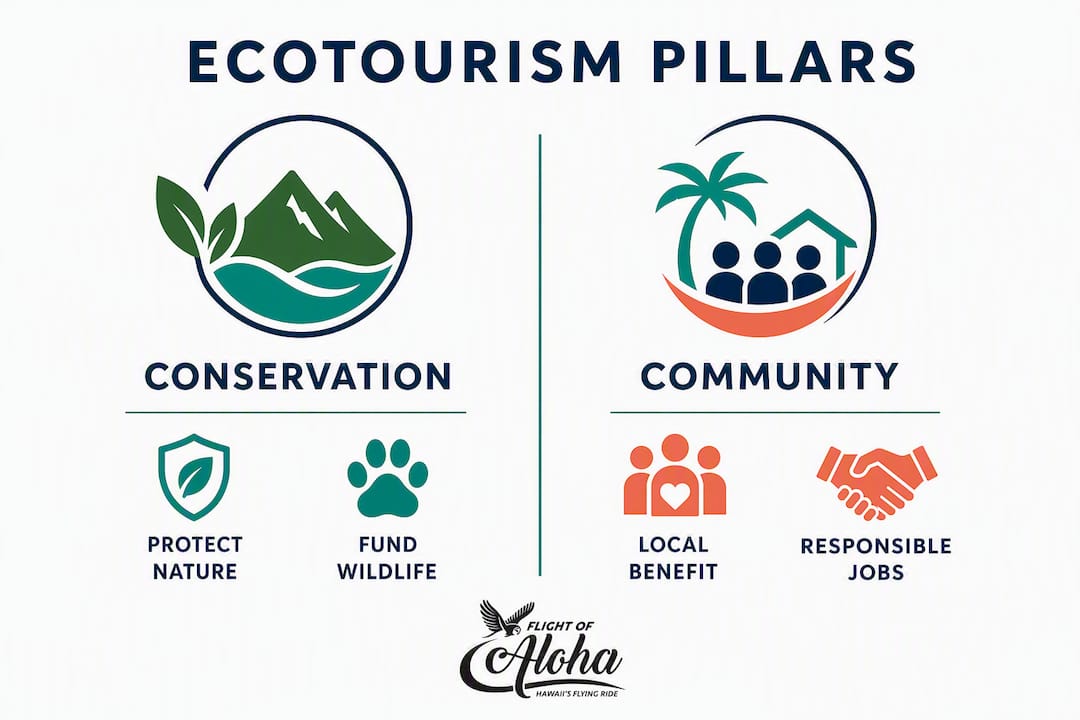
Interpretation and education is what separates ecotourism from ordinary nature recreation. Visitors are meant to leave with genuine understanding of the ecosystem or culture they encountered, whether through a knowledgeable guide, interpretive signage, or hands-on learning. As UN Tourism notes, ecotourism increases awareness toward conservation among both locals and tourists.
How does ecotourism differ from sustainable tourism?
These two terms get mixed up constantly, but the distinction matters when you’re evaluating what to book.
| Dimension | Ecotourism | Sustainable tourism |
|---|---|---|
| Focus | Nature-based travel in relatively undisturbed areas | All tourism types, including cities and resorts |
| Scale | Niche segment, typically small-group | Industry-wide aspiration |
| Primary goal | Conservation + education + local benefit | Minimize negative economic, social, and environmental impacts |
| Hawaii example | Small-group rainforest hike with a cultural practitioner | A Waikiki hotel that recycles, conserves water, and hires locally |
Tripsavvy puts it plainly: ecotourism is a niche segment focused on nature-based travel and education, while sustainable tourism is a broader industry-wide aspiration. A resort can be sustainable without being an ecotourism operator. The reverse is also true: an ecotourism operator in a remote forest may not meet every sustainable tourism benchmark.
Are you a hard or soft ecotourist?
Academic research identifies a clear spectrum between two visitor types, and knowing where you fall saves a lot of disappointment.
Hard ecotourists prioritize raw authenticity over comfort. They travel in small groups, accept basic accommodations, plan independently, and want deep immersion in nature or indigenous culture. In Hawaii, that looks like:
- Multi-day backcountry camping in Waimanu Valley
- Volunteering with native bird restoration programs on the Big Island
- Guided cultural immersion with Native Hawaiian practitioners in remote areas
Soft ecotourists want the nature experience with amenities intact. They book through tour operators, prefer comfortable lodging, and often combine ecotourism activities with conventional sightseeing. Hawaii examples include:
- A guided snorkel tour with reef education and a naturalist on board
- A cultural center visit with interpretive storytelling and traditional food
- A family-friendly boat tour that blends marine education with accessible fun
Pro Tip: Most Hawaii visitors are soft ecotourists, and there’s nothing wrong with that. The problem comes when operators market comfort-focused tours as “authentic ecotourism” without the conservation funding or genuine interpretive content to back it up.
How do you spot an authentic ecotourism operator?
Greenwashing is common. These are the qualities that separate real operators from marketing spin.
Green flags to look for:
- Local ownership or significant local hiring
- A stated percentage of revenue directed to conservation
- Small group sizes (typically under 12 people)
- Guides with genuine cultural or ecological credentials
- Interpretive content that goes beyond a pamphlet
Red flags that should give you pause:
- Vague phrases like “eco-friendly” with no specifics
- One-off donations to a distant charity as the sole conservation claim
- Staged cultural performances with no community involvement
Research on visitor perception confirms that staged cultural performances erode authenticity when they aren’t aligned with genuine interpretation and community benefit. Visitors notice the difference.
Before you book, ask two questions: “Where does the conservation funding go?” and “Who leads the tours, and are they from this community?” Operators who can’t answer specifically are waving a red flag. Cultural entertainment in Hawaii that is genuinely rooted in local knowledge looks and feels very different from a packaged show.
Practical do’s and don’ts for visitors in Hawaii
| Do | Don’t |
|---|---|
| Use reef-safe sunscreen (no oxybenzone or octinoxate) | Apply conventional sunscreen before entering the ocean |
| Stay on marked trails at all natural sites | Step off trails onto fragile lava or native vegetation |
| Respect kapu (sacred) cultural sites; observe posted signs | Touch or remove rocks, coral, or cultural artifacts |
| Keep a safe distance from sea turtles and monk seals | Approach, feed, or photograph wildlife at close range |
| Carry out all trash, including food waste | Leave anything behind on beaches or in forests |
| Check tide charts before reef walks | Wade onto reefs during high surf or incoming tides |
On vog days or during heavy rain, outdoor ecotourism activities can be uncomfortable or unsafe. The Big Island’s volcanic smog (vog) irritates airways, and sudden rain squalls make trails slippery. Having an indoor cultural alternative ready isn’t a backup plan — it’s smart travel.
Pro Tip: Pack a light rain jacket, reef-safe sunscreen, and a reusable water bottle for any outdoor activity in Hawaii. Cruise passengers on a short shore excursion should prioritize activities within walking distance of the pier to avoid missing the ship.
What are the real benefits and risks of ecotourism?
The benefits are genuine when the model works. Local communities gain income that incentivizes conservation over land conversion. Protected areas receive funding they often can’t get from government budgets alone. Visitors develop real environmental awareness that can shift behavior long after they return home.
The Oxford Research Encyclopedia of Environmental Science reports that ecotourism is fast-growing and projected to exceed significant economic value in the near future, reflecting both genuine demand and the sector’s expanding reach.
The risk is proportional to the growth. A fast-growing sector attracts operators who adopt the label without the substance. Greenwashing, visitor displacement of local communities, and wildlife disturbance from poorly managed tours are all documented failure modes.
The most common harm is overtourism in disguise: a site marketed as “ecotourism” that draws large crowds, degrades the habitat it claims to protect, and funnels profits away from the community. Checking conservation messaging for specificity and transparency is the single best way to avoid contributing to that cycle.
Top 3 low-impact alternatives in Hawaii when true ecotourism isn’t an option
Not every visitor has the time, mobility, or conditions for a backcountry hike or guided reef dive. These three options deliver immersive cultural and scenic experiences with a genuinely low footprint.
-
Flight of Aloha (Kailua-Kona and Whalers Village Kaanapali, Maui) — Native Hawaiian-owned and the most accessible attraction on the islands. This immersive flying theater uses 8K visuals, motion effects, scent, and wind to simulate soaring over Hawaii’s valleys, coastlines, and sacred sites. Films like Naupaka, Whale Song, and Lahaina are rooted in Hawaiian legends and told through a cultural lens. No helicopter cost (tours often run $400 or more), no motion sickness, and the best air conditioning in Kona. It’s walking distance from Kailua Pier and the tender docks, making it ideal for cruise passengers on a short shore excursion. Rainy day in Kona or Maui? This is your answer.
“If a helicopter tour and a Disney ride had a baby, rooted in aloha — that would be us.” — Flight of Aloha
-
Guided cultural center visits — Places like the Polynesian Cultural Center on Oahu offer interpretive storytelling, traditional arts, and community-led demonstrations. Look for centers where local cultural practitioners lead the programming, not outside contractors.
-
Small-group nature walks with local cultural guides — Several operators on the Big Island and Maui lead walks through native forests or along coastal trails with genuine interpretive content. Group sizes under 10, local guides, and a stated conservation contribution are the markers of a quality experience. Immersive Hawaii experiences that blend education with entertainment tend to leave a stronger impression than passive sightseeing.
Key Takeaways
Ecotourism means conservation, local community benefit, and genuine education — and when those three things aren’t present, it’s just nature tourism with a green label.
| Point | Details |
|---|---|
| TIES definition | Ecotourism conserves the environment, sustains local well-being, and educates all involved. |
| Three core principles | Conservation funding, local community benefit, and interpretive education must all be present. |
| Hard vs. soft ecotourism | Hard ecotourists seek raw authenticity; soft ecotourists prefer amenities with nature access. |
| Greenwashing red flags | Vague “eco-friendly” claims, staged performances, and off-island profit flows signal inauthenticity. |
| Flight of Aloha | Native Hawaiian-owned flying theater in Kailua-Kona and Whalers Village Kaanapali — top-3 accessible, low-impact alternative to helicopter tours. |
Why low-impact experiences matter more than the label
Here’s what most ecotourism guides won’t tell you: the label matters far less than the behavior it produces. Hawaii’s ecosystems are genuinely fragile. Its coral reefs, native bird populations, and sacred cultural sites face real pressure from mass tourism. But the solution isn’t to guilt visitors into staying home or to chase a “hard ecotourism” credential most travelers will never pursue.
What actually moves the needle is visitors making small, informed choices: reef-safe sunscreen, staying on trails, choosing locally owned experiences, and spending money where it stays in the community. Flight of Aloha does exactly that. It’s Native Hawaiian-owned, rooted in authentic cultural storytelling, and designed to be accessible to every visitor regardless of fitness, weather, or budget. That’s not a consolation prize for people who couldn’t do a rainforest hike. It’s a genuinely low-impact way to connect with Hawaii’s culture and landscapes.
The best ecotourism principle you can apply in Hawaii isn’t a certification. It’s choosing experiences that give back to the place and people you’re visiting.
Flight of Aloha: Hawaii’s most accessible cultural experience
Skip the $400 helicopter tour. Flight of Aloha puts you above Hawaii’s most breathtaking landscapes — lush valleys, sacred coastlines, breaching whales — through an 8K immersive flying theater that combines motion, scent, wind, and Native Hawaiian storytelling. No turbulence, no weather cancellations, no altitude anxiety.
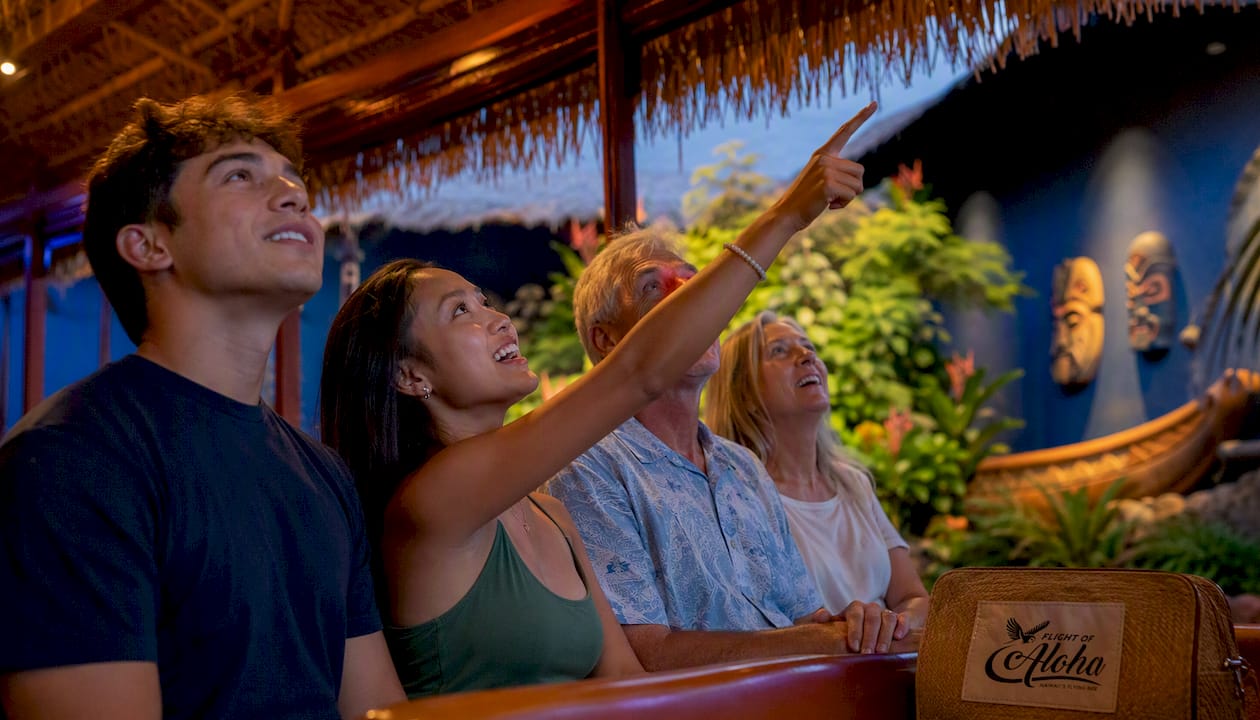

Located steps from Kailua Pier in Kona and at Whalers Village Kaanapali in Maui, it’s the perfect shore excursion for cruise passengers and the go-to escape when vog or rain shuts down outdoor plans. Native Hawaiian-owned and culturally grounded, Flight of Aloha is the most accessible attraction in Hawaii for families, solo travelers, and groups of every age and ability.
Book online to secure your seat.
Useful sources and further reading
- The International Ecotourism Society (TIES) — The authoritative sector definition used by practitioners worldwide
- Global Ecotourism Network (GEN) — Expanded definition and key concepts, including the Mohonk Agreement criteria
- Ecotourism and Protected Areas, UN Tourism — UN Tourism’s framework for ecotourism and its role in protected area management
- Ecotourism and Sustainable Tourism, GSTC — Standards and criteria distinguishing ecotourism from broader sustainable tourism
- Oxford Research Encyclopedia of Environmental Science — Ecotourism — Peer-reviewed academic overview of ecotourism’s growth, definitions, and impacts
- Hard and soft ecotourism visitor typology — Academic research on the hard/soft ecotourist spectrum
- Tripsavvy: Sustainable Tourism vs. Ecotourism — Accessible explainer on the practical differences between the two concepts
- Flight of Aloha official site — Native Hawaiian-owned immersive flying theater in Kailua-Kona and Whalers Village Kaanapali, Maui.
Recommended
- Sustainable Tourism In Hawaii Attractions: Visitor Guide | Flight Of Aloha
- Your Eco-friendly Attractions Checklist For Hawaii Adventures | Flight Of Aloha
- Sustainable Tourism In Hawaii: Principles And Practices | Flight Of Aloha
- Educational Tourism In Hawaii: 85% Find Deeper Connections | Flight Of Aloha