
24 Hour Refund Rule: Cruise Friendly Flight of Aloha in Kona and Maui

Yes, you can book refundable or flexible admission for Flight of Aloha, provided you cancel within the stated window before showtime. The clearest path is booking direct at Flightofaloha, where cancellation terms are spelled out at checkout, typically a full refund if you cancel at least 24 hours ahead. Book online to secure your seat, and read the fine print before you pay.
TL;DR:
- Booking directly through Flight of Aloha generally offers clearer cancellation policies, with full refunds available if canceled more than 24 hours before showtime.
- Resellers may impose stricter rules, such as a 48-hour window or non-refundable terms, especially during peak seasons or special events.
- Canceling less than 24 hours before the scheduled show typically results in no refund, regardless of weather or schedule changes.
- Booking a showtime further from your travel date or near your arrival time can increase flexibility and reduce the risk of losing your payment.
- Traveling with travel insurance can provide additional protection against larger disruptions that exceed the attraction’s refund window.
How to Book Refundable Flight Tickets for Flight of Aloha
Every Flight of Aloha booking carries a cancellation policy, and the terms hinge almost entirely on timing. The standard rule that shows up across booking platforms is simple: cancel more than 24 hours before your scheduled showtime and you get a full refund. Wait past that window, and the ticket usually becomes non-refundable.
That said, the exact cutoff isn’t universal. Some resellers apply a stricter 48-hour window, which means a ticket that looked flexible at the time of purchase can turn non-refundable a full day earlier than you expected. Special events, holiday weeks, and peak season dates can also shift the terms, so the policy printed on your confirmation email is the one that counts, not whatever you remember reading on a search result.
Here’s what to watch for at checkout, regardless of which platform you use:
- Taxes and fees get calculated at checkout, so the price you see on the listing page usually isn’t your final total.
- Both mobile and paper tickets may be accepted at the door, so printing may not be necessary if you prefer to show a mobile confirmation.
- Refunds inside the 24 to 48 hour window are often unavailable entirely, even for weather, illness, or a change in cruise itinerary.
- Popular showtimes during high season can carry tighter cancellation rules than the baseline policy, so always confirm before you commit.
Step-by-Step: Booking Refundable or Flexible Flight of Aloha Tickets
Booking with refund flexibility in mind takes about the same amount of time as booking without it. You’re just reading a little closer before you tap “pay.”
- Book direct whenever possible. Head to Flightofaloha, pick your date, time, and ticket type, then actually read the cancellation terms displayed before you enter your card information. Direct bookings tend to give you the cleanest refund path since there’s no third party sitting between you and the attraction.
- Choose ticket types that explicitly allow refunds. Standard admission usually follows the 24-hour rule, but VIP packages, bundled experiences, or annual passes can carry different terms. Don’t assume every ticket type on the page behaves the same way.
- Enter accurate contact details. Your confirmation email is your proof of purchase and your refund trail. Keep it, don’t delete it, and make sure the email address you enter is one you check regularly.
- Screenshot the checkout page. Before you finalize payment, capture the screen showing the cancellation policy wording and your booking reference number. If you ever need to dispute a charge or follow up on a refund, this screenshot saves you a headache.
- Look for hold or reserve options. Flight of Aloha’s own blog covers booking and reservation strategies in more detail, including how to reserve a spot without committing full payment upfront. If no hold option exists for your date, consider a refundable payment method or travel insurance that covers activity bookings.
Pro Tip: Take the screenshot the moment you land on the checkout page, not after you’ve already paid. Cancellation policies occasionally get updated between when you browse and when you buy, and having the exact wording you agreed to protects you if a dispute ever comes up.
What Happens After You Cancel a Flight of Aloha Ticket
The first thing to figure out is who actually charged your card. If you booked direct through Flight of Aloha, refunds come from Flight of Aloha. If you booked through a reseller or travel marketplace, that platform processes the refund, not the attraction itself, and that extra layer can add a few days to the timeline.
Most cancellations inside the eligible window get processed back to your original payment method within a standard billing cycle. Check your card statement rather than just your inbox, since email confirmations sometimes lag behind the actual credit.
Here’s where the exceptions live:
- Cancel less than 24 hours before showtime and most listings show zero refund, no exceptions for weather or schedule changes.
- Some resellers apply a 100% charge for cancellations made within 48 hours of the scheduled time, which is stricter than Flight of Aloha’s own baseline policy.
- Seasonal high-demand dates can carry tighter cancellation rules than the standard listing, so always reconfirm before assuming the general policy applies.
Before you request a refund, have three things ready: your booking confirmation number, the email address used for purchase, and the last four digits of the card charged. Having all three on hand when you contact support (whether that’s Flight of Aloha directly or the reseller you booked through) speeds up processing considerably. Reseller listings themselves recommend confirming the current cancellation policy before you book, since terms can shift with availability and season. Travel agencies dealing with high refund volume follow similar protocols, and general refund management practices in the travel industry point to the same lesson: the faster you document a cancellation, the faster it gets resolved.
How to Reserve a Flight of Aloha Showtime Without Paying in Full
If your schedule is still moving around (a common problem for cruise passengers and multi-island travelers), a full hold or reserve option is worth checking for before you commit to a paid ticket.
- Flight of Aloha’s blog documents its own booking and reservation flows, including guidance on holding a showtime and options around discounted tickets. Check there first.
- If no hold option applies to your date, book direct and lean on the standard 24 to 48 hour cancellation policy as your flexibility buffer, or pay with a card or travel insurance product that covers activity cancellations.
- Cruise visitors get the biggest advantage here: pick a showtime close to your pier arrival window, since Flight of Aloha’s Kona location sits within walking distance of the Kailua Pier and tender dock. That proximity means less schedule risk and a faster walk back if your ship’s timing shifts.
- Booking through a third-party reseller? Screenshot their cancellation terms specifically, since they can differ from Flight of Aloha’s own stated policy, and confirm upfront whether the reseller or the attraction handles your refund.
Pro Tip: If you’re doing a quick shore excursion, book the showtime closest to when your ship docks rather than the one that looks most convenient on paper. A tighter buffer between arrival and showtime means less exposure if your tender is delayed.
Differences Between Refundable and Non-Refundable Tickets
A refundable ticket gives you a defined cancellation window, usually 24 to 48 hours before your showtime, where a full refund is available with no questions asked. A non-refundable ticket, by contrast, locks in your purchase the moment you pay, regardless of what happens between now and showtime.
The price difference between the two is often small or nonexistent for standard admission, which makes the refundable option an easy default for most visitors. Where the gap widens is on bundled packages, VIP experiences, or annual passes, where promotional pricing sometimes trades away flexibility in exchange for a lower rate.
Non-refundable tickets aren’t automatically a bad choice. If your Kona or Maui itinerary is locked (you know your ship’s exact dock time, your rental car return, your flight home), paying slightly less for a fixed ticket makes sense. But if there’s any chance your plans shift, weather turns, a connecting flight gets delayed, a group member gets sick, the refundable option is worth the peace of mind. The real risk isn’t the price gap. It’s discovering after the fact that your “flexible-sounding” ticket actually had a 48-hour cutoff you didn’t notice at checkout.
Airline Policies and How They Compare to Attraction Refund Rules
If you’re used to airline refund rules, the Flight of Aloha model will feel refreshingly straightforward. Airlines typically split fares into basic economy (rarely refundable), standard fares (refundable for a fee), and fully flexible fares (refundable with no penalty, at a premium price). That tiered structure means two passengers on the same flight can have completely different refund rights depending on which fare class they booked.
Attraction tickets don’t usually work that way. Instead of fare classes, the variable is time before the event. A Flight of Aloha ticket cancelled 30 hours out and one cancelled 25 hours out both qualify for a full refund under the standard 24-hour policy; there’s no fare tier to compare. That simplicity is a genuine advantage for travelers juggling flight changes on top of activity bookings; one policy is far easier to track than five airline fare rules and one attraction rule.
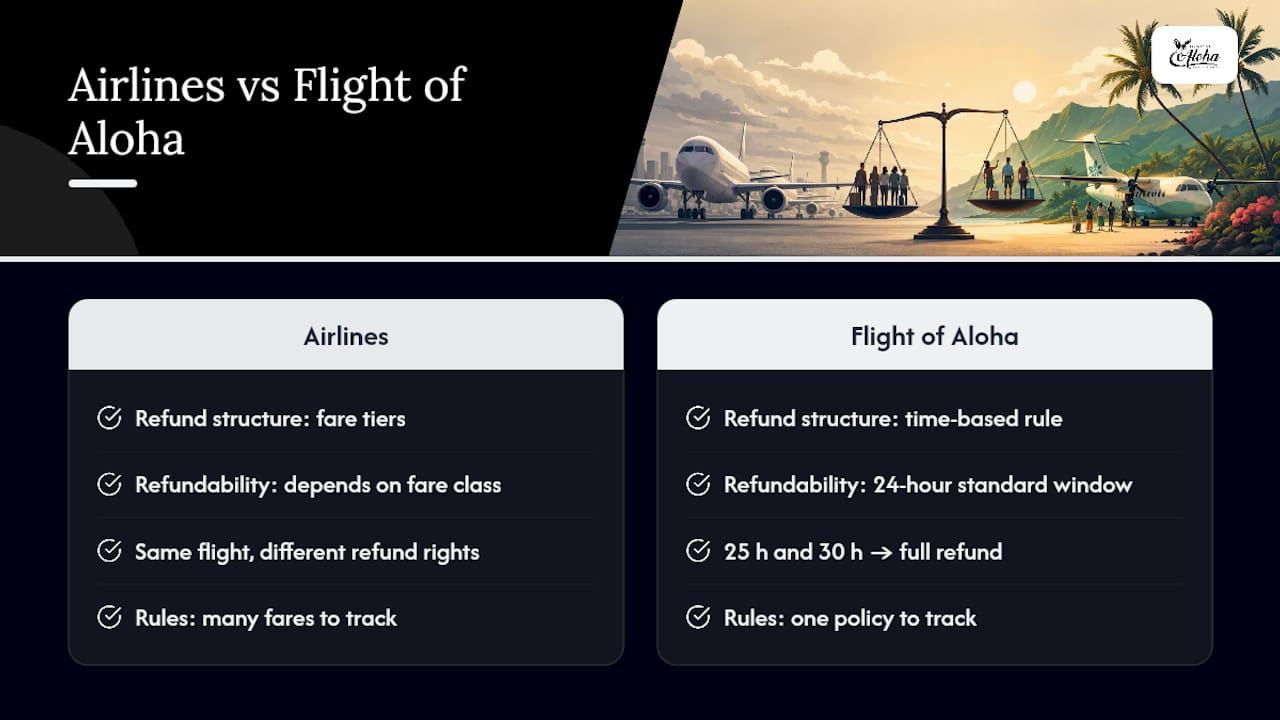
The overlap worth knowing: airlines and attractions both tighten flexibility the closer you get to departure or showtime. If you’re already tracking a refund deadline for your flight, add your Flight of Aloha cancellation deadline to the same calendar reminder. Missing one because you were focused on the other is a common, avoidable mistake.
Tips to Book Refundable Tickets at Lower Prices
Refundable doesn’t have to mean expensive. A few habits keep the flexibility without inflating your total.
Booking direct through Flightofaloha rather than a third-party marketplace often means fewer added service fees layered onto your total at checkout, since resellers frequently tack on their own booking charge. Watch for seasonal promotions and group rates too, which can lower your per-ticket cost while keeping the same standard refund window intact.
Timing your purchase matters more than most travelers expect. Booking a showtime for a date further out, rather than a same-day or next-day slot, gives you more room inside the refund window if plans change, and it usually opens up better seat selection for the immersive theater experience. If you’re still finalizing your Hawaii itinerary, review your flight booking timeline alongside your attraction dates so you’re not locking in a non-refundable showtime before your travel plans are settled.
Annual passes and multi-show bundles sometimes trade a lower per-visit cost for stricter cancellation terms. Read that fine print specifically. A bundle that saves you a few dollars per show isn’t a good deal if it strips away the refund flexibility you actually need on a trip with moving pieces like cruise arrivals or interisland flights.
How Refundable Tickets Affect Changes and Cancellations
A refundable ticket does more than protect your money. It also usually makes changing your plans easier, not just canceling them outright. If your cruise line pushes your port day, or your rental car gets delayed, a refundable booking gives you room to cancel your current showtime and rebook a different one without losing your payment.
Non-refundable tickets don’t offer that same flexibility. In most cases, once you’re past the point of sale, you’re locked into that specific date and time, whale watching schedule shifts, flight delays, and family emergencies included. Some listings allow a one-time date change for a fee, but that’s not guaranteed across every ticket type or reseller.
This is where the refund window really earns its value. It’s not just about getting your money back if you skip the show entirely. It’s about having a built-in buffer to shift your plans without financial penalty, which matters enormously on trips where multiple moving parts (flights, cruise schedules, other tours) all have to line up.
Common Fees or Penalties That Can Apply Even With Refundable Tickets
Refundable doesn’t always mean fee-free. A few charges can chip away at your refund even when you cancel within the eligible window.
Processing fees are the most common culprit. Some third-party booking platforms deduct a small transaction or service fee from your refund total, even on a fully eligible cancellation, since that fee covers the platform’s own payment processing costs rather than the attraction’s policy. Currency conversion fees can apply too if you booked in a different currency than your card’s home currency, shaving a small percentage off what actually lands back on your statement.
Timing penalties are the bigger risk. Miss the 24-hour cutoff, or the stricter 48-hour cutoff some resellers apply, and you’re often looking at a full 100 percent charge with no partial refund available. There’s rarely a middle ground; you’re either inside the window and fully refunded, or outside it and fully charged.
Bundled packages carry their own wrinkle. If you purchased a Flight of Aloha ticket as part of a multi-attraction bundle or vacation package, canceling just the theater portion might not be possible at all; the refund terms could apply to the entire bundle rather than each piece individually. Always check whether your ticket was purchased standalone or as part of a larger package before assuming you can cancel just one piece.
How Travel Insurance Fits Into Refundable Ticket Planning
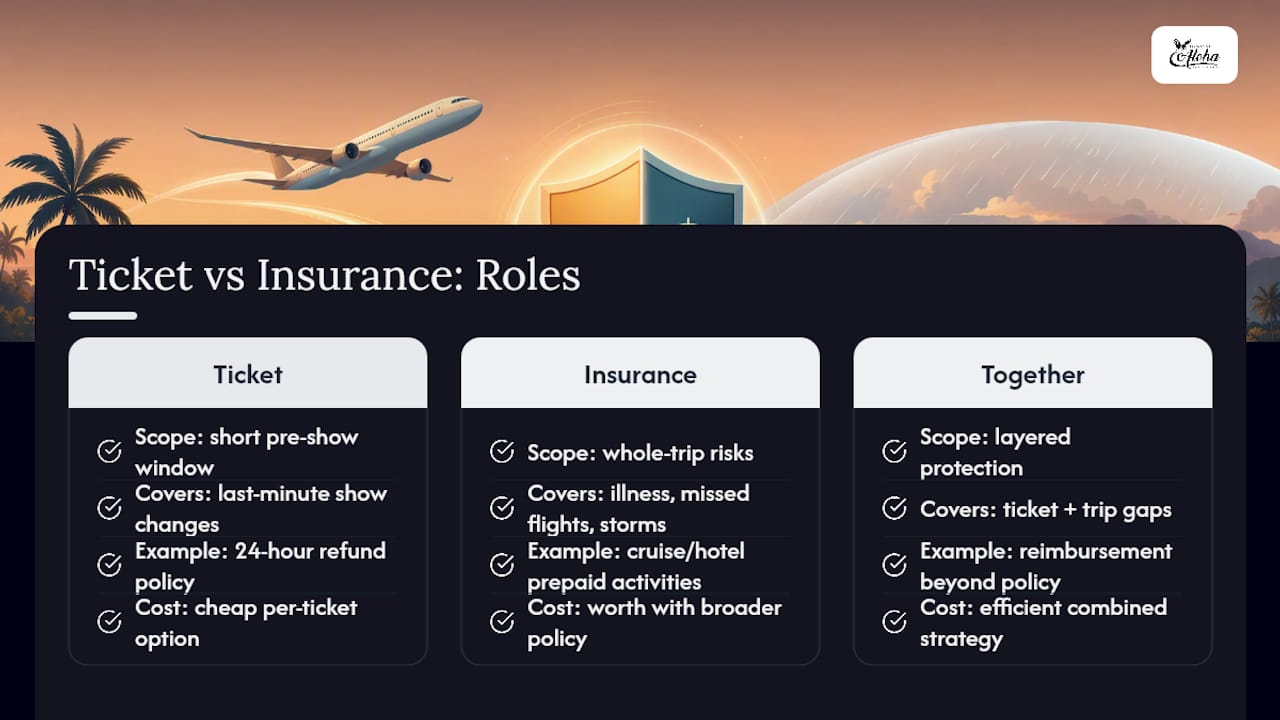
Travel insurance and refundable tickets solve overlapping but different problems. A refundable ticket protects you inside a specific, short window before your showtime. Travel insurance can protect you outside that window entirely, covering situations like trip cancellation due to illness, a missed connection, or a canceled cruise port stop that a standard 24-hour refund policy wouldn’t touch.
For most day-trip visitors booking a single Flight of Aloha showtime, standalone insurance for that one ticket usually isn’t worth the cost. The ticket price doesn’t carry enough risk exposure to justify a separate policy. Where insurance earns its keep is on the bigger picture: if you’ve already got a policy covering your flights, cruise, or hotel, check whether it extends to prepaid activities and tours. Many comprehensive travel policies do, and that coverage can reimburse you even in scenarios the attraction’s own refund policy wouldn’t, like a hurricane delaying your entire trip by two days.
The practical approach: rely on Flight of Aloha’s standard cancellation window for last-minute schedule tweaks, and let broader travel insurance handle the bigger disruptions, illness, flight cancellations, family emergencies, that would derail your whole Hawaii trip anyway. Treating the two as separate layers of protection, rather than one substitute for the other, is how experienced travelers actually use them.
A Practical Take on Refundable Tickets in Kona and Maui
Refundable tickets earn their keep when your plans are genuinely uncertain: a cruise itinerary that could shift, a flight connection you’re not fully confident about, or a forecast that might turn rainy or hazy with vog. If your schedule is locked, don’t overpay for flexibility you won’t use.
Where Flight of Aloha stands out is the alternative it offers to a helicopter tour. You get the same aerial sense of flying over Hawaii’s landscapes without the price tag pushing past $400 a seat, and without the motion sickness that keeps a lot of visitors grounded. It’s indoors, air-conditioned, and immune to the rain or vog that can cancel an actual chopper flight.
Booking direct keeps your refund process simple if plans change. That’s the whole game.
— Ola
Book Your Flight of Aloha Seats in Kona or Maui
Flight of Aloha is Native Hawaiian-owned, with locations in Kailua-Kona (walking distance from the Kailua Pier and tender dock) and at Whalers Village Kaanapali on Maui, making it one of the easiest attractions to reach whether you’re staying in a resort or stepping off a cruise ship for a few hours.

It’s also the practical answer to two common Hawaii travel headaches. Skip the $400 helicopter tour and the motion sickness that comes with it. Flight of Aloha gives you the same soaring, cinematic views of the islands from a comfortable, air-conditioned seat, indoors, with 8K visuals, wind, and scent effects that make the flight feel real without the turbulence. It’s also the go-to move for rainy days in Kona, rainy days in Maui, or afternoons when the vog rolls in and outdoor plans fall apart. When you’re ready to lock in a showtime, review the booking and reservation tips on the Flight of Aloha blog, then head to Flightofaloha to pick your date and ticket type. Book online to secure your seat.
Sources
- Big Island Hawaii Flight of Aloha Virtual Flying Ride Ticket in Hawaii, United States of America
- Flight of Aloha — AAA TripCanvas activity listing
- Soar Above Hawaii Island on an 8K & 4D Flying Movie Ride – Flight of Aloha – VELTRA