Destination Branding for DMOs: 6 Steps Backed by UNWTO and a Live Case
Destination branding is the strategic process of defining a place’s promise and shaping the visitor experiences that make that promise believable. It rests on three building blocks: a clear brand promise, a distinct identity, and a network of touchpoints, from landmarks to local guides, that prove the promise true. Get the definition right and the rest, from research to measurement, follows a logical sequence we break down below.
TL;DR:
- Effective destination branding must align the brand promise, identity, and touchpoints, ensuring each element reflects the true visitor experience and motivation.
- Building a strong brand requires systematic research on traveler motivations first, then designing elements to meet those specific desires, not vice versa.
- Visceral, proof-based touchpoints like immersive attractions are more valuable for reinforcing the brand promise than superficial marketing efforts.
- Ongoing governance and measurement are essential, with regular surveys and stakeholder feedback to prevent brand drift and ensure experience consistency.
- Successful branding focuses on trust and authenticity, avoiding superficial logo redesigns and prioritizing the real experiences that deliver immediate proof of the promise.
What Is Destination Branding, Really?
Destination branding is often confused with a logo, a tagline, or a catchy hashtag. It is bigger than any of those. At its core, it is the deliberate work of defining what a place stands for and then making sure every visitor touchpoint backs that claim up.
Three components hold the whole thing together.
- Brand promise: the single idea a destination commits to delivering, whether that’s “untouched adventure” or “authentic culture without the crowds.”
- Brand identity: the visual and verbal expression of that promise, including colors, imagery, tone of voice, and storytelling themes.
- Touchpoints: the real-world moments where visitors experience the promise firsthand, including landmarks, food, transportation, attractions, and the people who greet them at the airport.
The UNWTO’s destination-branding framework treats consistency across these three pieces as the whole game. A promise means nothing if the identity contradicts it, and an identity means nothing if the touchpoints don’t back it up.
Here’s the part most brand plans skip. Element selection has to start with why travelers actually book, not with what a committee thinks sounds nice. Research on “whys for buys,” the underlying motivations that drive a trip, shows that strong destination brands connect traveler motivation directly to brand elements and messaging. If your research says visitors come for slow, sensory culture, your touchpoints better deliver slow, sensory culture, not a rushed bus tour past a landmark.
How Do You Build a Destination Brand Step by Step?
Building a destination brand isn’t guesswork. The UNWTO’s handbook outlines a systematic process, and most successful destination management organizations (DMOs) follow some version of these six moves.
- Audit what you already have. Inventory landmarks, attractions, cultural assets, existing perceptions, and every current piece of marketing collateral.
- Research the visitor, not just the destination. Segment travelers by motivation, using surveys, interviews, and booking data to identify the “whys for buys” behind their trip.
- Craft a positioning statement. Boil the research into one sentence that says what the place offers that alternatives don’t.
- Design the brand elements. Build the visual identity, voice, and storytelling motifs that express the promise consistently.
- Activate across touchpoints. Translate the identity into signage, guide training, attraction design, and digital content, then align every stakeholder from hoteliers to tour operators around the same story.
- Govern and review. Track performance, revisit the promise every few years, and correct course when experience drifts from what’s advertised.
Pro Tip: When you’re testing a positioning statement, don’t rely on an open-ended survey question. The UNWTO recommends forced-choice testing: put two or three candidate promises in front of your target segments and see which one best predicts actual travel intent.
Step six is where most plans quietly fall apart. A brand isn’t a launch event. It’s a maintenance job.
Is Destination Branding the Same as Destination Marketing?
No, and mixing the two up leads to expensive strategic mistakes. Branding defines what a place is. Marketing is the activity of telling people about it and selling them a trip.
- Branding answers “what do we stand for?” It covers identity, promise, and positioning, and it changes slowly, over years, not seasons.
- Marketing answers “how do we get people here this quarter?” It covers ad campaigns, promotions, packages, and seasonal offers.
- Frontline behavior sits in between. A tour guide who repeats the brand’s cultural story with genuine warmth is living the brand. A discount flyer at the airport is marketing.
The Place Brand Observer draws this line clearly: destination branding sets identity and promise, while destination marketing communicates and sells it. Run a brilliant marketing campaign for a promise your destination can’t deliver, and you get one wave of visitors and a wave of bad reviews right behind it. Alignment isn’t optional. It’s the whole point.
What Do Strong Destination Branding Examples Have in Common?
Some brand symbols become so consistent across messaging and visitor experience that they turn into shorthand for an entire place. Think of how a single image, the Eiffel Tower, a stretch of Route 66, a red rock canyon, gets reused constantly until it is the brand. That repetition builds instant recognition, but it only works if the on-the-ground experience matches the picture.
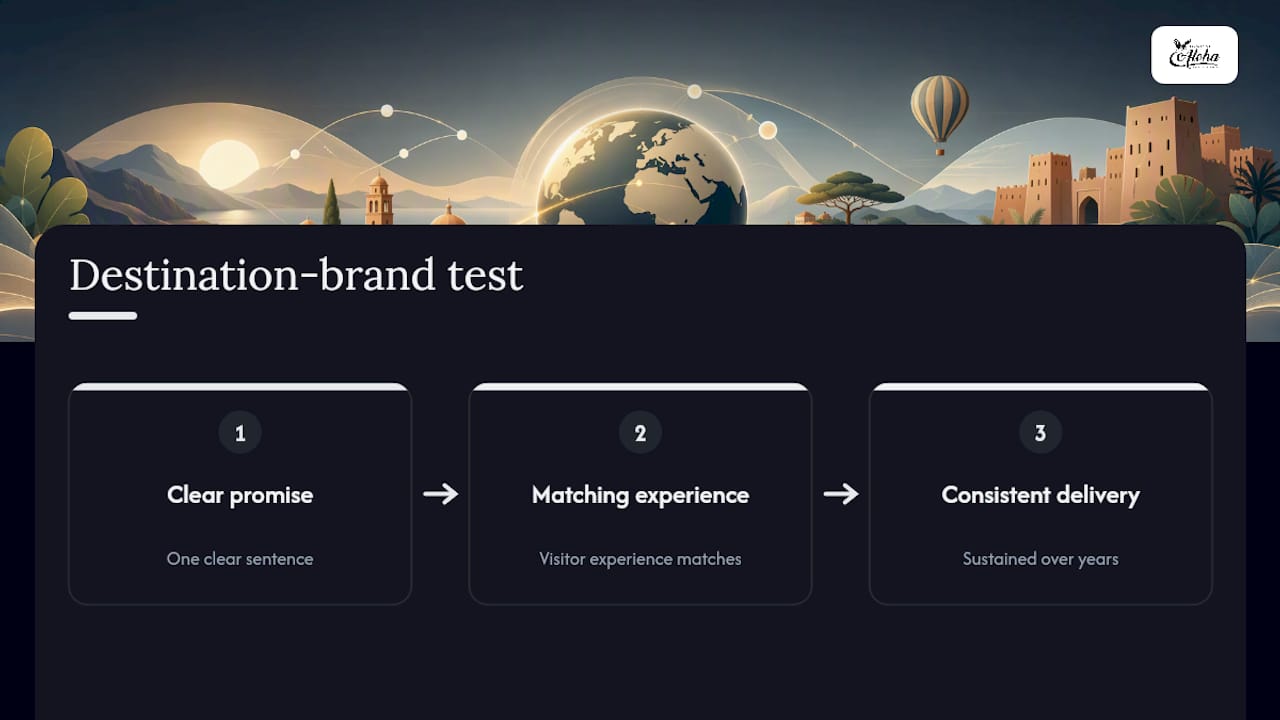
The failure case is just as instructive. A destination that markets pristine, quiet nature but delivers overcrowded, littered trails breaks its own promise on contact, and no tagline survives that gap for long. Good case studies always show the same three things: a promise stated in one clear sentence, evidence the visitor experience matches it, and proof the message stayed consistent over years, not one campaign cycle.
How Does Flight of Aloha Show Destination Branding in Action?
An attraction can be a brand touchpoint in the truest sense: a place where a visitor gets sensory, undeniable proof that the destination’s promise is real. Immersive attractions deliver that proof through storytelling, sensory cues, and the people who run the show, all working together in one sitting.
Flight of Aloha, the immersive flying theater in Kailua-Kona and Whalers Village Kaanapali on Maui, was built around exactly that idea. A few ways it maps to the brand elements covered above:
- Story: films like Naupaka and Lahaina root the experience in real Hawaiian legend, not generic aerial footage.
- Sensory design: 8K visuals, motion effects, wind, and scent work together so the promise of “flying over Hawaii” is felt, not just watched.
- Accessibility: no helicopter, no $400 price tag, no motion sickness, just a seat and a show, which makes the brand promise available to nearly anyone who walks in.
- Ownership and place: Flight of Aloha is Native Hawaiian-owned, which keeps the cultural storytelling grounded in the community it represents.
Pro Tip: If you’re a DMO trying to identify high-leverage touchpoints, look for experiences that let a visitor feel the brand promise in under an hour. Touchpoints that deliver visceral, immediate proof are worth more marketing spend than a dozen billboard impressions. Related reading on how attractions shape destination perception covers this in more depth.
How Do You Measure a Destination Brand Over Time?
A brand you can’t measure is a brand you can’t manage. The most useful destination brand programs track a mix of numbers and stories, not one or the other.
Metrics worth tracking:
- Awareness and top-of-mind recall among target segments
- Perception scores tied directly to the brand promise (does “authentic” actually register with visitors?)
- Visitation quality: length of stay, spend per visitor, repeat visit rate
- Frontline and resident sentiment, gathered through interviews, not just online reviews
- Broader tourism economic indicators, tracked against baseline years
Mixing quantitative tracking with qualitative visitor and staff feedback is what catches a gap between promise and experience before it shows up in falling numbers.
| Practice | Why it matters |
|---|---|
| Annual perception survey | Confirms whether the promise still lands with target visitors |
| Frontline staff feedback loop | Surfaces gaps between marketing and ground-level experience |
| Brand playbook for partners | Keeps hotels, guides, and vendors telling the same story |
| Multi-year positioning review | Prevents drift as visitor motivations shift |
Academic reviews of DMOs keep finding the same pattern: organizations that reduce branding to a logo redesign tend to see perception scores stagnate, while the ones treating brand as ongoing governance see it hold or improve. A short brand playbook with clear do’s and don’ts for partners and frontline staff is a low-cost way to keep everyone telling the same story.
What Should You Do Next to Build or Refresh a Brand?
Start small, but start with the right pieces in the right order.
- Run the audit first. Catalog every asset and every existing perception before touching a design file.
- Commission real visitor research. Skip the guesswork on motivation, go straight to the traveler segments you actually want.
- Convene stakeholders early. Hotels, guides, attractions, and local government all need to hear the promise before it launches, not after.
- Draft a one-sentence promise and pressure-test it. Use forced-choice testing against real travel intent, not a committee vote.
- Identify your highest-leverage touchpoint. Look for the one experience that proves your promise fastest and invest there first.
Related reading worth bookmarking: how immersive Hawaii experiences get designed as brand touchpoints, why attraction location matters for authenticity, and how local legends shape storytelling in attraction design. If your destination leans on food identity, the culinary angle in this traveler’s guide to culinary experiences is worth a look, too.
What Most Guides Get Wrong About Destination Branding
Most explainers treat destination branding as a design problem: pick better colors, write a punchier tagline, done. The research doesn’t support that. The UNWTO framework and the academic literature on DMOs both point to the same uncomfortable truth: branding fails or succeeds at the level of governance, not graphics. A gorgeous logo attached to an inconsistent visitor experience is worse than no logo at all, because it sets an expectation the destination then breaks.
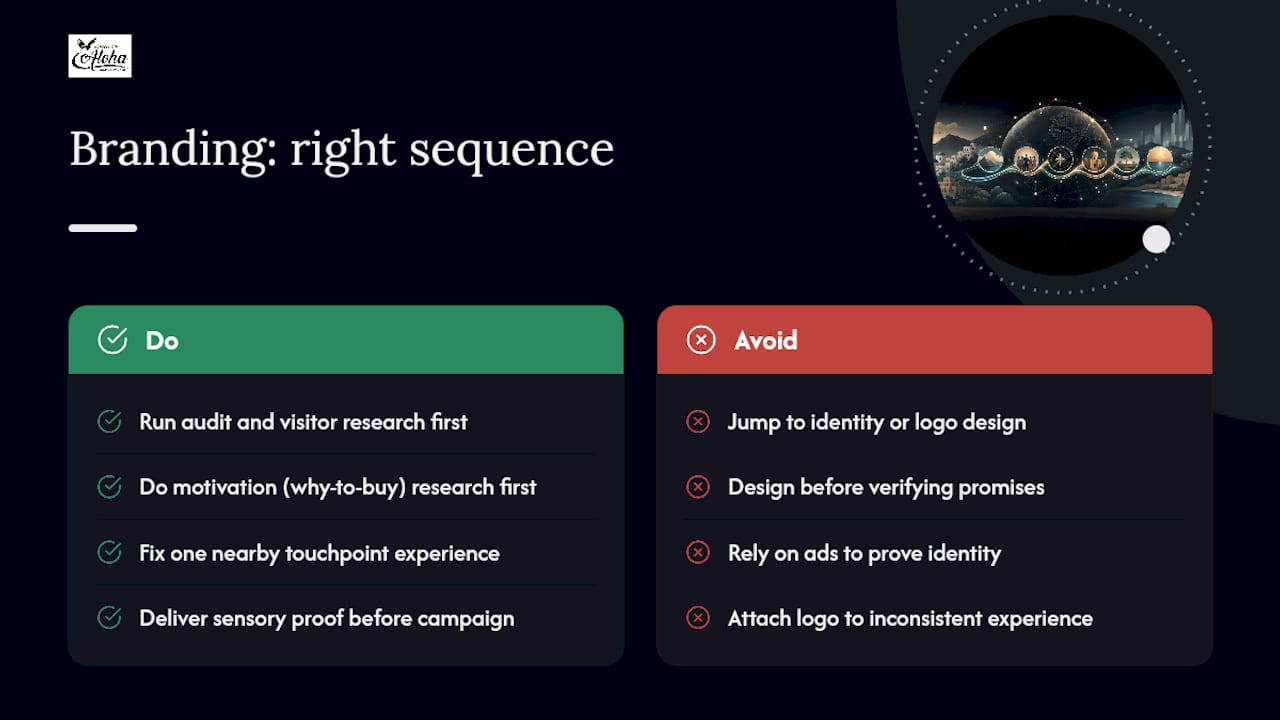
Where conventional advice really falls short is sequencing. Too many teams jump to identity design before finishing visitor research, which means the “whys for buys” never actually inform the promise. That’s backwards. Motivation research should come first, always.
If you’re starting from zero, prioritize the audit and the research phase over anything creative. Find one touchpoint, ideally an experience visitors can feel within an hour, and get that right before worrying about a full campaign. A single attraction that delivers sensory proof of your promise will do more for brand credibility than a year of ad spend chasing an identity nobody has verified yet.
— Ola
Rainy afternoon in Kona, a smoky Vog day on Maui, or a few free hours between the tender boat and your cruise departure: Flight of Aloha solves all three. Walking distance from Kailua Pier and steps from the tender dock in Kailua-Kona, plus a second location at Whalers Village in Kaanapali, it’s the most accessible activity in the islands: no boat, no bus, no $400 helicopter ticket, and none of the motion sickness that comes with one. Inside, it’s air-conditioned comfort paired with 8K visuals, wind, motion, and scent that put you in the middle of Hawaiian legends like Naupaka and Whale Song, told by a Native Hawaiian-owned attraction rooted in real aloha. Book online to secure your seat at Flightofaloha.
Sources
- UNWTO handbook / e-UNWTO (destination-branding frameworks)
- Positioning a place: Developing a compelling destination brand (Cornell Hospitality Research)
- Destination branding: Opportunities and new challenges (ScienceDirect)
- Place Brand Observer — difference between destination branding and destination marketing