
Find Cheap First Class Flights: Practical Tactics That Work

The fastest ways to find cheap first class flights are: redeem miles through partner loyalty programs at saver-award rates, source contracted cash fares through consolidators, monitor fare wars and error fares with dedicated alert tools, and bid on upgrade auctions. Use all four in combination and you will consistently pay a fraction of the published price.
Quick actions for the next 24–72 hours:
- Set a price alert on Google Flights for your target route in the premium cabin filter
- Search award availability on the operating carrier’s site AND at least one partner program before touching your points
- Request a consolidator quote for your route (shoulder-season routes often yield 20–40% below published fares)
- Check Kayak for aggregated cash deals across carriers and date combinations
Pro Tip: *Most travelers search the airline they want to fly.
Key Takeaways
Saver-level partner awards and consolidator cash fares are the two most reliable ways to fly first class at a fraction of the published price.
| Point | Details |
|---|---|
| Search partners before transferring | Partner programs often price the same seat at fewer miles; confirm live space before any transfer. |
| Target the 3–6 month window | International cash first-class deals peak in the 3–6 month booking window per Passport Premiere. |
| Layer your monitoring tools | Combine Google Flights for cash history with Seats.aero or ExpertFlyer for award availability. |
| Run the cents-per-point check | Divide cash fare by miles required and multiply by 100; above 5 cents per point is an excellent redemption. |
| Book immediately when you find a deal | First-class award space and error fares disappear fast — screenshot and confirm before doing anything else. |
What does “first class” actually mean today, and where can you find it?
True first class and premium business class are not the same product, even when airlines blur the marketing. Genuine first class means an enclosed suite, a dedicated lounge (sometimes a separate terminal), a maximum of eight seats per cabin, and a meal service that rivals a restaurant. Airlines that still operate true first-class cabins on long-haul routes include Lufthansa, Singapore Airlines, Emirates, Etihad, ANA, and Japan Airlines. Most North American carriers have retired the product on international routes, so “first class” on a domestic US flight is typically a wider business-class seat.
Award availability and booking rules differ sharply by carrier. Singapore Airlines, for example, releases KrisFlyer first-class award space to partners only occasionally, while ANA releases space to Star Alliance partners more freely. Knowing which carriers release inventory to which partners is the core skill.
Condé Nast Traveler notes that wide-body aircraft (777, 787, A350) on domestic “ferry” or repositioning routes carry more premium seats than narrowbody equipment on the same city pair, which increases both upgrade odds and pricing competition. Searching by aircraft type, not just route, is a move most travelers skip entirely.
Pro Tip: A positioning flight — a cheap one-way to a city with lower premium-cabin pricing — can cut your total itinerary cost significantly. Passport Premiere documents cases where travelers halved their premium-cabin cost this way.
How to use points and miles to book first class for less
The process that works: search availability first, compare partner programs, then transfer points, then book. Never reverse that order.
Thrifty Traveler confirms that saver-level award inventory and partner-program sweet spots are consistently the cheapest way into premium cabins with miles.
The booking process, step by step:
- Search award space on the operating carrier’s own site first (to confirm the seat exists)
- Cross-check the same flight on two or three partner programs (ANA Mileage Club, Air Canada Aeroplan, and Virgin Atlantic Flying Club are frequent sweet spots for transatlantic first class)
- Compare the total cost: miles + carrier-imposed surcharges + taxes
- Identify which transferable points currency (Amex Membership Rewards, Chase Ultimate Rewards, Capital One Miles, Citi ThankYou) transfers to your chosen program
- Transfer only after you have a seat on hold or confirmed live availability
Business Traveller illustrates how a British Airways first-class redemption using Avios can deliver significant cash-equivalent savings when saver space is available, demonstrating that points can be worth substantially more than their typical value in some scenarios.
Pro Tip: FlightPoints advises always confirming live award availability before transferring credit card points — transfers are irreversible and award space can vanish within hours of you finding it.
Which credit card perks get you to first class faster?
Flexible transferable-points cards are the fastest engine for first-class redemptions. American Express Membership Rewards, Chase Ultimate Rewards, Capital One Miles, and Citi ThankYou points each transfer to multiple airline programs, giving you optionality across partner sweet spots. One or two co-branded airline cards layered on top accelerate earning on that carrier’s own flights.
What to prioritize:
- A transferable-points card with a strong sign-up bonus (often enough for a one-way first-class award on its own)
- A co-branded card for the airline whose partner program you plan to use (status benefits and bonus miles on that carrier’s flights)
- Category spend alignment: dining, travel, and grocery multipliers add up fast on everyday purchases
Annual fees matter less than the math. A card with a $550 annual fee that includes lounge access, travel credits, and a companion certificate often nets positive value before you book a single award. Time your application so the sign-up bonus posts at least 30 days before you plan to transfer, giving the transfer time to process.
Pro Tip: Household your points. If two people in the same household each hold a transferable-points card, combining balances before a transfer can unlock a first-class award that neither balance could cover alone.
Can upgrade bids and gate tactics land you in first class for less?
Yes, and more reliably than most travelers realize. Airlines including Lufthansa, Singapore, Emirates, and most major US carriers run upgrade auction systems where you bid a cash amount for a cabin upgrade. A smart bid sits at roughly 20–30% of the typical fare difference between your purchased cabin and first class, according to upgrade auction research. Bidding the minimum almost never wins; bidding the maximum wastes money.
Upgrade paths ranked by reliability:
- Mileage upgrades from a confirmed upgradeable fare class (most reliable, requires knowing your fare bucket)
- Paid upgrade auction (moderate reliability, cash cost, no miles needed)
- Elite status complimentary upgrade (depends on status level and load factor)
- Day-of gate offer (least predictable, but occasionally very cheap)
Fare class is everything. An economy or basic business ticket bought at a discount fare code is often ineligible for upgrades entirely. Check the fare rules before you buy if an upgrade is part of your plan. Fare codes like Y, B, or M on most carriers are upgrade-eligible; O, Q, and N usually are not.
Pro Tip: At the gate, ask politely and early. Airlines sometimes offer discounted day-of upgrades to clear premium inventory before departure. Screenshot the offer price immediately — these disappear fast and you will want documentation if there is a billing dispute.
When should you start searching for first class deals?
Passport Premiere recommends a 3–6 month booking window for international cash first-class bargains, using historical pricing and fare monitoring to identify genuine dips. Domestic premium fares move faster; a 1–3 month window is more typical. Award space follows different logic entirely: some carriers release partner award space 330–360 days out at schedule open, then again closer to departure as unsold seats free up.
The practical timeline:
- 330–360 days out: Check schedule open for award space on your target carrier. Book immediately if space appears and your points are ready.
- 6–9 months out: Set fare alerts and begin tracking price history for cash fares.
- 3–6 months out: The sweet spot for international cash deals. Act when you see a genuine dip confirmed by price history.
- 4–6 weeks out: Watch for last-minute upgrade offers, auction invitations, and unsold premium inventory.
Seasonality matters. Shoulder seasons (think May, September, and early November for transatlantic routes) consistently produce lower premium fares than peak summer or holiday windows. Corporate travel cycles also affect premium inventory: business-heavy routes on Monday and Friday mornings fill fast; Tuesday and Wednesday departures on the same route often have more open seats.
Which tools help you find and monitor cheap first class fares?
A layered approach beats any single tool. Thrifty Traveler’s research supports combining a free aggregator, an award-search tool, and a paid alert service for the best deal-capture rate without excessive time investment.
The monitoring stack:
- Google Flights: Best for cash fare history, calendar view, and price tracking alerts. Filter by cabin class and use the “Explore” map to spot cheap departure markets.
- Kayak: Aggregates fares across a wide carrier set and date range; useful for surfacing unusually cheap premium-cabin cash fares you would not find on a single airline’s site.
- ExpertFlyer: The professional’s tool for award-seat availability, cabin-class filters, and upgrade waitlist tracking. A paid subscription unlocks real-time seat alerts.
- Seats.aero: Purpose-built for award-space search across multiple loyalty programs simultaneously. Faster than checking each airline site individually.
- Thrifty Traveler Premium: A curated alert service that flags premium-cabin fare deals and mistake fares directly to your inbox. Saves hours of manual monitoring.
- Passport Premiere: Specialist service focused on first-class and business-class deals, with context on whether a fare is genuinely cheap relative to historical pricing.
The professional move is to combine historical cash pricing from Google Flights with live award availability from Seats.aero or ExpertFlyer, then layer a Thrifty Traveler or Passport Premiere alert to catch deals you would otherwise miss while living your life.
What should you do the moment you find a cheap first class fare?
Book first. Verify second. Do not spend 20 minutes deliberating while the seat disappears.
The immediate checklist:
- Book the fare or award through the best available channel (direct with the airline for cash fares; through the partner program for awards)
- Screenshot the booking confirmation, the fare class shown, and the total price including taxes and surcharges
- Confirm the fare class and whether it is upgradeable or changeable (check the fare rules tab)
- Note all change and cancellation deadlines in your calendar with a 48-hour buffer reminder
- For error fares: book immediately, then wait 24–48 hours before making non-refundable downstream bookings (hotels, connections) until the airline confirms the ticket
For award bookings, book directly with the airline that holds the space, not through a third-party OTA. FlightPoints notes that booking direct also makes post-booking service (seat changes, upgrades, and cancellations) significantly easier.
Pro Tip: For consolidator cash fares, always confirm the ticket is issued on the operating carrier’s ticket stock (the 13-digit ticket number starts with the airline’s own code). A ticket issued on a consolidator’s own stock can lose protections if the airline has a schedule change.
What does “cheap” first class actually cost in miles and money?
Realistic price bands vary widely by route, season, and booking method. Award redemptions, when saver space is available, often deliver the best value per dollar of points spent.
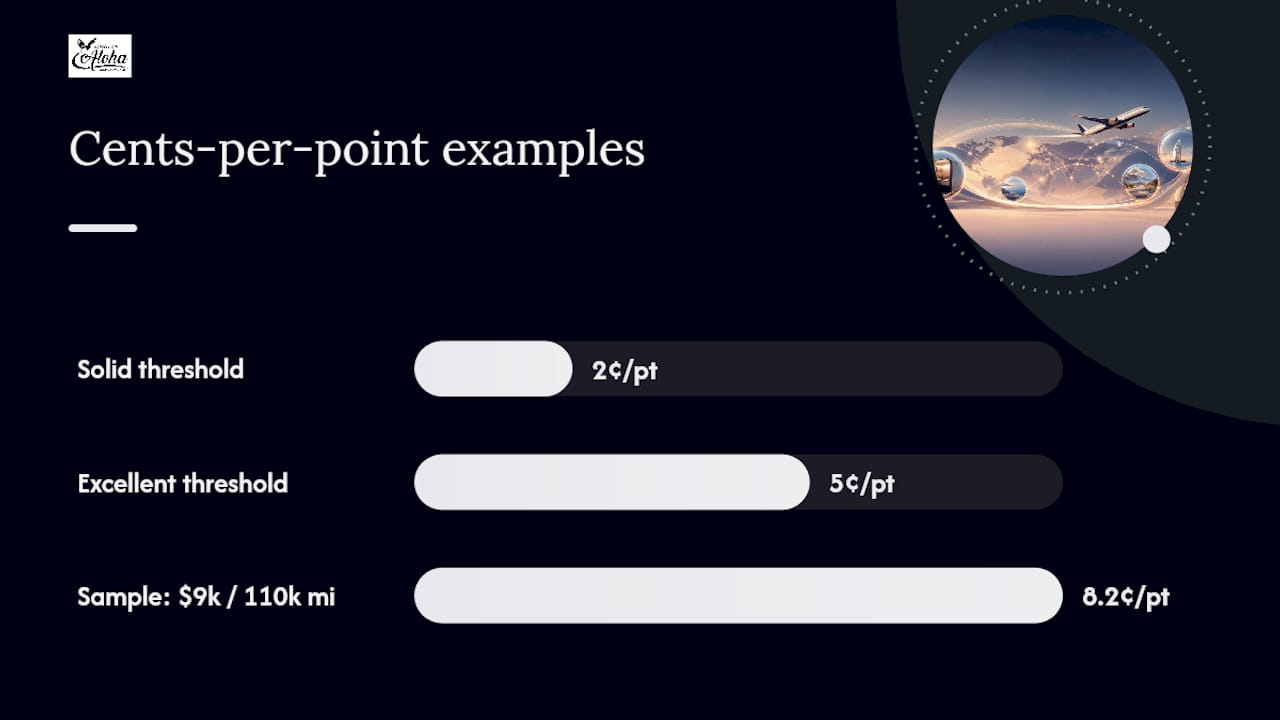
The cents-per-point formula: divide the cash fare by the miles required, then multiply by 100. A $9,000 fare redeemed for 110,000 miles = 8.2 cents per point. Most points experts consider anything above 2 cents per point a solid redemption; above 5 cents is excellent. When a discounted cash fare drops below the value of your miles at that rate, pay cash and save the miles.
Watch for carrier-imposed surcharges. Some programs (British Airways Avios on BA metal, for example) add fuel surcharges that can reach $600–$900 per person on a first-class award, eroding the value significantly. Programs like ANA Mileage Club and Air Canada Aeroplan impose minimal surcharges on partner awards, which is a major reason practitioners favor them.
For first class to Hawaii specifically, positioning to a West Coast hub before the transpacific leg often unlocks better award availability and lower cash fares than booking from a mid-continent city.
Your 6-step playbook for finding cheap first class right now
- Choose your target route and dates — identify the operating carrier and whether true first class exists on that equipment.
- Set alerts immediately — Google Flights for cash fares, ExpertFlyer or Seats.aero for award space on your target carrier and its partners.
- Search partner award programs — check at least two partner programs before deciding where to transfer points.
- Request a consolidator quote — for cash fares, a consolidator quote takes five minutes and can save thousands on shoulder-season routes.
- Decide cash vs. points — run the cents-per-point calculation; if the discounted cash fare beats your points’ value, pay cash.
- Transfer points only after confirming a live seat — then book immediately and document everything.
Pro Tip: If you are time-poor, skip the manual monitoring and subscribe to Thrifty Traveler Premium or Passport Premiere for one month before your target travel window. The cost of a paid alert service is trivial compared to the savings on a single first-class deal.
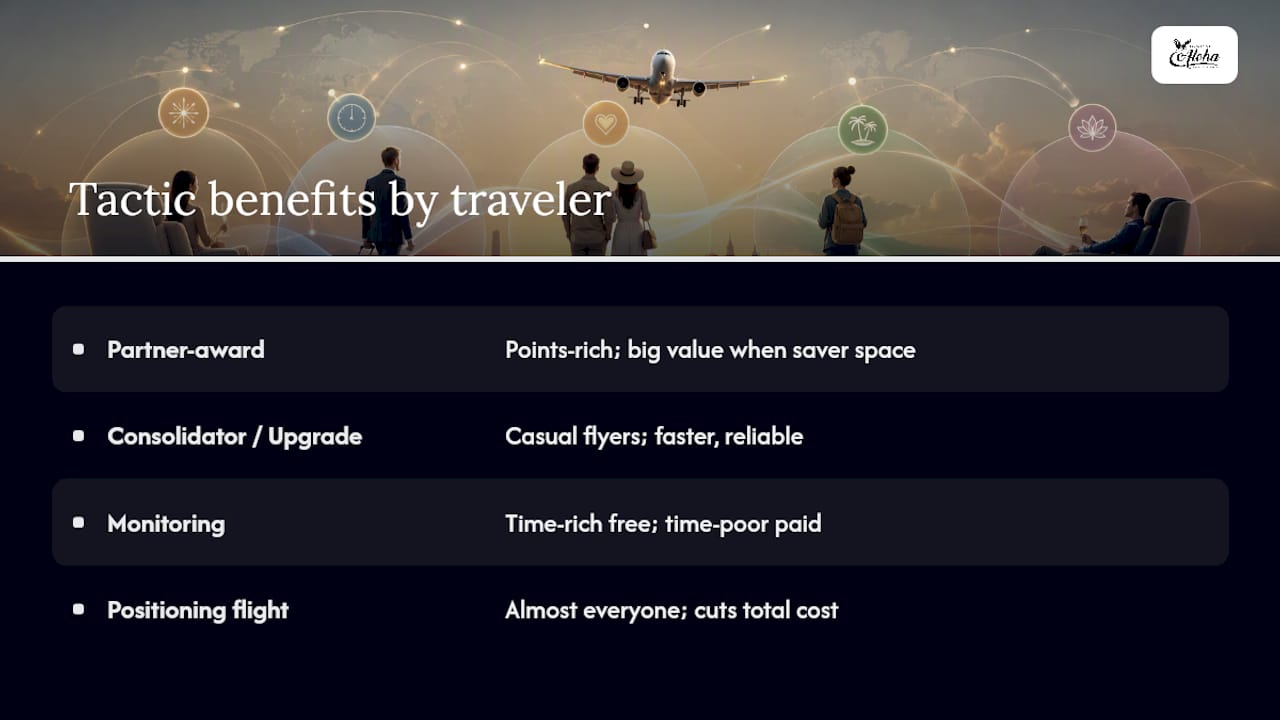
Which traveler type benefits most from each tactic?
Points-rich travelers who have accumulated transferable currencies through credit card spend get the most from the partner-award route: the math is simply extraordinary when saver space aligns. A casual traveler who flies twice a year and has no points balance will wait too long to accumulate miles for a meaningful redemption. For that person, a consolidator cash fare or a targeted upgrade bid is the faster, more reliable path.
Time-rich travelers can afford to monitor manually using free tools and wait for the right window. Time-poor travelers should invest in a paid alert service and act the moment a deal lands in their inbox. The two strategies are not mutually exclusive: many experienced travelers run both, using free tools for background monitoring and a paid service as a safety net.
The highest-leverage move for almost everyone, regardless of points balance, is the positioning flight that combines premium air travel with fly-in safaris. Passport Premiere’s research shows that booking a cheap one-way to a lower-priced departure market before the main premium leg can cut total itinerary cost dramatically. It takes planning, but the savings are real.
If your travel ends in Hawaii, the experience does not stop when you land. Flight of Aloha, a Native Hawaiian-owned immersive flying theater at Kailua-Kona and Whalers Village Kaanapali in Maui, delivers aerial views of the islands without the $400+ cost or motion sickness of a helicopter tour. It is the most accessible attraction in Hawaii, walking distance from Kailua Pier for cruise guests, and the best air-conditioned escape from the heat or vog on the island. Think of it as the perfect first stop after a long first-class flight. Explore entertainment packages for Hawaii and book online to secure your seat.
Sources
- How to Find the Cheapest First Class Flights: Guides and Points | Thrifty Traveler
- The brief: how to hack your way into first class | Business Traveller
- Cheap first class flights and upgrade costs | Condé Nast Traveler
- Cheap First Class Flights | KAYAK
Combine the free stack (Google Flights + Seats.aero) with one paid alert service if your time is limited. That combination captures the vast majority of deals without requiring daily manual searches.