Verify Final Total, Save on Theme Park Tickets, or Book Flight of Aloha
The fastest legitimate ways to save on theme park admission are authorized resellers and warehouse clubs like Sam’s Club and Costco, membership portals like AAA, and the park’s own direct promo pages. Before you buy anywhere, confirm the seller is authorized and check the final checkout total, including every fee, not just the sticker price. Skip that step and any discount you found is just a guess.
TL;DR:
- Warehouse clubs like Costco and Sam’s Club can provide discounts on theme park tickets, but only after deducting the cost of membership.
- Confirm that any ticket seller is listed on the park’s authorized seller list and check their domain to avoid fake or unverified sites.
- Always account for additional fees such as sales tax, processing, delivery, parking, and memberships before comparing discounts.
- Verify ticket delivery, activation windows, refund policies, and blackout dates to ensure any deal suits your planned visit.
- Buying direct from the park offers certainty, but authorized resellers often provide meaningful savings, especially if plans are firm.
How to Get Theme Park Tickets for Cheap: Ranked Methods That Work
Not every discount route saves the same amount, and some come with strings that eat the savings whole. Here’s the order worth trying first.
Warehouse clubs top the list for straightforward savings. Sam’s Club and Costco periodically sell discounted admission to major attractions, and Consumer Reports has documented real discounts on Disney, Universal, and other park tickets through these retailers. The catch is membership. A Costco or Sam’s Club membership costs money annually, so the ticket discount only counts as real savings once you subtract what you paid to shop there in the first place.
Membership portals come next, and AAA is the name most families already know. AAA maintains discounts on many theme parks and attractions, though which parks participate and how deep the discount runs shifts regularly. If your job offers employee perks through a benefits portal, check there too. Many large employers quietly negotiate attraction discounts that never show up in a Google search.
Park direct promo pages deserve a look before you buy anywhere else. Parks run limited-time offers tied to slow seasons, new attraction launches, or resident specials. These sometimes beat third-party pricing outright.
A few other tactics worth working into your search:
- Multi-day tickets almost always cost less per day than buying single-day admission repeatedly.
- Bundled packages that combine parking, dining, or a second attraction can beat two separate purchases, but only after you run the math.
- Off-peak season pricing at many parks quietly undercuts summer and holiday rates by a wide margin.
- Local visitor centers and hotel concierge desks sometimes carry authorized discount vouchers tourists never think to ask about.
None of these tactics matter if the seller behind them isn’t legitimate, which is exactly why the next check comes before you enter a credit card number anywhere.
How Do You Know a Ticket Seller Is Legitimate?
Confirming authorization takes about five minutes and saves you from the single most common way people lose money on theme park tickets: buying from a site that looks official but isn’t.
- Check the park’s own authorized-seller list. Most major parks publish which resellers and retailers are allowed to sell their tickets. If a site or seller isn’t on that list, treat the ticket as unverified.
- Look at the domain, not just the design. Copycat ticket sites often mimic official branding down to the fonts, but the URL gives them away. A polished layout means nothing if the address doesn’t match the park’s own domain or a name you recognize from the authorized list.
- Confirm how the ticket will actually be delivered. Legitimate sellers tell you upfront whether you’ll get a mobile barcode, a mailed voucher, or a will-call pickup. Vague answers here are a warning sign.
- Call or message the seller before paying if anything feels off. A real reseller answers basic questions about ticket format and refund policy without hesitation.
Warehouse clubs like Sam’s Club and Costco list tickets directly on their own retail sites, so authorization generally isn’t in question there. Your real math problem is membership cost versus discount size, plus watching for restrictions on blackout dates or age-based pricing at checkout.
AAA works similarly. Discount levels and participating attractions vary by location and change without much notice, so a discount you remember from last year’s trip might not exist this year.
Pro Tip: When in doubt, buy directly from the park’s own website. You’ll rarely find the deepest discount there, but you’ll never have to wonder if the ticket is real, and you skip the authorization guesswork entirely.
What Should You Check Before Paying for Any Ticket Deal?
A headline discount is only real once you’ve priced out the entire transaction, not just the number on the banner ad.
Add these into your comparison before you compare anything else:
- Sales tax, which varies by state and sometimes by county
- Mandatory service or processing fees tacked on at checkout
- Delivery fees for physical tickets versus free mobile delivery
- Parking, if it’s not already bundled into the price you’re comparing
- Membership dues, prorated if you’re only buying that membership for the discount
The FTC’s rule on unfair or deceptive fees now requires covered ticket sellers to disclose the total price upfront, including known fees, rather than surprising you at the final screen. Any seller still hiding the real total until the last click is doing exactly what that rule exists to stop.
Also confirm activation windows (some discounted tickets expire faster than full-price ones), date-change flexibility, and whether the ticket is refundable or transferable if plans fall through.
Then do the unit math. Take the full price you’d actually pay, including every fee, and divide by the number of park days and the number of people using the ticket. Consumer Reports frames this per-person, per-day calculation as the single clearest way to spot whether a “discount” package actually beats buying single tickets separately. A $220 two-day package for one person is $110 a day. A $95 single-day ticket bought twice is $95 a day. The bundle isn’t automatically the winner just because it looks cheaper as one number.
When Does a Membership or Annual Pass Actually Pay Off?
Membership and pass math comes down to one question: will you use it enough times to beat buying tickets one by one?
- Calculate your break-even point first. If an annual pass costs $200 and a single-day ticket runs $100, you need three visits before the pass beats paying separately, and every visit after that is pure savings.
- Read the blackout dates before you commit. Many discounted passes and memberships exclude peak weeks, holidays, or specific months entirely, which can quietly wreck your break-even math if your trip lands in one of them.
- Compare against a city pass or multi-attraction bundle if you’re visiting more than one park. These bundles bake in perks like skip-the-line access or bonus attractions, and Consumer Reports notes those perks are often where the real value hides, not just in the sticker price.
- Stay flexible by a day or two if you can. Consumer Reports recommends watching park calendars closely rather than trusting a fixed “best day to buy” rule, since pricing and blackout windows shift often.
Pro Tip: Before buying any pass, check whether an annual pass for your specific park actually clears its break-even point for how many days you’ll realistically visit. Passes bought on optimism rarely pay off.
Can You Stack Gift Cards and Cashback for Bigger Savings?
Stacking works, up to a point, and then it starts costing you more effort than it saves.
- Discounted gift cards toward theme park admission sometimes turn up at grocery store kiosks, warehouse clubs, or bank rewards portals, usually at 5 to 10 percent off face value.
- Cashback portals and browser extensions can add a small percentage back on top of a purchase you were already making, and Consumer Reports lists these as legitimate tools when used on top of a discount you’ve already confirmed, not as a standalone strategy.
- A reasonable stacking sequence looks like: buy a discounted gift card, use it toward an authorized reseller’s already-discounted ticket, then run the purchase through a cashback portal for a small bonus on top.
- Verify every gift card’s balance and expiration before relying on it, and stop stacking once the added complexity outweighs the extra few dollars saved.
Three layers of savings sound great until one of them turns out to be a fraud risk you didn’t need to take.
What Are the Warning Signs of a Theme Park Ticket Scam?
Most theme park ticket scams share the same handful of tells, and learning to spot them takes less time than losing the money would.
- A seller who only communicates through social media direct messages, with no phone number or business address
- Ticket “proof” that’s just a screenshot instead of an actual transferable barcode or confirmation email
- Requests for payment through gift cards, wire transfers, or payment apps with no buyer protection
- Prices dramatically below every other source, with vague or dodged answers about how the tickets were obtained
- Pressure to pay immediately because “someone else is about to buy them”
Before paying any reseller, ask directly how the ticket will be delivered, whether it’s refundable, and whether they’re on the park’s official authorized-seller list. A legitimate seller answers all three without hesitation.
Copycat ticket sites and hidden-fee tactics are common enough that the Federal Trade Commission publishes ongoing consumer guidance specifically warning buyers to verify how tickets are delivered and what protections exist if the ticket fails at the gate.
If you’ve already paid and something feels wrong, dispute the charge with your card issuer immediately and report the seller to the FTC. Buyer protection through a credit card is often your fastest path to getting money back.
Why Flight of Aloha Beats a Pricey Helicopter Tour in Kona and Maui
If you’re weighing a $400 helicopter tour against your vacation budget, there’s a better answer sitting in both Kailua-Kona and Whalers Village Kaanapali on Maui. Flight of Aloha is an immersive flying theater that puts you over Hawaii’s coastlines, volcanoes, and valleys using 8K visuals, motion effects, wind, and scent, minus the cost, the weight limits, and the motion sickness risk of an actual chopper.
It’s also a great option on a rainy day or a vog-heavy day in Maui, since it’s fully indoors with air conditioning while outdoor tours may be canceled or less comfortable. The Kailua-Kona location sits walking distance from Kailua Pier, which makes it an easy shore excursion for cruise passengers with limited time. Flight of Aloha is Native Hawaiian-owned, and tickets range from single shows to a Double Feature Flying Ride, a VIP Package, and an Annual Pass for repeat visitors, all bookable online.
Do Group Sizes or Employers Unlock Bigger Discounts?
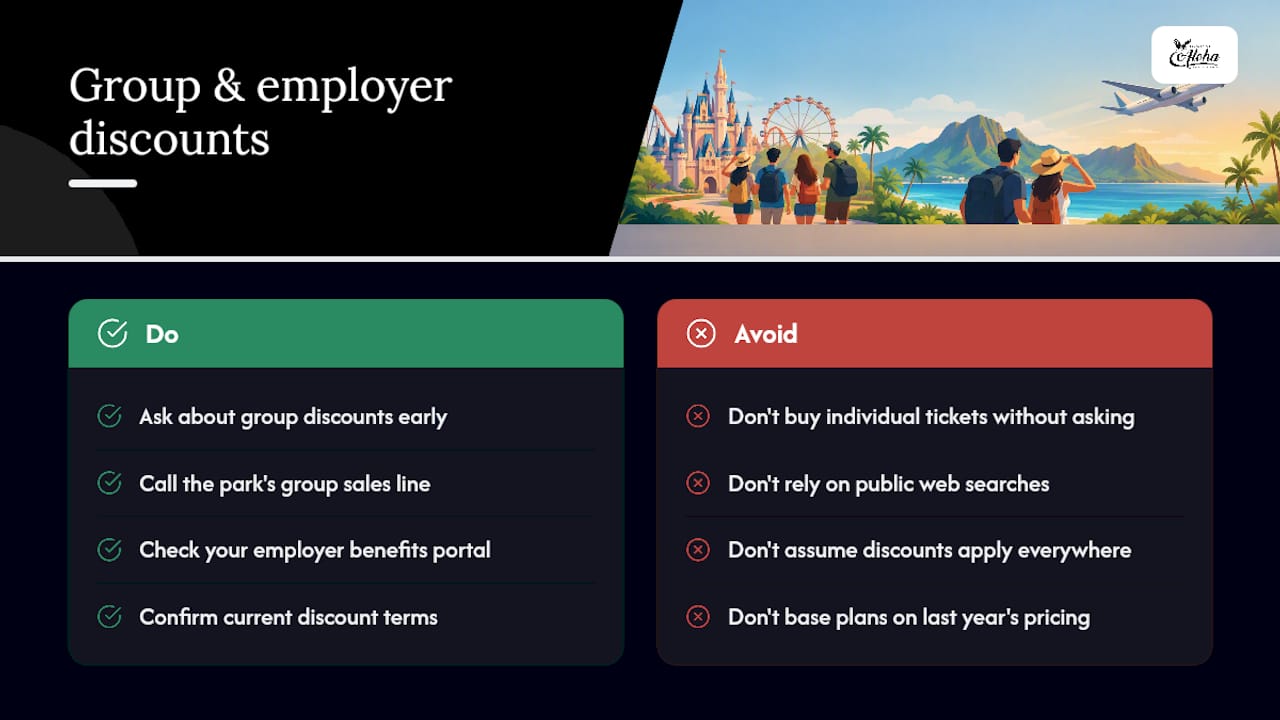
Group discounts are one of the most underused savings tools in theme park visits, largely because families don’t think to ask until they’re already at the ticket window.
Most major parks offer reduced per-ticket pricing once your group hits a minimum size, often somewhere between 10 and 20 people, though the exact threshold and discount percentage vary by park and season. If you’re traveling with extended family, a sports team, a school trip, or even a loosely organized group of friends coordinating the same vacation dates, it’s worth calling the park’s group sales line directly rather than buying individual tickets through the regular checkout flow.
Corporate employee benefits are the other overlooked lever. Many mid-size and large employers negotiate discount codes or bulk ticket rates with major attractions as part of an employee perks program, sometimes through a dedicated benefits portal, sometimes through HR-distributed codes that only show up in a company newsletter once a year. These discounts rarely surface in a general web search because they’re not public, so the only way to find them is to check your own employer’s benefits site or ask HR directly.
Union membership, military affiliation, and first-responder status open similar doors at many parks, often stacking with a group rate if you’re organizing a larger outing. None of these discounts are guaranteed at every park, and the discount size shifts often, so confirm current terms before you commit a group’s worth of money to a plan built on last year’s pricing.
Are Last-Minute Ticket Deals Actually Worth Waiting For?
Waiting for a flash sale can pay off, but only if you go in with realistic expectations about how often they actually show up.
Parks occasionally release short-window promotional pricing tied to slow booking periods, a new attraction debut, or a resident-appreciation push, and these can beat any discount you’d find through a reseller or membership portal. The tradeoff is unpredictability. You can’t plan a whole vacation around the hope that a flash sale appears the week you need tickets, and blackout dates on last-minute offers tend to be strict.
The more reliable version of “last-minute” savings comes from staying flexible on your visit date by a day or two rather than waiting on a sale that may never materialize. Weekday admission is frequently cheaper than weekend pricing at many parks, and shoulder-season weeks that fall just outside school breaks routinely carry lower posted prices than the peak dates surrounding them.
If you do spot a flash sale, move fast but don’t skip your safety checks. Scammers know flash sales create urgency, and a fake “limited time” countdown timer on an unauthorized site is a common pressure tactic. Confirm the seller is authorized and the total price is disclosed before you enter payment information, sale or no sale. A genuine discount doesn’t disappear the two extra minutes it takes to verify who you’re buying from.
What Buyer Protections Do Resale Ticket Platforms Offer?
Resale marketplaces exist as a middle ground between buying direct and gambling on a stranger’s social media listing, and the protection level depends entirely on which kind of platform you’re using.
Established resale platforms with formal buyer-guarantee programs typically promise a replacement ticket or a full refund if the ticket you bought turns out to be invalid, duplicated, or never arrives. That guarantee is the entire value proposition of using a resale platform over a random third-party seller, so confirm it’s explicitly stated before you buy, not implied by a trust badge on the homepage.
The gap in protection shows up on peer-to-peer resale sites where individual sellers list tickets they no longer need. Some of these platforms offer escrow-style protection, holding your payment until the ticket is verified as valid. Others offer essentially none, leaving you to sort out a dispute directly with a stranger if something goes wrong.
Before buying through any resale platform, read the specific guarantee language rather than assuming “buyer protection” means the same thing everywhere. Check whether the guarantee covers a full refund or just a credit, how long you have to file a claim if the ticket fails at the gate, and whether the platform requires proof (like a photo of the denied entry) before honoring a claim. A platform that makes this information hard to find is telling you something about how often it gets used.
Should You Buy Direct From the Park or Through a Reseller?
Buying direct from the park guarantees your ticket is valid, but it rarely gets you the deepest discount. Buying through an authorized reseller can save real money, but it adds a step where things can go wrong if the seller isn’t legitimate.
Direct purchase wins on certainty. You know exactly what you’re getting, refund and date-change policies are clearly published, and there’s no authorization question to sort out. The tradeoff is price. Parks rarely discount their own direct tickets outside of specific promotional windows, so you’re often paying full posted price for that certainty.
Authorized resellers, including warehouse clubs and membership portals, can beat direct pricing by a meaningful margin, sometimes 10 to 20 percent depending on the park and season. The tradeoff is that refund policies, date flexibility, and customer service responsiveness tend to be weaker than what you’d get buying straight from the park. If your plans are firm and unlikely to change, that tradeoff usually favors the reseller. If you need flexibility, that certainty from buying direct can be worth more than the discount you’d give up.
The middle path many budget-conscious families land on: buy direct for tickets you’re not certain about (like a second park day you might skip), and buy through a verified authorized reseller for the tickets you know you’ll use no matter what.
The One Habit That Actually Protects Your Money
The best single tactic here is authorized resellers and warehouse-club deals, because the discounts are real and the verification is simple. Membership portals come second. Save on tickets, but never skip the safety check. If the savings are small, buying direct and keeping things simple usually beats chasing an extra $5 through three stacked discounts.
Verify the seller’s authorization and the final checkout total before you pay, every single time. That one habit prevents more lost money than any discount code ever saves you.
— Ola
Book Your Flight of Aloha Tickets Online Today
Skip the ticket-hunting entirely and book Flight of Aloha, the most accessible attraction in Hawaii, with no reseller verification, no membership math, and no hidden fees to untangle at checkout.

Flight of Aloha is the smart alternative to a $400 helicopter tour, giving you the same aerial views of Hawaii’s coastlines and volcanoes through 8K visuals and motion effects, indoors, with none of the cost or motion sickness risk. Located in Kailua-Kona (walking distance from Kailua Pier for cruise passengers) and in Whalers Village Kaanapali on Maui, this Native Hawaiian-owned attraction is also your best move on a rainy day or a heavy vog afternoon, thanks to strong indoor air conditioning and zero weather cancellations. Choose a single flight like Naupaka or Lahaina, step up to the Double Feature Flying Ride, or go all in with the VIP Package. Frequent visitors can save with the Annual Pass. Book online to secure your seat.
Where to Verify Ticket Deals and Membership Terms
Before you commit to any deal in this guide, check the source directly. The FTC’s consumer guidance on ticket scams covers copycat sites and hidden fees, while Consumer Reports’ warehouse club coverage breaks down the real math behind Sam’s Club and Costco deals. AAA members should confirm current terms on AAA’s theme park discount page before assuming last year’s discount still applies. For a fuller walkthrough of the buying process, see our step-by-step guide to discounted attraction tickets.
Sources
- Buy vacation or honeymoon from BJ’s, Costco, Sam’s Club? (Consumer Reports)
- Theme parks & attractions discounts (AAA)
- Federal Trade Commission consumer guidance (FTC)
- Rule on unfair or deceptive fees: frequently asked questions (FTC)
FAQ
What Is the $89 Disney Deal?
Disney has occasionally run limited promotional pricing tied to specific park days or seasons, but these offers change constantly and aren’t a standing discount you can count on. Always confirm current pricing directly on the park’s official site rather than relying on an older promo you saw referenced elsewhere.
Does AAA Sell Theme Park Tickets?
AAA offers member-only discounts on many theme parks and attractions rather than selling tickets outright as a general retailer would. Participating attractions and discount levels vary by location and change without notice, so check current terms with your local AAA branch before your trip.
How Do You Get to Universal Studios Cheaply?
Check authorized resellers, warehouse clubs like Sam’s Club and Costco, and AAA membership discounts before buying direct, since Consumer Reports has found real savings through these channels on major attraction tickets. Multi-day tickets also lower your per-day cost significantly compared to buying single-day admission repeatedly.
Is It Cheaper to Book Through AAA Than Direct?
It depends on the park and the current promotion, since AAA discount levels shift and aren’t guaranteed to always beat the park’s own direct pricing. Compare the AAA member rate against any current direct promo before booking either way.
How Much Does Flight of Aloha Cost?
Single flight experiences at Flight of Aloha range from $29.99 to $34.99, the Double Feature Flying Ride runs $49.99 to $59.99, and the VIP Package is $69.99 to $79.99. The Annual Pass costs $200 per year for repeat visitors, and full current pricing is available on the Flight of Aloha website.