
How to Pick the Best Hawaii Annual Pass for Your Trip

TL;DR:
- Choosing the right pass depends on your trip style, attractions, and trip length.
- Hawaii offers several passes, like the Tri-Park Pass and Go City, tailored to different travelers.
- Calculating savings involves comparing pass costs against individual tickets for your planned attractions.
Planning a trip to Hawai’i is thrilling. But there’s a frustrating moment many families hit mid-vacation: standing at the ticket counter, realizing you’ve already spent more on single-entry fees than you budgeted for the whole week. 🌺 Cultural sites, national parks, luaus, and immersive experiences all charge separately, and those costs stack up fast. The good news? Annual and multi-attraction passes can flip that script entirely. This guide walks you through exactly how to choose the right pass for your Hawaiian adventure, so you spend less time worrying about costs and more time soaking in the magic.
Table of Contents
- Understand your trip style and must-see attractions
- Know your annual pass options: What’s available and what they cover
- Calculate your savings and break-even point
- How and when to buy your annual pass
- The overlooked truth about annual passes in Hawaii
- Plan your perfect Hawaii adventure with expert resources
- Frequently asked questions
Key Takeaways
| Point | Details |
|---|---|
| Match pass to trip | Pick an annual pass based on your planned attractions, islands, and trip length for maximum savings and fun. |
| Calculate before buying | Compare the total price of passes and single tickets to ensure real savings for your group. |
| Buy smart | Purchase your pass online or at the gate, and check coverage and reservation requirements to avoid surprises. |
| Use flexibility wisely | Choose passes if you want to explore lots of attractions; singles work well for relaxed or focused visits. |
Understand your trip style and must-see attractions
Now that you know why annual passes matter, the next step is identifying the type of trip you want to build. Not every Hawaii vacation looks the same. Some families want to hike volcanic craters at dawn and snorkel coral reefs by noon. Others prefer a slower pace: a cultural center in the morning, a beachside luau at sunset. Both styles are valid, but they call for very different pass strategies.
Start by making a concrete list of every attraction you genuinely want to visit. Here are the most popular categories to consider:
- Cultural landmarks: Polynesian Cultural Center, Puʻuhonua o Hōnaunau National Historical Park, Bishop Museum
- Historical sites: Pearl Harbor, Iolani Palace
- National parks: Hawaiʻi Volcanoes National Park, Haleakalā National Park
- Entertainment and immersive experiences: Luaus, flying theater attractions, snorkel tours
- Family-friendly stops: Aquariums, botanical gardens, wildlife sanctuaries
Once your list is built, count how many islands you plan to visit. A single-island trip to Oʻahu looks very different from a multi-island itinerary covering the Big Island and Maui. Your length of stay matters too. A four-day trip and a ten-day trip have completely different pass economics.
According to a step-by-step methodology, the smartest approach is to list your planned attractions first, then estimate total visits, islands, and trip length before comparing any pass options. This prevents the common mistake of buying a pass that sounds great but doesn’t actually match your itinerary.
If you’re traveling with kids, think about which experiences will genuinely captivate them versus which ones are more adult-focused. Passes that enhance your Hawaii family adventures tend to focus on variety and flexibility, giving you room to pivot if a child needs a break or gets unexpectedly excited about something new.
Pro Tip: For multi-island or park-focused trips, build your itinerary around your pass’s covered locations first, then layer in single-ticket experiences as extras. This keeps your base costs predictable and your schedule flexible.
Think about your group’s energy level honestly. High-energy families who want to hit three or four attractions per day will extract far more value from a pass than a couple planning two relaxed days on the beach. Knowing your pace is just as important as knowing your destinations. For inspiration on structuring your days, check out ideas for family outings in Hawaii that balance adventure with downtime.
Know your annual pass options: What’s available and what they cover
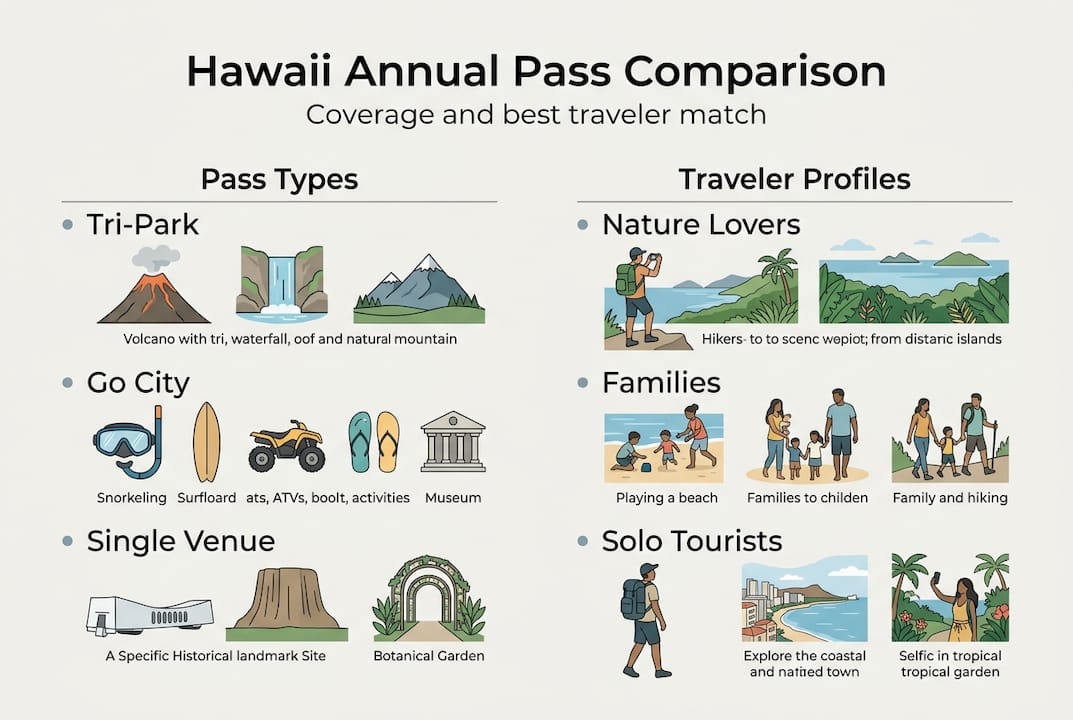
With your Hawaii wish-list in hand, it’s time to see which passes best fit your travel style. The pass landscape in Hawai’i breaks down into three main categories, each designed for a different type of visitor.
1. Hawaiʻi Tri-Park Annual Pass
This is the go-to option for nature lovers and park hoppers. The Tri-Park Annual Pass at $55 gives you 12 months of vehicle entry to Hawaiʻi Volcanoes National Park, Puʻuhonua o Hōnaunau NHP, and Haleakalā National Park. It covers everyone in your vehicle, making it exceptional value for families. It saves $25 or more compared to paying single-entry fees at each park.

2. Go City Hawaii Explorer Pass
This pass is built for Oʻahu-heavy itineraries packed with cultural and entertainment experiences. You choose a set number of attractions from a large menu, including the Polynesian Cultural Center, various luaus, and adventure tours. It’s ideal for visitors who want maximum variety in a short window.
3. Single-venue memberships
Some attractions, like specific cultural centers or immersive experiences, offer their own annual passes or membership programs. These make the most sense for locals or repeat visitors who plan to return multiple times within a year.
Here’s a quick comparison to help you decide:
| Pass | Price | Coverage | Best For |
|---|---|---|---|
| Tri-Park Annual Pass | $55/vehicle | 3 national parks, 12 months | Multi-island, park-focused families |
| Go City Explorer | Varies by selections | 30+ Oʻahu attractions | Short trips, high-activity visitors |
| Single-venue membership | Varies | One attraction | Locals, repeat visitors |
| America the Beautiful | $80/vehicle | All US national parks | Multi-national-park travelers |
Pro Tip: Some passes cover all passengers in a vehicle (like the Tri-Park), while others are priced per person. Always read the fine print before buying, especially for larger groups.
For a deeper look at how Hawaii park annual passes compare across different traveler types, it helps to map each pass against your specific itinerary rather than relying on general reviews. You can also explore options for annual passes for attractions beyond the national parks to round out your planning.
Calculate your savings and break-even point
After considering which pass fits your attractions, confirm the savings make sense for your wallet. This is where many families skip a step and end up either overpaying for a pass they barely use or missing out on real savings by sticking with single tickets.
Here’s a sample scenario for two adults and one child visiting three major attractions:
| Attraction | Single Entry (per vehicle/person) | With Tri-Park Pass |
|---|---|---|
| Hawaiʻi Volcanoes NP | $35/vehicle | Included |
| Puʻuhonua o Hōnaunau NHP | $25/vehicle | Included |
| Haleakalā NP | $30/vehicle | Included |
| Total | $90 | $55 |
That’s $35 saved on just one round of visits. Visit each park twice and you’re looking at $125 saved over the cost of the pass.
“Families can save $75 or more using the Tri-Park pass across a multi-park Hawaii itinerary.”
For cultural attraction-heavy itineraries, Go City savings on a three-day pass can reach 40 to 50 percent for families hitting the Polynesian Cultural Center, a luau, and Pearl Harbor in the same trip.
Here are the key questions to run through before buying any pass:
- How many people are in your group?
- How many days will you be visiting attractions?
- Will you revisit any location more than once?
- Are the pass-covered attractions actually on your must-do list?
- Does the pass cover your full group or just one person?
The break-even point for most passes lands at two or more visits per covered location. If you’re only hitting one park once, a single ticket is almost always cheaper. But for active families with full itineraries, saving with Hawaii annual passes becomes a genuine financial win. If your trip is centered around Kailua-Kona, there are also specific strategies for saving in Kailua-Kona that can stretch your budget even further.
How and when to buy your annual pass
Once you’ve crunched the numbers and chosen your pass, make sure the purchase process is smooth and stress-free. Buying at the right time and through the right channel saves you from common headaches.
Where to buy:
- Online before your trip: The best option for most visitors. You can buy via Recreation.gov for national park passes, or directly through attraction websites for Go City and single-venue memberships.
- At park entrances: Available for national park passes, but lines can be long during peak season. Parks are cashless, so bring a card or use a digital wallet.
What you’ll need:
- A valid photo ID
- Payment by card or digital method (no cash at national parks)
- Vehicle information if purchasing a vehicle-based pass
- Email address for digital confirmation and pass delivery
Best timing tips:
- Buy your pass at least a week before your trip so you have time to resolve any issues
- Avoid purchasing at the gate on busy holiday weekends
- Check for any reservation requirements tied to the pass (some parks require timed entry even with a pass)
Common mistakes to avoid:
- Buying a per-person pass when a vehicle pass would cover your whole group
- Forgetting to check whether premium experiences (like ranger-led tours) require separate reservations
- Purchasing a pass that covers attractions you’ve already decided to skip
Pro Tip: Double-check whether any premium experience reservations or timed-entry slots need to be booked separately after your pass purchase. Some high-demand parks fill up weeks in advance.
For more guidance on navigating purchases, explore tips for family attractions and strategies for planning attraction itineraries that keep your days flowing smoothly.
The overlooked truth about annual passes in Hawaii
Now that you know the logistics, here’s some hard-won wisdom from locals and family travel experts. 🌌
Most visitors spend more energy trying to maximize savings than they do matching the pass to their actual travel style. That’s a mistake. A pass is only valuable if it fits how you genuinely want to explore Hawai’i, not how you think you should explore it.
As the data shows, passes work best for volume and high-energy itineraries. If your group is relaxed and niche-focused, single tickets often serve you better and leave you feeling less pressured to “get your money’s worth.”
The biggest regret we hear? Families who skipped low-cost or free experiences because they felt obligated to use every covered attraction on their pass. That’s letting a ticket drive your vacation instead of your curiosity.
The best Hawaii trips are the ones where you plan family adventures in Hawaii around what genuinely excites your group, then find the pass that supports that vision.
Pro Tip: Use your pass as a ticket to explore freely and without FOMO, not as a success metric to optimize.
Plan your perfect Hawaii adventure with expert resources
For deeper planning and ongoing tips, make your next step an easy one. Whether you’re a first-time visitor or a returning Hawaii lover, having the right resources makes all the difference. 🌺

Flight of Aloha offers up-to-date guides, sample itineraries, and detailed breakdowns designed to help families and tourists get the most out of every moment in Hawai’i. From immersive cultural experiences in Kailua-Kona to tips on why Hawaii annual passes save money, our free resources are built to make your planning easier and your trip more memorable. Stop guessing and start exploring with confidence.
Frequently asked questions
What is the Hawaii Tri-Park Annual Pass and who should buy it?
The Hawaiʻi Tri-Park Annual Pass costs $55 and provides 12 months of vehicle entry to Hawaiʻi Volcanoes NP, Puʻuhonua o Hōnaunau NHP, and Haleakalā NP. It’s the best choice for families visiting multiple islands or planning two or more park visits.
How do I figure out which annual pass saves me the most money?
List your planned attractions, then compare single-ticket totals against available pass prices for your group size and trip length. Passes typically save money when you visit more than two covered locations.
Where can I buy Hawaii annual passes?
National park passes are available online through Recreation.gov or at park entrances, which are cashless and accept cards or digital payments. Go City and single-venue passes are best purchased directly through their official websites before your trip.
Are Hawaii annual passes worth it for a short trip?
For short trips or single-park visits, single tickets are often cheaper and more practical. Annual passes deliver the best value on longer stays or multi-island itineraries with several covered attractions.
Recommended
- Why Annual Passes Can Enhance Your Hawaii Family Adventures | Flight Of Aloha
- How To Buy Hawaii Annual Passes: Save Big In Kailua-Kona | Flight Of Aloha
- Why Book Annual Passes For Hawaii Parks In 2026: Save $75+ | Flight Of Aloha
- Annual Passes For Attractions—How They Enhance Travel | Flight Of Aloha