
Maui Whale Season: When Humpbacks Are Here and Where to See Them
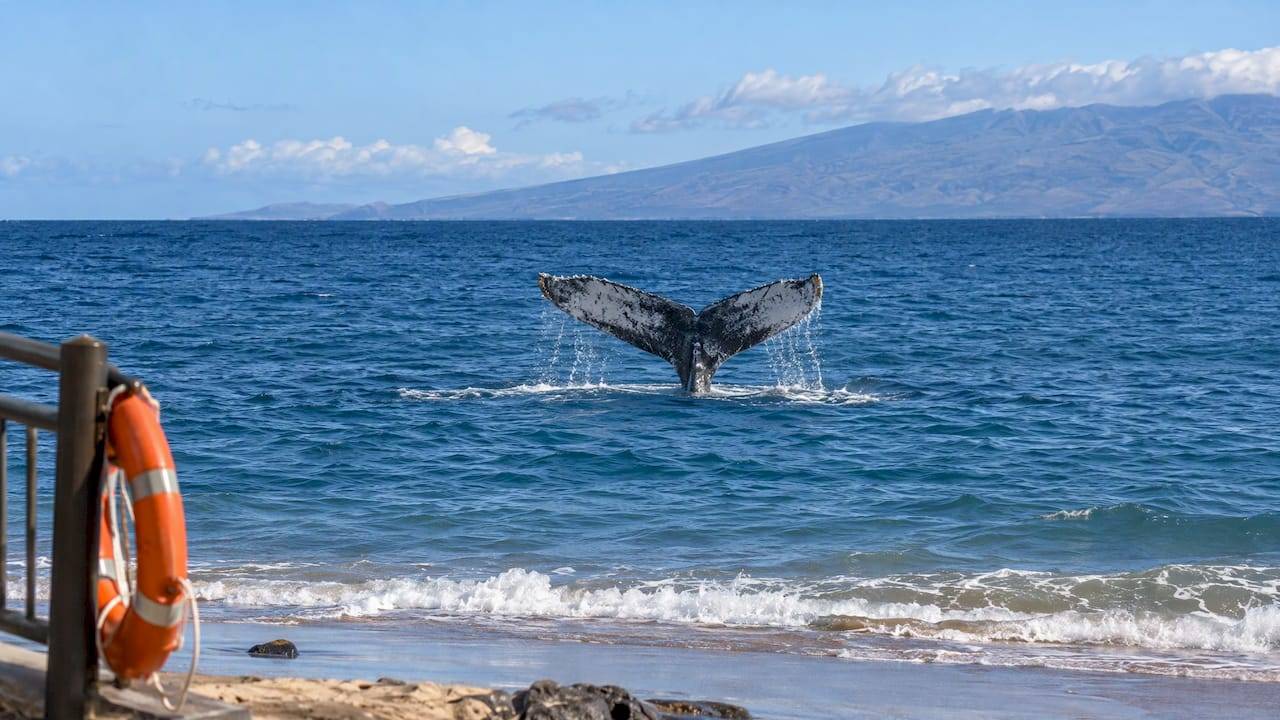
Maui whale season runs from about November through May, with the most humpbacks in the water from January through March. NOAA’s Hawaiian Islands Humpback Whale National Marine Sanctuary treats those months as the season and says the usual peak in abundance falls in January to March. Plan a February trip and you are visiting at the busiest time. Whales don’t keep a schedule, though, and a rainy or choppy day can hide them. That is where we come in: Flight of Aloha at Whalers Village in Kaanapali is a cool, indoor flying theater, a dependable plan B when the ocean doesn’t cooperate.
TL;DR
- Humpbacks are generally in Hawaiian waters from November through May, with the peak from January through March.
- State officials say the highest concentrations of sightings are in the shallow waters between Maui, Lanai and Molokai.
- You can watch from shore with binoculars. By law, stay at least 100 yards from any humpback, by any means.
- Rainy, windy or hazy day? Flight of Aloha, Native Hawaiian-owned, offers an air-conditioned flight over Hawaii at Whalers Village in Kaanapali and in Kailua-Kona.
When is whale season on Maui?
The sanctuary’s boating guide says humpback season in Hawaii generally runs November through May, with whales seen in limited numbers in other months. Its visitor guide frames the prime viewing window from shore and at sea as November through April.
The state’s Division of State Parks gives a wider range: whales begin arriving at the main islands as early as September and stay as late as May, with the peak in January and February. Different agencies draw the edges differently because the whales trickle in and out rather than arriving on one day.
Here is a simple way to read the calendar:
| Period | What to expect |
|---|---|
| September to November | Early arrivals. Sightings are occasional. |
| December | Numbers build quickly. |
| January to March | Peak season. The best odds, from shore or boat. |
| April to May | Numbers drop as whales head north. Mothers with calves are often among the last to leave. |
The last row follows research on Hawaii’s humpbacks by Jim Darling, which found cows with newborn calves peak in February and March and are usually the last groups seen in May and June.
What is the best month for whales on Maui?
February is the safest answer, and January and March are close behind. Hawaii’s Department of Land and Natural Resources said in a February 2026 release that the season had reached its peak and that more than 10,000 humpbacks come to Hawaii each winter to breed and nurse their calves.
A few practical notes for planning:
- Book your trip around late January to early March if whales are the main goal.
- Visiting in December or April? You will still likely see whales, just fewer of them.
- Visiting in summer? Whales are not here. Look for other ways to spend your Maui days.
Why do the whales come to Maui?
Humpbacks feed in Alaska and other cold northern Pacific waters, then travel roughly 2,500 miles south to breed, give birth and nurse their young. Hawaii’s Division of Aquatic Resources explains that the shallow, warm waters around Maui County suit mating, birth and nursing. The warmth helps newborns stay warm and avoid orcas, and it lets calves build the blubber they need for Alaska’s cold.
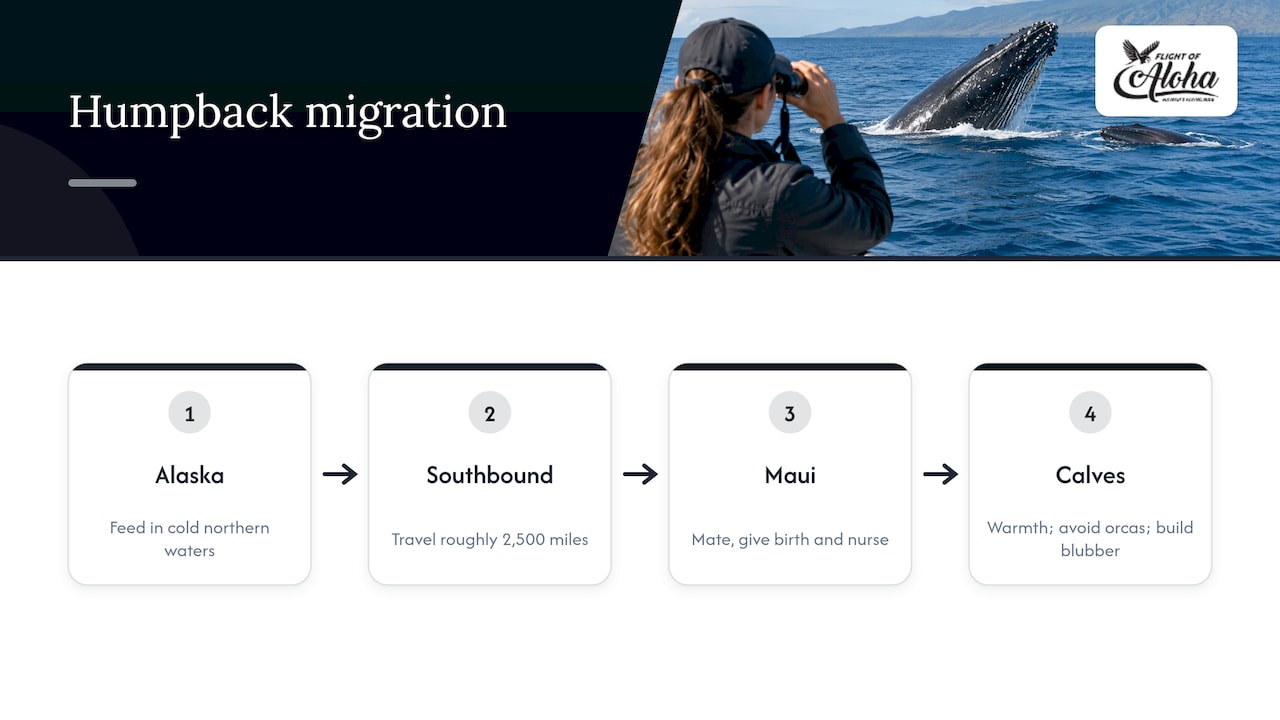
That is why the stretch between Maui, Lanai and Molokai is so busy. Hawaiians know the humpback as koholā, and the whale has a place in island stories and traditions.
What you might see
The sanctuary’s guide describes the behaviors to watch for:
- Blow: a bushy spout, often 10 to 16 feet high. Spot this first.
- Breach: the whale launches its body out of the water.
- Tail and fin slaps: loud, flashy, and easy to spot from a distance.
- Spy hop: the whale raises its head vertically to look around.
See the sanctuary whale-watching guide for the full list. Calves are especially fun: Darling’s research found calves surface every 5 to 6 minutes, while the mother surfaces every 10 to 20 minutes. Keep watching one spot and the calf will pop up.
Whale watching without a boat
You do not need a ticket to see humpbacks. Whales stay close to shore in water under 600 feet deep, so a good lookout and patience go a long way.
- Pick a high, west-facing or south-facing viewpoint. The coastline along Honoapiilani Highway above Maalaea, near McGregor Point, is a classic choice, as are the Wailea coastal path and the beach walk at Kaanapali.
- Go early. Mornings are usually calmer, before trade winds chop the water and make blows harder to spot.
- Bring binoculars. Scan the horizon for a blow first, then look for the body.
- Be patient. Give each spot 15 to 20 minutes before you move on.
Staying on land is also the simplest way to follow the viewing rules: NOAA asks everyone to keep at least 100 yards away and use binoculars or camera zoom rather than moving closer. That is about the length of a football field.
Watching whales respectfully
The rules are straightforward, and they protect both whales and visitors:
- Stay 100 yards back. It is illegal to approach a humpback within 100 yards, and the state notes this applies by any means, including kayaks, paddleboards, swimmers and drones.
- Keep aircraft high. Federal rules set a 1,000-foot minimum altitude over humpbacks in Hawaii.
- Never swim with, touch or feed whales. Humpbacks weigh more than 40 tons.
- Report a distressed whale. Stay back 100 yards and call the NOAA Fisheries Marine Wildlife Response Hotline at 888-256-9840, or use Coast Guard VHF channel 16, as DLNR advises. Never try to free an entangled whale yourself.
Curious calves can surface suddenly and are hard to see, so vessel operators are asked to slow down during the season. If you are out on the water, DLNR’s boating guidance recommends traveling at 15 knots or less in water 600 feet deep or shallower, and slowing to 6 knots within 400 yards of a whale.
When the weather or the whales don’t cooperate
A wet, gray or hazy day is the one that bothers whale watchers most. Rain flattens contrast, wind chops the surface and blows disappear. It is also when many visitors realize they have a free afternoon and no plan.
Here is how we would rank the best backup options on Maui and the Big Island:
- A shorter shore stroll between showers. Scan at a lookout, then head inside when it rains.
- Flight of Aloha. Out of the rain, out of the heat and the vog, and seated in a cool theater. Of the options on Maui and in Kona, it is the one we call the most accessible: it is built for all ages and abilities.
- A museum or cultural stop. Browse our guide to Hawaii cultural experiences.
For more ideas after dark or in bad weather, see our list of night activities in Maui and the things to do near Kaanapali.
The smart alternative to a helicopter
Some visitors picture whale season from above, in a helicopter. Aerial tours can cost around $400 per person, which is why our guide to Maui must-dos pairs local tips with a lower-cost alternative. Our theater gives you the feeling of soaring over the islands with 8K visuals, motion, scents and wind, in a seat, indoors, with no rotor noise and no turbulence to worry about.
One caution about the real thing: federal rules require aircraft to stay at least 1,000 feet above humpbacks, so even a flight does not bring you close to whales. That is another reason to enjoy a flight for the scenery and watch whales from the shore.
Flight of Aloha: your flight over Hawaii, rain or shine
We are a Native Hawaiian-owned flying theater with two locations: Kailua-Kona and Whalers Village in Kaanapali, Maui. Each film pairs cultural storytelling with 8K visuals, motion effects, scents and wind. Our lineup includes Naupaka, Lahaina, Whale Song and Europe.
Cruise visitors will like the Kona location: it is within walking distance of Kailua Pier and the tender dock, so it fits a short shore excursion.
Prices as published on our site:
| Option | Price |
|---|---|
| Single feature (Naupaka, Lahaina or Europe) | $29.99 to $34.99 |
| Double Feature Flying Ride | $49.99 to $59.99 |
| VIP Package | $69.99 to $79.99 |
| Annual Pass | $200 per year |

If you are on Maui for more than a day or two, the Annual Pass is worth a look. Gift cards are also available through our site. For more on how our films are made, read about cultural storytelling at Flight of Aloha.
Our perspective
Every winter, the koholā return, and it is a gift to watch them. We hope every visitor gets that moment from the shore: a blow on the horizon, a tail rising out of the blue.
We also know the ocean has its own plans. Rain moves in, the wind picks up, and a whale day turns into a what-now day. We built Flight of Aloha so that no one’s Hawaii trip depends on the weather.
As a Native Hawaiian-owned attraction, we tell stories rooted in Hawaiian legends, working with local advisors and storytellers. Our theater is for everyone, from keiki to kupuna, with no climbing, no boarding and no waiting on the sea. Come out of the heat or the rain, buckle in, and fly over the islands with us.
Ola
FAQ
What month is best to see whales on Maui?
February is the best bet, with January and March close behind. The state’s wildlife officials describe January and February as the peak, and NOAA puts the busiest stretch at January through March.
Are there whales on Maui in December or April?
Yes, though in smaller numbers than at the peak. December sees numbers building, and April sees them dropping as whales head north. Mothers with calves are often among the last to depart.
Can I see whales without taking a boat?
Yes. Humpbacks gather in shallow water close to the coast, so shore lookouts work well. Go early, bring binoculars and look for the blow first. Keep at least 100 yards from any whale you encounter in the water.
Where do whales gather around Maui?
The highest concentrations are in the shallow waters between Maui, Lanai and Molokai. Shore viewing from the west and south coasts, including Kaanapali, is popular.
What can we do with kids on a rainy Maui day?
Try a flight at Flight of Aloha in Whalers Village, Kaanapali. It is indoors, air-conditioned and suitable for all ages and abilities. For more ideas, see our year-round family fun guide.
Sources
- NOAA Hawaiian Islands Humpback Whale National Marine Sanctuary: Boating Guide
- Hawaii Division of State Parks: best time for whale watching
- Hawaii Division of Aquatic Resources: Humpback Whale
- Sanctuary whale-watching guide
- Darling: Characterization of Behavior of Humpback Whales in Hawaiian Waters
- NOAA Fisheries: Viewing Marine Wildlife in Hawaii
- NOAA Fisheries: Guidelines and Distances
- DLNR news release, February 5, 2026
- DLNR Division of Boating and Ocean Recreation: Boating with Whales
Book online to secure your seat.