
What Is the Naupaka Legend: Hawaiʻi’s Half-Flower Story

Every family visiting Kailua-Kona hopes to find a story that brings everyone together while exploring Hawaiian culture. The Naupaka legend stands out for its unforgettable tale of forbidden love, dramatic separation, and the deep symbolism found in the distinctive half-flower. Discover how this romance between Princess Naupaka and Kaui reveals Hawaiian values like respect for hierarchy and the power of symbolic storytelling through engaging local folklore, immersive experiences, and living botanical wonders.
Table of Contents
- Naupaka Legend Defined and Debunked
- Key Versions and Core Characters
- Symbolism of the Half-Flower Shape
- Mountain and Beach Naupaka Varieties
- Cultural Role in Hawaiian Storytelling
Key Takeaways
| Point | Details |
|---|---|
| Naupaka Legend | The Naupaka legend illustrates a poignant tale of forbidden love, emphasizing cultural restrictions and divine intervention. |
| Cultural Values | The story reflects critical Hawaiian cultural values, such as respect for hierarchy and the significance of spiritual beliefs. |
| Botanical Significance | The unique half-flower shape of Naupaka serves as a powerful metaphor for the lovers’ separation and the complexities of love. |
| Storytelling Impact | The Naupaka legend functions as an intricate cultural artifact, preserving societal norms and spiritual understanding through narrative. |
Naupaka Legend Defined and Debunked
The Naupaka legend captures the heart of Hawaiian storytelling, weaving a poignant tale of forbidden love that transcends social boundaries. Hawaiian folklore reveals a narrative of Princess Naupaka and a humble fisherman named Kaui, whose passionate relationship was destined to be tragically separated by cultural restrictions.
The core storyline unfolds with dramatic tension:
- A princess falls in love with a commoner
- Their relationship violates strict social class hierarchies
- Divine intervention through supernatural signs signals disapproval
- The lovers are forced to separate
Unlike typical romantic narratives, the Naupaka legend takes a uniquely Hawaiian approach to explaining love’s complexity. The tale describes how the lovers were denied permission to marry despite seeking blessings from every possible authority—elders, priests, and even gods. When their prayers were met with dramatic lightning and rain, symbolizing celestial rejection, they made a heart-wrenching decision.
The legend’s most symbolic moment occurs when Princess Naupaka splits a flower in half, giving one portion to Kaui. This act represents their permanent separation: he retreats to the mountains while she remains by the sea. Remarkably, this mythical narrative directly explains the existence of two distinct Naupaka flower varieties—one thriving in coastal regions and another in mountainous landscapes.
Cultural Significance
Beyond a simple love story, the Naupaka legend reflects profound Hawaiian cultural values:
- Respect for social hierarchy
- Divine intervention in human affairs
- The power of symbolic representation
- Explaining natural phenomena through narrative
The story serves not just as entertainment but as a complex cultural artifact that communicates deep societal norms and spiritual beliefs.
The following table highlights how the Naupaka legend illustrates core Hawaiian cultural values:
| Cultural Value | How the Legend Reflects It | Societal Impact |
|---|---|---|
| Respect for hierarchy | Love forbidden by social class | Reinforces social boundaries |
| Divine intervention | Supernatural signs and rejection | Validates spiritual beliefs |
| Symbolic storytelling | Half-flower as narrative device | Connects story to nature |
| Explaining phenomena | Flower origin tied to myth | Preserves cultural memory |
Pro tip: When visiting Hawaiʻi, look for both mountain and coastal Naupaka flowers as living reminders of this powerful legend.
Key Versions and Core Characters
Hawaiian folklore presents multiple intriguing versions of the Naupaka legend, each offering a unique perspective on the tragic love story. At the heart of these narratives are several key characters whose interactions define the myth’s emotional landscape.
Primary Characters:
- Princess Naupaka: A noble woman from the upper social class
- Kaui: A humble fisherman from a lower social status
- Kupuna: Respected elders who judge the lovers’ fate
- Kahuna: Priests who provide spiritual guidance
- Pele: The volcano goddess who sometimes intervenes
Primary Legend Variations:
- The Classic Forbidden Love Version
- The Pele Intervention Version
The most prevalent narrative describes a love that defies social boundaries between Princess Naupaka and Kaui. Their relationship becomes impossible due to strict hierarchical restrictions, with divine forces seemingly conspiring against their union. In this version, supernatural signs—like dramatic lightning and rain—symbolize celestial disapproval of their relationship.
A fascinating alternative version introduces Pele, the volatile volcano goddess, as a central character. In this telling, Pele becomes jealous of the lovers’ passion and actively works to separate them. She reportedly sends destructive lava flows after Kaui, forcing the lovers to seek refuge in different landscapes—Naupaka by the sea, and Kaui in the mountains.
Cultural Context
Both versions of the legend share critical thematic elements:
- Respect for social hierarchy
- The power of divine intervention
- Symbolic representation of natural phenomena
- The consequences of challenging cultural norms
These narratives are more than simple love stories; they represent complex cultural artifacts that communicate profound societal values and spiritual beliefs.
Pro tip: When exploring Hawaiian cultural sites, ask local storytellers about the different versions of the Naupaka legend to gain deeper insights.
Symbolism of the Half-Flower Shape
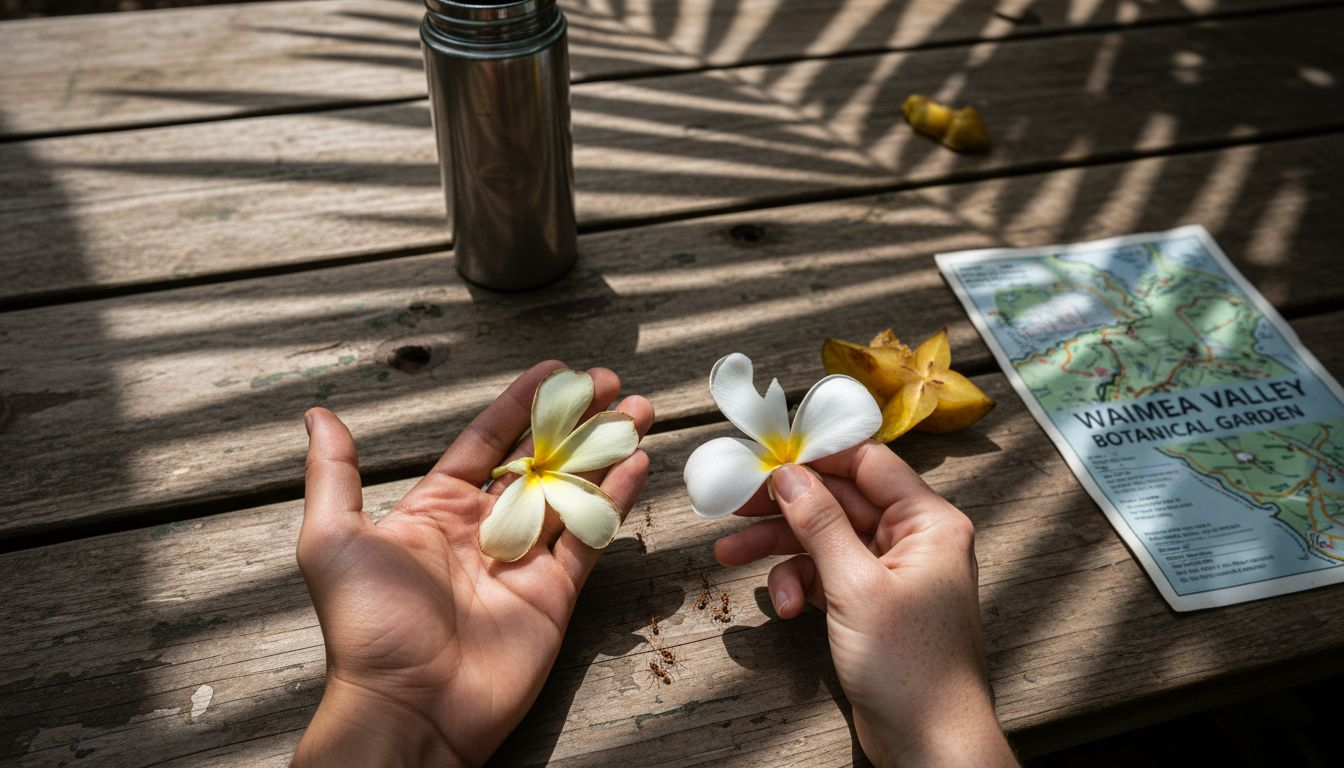
The Naupaka flower’s unique half-flower shape carries profound metaphorical significance that transcends mere botanical curiosity. This distinctive floral form serves as a powerful visual representation of the legendary love story’s emotional complexity.
Botanical Metaphor:
- Represents incomplete romantic union
- Symbolizes forced separation
- Embodies unresolved emotional tension
- Reflects cultural constraints on love
The flower’s extraordinary morphology tells a story of divided landscapes where each half grows in dramatically different environments. One variant thrives along coastal beaches, while its counterpart flourishes in mountainous regions—mirroring the lovers’ enforced separation.
Symbolic Interpretations
The half-flower shape communicates multiple layers of meaning:
- Incomplete Love: Representing a relationship interrupted
- Cultural Boundaries: Demonstrating the power of social restrictions
- Spiritual Intervention: Illustrating divine influence on human connections
- Resilience: Showing beauty can emerge from profound loss
When the mountain and beach Naupaka flowers are brought together, they momentarily complete each other—a poignant reminder of the lovers’ unfulfilled potential. This botanical metaphor transforms a simple flower into a powerful narrative device that continues to captivate those who understand its rich cultural context.
Pro tip: When exploring Hawaiian botanical gardens, look for both mountain and coastal Naupaka to appreciate the full symbolic story.
Mountain and Beach Naupaka Varieties
Hawaiian botanists recognize two distinct Naupaka varieties that embody the legendary love story through their unique geographic distribution. These botanical cousins—mountain Naupaka (Naupaka kuahiwi) and beach Naupaka (Naupaka kahakai)—represent the separated lovers’ enduring connection through their complementary half-flower forms.
Botanical Characteristics:
- Mountain Naupaka: Thrives in higher elevation environments
- Beach Naupaka: Grows in coastal and salt-exposed regions
- Both share half-flower morphology
- Distinct species with parallel evolutionary adaptations
Coastal and mountain environments shape these remarkable plants differently, reflecting the legend’s themes of separation and environmental adaptation. The beach Naupaka demonstrates remarkable resilience against harsh saltwater and wind conditions, while the mountain variety flourishes in cooler, moister upland ecosystems.
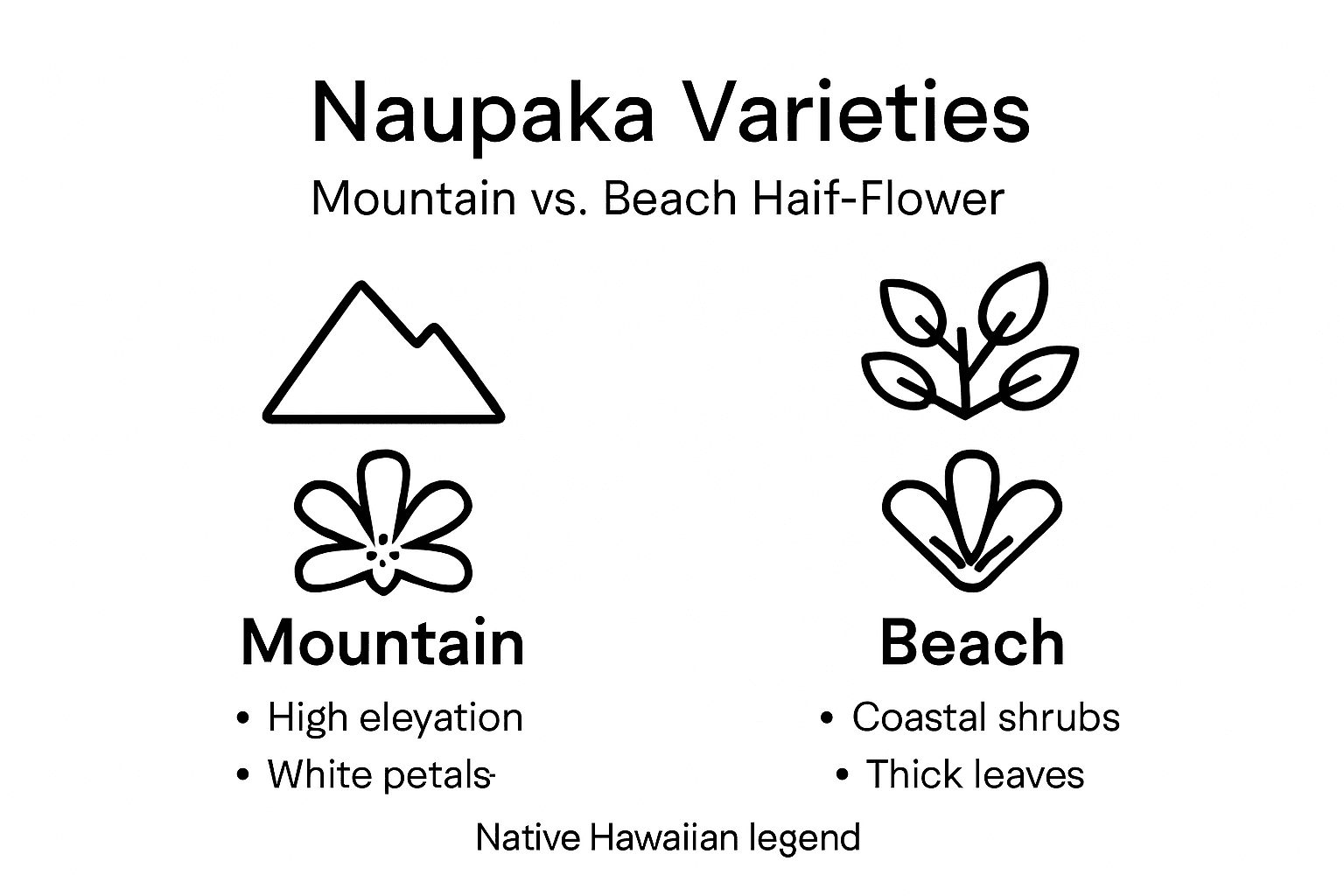
Here’s a summary comparing the two main Naupaka flower varieties and their legendary symbolism:
| Variety | Growing Location | Legendary Role | Key Characteristics |
|---|---|---|---|
| Mountain Naupaka | Mountains, uplands | Princess’s separation | Thrives in cool, moist areas |
| Beach Naupaka | Coastal, sandy areas | Fisherman’s separation | Adapts to salt and wind |
Ecological Significance
Each Naupaka variety represents a unique botanical narrative:
- Mountain Naupaka symbolizes Princess Naupaka’s highland refuge
- Beach Naupaka represents Kaui’s coastal existence
- Both plants showcase remarkable survival strategies
- Their half-flower structure remains a living metaphor for interrupted love
Interestingly, when the mountain and beach Naupaka flowers are conceptually reunited, they complete the botanical representation of the lovers’ story—a poetic reminder of nature’s capacity to preserve cultural memory through living organisms.
Pro tip: Visit botanical gardens in Hawaiʻi to observe both Naupaka varieties and appreciate their unique growing environments.
Cultural Role in Hawaiian Storytelling
The Naupaka legend represents a profound storytelling tradition that goes far beyond a simple romantic narrative. These oral histories serve as intricate cultural mechanisms for preserving Hawaiian social values, spiritual connections, and understanding of the natural world.
Storytelling Functions:
- Transmit cultural knowledge
- Explain natural phenomena
- Reinforce social norms
- Preserve historical memory
- Connect generations through shared narrative
Hawaiian myths like Naupaka communicate complex social rules through compelling metaphorical storytelling. The legend operates simultaneously as an origin story for the unique half-flower plant, a moral lesson about social boundaries, and a nuanced exploration of love’s limitations within traditional Hawaiian society.
Narrative Significance
The story embodies critical cultural principles:
- Respect for social hierarchy
- Understanding of kapu (sacred prohibitions)
- Spiritual interconnectedness
- Consequences of challenging established norms
- Relationship between humans and natural environment
By transforming a love story into a botanical explanation, the Naupaka legend demonstrates the remarkable Hawaiian storytelling technique of embedding profound cultural wisdom within seemingly simple narratives. These stories are not mere entertainment but living repositories of collective cultural memory and philosophical understanding.
Pro tip: Ask local Hawaiian cultural practitioners about the deeper meanings behind traditional legends to gain richer cultural insights.
Experience the Heart of Hawaiian Legends Like Never Before
The Naupaka legend explores themes of forbidden love, cultural boundaries, and the deep spiritual connection between nature and people. For visitors seeking to immerse themselves in these powerful Hawaiian stories, understanding the symbolic half-flower and its dual mountain and coastal varieties can inspire a deeper appreciation of Hawaii’s rich cultural heritage. If you have been captivated by the story of Princess Naupaka and Kaui and want to see Hawaiian legends come alive through breathtaking visuals and multisensory experiences Flight of Aloha offers the perfect solution.

Discover how this iconic tale translates into a stunning immersive flying theater attraction in Kailua-Kona where 8K visuals, motion effects, scents, and wind simulate flying over the islands. Dive into culturally rooted storytelling featuring the Naupaka legend and other Hawaiian myths with vivid detail and emotional impact. Don’t miss your chance to transform a traditional story into a modern unforgettable adventure. Visit Flight of Aloha and explore all available experiences including VIP packages and annual passes. Book your tickets today to connect with Hawaii’s soul in a brand new way on this uniquely crafted ride that honors aloha and legacy.
Start your journey now by exploring Flight of Aloha and immerse yourself in the story of Naupaka and beyond.
Frequently Asked Questions
What is the main story of the Naupaka legend?
The Naupaka legend tells the tale of Princess Naupaka and a humble fisherman named Kaui, whose love is forbidden due to social class hierarchies. Despite seeking approval for their union, they ultimately face divine disapproval and are forced to separate, symbolized by the splitting of a flower.
What do the two varieties of Naupaka flowers represent?
The two varieties, mountain Naupaka and beach Naupaka, symbolize the separated lovers. Mountain Naupaka grows in higher elevations, representing Princess Naupaka, while beach Naupaka flourishes in coastal areas, representing Kaui. Their half-flower morphology reflects their incomplete union.
How does the Naupaka legend reflect Hawaiian cultural values?
The Naupaka legend illustrates important Hawaiian cultural values, including respect for social hierarchy, the role of divine intervention in human affairs, and the use of symbolic storytelling to explain natural phenomena and societal norms.
What significance does the half-flower shape have in the Naupaka story?
The unique half-flower shape serves as a powerful metaphor for incomplete love and forced separation. It represents the cultural constraints on relationships, the resilience that can emerge from loss, and serves as a living reminder of the lovers’ story through the botanical existence of the Naupaka flowers.