
Save $400 in Hawaii: Interactive Storytelling With Flight of Aloha
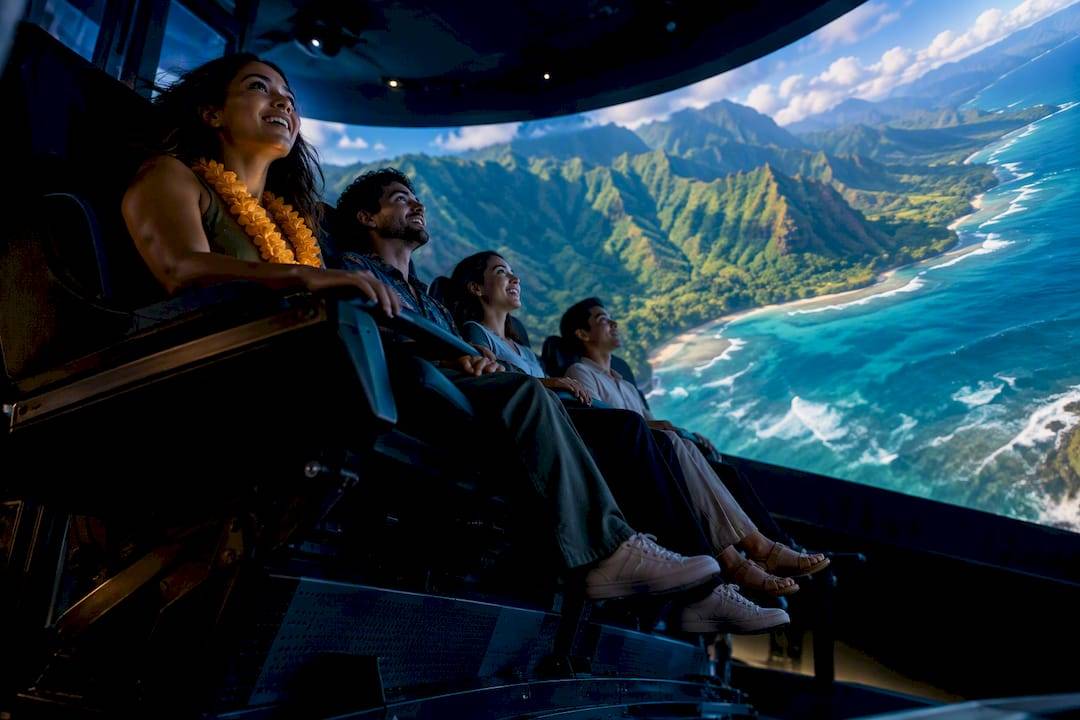
Interactive storytelling, in the context of Hawaii’s most talked-about new attraction, means a sensory flying-theater experience: 8K visuals on a wraparound screen, motion seats, wind, scent, and Hawaiian cultural narration working together to simulate flight over the islands. Flight of Aloha delivers exactly this at its Kailua-Kona and Whalers Village Kaanapali Maui locations, and it does it without the $400 price tag, the open-door motion sickness, or the weather cancellations that come with a real helicopter tour.
TL;DR:
- The experience uses 8K visuals, motion seats, wind, scent, and sound to replicate a flight over Hawaii, providing a realistic and comfortable alternative to helicopter tours.
- Unlike traditional theme rides, it features a fixed script based on Hawaiian legends, with sensory synchronization that enhances believability and long-lasting impressions.
- The attraction is suitable for families, cruise passengers, those avoiding helicopters, and locals seeking indoor relief from heat or vog, with accessible seating for various needs.
- Tickets range from $29.99 to $79.99, with an indoor, climate-controlled setting that operates regardless of weather or vog conditions, ideal for rainy days.
- The core technique involves sensory alignment instead of branching narratives, creating an immersive experience that emphasizes storytelling over audience control.
What Interactive Storytelling Means at Flight of Aloha
Let’s clear something up before we go further. This article is not about branching video games or choose-your-own-path apps. When we talk about interactive storytelling here, we mean the flying-theater genre. It’s a scripted, cinematic ride film paired with synchronized motion and environmental effects that make you feel like you’re inside the story rather than watching it.
The format works because it doesn’t ask you to make choices. It asks you to hold on and let the story carry you. The film is the script, the seats and wind are the stage directions, and the whole thing moves as one unit through the skies above Hawaii. Flight of Aloha builds that story around real Hawaiian legend and place. Films like “Naupaka” pull from native mythology, while others sweep you over Lahaina’s coastline or across a Europe-themed feature for guests craving variety on a double bill. The narration and imagery are shaped with input from Hawaiian cultural voices, so the flight feels less like a theme-park gimmick and more like a guided visit through a story that belongs here. That grounding is what separates this from a generic motion-simulator ride bolted onto stock footage.
How the Flight Illusion Actually Gets Built
The trick starts with scale. An 8K wraparound screen fills your entire field of vision, and that resolution matters because peripheral vision is what convinces your brain you’re moving, not just watching a movie. Motion-based ride platforms paired with high-definition visuals and environmental effects are used in museum and attraction settings for exactly this reason: they create a strong sensation of travel and presence.
From there, the seats do the heavy lifting. Motion cueing tilts, lifts, and sways in sync with the film, so when the camera banks over a valley, your body banks with it. That physical agreement between what you see and what you feel is what keeps the illusion believable instead of nauseating.
The environmental layer seals the deal:
- Wind bursts timed to on-screen speed and altitude changes
- Scent cues, like plumeria or ocean spray, released at story-relevant moments
- Surround sound that places waterfalls, waves, and Hawaiian chant around you rather than just in front
- Haptic feedback in the seat for turbulence, landings, and dramatic swoops
Pre-show pacing matters just as much as the ride itself. A well-built pre-show sets expectations, calms first-time riders, and slowly ramps the music and lighting before the motion even starts, which is exactly the design philosophy behind large-scale flying-theater attractions elsewhere in the industry.
Pro Tip: If you get queasy on rides, sit near the center of the row. Motion cueing is calibrated for the middle seats, and the sensation is smoothest there.
Why Skip the Helicopter and Fly From Your Seat Instead
A Kona helicopter tour runs close to $400 per person, requires clear skies, and puts you in an open cabin for 45 minutes of real turbulence. A flying theater gives you the same aerial perspective over Hawaiian coastlines and valleys, minus the fuel surcharge, the weight limits, and the risk of a cancelled tour when the vog rolls in.
Comfort is the real differentiator here. Flight of Aloha’s theaters are fully air-conditioned, which locals will tell you is no small thing on a humid Kona afternoon. The motion is smooth and seated, not the jolting drop of a coaster, so grandparents and toddlers can ride the same show.
Here’s what that comfort actually means:
- No altitude, no open doors, no seatbelt-only safety net
- Climate-controlled seating indoors
- A gentler motion profile suited to sensitive stomachs
- A fixed, predictable show time independent of weather conditions
That last point matters more than people expect on a Hawaii trip. Rainy days in Kona, vog advisories, or a heat spike that makes an outdoor tour miserable don’t touch a flying theater. The show goes on, indoors, in comfort, every single time.
Who This Experience Is Really Built For
If you’re trying to figure out whether Flight of Aloha fits your group, run through this short list:
- Families with mixed ages. The motion is gentle enough for kids and grandparents to ride together, closer to a smooth family attraction than a thrill ride, similar to how flying theaters are designed to appeal across age groups without roller-coaster intensity.
- Cruise passengers on a tight clock. The Kona location sits walking distance from the Kailua Pier tender dock, which makes it one of the easiest shore excursions to pull off without a rental car or a tour bus schedule.
- Anyone avoiding helicopters. If motion sickness, cost, or nerves have kept you out of a real aerial tour, this is the workaround.
- Local residents looking for an air-conditioned escape. On a hot or voggy afternoon, this beats sitting in traffic hunting for shade.
Before you go: wear comfortable shoes, expect to store bags and loose items before the ride starts, and mention any mobility needs at the counter. Seating is arranged to accommodate a range of physical needs, and staff can walk you through the best row for your situation.
What to Expect When You Book Your Flight
Plan for roughly 30 minutes total once you factor in the pre-show and the main film, which is short enough to slot into a cruise stop without eating your whole afternoon in port.
Ticket options scale to how deep you want to go:
- Single-feature shows like “Naupaka,” “Lahaina,” or “Europe,” each priced $29.99 to $34.99
- A Double Feature Flying Ride combining two films for $49.99 to $59.99
- A VIP Package with upgraded seating and perks, $69.99 to $79.99
- An Annual Pass for $200 per year, built for residents who want repeat visits
- Gift Cards available for anyone who’d rather let a friend pick their own flight
Booking runs online or at the venue counter, and pre-show design at flying-theater attractions is built for smooth guest flow, which keeps lines moving even during busy cruise-ship days. Show up about 15 minutes early, especially in Kona, where walk-up cruise traffic can bunch up around midday tender arrivals.
What “Interactive Storytelling” Means Outside the Theater
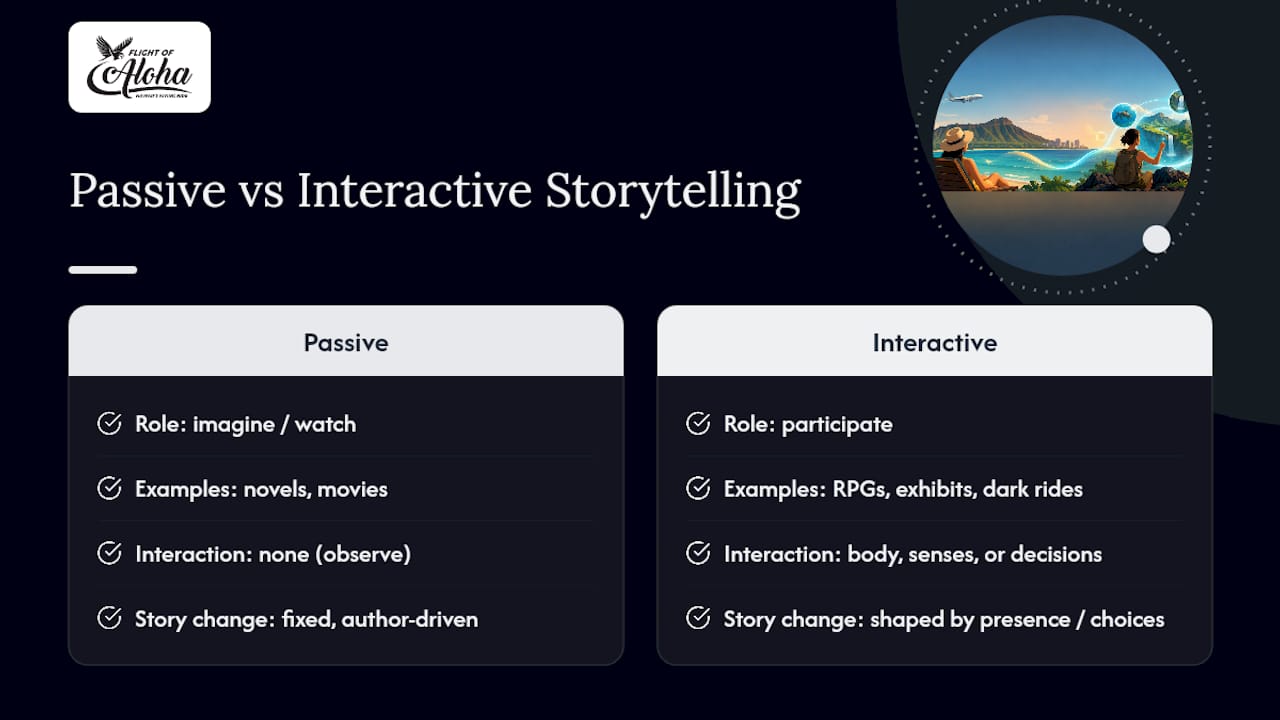
Strip away the flying-theater specifics and interactive storytelling, in its broadest sense, describes any narrative format where the audience’s presence, choices, or physical sensations shape how the story is experienced rather than simply watched or read. That’s a wide net. It covers everything from tabletop role-playing games to museum exhibits with motion sensors to theme-park dark rides where your cart’s path determines what you see next.
The common thread across every format is participation beyond passive viewing. A novel asks you to imagine. A movie asks you to watch. Interactive storytelling asks your body, your senses, or your decisions to become part of how the story unfolds. In a flying theater, that participation is sensory rather than decision-based. You’re not choosing plot branches, but your seat is moving, the wind is hitting your face, and the scent in the air is timed to the landscape flashing past you. That’s still interactive in the truest sense: the story is happening to you, not just in front of you.
Understanding this broader definition matters because it explains why flying theaters get grouped with video games and VR headsets in general conversation, even though the experience and the audience are completely different. A tourist looking for a family-friendly Kona activity and a teenager looking for a branching video game plot are searching for two different things, even if they type similar words into Google.
From Campfire Tales to 8K Projection: A Short History
Storytelling has always tried to pull the audience closer to the action. Oral tradition used call-and-response. Medieval mystery plays staged scenes around the audience rather than in front of them. Radio dramas in the 1930s used sound effects to build a mental picture without a single image on screen. Each step added a new sensory layer to bridge the gap between listener and story.
The 20th century sped that evolution up considerably. Theme parks in the mid-1900s introduced dark rides, where a moving cart guided guests through a physical, three-dimensional story set. That was arguably the first mainstream taste of a flying-theater-style approach: motion plus environment plus narrative, all synchronized. By the 1990s, simulator technology matured enough for attractions to combine motion platforms with projected film, giving audiences the sensation of flight or high-speed travel without ever leaving the building.
Museums picked up the same tools for education. Large-format attractions using motion-based virtual reality platforms have opened at institutions like the Smithsonian’s National Air and Space Museum, proving that this style of storytelling works just as well for teaching as it does for entertaining. Hawaii’s flying theaters are the latest branch of that same tree, swapping generic footage for culturally rooted narratives specific to the islands they’re built on.
The Many Formats Interactive Storytelling Takes Today
Interactive storytelling shows up in more places than most people realize, and each format uses a different tool to pull the audience in.
Video games are the most familiar version, where player choices steer dialogue, combat, or plot outcomes. Virtual reality headsets go a step further, surrounding the viewer’s entire visual field so head movement itself becomes part of the story. Immersive theater puts live actors in the same physical space as the audience, sometimes letting attendees walk between scenes happening simultaneously in different rooms.
Flying theaters sit in their own category. Unlike games or VR, there’s no branching and no player agency over plot. What makes them interactive is physical: motion seats, wind, and scent respond in real time to what’s on screen, creating a shared, guided sensory event rather than an individual, choice-driven one. This format trades control for spectacle, and for a lot of visitors, especially families and travelers with limited time, that trade is worth it. You don’t have to learn a control scheme or make a decision. You just sit down and the story happens to you, which is a big part of why flying theaters translate so well to tourist attractions rather than living rooms.
Interactive exhibits in museums and science centers round out the list, using motion sensors and touchscreens to let visitors trigger parts of a narrative through movement or touch.
The Techniques That Make a Story Feel Interactive
A handful of core techniques separate genuinely interactive storytelling from a story that simply has good production values.
Branching narrative is the technique most people associate with the term, where the plot forks based on a choice the audience makes. That’s the backbone of video games and choose-your-path fiction, but it plays almost no role in flying-theater attractions, which run a single, fixed sequence for every audience member.
Sensory synchronization is the technique that matters most in a flying theater. This is the timing discipline that lines up motion, wind, scent, and sound to the exact frame of film playing on screen. Pairing motion cues with scent and wind gives the brain multiple consistent signals, which increases how believable the simulated flight feels, since the brain trusts agreement between senses far more than any single sense alone.
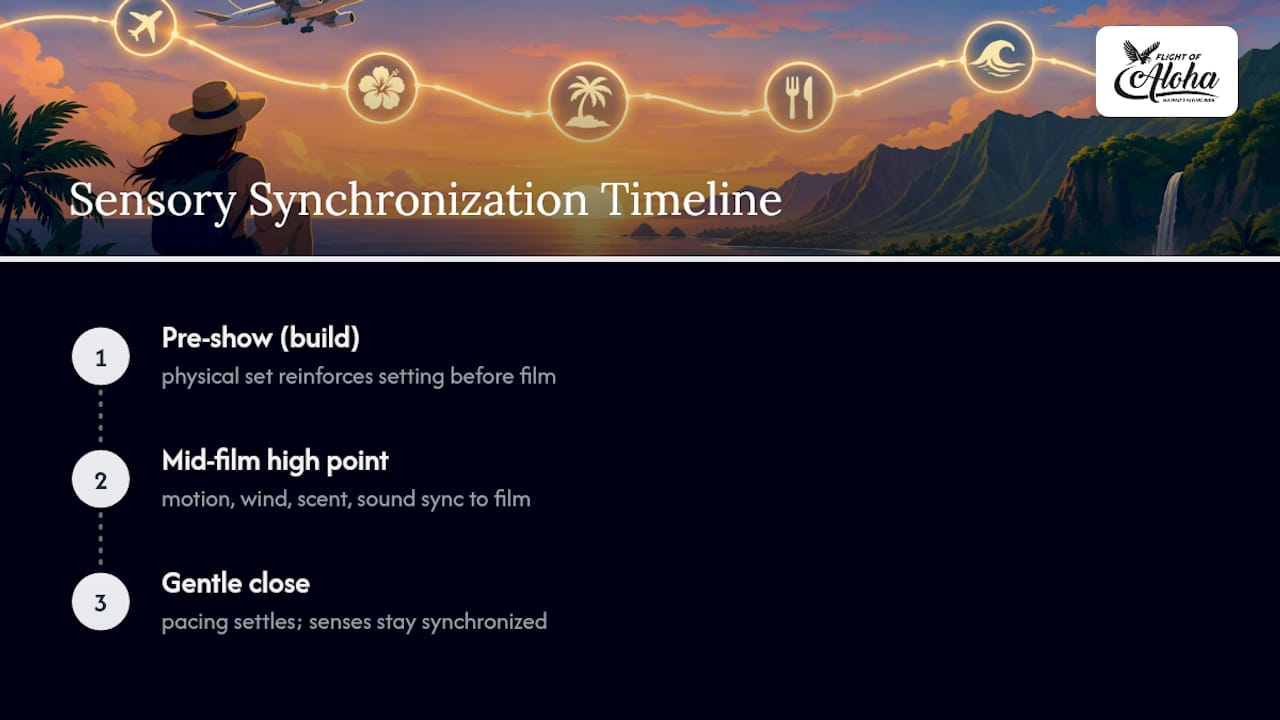
Pacing and emotional arc design borrow from film editing. A flying-theater script builds slowly through a pre-show, escalates through a mid-film high point, and settles into a gentler close, mirroring the structure of a well-told campfire story even though the medium is entirely different.
Environmental staging, meaning physical set design around the screen itself, rounds out the toolkit, reinforcing the story’s setting before the film even starts.
Where You’ll Find Interactive Storytelling Today
The technique shows up across a surprising range of industries once you start looking for it. Marketing teams use narrative-driven campaigns to hold attention longer than a straight advertisement ever could, and storytelling techniques built around emotional arcs and audience connection are now standard practice for brands trying to stand out.
Museums and science centers use motion-based platforms to teach history and physics in a way textbooks can’t. Theme parks built entire business models around dark rides and flying-theater attractions, from large-scale venues like Sphere in Las Vegas to compact regional flying theaters serving tourist markets. Corporate training programs use branching scenario software to simulate decision-making under pressure. Even healthcare has picked up interactive storytelling for exposure therapy and rehabilitation exercises that use VR environments to guide patients through controlled scenarios.
Hawaii’s flying theaters fit into this landscape as the tourism-and-culture branch of the family. Instead of teaching physics or training employees, they’re using the same sensory tools to hand visitors a felt connection to Hawaiian legend and landscape, something a brochure or a guided bus tour struggles to match.
Why It Works: The Engagement Payoff
Passive storytelling asks your brain to imagine. Interactive storytelling, in any of its forms, asks your brain to react, and reaction sticks with people longer than imagination does.
That’s measurable in attention and memory. A film you watch fades. A story you felt in your seat, that pushed wind into your face at the exact moment a waterfall crossed the screen, tends to stay with you. Attractions that pair motion platforms with visual and audio cues are built specifically to create those layered “wow” moments, because a single sensory hit fades fast, but three or four consistent signals arriving together create a memory that outlasts the ride itself.
For Hawaii specifically, that engagement translates into something more valuable than a fun 30 minutes. Riders leave a flying theater with a felt sense of the islands’ geography and legends, not just a mental note that they saw a cool ride. Families walk out talking about the story, not the technology, which is exactly the outcome a well-built interactive narrative is supposed to produce. The tech disappears into the background. The story is what stays.
A Local Voice on Keeping the Story True to Hawaii
Working alongside Hawaiian cultural advisors on films like “Naupaka” taught me that authenticity isn’t a marketing checkbox. It shapes every creative decision, from which legend gets told to how it’s narrated. Visitors consistently tell me the same thing after their ride: they didn’t just see Hawaii, they felt like they understood a piece of it. That reaction is the whole point of building these stories with respect instead of shortcuts.
— Ola
Book Your Flight of Aloha Experience Today
Flight of Aloha is the smart alternative to a $400 helicopter tour, and it’s the most accessible activity in Kona and Maui for anyone who wants aerial views without the cost, the open cabin, or the motion-sickness risk. As a Native Hawaiian-owned attraction with locations in Kailua-Kona and Whalers Village Kaanapali Maui, it also solves the two problems every Hawaii traveler eventually runs into: rainy days and vog. Step into the best air conditioning in town and let the story do the flying for you.

Choose a single feature like Naupaka or Lahaina, go bigger with the Double Feature Flying Ride, or treat yourself to the VIP Package for upgraded seating. Kona’s location sits walking distance from the Kailua Pier tender dock, making it the easiest shore excursion on your cruise itinerary. Locals who want unlimited repeat visits should look at the Annual Pass. Book online to secure your seat.
Sources
- New motion-based virtual reality attraction opens at National Air and Space Museum
- Flyover Las Vegas | Moment Factory
- Immerse yourself in Hawai‘i’s landscapes through Flight of Aloha theater : Big Island Now
- New flying theater helps Dynamic Attractions launch co-venture effort
FAQ
What Is Interactive Storytelling in a Flying Theater?
It’s a sensory attraction format that uses 8K visuals, motion seats, wind, and scent to simulate flight, paired with a scripted narrative rather than audience-controlled choices. Flight of Aloha builds its version around Hawaiian cultural legends and landscapes.
How Long Does a Flight of Aloha Ride Last?
The full experience, including the pre-show, runs about 30 minutes, making it easy to fit into a cruise stop or a single afternoon.
Is Flight of Aloha Better Than a Helicopter Tour?
For comfort, cost, and reliability, yes. It delivers the same aerial perspective without the roughly $400 helicopter price, the open-air motion sickness risk, or the chance of a weather cancellation.
How Much Do Tickets Cost?
Single-feature shows run $29.99 to $34.99, a Double Feature is $49.99 to $59.99, and a VIP Package runs $69.99 to $79.99. An Annual Pass is available for $200 per year for frequent visitors.
Is This Attraction Good for Rainy Days or Vog?
Yes. It’s fully indoor and climate-controlled, making it one of the top options in Kona or Maui when the weather or vog rules out an outdoor tour.