
Nervous First Time Travelers: Government Checklist and Flight of Aloha
Pick a destination that matches your comfort level, confirm your passport and visa status, book your flight and first night’s stay, then schedule a travel health check and buy insurance. Enroll in the State Department’s STEP program, know your TSA ConfirmID options, and if Hawaii is on your list, look at Flight of Aloha in Kailua-Kona or Whalers Village Kaanapali for an easy first-day activity. Those five moves cover almost everything a nervous first-timer needs before takeoff.
TL;DR:
- Confirm your passport is valid for at least six months beyond your travel dates and check visa requirements early to avoid last-minute issues.
- Book flights and accommodations four to six weeks out, and enroll in STEP for alerts and emergency assistance, especially for international trips.
- Pack essentials in your carry-on, including copies of documents, medications, chargers, and a change of clothes, to prevent stress and delays.
- Use trusted transportation options like ride-hailing apps or pre-arranged shuttles, and arrive early to handle security smoothly, especially on international flights.
- For Hawaii, Flight of Aloha offers a convenient indoor activity near ports that provides cultural storytelling and aerial views, suitable for all ages.
Your pre-trip timeline: what to do and when
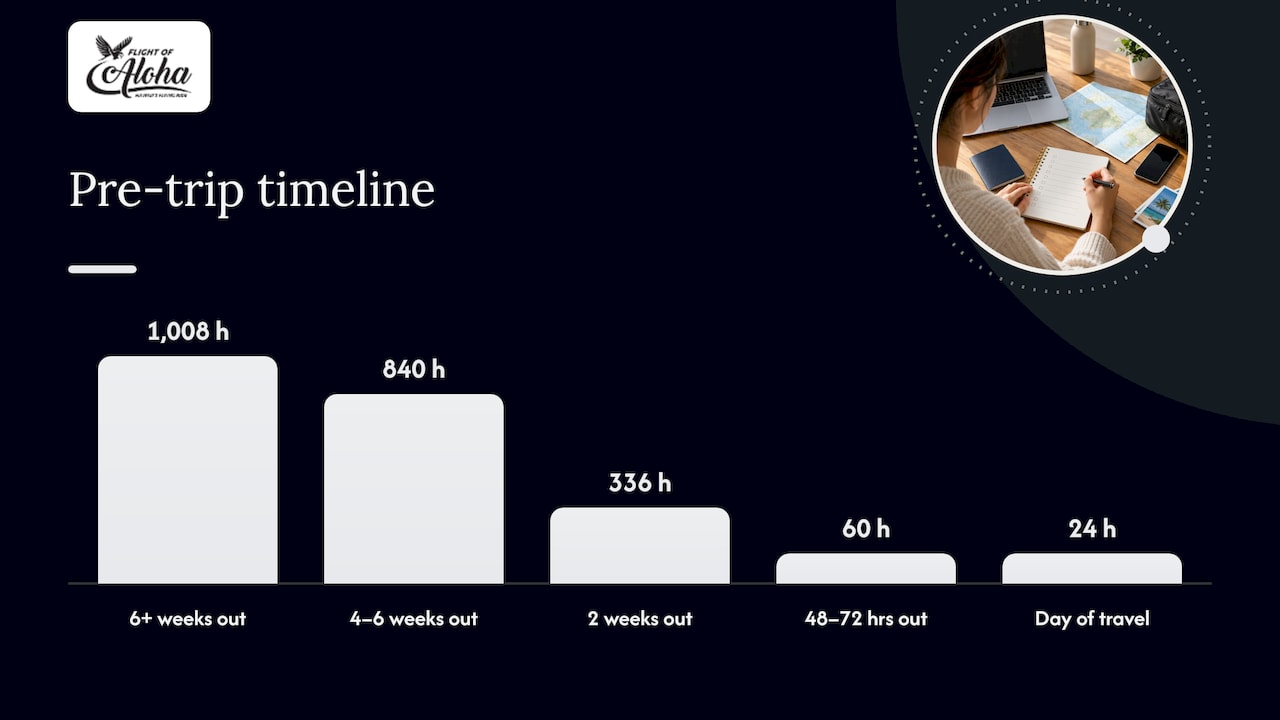
Nervous energy before a first trip usually comes from not knowing what to do first. A timeline fixes that. Break your prep into five windows and the whole process feels manageable instead of overwhelming.
Six or more weeks out, focus on the big structural pieces:
- Confirm your passport is valid and check whether your destination requires at least six months of validity beyond your travel dates, a common rule worth verifying on the embassy or State Department site.
- Research your destination’s climate, safety profile, and general vibe so you know what you are walking into.
- Apply for a visa if your destination requires one, since processing can take weeks depending on the country.
Four to six weeks out, the State Department and CDC recommend locking in health and logistics:
- Book a travel health appointment for vaccines or destination-specific medicine, since some vaccines need multiple doses spaced weeks apart.
- Reserve your flights and your first night of lodging near your arrival point, so you are not scrambling after a long travel day.
- Enroll in the State Department’s Smart Traveler Enrollment Program (STEP) for international trips, which sends you location-specific alerts and helps the nearest embassy find you in an emergency.
Two weeks out, shift toward the details that make travel day smoother. Buy travel insurance if you have not already, since waiting too close to departure can limit coverage options. Check that your itinerary, hotel confirmations, and any tour bookings are all saved somewhere you can access offline.
Forty-eight to seventy-two hours out, handle the tasks that keep money and logistics moving smoothly:
- Notify your bank and credit card companies of your travel dates and destinations.
- Complete online check-in for your flight if the airline offers it.
- Fill any prescriptions you will need and pack a few extra days’ supply.
Day of travel, keep it simple. Arrive at the airport with enough buffer for parking, check-in, and security. Carry both paper and digital copies of your passport, boarding pass, and hotel confirmation. Do a final pocket check of your carry-on so nothing critical got left on the counter at home.
This staged approach mirrors what the State Department’s planning guidance recommends: start early, verify entry and health requirements well ahead of departure, and treat the final week as confirmation, not discovery.
The documents and ID rules you need to check first
Nothing derails a first trip faster than a document problem at the gate. Most of these issues are avoidable if you check the right things early.
Many countries require your passport to be valid for at least six months beyond your travel dates, and this is one of the most commonly missed rules among first-time travelers, according to the State Department. Check your destination’s embassy page directly rather than assuming a general rule applies, since requirements vary by country.
Statistic Callout: The State Department advises reviewing destination-specific entry requirements and health guidance four to six weeks before departure, giving you enough runway to fix a passport or vaccine issue before it becomes a crisis.
For U.S. domestic flights, you will need a REAL ID-compliant license or another acceptable form of identification. Starting February 1, 2026, travelers without acceptable ID can use TSA ConfirmID, a fee-based identity verification option that costs $45 and lets you continue through screening rather than getting turned away.
For international travel, visa requirements depend entirely on your passport and destination. Some countries offer visa-free entry, others require an application week in advance, and a few issue a visa on arrival. Check your destination’s official government or embassy site directly, since travel forums and outdated blog posts are a common source of bad information.
A few habits protect you no matter where you are headed:
- Keep a photo of your passport and ID on your phone and a paper copy in a separate bag from the original.
- Leave a copy of your passport, itinerary, and emergency contacts with someone at home.
- Screenshot your hotel confirmation and boarding pass in case your phone loses signal or battery.
None of this takes more than twenty minutes, and it is the cheapest insurance you will buy on the whole trip.
Getting through the airport with minimal stress
Airport stress usually comes down to timing and unfamiliarity. Fix both and the whole process feels routine instead of chaotic.
Arrive with a real buffer. Parking, check-in lines, and security queues all eat time unpredictably, and international flights typically need more cushion than domestic ones. Build in extra time rather than cutting it close, especially on your first trip when you do not yet know your airport’s rhythms.
TSA screening moves faster when you know the basics ahead of time:
- Follow the 3-1-1 liquids rule: containers of 3.4 ounces or less, all fitting in one quart-sized bag.
- Remove laptops and larger electronics from your bag and place them in a separate bin.
- Wear shoes that slip off easily and keep metal accessories to a minimum.
Statistic Callout: Starting February 1, 2026, TSA ConfirmID offers a $45 identity verification path for travelers who show up without acceptable ID, a useful backup if you misplace your license before a flight.
If your ID is lost, stolen, or expired, do not assume you are stuck. TSA ConfirmID exists precisely for that situation, though it is faster and cheaper to simply confirm your ID is current before you leave home.
Delays and cancellations happen, and you have more protection than most first-timers realize. Under Department of Transportation rules, a significant delay is defined as three or more hours for domestic flights and six or more hours for international ones, and airlines must issue automatic refunds or timely notice when a refund is owed rather than making you fight for it. The same rules set expectations around baggage delivery timing, which matters if your suitcase does not show up on the belt.
Knowing these thresholds ahead of time turns a stressful gate-agent conversation into a straightforward request.
What to pack and what to keep within reach
Packing anxiety is almost always about forgetting something critical, not about bringing too little. Fix that fear with a system instead of guesswork.
Start with an empty bag and build from a checklist rather than pulling items from drawers at random. A TSA travel tip worth following: check every pocket and compartment of your bag before you leave home, since forgotten items like a multitool or an old lighter are a common cause of screening delays.
Your carry-on should hold everything you cannot afford to lose track of:
- Passport, ID, boarding pass, and printed hotel confirmation.
- Prescription medications in their original bottles, plus a few extra days’ supply.
- Phone charger, a compact power bank, and any travel adapter your destination requires.
- One change of clothes, in case checked luggage is delayed.
- A small toiletry kit that fits the 3-1-1 liquids rule for security screening.
Pro Tip: Pack your carry-on the night before, then set it by the door, so a groggy morning departure does not turn into a last-minute scramble through the house.
If you take prescription medication, bring more than you think you need and carry a copy of the prescription or a doctor’s note, particularly for controlled substances that some countries restrict. This one detail causes more mid-trip headaches than almost anything else on a first-timer’s packing list.
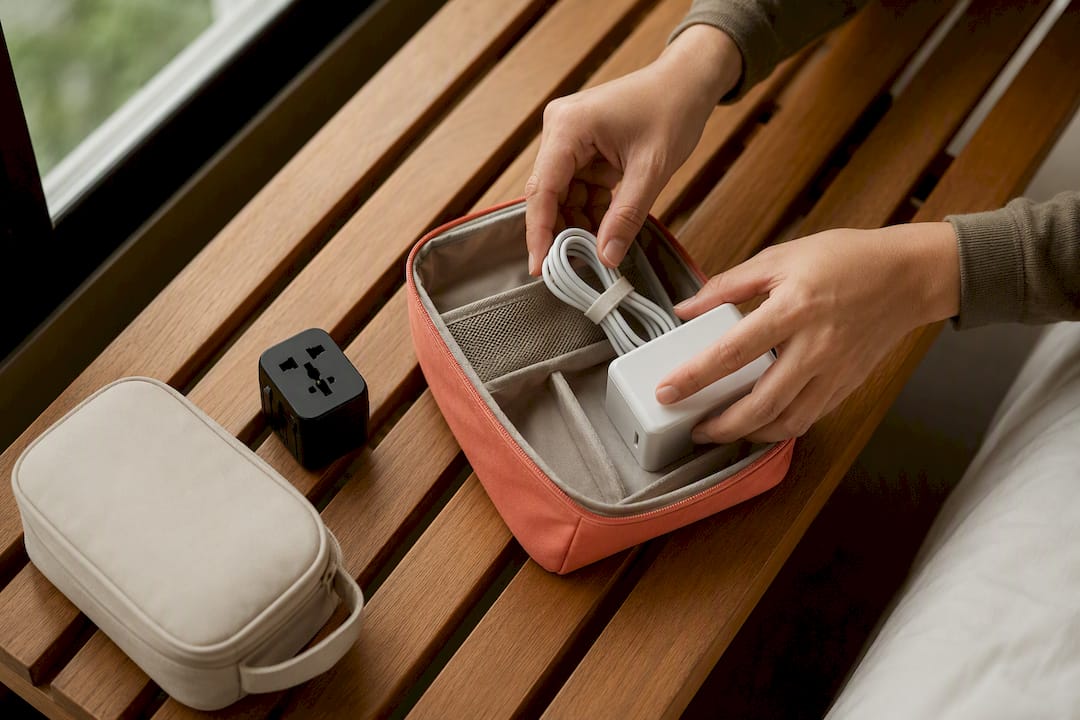
Electronics deserve a little extra care. Pack chargers and cables in a dedicated pouch rather than loose in your bag, and check your destination’s outlet voltage and plug shape before you leave, not after you arrive with a dead phone. A universal adapter is worth the small cost if you are headed somewhere with a different plug standard.
Keep a physical printout of your most important bookings, your flight confirmation, your first hotel reservation, and any prepaid tours. Phones die, apps glitch, and a folded piece of paper never runs out of battery.
Health prep and insurance choices worth making
The health side of trip planning gets skipped more than any other step, mostly because it feels optional until it is not.
Book a travel health appointment four to six weeks before departure. The CDC recommends this window specifically because some destination-required vaccines need multiple doses spaced weeks apart, and a rushed appointment the week before you fly may not leave enough time to complete the series. A travel clinic can also advise on region-specific risks your regular doctor might not track closely.
Travel insurance is where a lot of first-timers either overspend on coverage they do not need or skip it entirely and gamble on a trip going perfectly. Neither extreme is smart. Policies generally break into a few categories:
- Trip cancellation and disruption coverage, which reimburses you if illness, a family emergency, or a canceled flight derails your plans.
- Travel health insurance, which covers medical treatment abroad since most domestic health plans stop working the moment you cross a border.
- Medical evacuation coverage, which pays for transport to adequate medical care if you are injured somewhere remote.
Statistic Callout: CDC guidance notes that comprehensive travel insurance can cost a moderate percentage of your total trip cost, while a medical evacuation without coverage can be very expensive, a gap wide enough to make the premium look small by comparison.
Insurance matters most in specific situations: remote destinations with limited hospitals nearby, adventure activities like diving or mountain trekking, and longer stays where the odds of something going wrong simply increase with time. A quick weekend trip to a well-connected city carries less risk than three weeks backcountry hiking in a country with sparse medical infrastructure.
Domestic health plans frequently do not cover care abroad at all, which is part of why the CDC’s Yellow Book treats travel insurance as the primary financial protection for international medical emergencies rather than a nice-to-have add-on.
Round out your health prep with two low-effort habits: enroll in STEP if you are traveling internationally, and leave a written list of emergency contacts and copies of your key documents with someone you trust at home. Neither takes more than a few minutes, and both matter enormously if something actually goes wrong.
Managing money and staying connected on the road
Money problems on a first trip are almost always preventable. A few calls and a little planning before departure save you from a declined card in a foreign grocery store.
Call your bank and credit card companies before you leave and tell them your travel dates and destinations. An unannounced charge from another country is one of the most common reasons a card gets frozen mid-trip, and it is entirely avoidable with a two-minute phone call. While you are at it, check your card’s foreign transaction fee, since some charge nothing and others quietly add a few percentage points to every purchase.
Carry a modest amount of local cash for situations where cards are not accepted, small vendors, transit systems, and tips. When you use an ATM abroad, decline any prompt for “dynamic currency conversion,” which converts the charge at an inflated rate before your bank even gets involved. Let your own bank handle the currency exchange instead.
For staying connected, you generally have three options:
- An eSIM purchased before you leave, which activates instantly and skips the hassle of finding a local shop.
- A local SIM card bought at your destination, often cheaper for longer stays but requiring a store visit on arrival.
- A pocket Wi-Fi device, useful if you are traveling with multiple people or devices that all need a connection.
Each has trade-offs: eSIMs are the most convenient but sometimes pricier per gigabyte, local SIMs save money but cost you time on day one, and pocket Wi-Fi adds another device to charge and carry.
Keep a small emergency cash reserve separate from your everyday wallet, tucked into a different bag or a hotel safe. If your primary wallet is lost or stolen, you still have a backup that gets you through a day or two while you sort out replacement cards.
Choosing an easy first destination and simple starter trips
The best first trip is one that matches your comfort level, not the most impressive one on your social feed. A few criteria make the decision easier.
Look for destinations with a language you can navigate, either your own or one with widespread English use in tourist areas. Check the general quality of healthcare infrastructure, since knowing a decent hospital is nearby if you need one lowers the stakes considerably. Reliable public transportation and well-developed tourist infrastructure, marked trails, clear signage, established tour operators, also reduce the number of things that can go sideways.
Broadly, first-time travelers tend to do well with one of three categories:
- English-speaking or English-friendly cities, where navigation and communication carry minimal friction.
- Resort-style island destinations, where infrastructure is built specifically around visitors and logistics are simplified.
- Countries known for reliable guided-tour networks, where a local operator handles the logistics you would otherwise manage yourself.
Once you have picked a category, keep your first itinerary simple:
- A two- to three-day city break built around one or two major sights per day, with slack built in for jet lag.
- A three- to five-day beach or resort stay, where the destination itself is the itinerary and you can decompress without much planning.
- A short guided small-group trip, where a local guide handles logistics and you focus on absorbing the experience.
Guided tours in particular take a lot of pressure off a first-timer. Someone else handles transportation, timing, and local navigation, which leaves you free to enjoy the destination instead of managing it. If your anxiety about a first trip centers on logistics rather than the destination itself, a guided structure solves that directly.
Common first-trip mistakes and how to fix them fast
Most first-trip problems fall into a short list of repeat offenders, and nearly all of them have a fast fix if you catch them early.
Missing documents top the list. If you realize your passport is not valid long enough or you forgot a visa, contact the nearest embassy or consulate immediately rather than hoping it resolves itself. Overpacking is the second most common issue, and the fix is simple: unpack anything you have not used by day three of a trip and mail it home or leave it behind if the return trip allows.
Skipping travel insurance becomes a real problem only when something goes wrong, at which point it is too late to buy it. If you are already mid-trip without coverage, at minimum note your embassy’s contact information and keep a record of any medical costs in case you can seek partial reimbursement later.
Poor timing, booking flights that land too late for public transit or arriving on a holiday when offices are closed, is avoidable with a quick calendar check before you book.
If your baggage is lost or delayed, file a Mishandled Baggage Report at the airport before you leave the baggage claim area. That report is your paper trail for any refund or reimbursement claim, and airlines are far less flexible without it.
Pro Tip: Photograph your luggage tag and the contents of your checked bag before you fly, so you have a record ready if you ever need to file a claim.
Contact your embassy for lost passports, arrests, or serious emergencies abroad, and contact your insurer for medical costs, trip disruptions, or canceled bookings. Have your policy number, passport details, and a summary of what happened ready before you call, since it speeds up every conversation that follows.
Why Flight of Aloha works so well for first-time Hawaii visitors
If Hawaii is your first stop, one attraction consistently earns a spot in the top three things to do in Kona or Maui: Flight of Aloha. It is an immersive flying theater that combines visuals, motion effects, wind, and scent to simulate soaring over scenic islands, built around legends and storytelling rather than generic special effects. It features cultural framing behind films like ‘Naupaka’ and ‘Lahaina’ based on native stories rather than a tourist gloss.
Think of it as an alternative to a helicopter tour. You get sweeping aerial views without the high cost or the motion sickness risk that limits some travelers from helicopter rides. For a first-timer still adjusting to a new time zone and a full itinerary, that lower-friction option matters.
It also solves a common problem for visitors: weather. On a rainy day or when vog affects outdoor plans, it offers an indoor, air-conditioned experience that keeps your day moving. Cruise passengers benefit, since the Kona location is within walking distance of the pier and tender dock, making it a convenient option for a short shore excursion.
Locations include sites on the Big Island and in Kaanapali, Maui.
| What matters to first-timers | How Flight of Aloha fits |
|---|---|
| Limited time in port | Walking distance from Kailua Pier and the tender dock |
| Rainy or vog-heavy days | Indoor, air-conditioned alternative to outdoor tours |
| Motion sickness concerns | Simulated flight without the helicopter’s physical motion |
| Budget versus a helicopter tour | Aerial-style views without the roughly $400 helicopter cost |
- Bring the family: the format is built to work across ages and comfort levels.
- Book ahead if you are working around a tight cruise schedule.
If you want a fuller walkthrough before you go, our step-by-step attraction guide and first-time flying theater tips cover what to expect from the moment you walk in.
Cultural etiquette worth knowing before you go
Respecting local customs takes almost no effort and changes how welcome you feel. In Hawaii specifically, learn the difference between casual tourist language and genuine cultural terms, and use words like “aloha” and “mahalo” with sincerity rather than as a punchline.
Ask before photographing people, sacred sites, or ceremonies anywhere you travel, not just in Hawaii. Many cultures treat certain locations as spiritually significant, and a casual snapshot can feel disrespectful even when no sign says so explicitly.
Dress codes matter more than most first-timers expect, particularly at religious sites, where shoulders and knees often need to be covered regardless of the weather. Check a destination’s norms before you pack so you are not caught improvising with a scarf at the entrance.
Tipping customs vary widely by country, and assuming your home country’s habits apply everywhere is a common misstep. Research the expected norm before your trip rather than guessing at the register.
Basic greetings and a few polite phrases in the local language go further than most travelers expect, even in destinations where English is common. It signals effort and respect, and it often changes how locally owned businesses treat you compared to a visitor who never tries.
Common travel scams and how to spot them early
Scams targeting first-time travelers tend to follow a small number of patterns, which makes them easier to avoid once you know what to look for.
Overly friendly strangers who offer unsolicited help, directions, or a “free” gift are a common setup, particularly near major landmarks. A polite decline and a walk in the other direction handles most of these before they escalate.
Taxi overcharging is common in unfamiliar cities. Agree on a fare or confirm the meter is running before the car moves, and use a reputable app-based service where one is available.
Fake ticket sellers outside popular attractions prey specifically on travelers who look unsure of where to go. Buy tickets from official sites or box offices, and be skeptical of anyone selling “skip the line” access on the street.
Distraction theft, where one person creates a commotion while another lifts a wallet or bag, works best in crowded areas like markets and transit stations. Keep valuables in a front pocket or a bag worn across your body rather than a back pocket or an open tote.
If something feels off, trust that instinct. A legitimate vendor, guide, or official will not pressure you into an immediate decision.
Basic phrases that make communication easier
You do not need fluency to travel comfortably, just a handful of phrases that cover the essentials.
Learn how to say “hello,” “please,” “thank you,” and “excuse me” in the local language before you arrive. These four phrases alone smooth over dozens of small daily interactions, from ordering food to asking for directions.
“Where is the bathroom?” and “How much does this cost?” solve two of the most frequent needs travelers run into. A simple “I don’t understand” or “Do you speak English?” also helps redirect a conversation quickly instead of leaving both sides stuck.
Translation apps like Google Translate handle the gaps, especially the camera-based translation feature for menus and signs. Download the offline language pack for your destination before you leave, since spotty airport or rural Wi-Fi can leave you without a connection exactly when you need it most.
Even a rough attempt at the local language, mispronunciation included, tends to earn goodwill that a flawless English request never quite matches.
Emergency contacts to save before you land
A little prep here means you are not searching for a number in a panic if something goes wrong.
Save the local equivalent of 911 for your destination before you arrive, since it is not universal, some countries use 112, others use entirely different numbers for police, fire, and medical response. A quick search on your destination’s official tourism or government site will confirm it.
Store your country’s nearest embassy or consulate contact information in your phone and on paper. This matters most for lost passports, arrests, or serious emergencies where local authorities may not be your first call.
Keep your travel insurance provider’s emergency line saved and accessible, along with your policy number, so you are not digging through email during a medical situation. If you enrolled in STEP, the State Department’s alerts can also point you toward the right local resources during a crisis.
Write down your hotel’s address and phone number in the local language, not just in English. Handing a written address to a taxi driver or a passerby is often faster than trying to explain it verbally in an unfamiliar accent.
Getting from the airport to your hotel
Airport transportation options vary by destination, but the same basic categories apply almost everywhere.
Ride-hailing apps like Uber or Lyft, where available, tend to offer predictable pricing and English-language interfaces, making them a low-stress option for first-timers. Official airport taxis, usually queued at a designated stand, are a safe fallback in cities where ride-hailing apps do not operate widely, though it pays to confirm the fare or metered rate before getting in.
Public transit, trains or airport buses, is often the cheapest option and works well if you are not hauling heavy luggage and your hotel sits near a stop. Pre-arranged airport shuttles, booked through your hotel or a travel service, remove the guesswork entirely, which is worth the small premium on a first trip when you would rather not navigate an unfamiliar transit map after a long flight.
Whichever option you pick, confirm it before you land rather than deciding in the arrivals hall. Jet lag and an unfamiliar airport are a bad combination for making a snap decision about transportation, and a little research beforehand keeps that first hour on the ground calm instead of stressful.
A calmer way to think about your first trip
Plan thoroughly, then let go of needing everything to go exactly to script. Some of the best moments on a first trip come from the parts nobody planned, and holding your itinerary loosely tends to make the whole experience less stressful than gripping it tightly.
If you land in Hawaii, book your first night near your arrival point and consider scheduling an easy, indoor activity like Flight of Aloha for that first day. It takes the pressure off planning something ambitious while you are still adjusting to the time change, and it gives you a cultural introduction to the islands before you dive into beaches and hikes.
Travel rewards flexibility more than perfect planning ever does.
— Ola
Book your first Kona or Maui activity with confidence
The attraction is built for travelers seeking a real Hawaiian experience without the logistics of a helicopter tour or the uncertainty of an outdoor excursion. It is indoors, air-conditioned, and accessible across ages and comfort levels, making it among the most accessible attractions in Kona and Maui for first-time visitors.

If you are docking for the day, the Kona site is within walking distance of the pier and tender dock, making it convenient for a short cruise shore excursion. If rain or vog disrupts outdoor plans in Kailua-Kona or Whalers Village Kaanapali, it is a reliable indoor backup that delivers aerial views and cultural storytelling without the high cost or motion sickness risk associated with helicopter tours.
- Choose a single feature like Naupaka or Lahaina for a shorter visit.
- Book the Double Feature Flying Ride if you want the fuller experience in one stop.
- Consider the VIP Package for an upgraded visit, or the Annual Pass if you are a frequent island visitor.
Book online to secure your seat.
Official resources to check before you travel
A handful of government sources cover almost everything a first-time traveler needs to verify, and they are worth bookmarking before your trip.
- The State Department’s travel planning page covers entry requirements, advisories, and STEP enrollment.
- The International Travel Checklist walks through document and safety prep step by step.
- The CDC’s travel health guidance covers vaccines and destination-specific medical advice.
- CDC guidance on travel insurance explains what different policy types cover.
- TSA ConfirmID explains the identity verification process for travelers without acceptable ID.
- The TSA’s 3-1-1 liquids rule page covers what you can bring through security.
- The DOT’s airline refund rule briefing explains your rights around delays and cancellations.
For readers preparing specifically for an attraction visit in Hawaii, our guide to preparing for Hawaii attractions and safety tips for families and cultural explorers round out the practical side of your trip.
This article is general information, not a substitute for advice from a qualified doctor. Consult a qualified healthcare professional about your own circumstances before acting on anything here.
Sources
- Planning Your Travel | U.S. Department of State
- Travel Insurance | Travelers’ Health | CDC
- TSA ConfirmID
- U.S. Department of Transportation briefing on refund rule
FAQ
What should I do first when planning my first trip?
Start by confirming your passport validity and checking whether your destination requires visas, then book your flights and first night of lodging. The State Department recommends handling entry and health requirements four to six weeks before departure to leave time for any fixes.
Do I need a visa for my first international trip?
It depends entirely on your passport and destination, so check the official government or embassy site for your specific country pairing rather than relying on general assumptions. Some countries offer visa-free entry, others require an application weeks in advance.
Is travel insurance worth it for a first trip?
Travel insurance protects against medical emergencies, trip cancellations, and evacuation costs that most domestic health plans do not cover abroad. CDC guidance notes that comprehensive coverage can cost up to about 15% of your trip cost, while an uninsured medical evacuation can exceed $100,000.
What ID do I need for a domestic flight in the U.S.?
You need a REAL ID-compliant license or another acceptable form of identification to fly domestically. Starting February 1, 2026, travelers without acceptable ID can use TSA ConfirmID, a $45 fee-based verification option that lets you continue through screening.
What’s a good first activity if I’m visiting Kona or Maui?
Flight of Aloha is one of the most accessible attractions in Kona and Maui, especially for first-time visitors dealing with jet lag, rain, or a short cruise stop. It offers an aerial-style experience of Hawaii without the cost or motion sickness risk of a helicopter tour, with locations in Kailua-Kona and Whalers Village Kaanapali.