
7 Ecotourism Principles That Fund Conservation and Local Communities

Ecotourism, as defined by The International Ecotourism Society, is responsible travel to natural areas that conserves the environment and sustains the well-being of local people through interpretation and education. The core principles cluster around a few clear ideas: minimizing impact, funding conservation, benefiting local communities, teaching through interpretation, building low-impact facilities, honoring indigenous rights, and creating good experiences for both visitors and hosts. This guide breaks each one down with real-world application, so you can travel with purpose and spot the difference between genuine ecotourism and a pretty label.
TL;DR:
- Genuine ecotourism requires clear benefits for conservation, such as revenue-sharing with local communities and funding habitat protection, not just scenic marketing.
- Responsible travelers should research operators for local partnerships, conservation funding, and educational components before booking trips to avoid greenwashing.
- The most effective ecotourism involves inclusive governance that includes local stakeholders, ensuring environmental and social goals are truly aligned.
- Low-impact facilities and visitor limits are crucial to prevent damage on sensitive sites, especially when designed with the landscape in mind.
- Experiences like Flight of Aloha demonstrate cultural storytelling and indoor, footprint-free attractions that support education and stewardship.
Definition and core principles of ecotourism
The framing behind most global standards, including guidance from UNWTO, treats ecotourism as nature-based travel motivated by genuine appreciation of the environment and culture, paired with a real effort to reduce harm. According to the IFAS extension’s ecotourism guide, the practice rests on a handful of concrete commitments rather than vague good intentions.
- Minimize impacts: Reduce physical, social, and behavioral disruption to habitats and host communities, such as sticking to marked trails.
- Build awareness and education: Deliver interpretation that helps visitors understand what they’re seeing and why it matters.
- Provide direct financial benefits for conservation: Route a share of visitor spending straight into habitat protection, not just marketing budgets.
- Generate local economic benefits: Hire local guides, buy from local vendors, and keep money circulating in the community.
- Create memorable interpretive experiences: Turn a walk in nature into a story that sticks, told by people who know the land.
- Design low-impact facilities and manage capacity: Build infrastructure that fits the landscape and cap visitor numbers before crowding causes damage.
- Recognize Indigenous rights and partnerships: Work with, not around, the people whose ancestral knowledge and stewardship shaped the place.
Each principle earns its place because it closes a loophole that “nature tourism” alone leaves open. A rainforest lodge can market gorgeous views and still fail every one of these tests if profits leave the region and visitors never learn a single thing about the ecosystem they walked through.
How ecotourism funds and governance support conservation and local communities
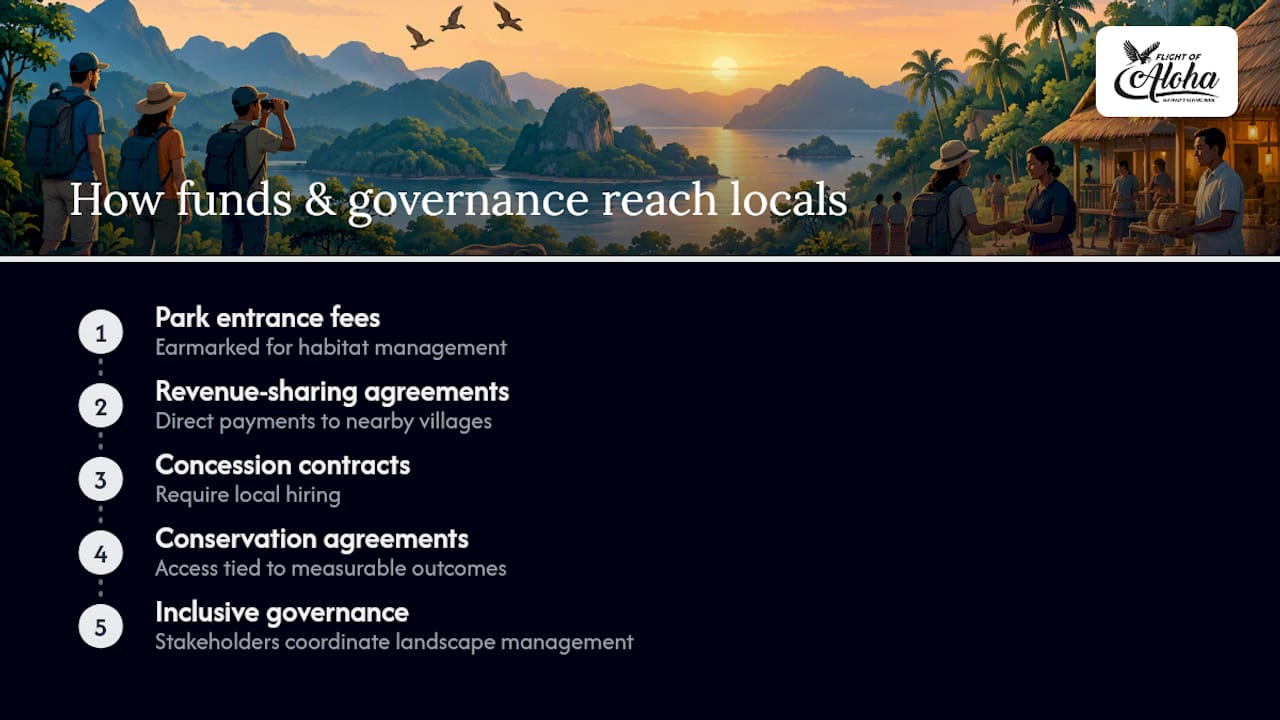
Ecotourism only means something when the money and decision-making actually reach the places and people it claims to protect. That happens through a few practical channels: park entrance fees earmarked for habitat management, revenue-sharing agreements with nearby villages, concession contracts that require local hiring, and conservation agreements that tie tourism access to measurable environmental outcomes.
A USGS study of national park visitors found that wildlife viewing delivers substantial value to visitors, and that most support conservation funded through their own visits. The same research noted something operators should take seriously: a decline in the species people come to see would likely hurt visitation more than raising visitor fees would. In plain terms, protecting the resource protects the business model.
Governance matters just as much as funding. The Conservation International case in the Galápagos shows what inclusive, landscape-scale management looks like in practice: local government, fishers, farmers, businesses, and donors coordinating together instead of competing over the same reef or trail. That collaborative model, balancing fisheries, food supply, and tourism, is closer to what durable ecotourism requires than any single certification badge. When decision-making includes the people who live with the consequences, conservation stops being an outside imposition and becomes a shared project.
Putting ecotourism principles into practice
Knowing the principles is one thing. Applying them on your next trip, or in how you run tours, is where it counts.
For travelers:
- Research the operator before booking: look for stated local partnerships and conservation funding, not just scenic photos.
- Choose smaller group tours over mass-market buses; smaller groups mean less strain on trails and wildlife.
- Keep a respectful distance from wildlife and follow posted guidelines without exception.
- Support local restaurants, guides, and shops instead of routing every dollar back to a foreign-owned chain.
- Ask what percentage of your fee supports conservation or community programs, and expect a real answer.
For operators: design facilities that blend into the landscape rather than dominate it, hire and train locally, publish where the money goes, run genuine interpretation programs, and monitor ecological and social indicators over time so management can adapt before damage becomes permanent, a practice the IFAS extension flags as central to protecting sensitive sites.
Pro Tip: Ask any tour supplier for one specific example of a local partnership or conservation project they fund. A vague answer is your fastest red flag.
Spotting greenwashing before it spots you
Nature tourism and ecotourism sound similar but aren’t the same thing. A zipline through a rainforest canopy is nature-based, sure, but it’s only ecotourism if a share of that ticket funds conservation and the operator teaches you something real about the forest below. Plenty of businesses borrow the word “eco” without doing any of the work behind it.
Watch for these warning signs:
- Vague claims like “eco-friendly” or “sustainable” with no specifics on what that means or who benefits.
- No visible connection to local hiring, local ownership, or community revenue-sharing.
- No interpretation, guiding, or educational component beyond a gift shop pamphlet.
- Visitor numbers that keep climbing with no mention of capacity limits or monitoring.
Verification is simpler than it sounds: look for GSTC-aligned training or criteria, check for named local partners, ask about financial transparency, and read independent reviews rather than the operator’s own marketing copy.
How Flight of Aloha reflects interpretation and low-impact design
Flight of Aloha is a Native Hawaiian-owned, immersive flying theater with locations in Kailua-Kona and Whalers Village Kaanapali on Maui. It uses 8K visuals, motion, scent, and wind to simulate flight over the islands while telling stories rooted in Hawaiian legends, an approach to cultural storytelling that lines up with the education and interpretation principle at the heart of ecotourism. Because the experience happens entirely indoors, it also sidesteps the physical footprint that comes with foot traffic on sensitive trails or reefs.
Interpretation delivered by local guides or cultural partners is one of the clearest ways an attraction turns a visit into stewardship rather than just sightseeing.
Ola
What responsible travel actually asks of us
Ecotourism isn’t a checklist you complete once and forget. It’s a constant negotiation between wanting to see beautiful places and making sure those places, and the people who call them home, are still thriving after you leave. The travelers who get this right partner with local and Indigenous stewards instead of treating them as scenery.
Every checklist item earlier in this guide, from asking about revenue-sharing to respecting wildlife distance, comes back to that one idea: access without protection is just extraction with better marketing.
— Ola
A smart alternative to the helicopter tour
If you want the aerial thrill of Hawaii without a $400 helicopter ticket or the motion sickness that comes with it, Flight of Aloha delivers the same sweeping perspective from a comfortable seat. It’s Native Hawaiian-owned, family-friendly, and ranks among the most accessible attractions in Kona and Maui.

It also serves as a suitable option for a rainy day or to escape the heat and vog, as the theater is fully air-conditioned. Cruise visitors love that the Kona location sits within walking distance of Kailua Pier and the tender dock, making it a perfect quick shore excursion between Naupaka, Lahaina, or the Double Feature Flying Ride. Book online to secure your seat.
Sources
- TIES: TIES announces ecotourism principles revision
- Principles of ecotourism (IFAS extension)
- Conservation International: Galápagos conservation approach
- USGS study on visitor support for conservation in national parks
- GSTC: Sustainable Tourism Training Program
FAQ
What are the principles of eco-tourism?
The core principles are minimizing environmental and social impact, funding conservation directly, benefiting local communities economically, providing education and interpretation, building low-impact facilities, and partnering with Indigenous Peoples, as outlined by TIES. Together they distinguish genuine ecotourism from ordinary nature-based travel.
What are the four pillars of ecotourism?
Definitions vary, but a common version groups the principles under conservation, community benefit, education, and low-impact experience. These pillars echo the same categories laid out in the IFAS extension guide and TIES framework covered earlier.
What are the seven principles of the environment?
This question usually points to broader environmental ethics rather than a formal ecotourism standard, and definitions differ by source. Within ecotourism specifically, the seven commonly cited principles are the ones detailed in the definition section above: minimizing impact, education, conservation financing, local benefit, memorable interpretation, low-impact facilities, and Indigenous partnership.
What are the main principles of tourism?
General tourism principles focus on visitor satisfaction, economic growth, and destination promotion, while ecotourism narrows that focus toward conservation and community well-being. The distinction matters because not every appealing trip qualifies as responsible travel.
How can I tell if a tour is real ecotourism or just marketing?
Look for named local partnerships, transparent statements on where your money goes, and a genuine interpretation or education component led by local guides. If an operator can’t answer specifics about conservation funding or community involvement, treat the “eco” label with skepticism.