
Presence and Flow in Immersive Entertainment: Flight of Aloha
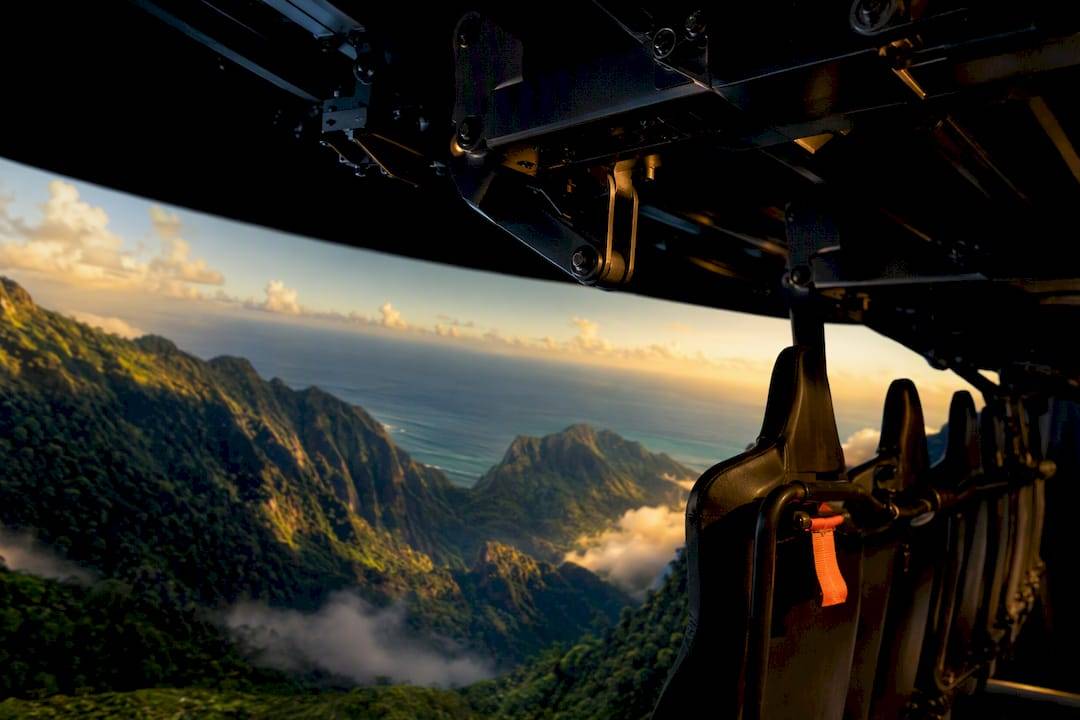
Immersive entertainment is any experience that surrounds you in visuals, sound, motion, and sometimes scent or wind so completely that you feel present inside the story rather than watching it from a seat. It blends technologies like virtual reality, projection mapping, and motion platforms with narrative design to create that sense of presence. You will find it in museums, immersive theater productions, and flying theaters across the world, including right here in Hawaii.
TL;DR:
- Immersive entertainment combines multisensory technologies like VR, projection mapping, and motion platforms to create a sense of presence rather than just viewing.
- Achieving immersion relies on precise tracking, synchronization, and safety systems, with a typical session lasting around 40 minutes in well-designed experiences.
- Accessibility features such as captioning, audio description, and wheelchair-friendly layouts are essential to ensure that immersion is inclusive.
- The effectiveness of immersion depends on narrative pacing, spatial audio, and subtle guidance cues that keep visitors engaged without breaking flow.
- Experiences like Flight of Aloha demonstrate the potential for hybrid immersive attractions that are accessible, location-based, and suitable for a broad audience.
What immersive entertainment means: definitions and taxonomy
Immersion is really two different things under one name. There is immersion as a feeling, the psychological state of deep involvement that researchers call presence, and there is immersion as a system property, meaning the technical setup (screens, sound, motion) built to produce that feeling. A literature synthesis on defining immersion frames presence as the real goal, shaped by narrative and spatial design as much as by hardware. Technology alone does not guarantee it.
Immersive entertainment generally falls into a few buckets:
- Fully digital: virtual reality (VR) headsets that replace your entire field of view.
- Augmented and mixed reality: AR and MR overlay digital elements onto the real world you can still see.
- Physical, location-based experiences: projection-mapped rooms, walk-through installations, and immersive theater sets.
- Hybrid formats: flying theaters and motion-simulator attractions that combine giant screens with physical movement, scent, and wind.
The contrast with a regular movie or stage play is the fourth wall. A comparison of VR theater and traditional staging notes that immersive theater removes that wall entirely, staging action around or among the audience rather than in front of it, and pairs the effect with multisensory layers like movement and scent.
How immersive entertainment works: core technologies and multisensory techniques
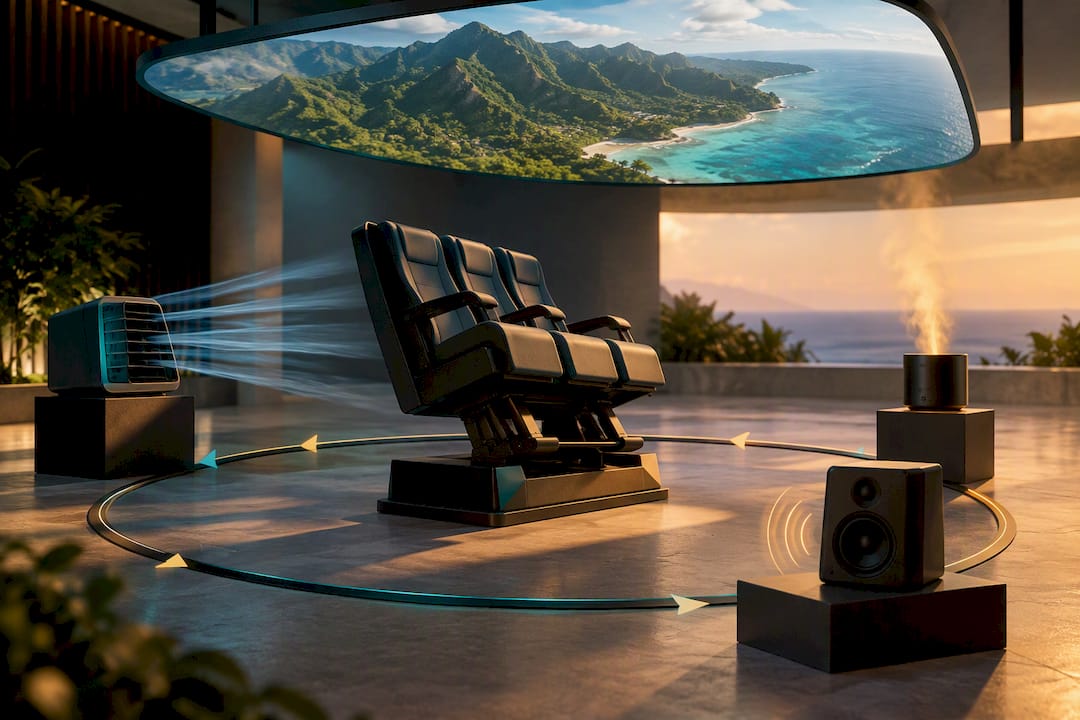
Under the surface, immersive entertainment runs on a stack of tools working together. Visual systems range from VR headsets to 8K or 4K projection mapping that wraps an entire room in imagery. Spatial audio places sound around you rather than in front of you, while motion platforms tilt, drop, and sway seats in sync with the footage. Haptics add touch feedback, and scent or wind systems complete the picture by triggering the senses that screens alone cannot reach.
- Tracking and synchronization: headsets and motion rigs need low-latency tracking so movement matches what your eyes see, or the illusion breaks.
- Safety systems: restraint checks, clearance sensors, and staff monitoring keep physical movement safe during motion sequences.
- User guidance: subtle audio or lighting cues shepherd visitors through content zones without breaking the story.
Statistic: The Smithsonian’s Starstruck experience runs about 40 minutes as a free-roam, group-based journey that translates real astronomical data into an interactive immersive show, a useful benchmark for how long a well-paced immersive session tends to run.
Getting all these systems to sync in real time is the real engineering challenge behind any immersive attraction, whether it is a museum installation or a flying theater seat that pitches and rolls with the footage overhead.
Common uses and concrete examples
Immersive entertainment now shows up everywhere from science museums to concert stages, and the format shifts depending on the goal.
- Museums and data-driven installations: the Smithsonian Starstruck exhibit turns astronomical datasets into a walkable, interactive cosmos, showing how institutions use immersion to teach as much as to entertain.
- Immersive theater and XR concerts: free-roam productions and social VR concerts let audiences move through a set or a virtual venue instead of sitting still, echoing the fourth-wall removal seen in VR theater research.
- Tourism and cultural attractions: flying theaters and VR attractions bring aerial adventure and cultural storytelling indoors, a category Flight of Aloha’s own writing on immersive attractions in Hawaii covers in more depth.
Each format uses a different mix of technology, but all three chase the same outcome: making you feel like a participant rather than a spectator.
Design principles that make experiences feel immersive
Presence and flow are the two ideas that separate a memorable immersive show from a gimmicky one. Presence is that felt sense of “being there,” and flow is the state of staying absorbed without noticing time pass. Neither happens by accident. A wide-area AR and immersive theater study found that subtle guidance, things like particle trails or ambient audio cues, keeps visitors moving through content zones without breaking that flow state.
- Presence: built through narrative pacing, spatial audio, and environment design working together, not technology alone.
- Accessibility: guidelines from Monash University recommend captioning, audio description, and wheelchair-optimized sight lines as standard practice.
- Guidance and safety: invisible cues like light and sound direct movement so visitors do not miss key scenes or wander into unsafe areas.
Pro Tip: When you are evaluating an immersive attraction, notice whether the guidance feels invisible. If you are hunting for signs telling you where to look, the flow has already broken.
Flight of Aloha: a real-world hybrid example
A certain flying theater attraction puts these principles to work in a single seat. Riders get 8K visuals, a motion platform, wind, and scent effects timed to films rooted in Hawaiian legend, including titles like Naupaka and Lahaina, so the storytelling and the sensory design move together rather than as separate layers. A closer breakdown of that layering lives in Flight of Aloha’s own explanation of its immersive theater.
- Comfort: fully indoor, air-conditioned seating makes it a strong option on rainy days in Kona or Maui, or when volcanic haze thickens the air outside.
- Accessibility: seated, motion-controlled design suits families, older visitors, and travelers who want an aerial view without the physical demands of a helicopter tour.
- Convenience: the Kailua-Kona location sits walking distance from Kailua Pier, making it an easy fit for a cruise shore excursion.
Why immersive entertainment matters right now
Presence is not just a neat trick. Research on immersion suggests that when multiple senses engage together with a participatory narrative, audiences report stronger emotional and empathic responses than they do watching a flat screen. For tourism and cultural storytelling, that matters enormously: a well-designed immersive show can teach a place’s history in ways a brochure never will. The design choice that deserves more attention is accessibility, because presence should not be a privilege reserved for the able-bodied or the tech-savvy.
— Ola
How to experience Flight of Aloha
Skip the $400 helicopter tour and the motion sickness that comes with it. This attraction gives you soaring, cliff-hugging views of Hawaii from a seat that never leaves the ground, positioned as an accessible activity in the Kona and Maui areas.

Tickets cover single-feature rides like Naupaka, Lahaina, and Europe, priced from $29.99 to $34.99 each, along with a Double Feature Flying Ride running $49.99 to $59.99 and a VIP Package from $69.99 to $79.99. Frequent visitors can grab an Annual Pass for $200 a year, and gift cards are available for travelers planning ahead. There are locations near Kailua-Kona and at Whalers Village in Kaanapali, Maui, both offering indoor, air-conditioned environments suitable for escaping rain, heat, or vog. Book online to secure your seat.
Sources
- Smithsonian Starstruck Makes Its World Premiere in Washington, D.C., Launching an Immersive Journey to the Cosmos | Smithsonian Institution
- How VR Theater Changes the Audience Experience – 62-830/93-430/830 Spring 2022
- Monash University VR guidelines (accessibility and design considerations)
- Defining immersion (literature synthesis)
- Dynamic Theater: Location-Based Immersive Dance Theater, Investigating User Guidance and Experience
FAQ
What does immersive entertainment mean?
Immersive entertainment describes experiences that surround you in visuals, sound, and often motion or scent so you feel present inside a story rather than watching it from a distance. It spans virtual reality, projection-mapped rooms, immersive theater, and flying theaters like Flight of Aloha.
What is the difference between immersive and regular movies?
A regular movie keeps you seated in front of a screen with a clear line between you and the story. Immersive entertainment removes that boundary, staging action around the audience and layering in physical sensations, a shift documented in research on VR theater.
What should I expect at an immersive show?
Expect multiple senses engaged at once: visuals wrapping your field of view, spatial sound, and often motion, scent, or wind timed to the footage. Sessions commonly run under an hour, similar to the 40-minute format seen in the Smithsonian’s Starstruck experience.
What is an example of an immersive experience?
Examples range from museum installations like the Smithsonian’s data-driven Starstruck exhibit to flying theaters that simulate aerial flight with motion, scent, and cultural storytelling. Flight of Aloha is one such hybrid example, blending 8K visuals with Hawaiian legend and physical motion.