
Group Booking Workflow: A 2026 Guide for Planners 🌺

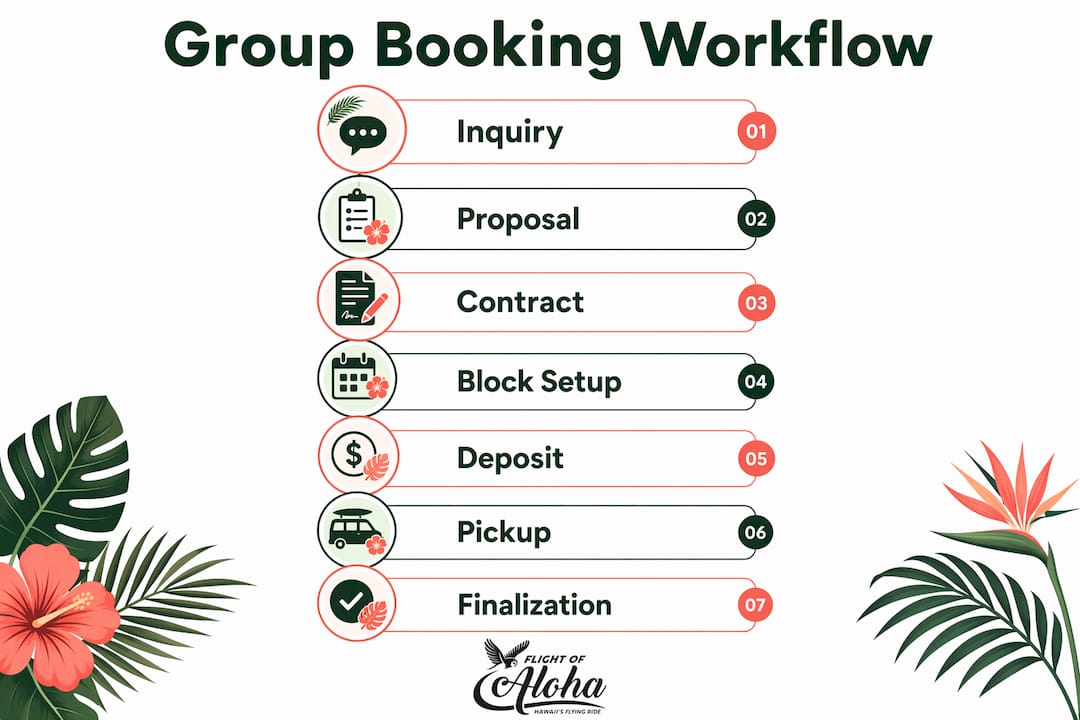
A group booking workflow is the structured series of steps that event planners and group coordinators follow to manage multiple reservations together, from the first inquiry through final reconciliation. Industry standards define a group as 10 or more people, and the process spans seven distinct stages: Lead/Inquiry, Proposal/Quote, Contract/Deposit, Block Setup, Pickup/Rooming List, Arrival, and Reconciliation. Tools like SendSquared, EveryBooking, and Tixello have transformed what was once a manual, error-prone process into a trackable, automated pipeline. Whether you’re coordinating a corporate retreat, a school tour, or a shore excursion in Kona, mastering this workflow saves time, cuts costs, and protects you from costly contract penalties.
What is a group booking workflow and why does it matter?
A well-defined pipeline is the operating system for group sales. Without it, inquiries fall through the cracks, deposits get missed, and coordinators scramble at the last minute. The group reservation process is not just about holding seats or rooms. It is about managing communication, money, and logistics across dozens or hundreds of people simultaneously.
The seven-stage framework used by leading platforms like SendSquared gives every team a shared language. Each stage has a clear entry point, a defined set of tasks, and an exit condition that moves the booking forward. That structure is what separates a smooth group experience from a chaotic one.

Bulk booking management also delivers real financial benefits. Negotiated rates, complimentary upgrades, and waived fees are all standard perks for groups that commit early and meet their minimums. The workflow is the mechanism that makes those commitments trackable and enforceable.
What are the core stages of a group booking workflow?
The group booking lifecycle includes seven standard stages. Each one builds on the last, and skipping any stage creates downstream problems.
- Lead/Inquiry — A potential group contacts the venue or operator. The goal here is speed. Automated pipelines improve response times from days to hours, which directly reduces lost bookings.
- Proposal/Quote — The coordinator sends a detailed offer: pricing, availability, inclusions, and terms. This document sets expectations for everything that follows.
- Contract/Deposit — Both parties sign a formal agreement. The deposit secures the block and activates the attrition clause, which penalizes the group if actual usage falls below the contracted minimum.
- Block Setup — The venue or operator reserves the inventory: rooms, seats, or activity slots. This stage also includes setting the release date, typically 7–14 days before arrival.
- Pickup/Rooming List — Individual participants confirm their details. This is where the “coordination tax” hits hardest. Collecting dietary needs, waivers, and payment from each person takes significant time without automation.
- Arrival — The group checks in or shows up. Batch check-ins and group QR codes, as used by platforms like Tixello, reduce wait times and confusion on the day.
- Reconciliation — Final counts are compared against contracted minimums. Adjustments, refunds, or penalty charges are processed here.
Pro Tip: Define clear entry and exit criteria for each stage before your first inquiry arrives. Knowing exactly what “done” looks like at each step prevents your pipeline from stalling mid-process.
How do automation and digital tools optimize group bookings?
Automation is the single biggest upgrade available to group coordinators in 2026. The right tools eliminate repetitive manual tasks and replace them with triggered actions that run without your involvement.
Here is what modern group travel coordination platforms handle automatically:
- Deadline reminders — Automated workflows trigger reminders at 7 days, 3 days, and 24 hours before key deadlines. This keeps participants on track without requiring a coordinator to chase each person individually.
- Digital rooming lists and self-service pages — Participants fill in their own details through a personalized URL. The coordinator sees a live dashboard instead of a cluttered email inbox.
- Waiver and data collection — Platforms like EveryBooking automate sending waivers, collecting dietary information, and splitting deposits across group members. This directly reduces the coordination tax that delays finalization.
- Batch check-in — Group QR codes and leader dashboards from tools like Tixello simplify on-site arrival and cut check-in times for large groups significantly.
- Payment tracking — Split deposit features let each attendee pay their share directly, removing the burden from the group leader and reducing the risk of last-minute shortfalls.
The shift from spreadsheets and email chains to a dedicated team booking system is not incremental. It is transformational. Coordinators who have made the switch report handling twice the volume with the same staff.
Pro Tip: Set up your self-service booking page before you send the first confirmation email. Giving participants a link to complete their own details from day one cuts your follow-up workload by more than half.
What are the key contractual challenges in group bookings?
Group contracts contain terms that catch even experienced planners off guard. Two clauses cause the most problems: the attrition clause and the release date.
| Contract Term | What It Means | Risk If Ignored |
|---|---|---|
| Attrition Clause | Penalizes the group financially if actual usage falls below the contracted minimum | Unexpected charges after the event |
| Release Date | The deadline to return unused inventory, typically 7–14 days before arrival | Lost inventory, penalties, and no-show fees |
| Deposit Schedule | Staged payments tied to headcount milestones | Cash flow problems and contract disputes |
| Cancellation Notice | Groups often need 30–60 days notice to receive a deposit refund | Forfeited deposits on late cancellations |
The attrition clause is the most misunderstood term in group contracts. Many coordinators sign agreements without calculating the financial exposure if attendance drops. A group that contracts 50 hotel rooms but only fills 35 can face charges for the 15 unused rooms at a percentage of the room rate.
The release date problem is equally serious. Missing this deadline causes lost inventory and penalties. Automation that enforces these deadlines is not optional. It is critical protection for your budget and your client relationship.
Financial transparency is the other major challenge. Shared tracking platforms prevent disputes and protect lead coordinators from being left covering balances that other participants failed to pay. Always use a system where every stakeholder can see the current payment status in real time.
Pro Tip: Track your pickup pace weekly starting 30 days before the release date. If you are below 70% of your contracted block with two weeks to go, release the excess inventory early rather than waiting and risking the penalty.
How to manage group bookings across different activity types
Event booking procedures vary significantly depending on whether you are coordinating a hotel block, a tour, or an entertainment venue. The core workflow stages stay the same, but the emphasis shifts.
Here is how to adapt your approach by group type and size:
- Hotels and resorts — Focus on the rooming list and attrition clause. Use a team booking system that syncs with the property management system to avoid double-counting. For groups of 50 or more, assign a dedicated on-site contact who owns the reconciliation stage.
- Tours and outdoor activities — Waivers and health disclosures are the priority. Automate collection through EveryBooking or a similar platform so every participant has completed their forms before arrival day. For the group visit workflow, this step is non-negotiable.
- Entertainment venues and immersive experiences — Seat blocking and batch check-in matter most. Tixello’s group QR codes work especially well here. For smaller groups of 10–20, a single personalized URL for the group leader is usually sufficient.
- Corporate events and conferences — Multi-step deposit schedules and individual invoicing are common. Use a platform that supports split billing so the finance team can track each participant’s payment separately.
- School and youth groups — Dietary needs, accessibility requirements, and guardian consent forms add layers to the standard workflow. Build these collection steps into your self-service page from the start.
For groups of 50 or more, delegate aggressively. Assign sub-leaders for each subgroup of 10–15 people and give each one a leader dashboard. This distributes the coordination load and keeps the primary planner focused on the big picture. You can find a detailed breakdown of this approach in the family group booking process guide from Flightofaloha.
Regardless of activity type, collect money early. Groups that delay payment collection until close to the event date consistently face higher dropout rates and last-minute headcount changes. Build your deposit schedule into the contract and automate the reminders.
Key takeaways
A well-structured group booking workflow, supported by automation and clear contract terms, is the difference between a profitable group event and a costly, chaotic one.
| Point | Details |
|---|---|
| Seven-stage framework | Every group booking moves through Inquiry, Proposal, Contract, Block Setup, Pickup, Arrival, and Reconciliation. |
| Automate the coordination tax | Use tools like EveryBooking or Tixello to collect waivers, deposits, and details without manual follow-up. |
| Know your contract terms | The attrition clause and release date are the two biggest financial risks in any group contract. |
| Track pickup pace weekly | Monitor headcount progress 30 days out and release unused inventory before the deadline to avoid penalties. |
| Delegate for large groups | Assign sub-leaders with dashboards for groups of 50 or more to distribute coordination across the team. |
Why most planners underestimate the workflow until it’s too late
I have seen coordinators with years of experience get blindsided by attrition clauses they signed without fully reading. The clause is buried in the contract, written in neutral language, and it does not feel threatening until the headcount drops and the invoice arrives. My honest advice: model your worst-case attendance scenario before you sign anything. If 20% of your group cancels, can you still meet the minimum? If not, negotiate the threshold down before you commit.
The other thing I have learned is that the coordination tax is real and it compounds. Chasing 40 people for dietary preferences, waivers, and payment confirmations via email is not just annoying. It delays your entire timeline and pushes finalization closer to the release date than it should ever get. Platforms that automate this collection are not a luxury. They are the only way to run a high-volume group operation without burning out your team.
The future of group travel coordination is mobile-first and self-service. Participants expect a link they can open on their phone, fill out in two minutes, and be done. Any workflow that still relies on PDF forms and reply-all email threads is already behind. The planners who build their systems around self-service pages and live dashboards today will be the ones handling the most complex, highest-value groups in 2026 and beyond.
— Ola
Experience kona’s most thrilling group activity
Planning a group activity in Kona? Flightofaloha is the top choice for group coordinators looking for a truly unforgettable experience. Located inside King Kamehameha’s Kona Beach Hotel and walking distance from Kailua Pier, it is perfect for cruise shore excursions and family groups alike. This Native Hawaiian-owned immersive flying theater blends 8K visuals, motion effects, scents, and wind to soar over Hawai’i’s most breathtaking landscapes. Think of it as the smart alternative to a helicopter tour, with none of the motion sickness and all of the wonder. It is also the best air-conditioned indoor activity on the Big Island, ideal for rainy days or escaping the vog.
Group coordinators love Flightofaloha for its group booking experience that is easy to coordinate, culturally rich, and genuinely memorable for every participant. Book online to secure your seat.
FAQ
What is a group booking workflow?
A group booking workflow is the structured process coordinators use to manage multiple reservations together, covering stages from initial inquiry through final reconciliation. It typically applies to groups of 10 or more people.
How many stages does a group booking process have?
The standard group booking lifecycle includes seven stages: Lead/Inquiry, Proposal/Quote, Contract/Deposit, Block Setup, Pickup/Rooming List, Arrival, and Reconciliation.
What is an attrition clause in a group booking contract?
An attrition clause penalizes the group financially if actual usage of reserved rooms or seats falls below the contracted minimum. Always model your worst-case headcount before signing.
What tools help automate group booking coordination?
Platforms like SendSquared, EveryBooking, and Tixello automate reminders, rooming lists, waiver collection, split deposits, and batch check-ins. These tools reduce manual follow-up and cut coordination time significantly.
How far in advance should groups book and cancel?
Most venues require cancellation notices 30–60 days in advance to secure a deposit refund. Release dates for unused inventory typically fall 7–14 days before arrival.