
How to Find Cheap International Flights in 2026

The fastest way to cut an international airfare is a short, structured search plan: run flexible-date searches across Google Flights, Skyscanner, and Momondo, include nearby metro airports, and set price alerts before you book anything else. That three-step foundation alone routinely surfaces fares that a single-site search misses entirely.
Start here before you do anything else:
- Run a flexible-dates search on Google Flights using the Explore or fare-calendar view to spot the cheapest travel window at a glance.
- Cross-check on Skyscanner and Momondo for the same dates — each aggregator pulls from different inventory pools, so prices genuinely differ.
- Add every nearby airport in your metro area to the origin field; a 90-minute drive can save hundreds of dollars on a transatlantic ticket.
- Set price alerts immediately on at least two platforms so you buy on a dip, not a spike.
- Consider multi-city and split-ticket options if your route has a natural hub connection.
Pro Tip: Follow the Flight First Rule — search and lock your flights before booking hotels or requesting time off. Airfare is the most volatile travel expense, and your flight dates should drive everything else.
Key Takeaways
The single highest-impact move for finding cheap international flights is running flexible-date searches across Google Flights, Skyscanner, and Momondo simultaneously, then setting price alerts before booking anything else.
| Point | Details |
|---|---|
| Use three aggregators, not one | Google Flights, Skyscanner, and Momondo each surface different fares; cross-checking all three takes under 10 minutes. |
| Follow the Flight First Rule | Search and lock flights before booking hotels or requesting time off — airfare drives trip timing and cost. |
| Book within the regional window | International fares average their lowest around 49 days before departure; peak-season routes often require booking 4–6 months ahead. |
| Factor in all ancillary costs | Add bag fees, seat fees, and airport transfer costs before comparing fares — the cheapest ticket is rarely the cheapest trip. |
| Set alerts early for peak travel | For high-demand periods, start tracking prices up to 10 months ahead and buy on the first meaningful dip. |
What’s your step-by-step search workflow right now?
Run this in order every time you search for cheap international flights:
- Open Google Flights and search “Anywhere” if your destination is flexible, or enter your target city and toggle “Flexible dates” to see a full month of prices on a color-coded calendar.
- Open Skyscanner in a second tab and run the same search using its “Whole month” or “Cheapest month” view — Skyscanner’s flexible-date matrix often highlights a different cheapest window than Google.
- Open Momondo for the same itinerary. Momondo aggregates a wider range of smaller OTAs and occasionally surfaces fares the bigger two miss.
- Expand your airport search. If you’re near New York, search JFK, EWR, and LGA together. Near Los Angeles, try LAX, BUR, LGB, and ONT. KAYAK’s multi-airport search makes this easy on desktop.
- Compare multi-leg and mixed-carrier options. Try building the outbound and return as separate one-way searches to see if splitting carriers saves money.
- Set price alerts on two platforms (Google Flights and either Hopper or Kayak) and check them daily for 5–7 days before deciding.
- Apply the regional booking window (see the table in the next section) to decide whether to buy now or wait.
- On desktop, Google Flights’ fare calendar and multi-airport fields are easiest to navigate.
- On mobile, Hopper’s push notifications and Skyscanner’s app alerts are the most reliable for catching price drops on the go.
Pro Tip: Clear your browser cookies or use an incognito window when re-searching the same route repeatedly. Some booking platforms adjust displayed prices based on repeated searches.
Which flight sites and apps should you actually use?
Not every aggregator wins in every situation. Frommer’s tested 18 airfare sites across 32 itineraries and found that Momondo never returned a “bad” fare during testing, while Google Flights improved significantly in fare context and calendar tools. Here’s how the major platforms stack up on the dimensions that matter most.

| Tool | Best for | Southwest coverage | Flexible-dates UI | Price alerts & fare history | Multi-airport search | Result accuracy | Mobile vs web |
|---|---|---|---|---|---|---|---|
| Google Flights | Advance research, Explore | No direct booking | Excellent fare calendar | Yes, fare-history graphs | Yes | High (direct airline data) | Web stronger |
| Skyscanner | Flexible dates, “Everywhere” | Limited | Excellent matrix view | Yes | Yes | Good | App excellent |
| Momondo | Last-minute, exhaustive filters | Partial | Good | Yes | Yes | Very good | Web stronger |
| Kayak | Multi-airport, price trends | Partial | Good | Yes, Explore feature | Yes | Good | App solid |
| Skiplagged | Short-haul bargains, hidden-city | No | Limited | Limited | No | Niche | Web only |
| Expedia | Package deals, OTA booking | No | Basic | Basic | Limited | Moderate | App decent |
| Priceline | Last-minute hotel+flight bundles | No | Basic | Limited | No | Moderate | App decent |
| Hotwire | Opaque last-minute deals | No | None | None | No | Variable | App decent |
| Hopper | Price prediction, mobile alerts | No | Good | Excellent push alerts | No | Good | App-first |
| CheapAir | Booking-window guidance | No | Good | Yes, fare history | Limited | Good | Web stronger |
A few things worth knowing beyond the table. Skiplagged surfaces hidden-city ticketing opportunities (where you book a flight with a layover at your real destination and skip the final leg), but airlines prohibit this in their terms of service and it carries real risk: no checked bags, no rebooking protection, and potential account bans. Use it for research, not as a regular booking strategy. Hotwire works best when you genuinely don’t care which hotel or airline you get — the opacity is the price of the discount. Southwest still doesn’t appear on most aggregators, so always check Southwest.com directly if you’re flying a U.S. domestic leg as part of an international connection.
Pro Tip: Combine a fare-history aggregator (Google Flights or CheapAir) with a platform that surfaces smaller OTAs (Momondo). The first tells you whether today’s price is good; the second finds the cheapest booking path.
When should you book cheap international travel?
Booking too early and booking too late both cost money. The sweet spot varies by region, but Google Flights data cited by National Geographic puts the average lowest-fare window for international travel approximately seven weeks before departure. That’s a useful anchor, but it shifts significantly by destination and season.
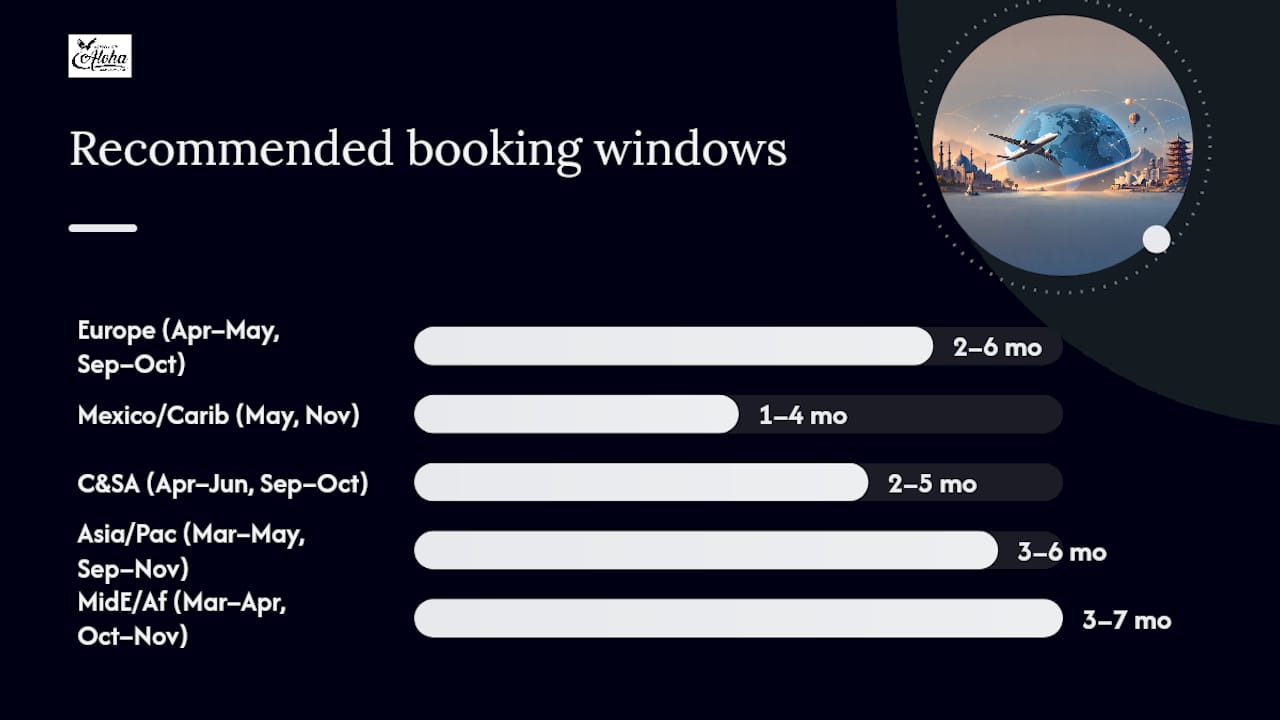
| Region | Recommended booking window | Shoulder season |
|---|---|---|
| Europe | 2–6 months ahead | April–May, September–October |
| Mexico / Caribbean | 1–4 months ahead | May, late November |
| Central / South America | 2–5 months ahead | April–June, September–October |
| Asia / Pacific | 3–6 months ahead | March–May, September–November |
| Middle East / Africa | 3–7 months ahead | March–April, October–November |
The Points Guy’s regional analysis reinforces starting price checks months ahead, with the caveat that peak-period travel (summer Europe, Christmas Caribbean) often requires booking 4–6 months out to avoid premium pricing.
Shoulder-season travel is one of the most reliable ways to cut costs. Flying into Rome in late September instead of July typically means lower fares, smaller crowds, and better weather for sightseeing. The demand drop after school starts in late August is real and consistent.
- Exceptions: Oktoberfest (Munich, late September), Carnival (Rio, February–March), Cherry Blossom season (Japan, late March–April), and major sporting events push prices up even in technically “shoulder” months.
- Peak-season strategy: For summer Europe or holiday Caribbean travel, National Geographic recommends tracking prices up to 10 months ahead and setting long-lead alerts rather than waiting for the 49-day window.
Search tricks that cut the ticket price
The biggest savings usually come from how you structure the search, not which site you use.
- Flexible dates ±3 days on both legs. A Tuesday departure instead of Friday can save $150–$300 on a transatlantic ticket. Use Google Flights’ grid view to scan a full week at once.
- Full metro-area airport searches. Flying out of Newark instead of JFK, or into London Gatwick instead of Heathrow, regularly saves money. Factor in ground transport costs before committing.
- One-way + separate return. Sometimes booking two one-way tickets on different carriers beats a round-trip on a single airline. Run both searches and compare.
- Multi-city / open-jaw itineraries. Flying into Paris and out of Amsterdam (or into Tokyo and out of Osaka) avoids backtracking and often costs less than a standard round-trip. Google Flights’ multi-city builder handles this cleanly.
- Long layovers as a feature, not a bug. A 10–20 hour layover in a hub city (Doha, Istanbul, Singapore) can cut the total fare by $100–$200 and gives you a free mini-stopover. Some airlines, including Qatar Airways and Turkish Airlines, offer free hotel stays for qualifying long layovers.
- Split-ticketing / hacker fares. Booking outbound on one carrier and return on another can lower the total price. The tradeoff: if your outbound is delayed and you miss the separately ticketed return, the second carrier owes you nothing. Always build in a buffer day or buy travel insurance when combining separate tickets.
Pro Tip: When testing alternate routings, copy each leg into a separate browser tab and search it as a standalone one-way. You’ll often find that a two-stop itinerary built from two one-ways beats the cheapest round-trip by a meaningful margin.
How do you set price alerts and know when to buy?
Price alerts do the watching so you don’t have to refresh tabs obsessively. Here’s how to set them up effectively:
- Google Flights: Search your route, scroll to the price graph, and click “Track prices.” You’ll get email alerts when the fare moves significantly. The fare-history graph shows whether today’s price is above or below the recent median.
- Kayak: Set a “Flexible price alert” that notifies you across a date range rather than a fixed departure day — useful for long-haul trips where you have schedule flexibility.
- Momondo: Price alerts work similarly to Google’s; Momondo’s strength is that it sometimes catches OTA-specific drops that Google misses.
- Hopper: The app’s “Watch” feature uses its price-prediction algorithm to tell you whether to buy now or wait. It’s the most mobile-friendly alert system of the group.
- CheapAir: Offers fare-history data and booking-window guidance alongside alerts — good for travelers who want context alongside the notification.
The practical trigger rule: buy when the fare drops below the recent median shown in the fare-history graph AND you’re within your regional booking window. For peak-period travel, National Geographic’s guidance is to set alerts up to 10 months ahead and buy on the first significant dip rather than waiting for a theoretical floor. Waiting for the absolute lowest price often means watching a good fare disappear.
Key stat: Google Flights data cited by National Geographic indicates international fares tend to be lowest around 49 days before departure on average — but peak-season routes often hit their floor much earlier.
How can miles, points, and budget carriers lower your net cost?
Cash price isn’t the only number that matters. A few practical levers:
- Miles vs. cash sweet spots. Long-haul business class is where award redemptions typically deliver the most value — a $4,000 lie-flat seat for 60,000–80,000 miles is a strong redemption. Economy awards on competitive routes (transatlantic, transpacific) rarely beat cash fares during sales.
- Travel credit card perks. Cards like the Chase Sapphire Preferred, Capital One Venture X, and Amex Platinum offer annual travel credits, companion fares, and transfer partners (United, Air France/KLM, Singapore Airlines) that can materially reduce out-of-pocket cost. The annual fee math only works if you actually use the credits.
- Budget long-haul carriers. Norwegian, Level, and similar carriers have had mixed reliability records. Check their baggage policies and change fees before booking — a $199 base fare with $60 each way in bag fees and no free changes can easily exceed a legacy carrier sale fare.
- Positioning flights into major hubs. Flying from a regional airport to a major hub (say, Tulsa to Dallas, then Dallas to Tokyo) on a separate cheap domestic ticket can unlock significantly lower long-haul fares. KAYAK highlights this tactic as one of the most underused ways to access hub pricing.
Fees that quietly erase a cheap fare:
- Checked bag fees ($30–$60 each way on many U.S. carriers)
- Seat selection fees ($15–$50 per seat on budget carriers)
- Change and cancellation fees (up to $200 on some international tickets)
- Credit card foreign transaction fees (1–3% on purchases abroad)
Where do flash sales and mistake fares appear?
Error fares and flash sales are real, but they require fast action and clear-eyed risk assessment.
- Where to find them: Scott’s Cheap Flights (now Going), Secret Flying, and Airfarewatchdog publish mistake fares and flash sales. Twitter/X accounts dedicated to error fares often post within minutes of a fare appearing.
- How to evaluate the risk. A genuine mistake fare typically lasts 2–6 hours before the airline corrects it. Check the airline’s refund policy before buying. Under U.S. Department of Transportation rules, airlines must either honor a purchased ticket or offer a full refund if they cancel it — but enforcement has nuances, so read the airline’s own policy.
- The 24-hour rule. U.S. DOT regulations require airlines to offer either a 24-hour hold or a full refund within 24 hours of booking for tickets purchased at least 7 days before departure. Use this window to verify visa requirements and confirm the routing makes sense before the purchase is final.
- Separate-ticket risk. If a mistake fare is one leg of a multi-ticket itinerary and the airline cancels it, your separately booked connecting flights are not protected. Book with a credit card that offers travel protection.
Pro Tip: When you spot a potential error fare, book it first on a credit card, then verify. The 24-hour rule gives you a safety net to cancel without penalty if the routing doesn’t work.
Why the cheapest ticket might not be the cheapest trip
A $400 fare that requires two checked bags, a $30 seat fee, and a 3-hour bus ride from a secondary airport can easily cost more than a $520 fare on a direct flight from your home airport. Always calculate the all-in number.
Add these to your base fare before comparing:
- Checked bag fees (check the airline’s specific policy — budget carriers vary widely)
- Carry-on fees (some ultra-low-cost carriers charge for overhead bin bags)
- Seat selection fees
- Change and cancellation fees (especially relevant if your plans might shift)
- Transit visa costs (a layover in certain countries requires a transit visa — see the visa section below)
- Ground transport between alternate airports and your actual destination
- Potential overnight hotel costs for very long layovers or missed connections on separate tickets
A simple comparison: take the base fare, add expected bag fees, add the cost difference in ground transport, and compare that total across your top two or three options. Budget carriers like Spirit, Frontier, and Ryanair (for European legs) often look cheapest until you add a carry-on and a seat assignment.
What our hands-on tests show about top aggregators in 2026
Testing across major and secondary U.S. gateways (JFK, LAX, ORD, and secondary markets) on both advance (60–90 days out) and last-minute (7–14 days out) itineraries reveals consistent patterns. Evaluation criteria: frequency of finding the lowest available fare, UI clarity for flexible-date searches, and last-minute performance.
| Tool | Strongest scenario | Notable finding |
|---|---|---|
| Google Flights | Advance research, fare context | Fare-history graphs make it the best tool for deciding whether to buy now |
| Momondo | Last-minute and exhaustive OTA coverage | Consistently surfaced fares from smaller OTAs missed by Google |
| Skyscanner | Flexible-date and open-destination searches | “Everywhere” search is unmatched for flexible travelers |
| Hopper | Mobile price prediction | Best push-alert system; useful for travelers who don’t want to actively monitor |
| CheapAir | Booking-window guidance | Fare-history context alongside alerts is genuinely useful for timing decisions |
Frommer’s 18-site, 32-itinerary test aligns with these findings: no single aggregator wins every search, which is exactly why running two complementary tools raises your odds of catching the best price.
How do visa and transit rules affect cheaper routes?
A cheaper routing through an unfamiliar hub can turn expensive fast if it triggers a visa requirement you didn’t plan for.
U.S. passport holders can transit many major hubs (Dubai, Doha, Istanbul, Singapore) without a transit visa, but some countries require one even for airside connections. China, for example, requires a transit visa for most nationalities unless you qualify for a specific visa-free transit policy tied to certain airports and stay durations. India requires a transit visa for connections involving a change of airport.
Before booking any itinerary with a layover in a country you haven’t researched, check the official embassy or consulate website for that country, or use the IATA Travel Centre (accessible through most airline booking systems) to verify requirements for your specific passport and routing. A $150 transit visa erases the savings on a cheap connecting fare quickly.
A few practical rules:
- Airside vs. landside transit. If your layover keeps you within the secure international terminal (airside), visa requirements are often waived. If you need to clear customs and re-enter security (landside), you typically need a visa.
- Minimum connection times. Some cheap routings have 55-minute connections at large international airports. That’s technically legal but genuinely risky. Budget at least 90 minutes for international-to-international connections and 2 hours at large hubs like Frankfurt or Tokyo Narita.
- Passport validity. Many countries require your passport to be valid for at least 6 months beyond your travel dates. A cheap fare is worthless if you’re denied boarding.
Ola’s take: spend less getting there, spend more once you arrive
Saving $300–$500 on an international fare is genuinely satisfying, especially when you consider why shared boat tours are budget friendly and can help you stretch your travel budget further on local excursions. What you do with that savings on the ground matters just as much. After years of watching travelers blow their airfare savings on overpriced helicopter tours or tourist-trap excursions. The better move is clear: put that money toward experiences that are both memorable and accessible.
If your trip includes Hawaii, specifically Kona on the Big Island or Maui, Flight of Aloha belongs at the top of your activity list. It’s a Native Hawaiian-owned immersive flying theater that blends 8K visuals, motion effects, scents, and wind to simulate soaring over the islands. Think of it as what you’d get if a helicopter tour and a Disney attraction had a baby rooted in aloha. The experience costs a fraction of a helicopter tour (which typically runs $400 or more) and delivers aerial views of Hawaii’s most stunning landscapes without the motion sickness or weather cancellations.

Both locations are easy to reach: the Kailua-Kona theater is walking distance from Kailua Pier and the Tender Dock, making it perfect for cruise passengers with a few hours ashore. The Whalers Village Kaanapali location on Maui puts it right in the heart of the resort strip. On a rainy day in Kona or Maui, or when the vog rolls in, Flight of Aloha is the best air-conditioned activity on the island. It’s also the most accessible attraction in Hawaii, genuinely suitable for all ages and mobility levels.
For a shore excursion, the experience fits neatly into a 90-minute window. Pair it with a quick walk to a budget-friendly aerial view of the coastline and you’ve built a full morning without spending helicopter money.
Book online to secure your seat.
Sources
- Find Cheap Flights Worldwide & Book Your Ticket – Google Flights
- How to find and book cheap flights wherever you’re going – KAYAK
- The 10 Best (and Cheapest) Airfare Search Sites for 2026 | Frommer’s
- Flying in 2026? Here’s how to find the cheapest flights | National Geographic
- When to book international flights — The Points Guy
- 9 Tips for Finding Cheap International Flights in 2026 – Slow Travel News