
Cultural Tourism Defined: What Every Traveler Should Know

Cultural tourism is travel where your essential motivation is to learn, discover, experience, and consume the tangible and intangible cultural attractions of a destination — a definition formalized by the UN Tourism General Assembly. That single sentence carries enormous weight. It means the Smithsonian visit, the hula performance, the cooking class in a local kitchen, and the walking tour through a historic district all qualify. The Americans for the Arts AEP6 study confirms that arts and culture events are a primary driver of travel decisions for nonlocal attendees — making cultural programming one of the most powerful tools a destination has. At the local level, experiences like Flight of Aloha in Kailua-Kona and Whalers Village Kaanapali show exactly what that looks like in practice: a Native Hawaiian–owned immersive attraction that uses 8K visuals, motion, scent, and wind to tell the stories of the islands.
Key Takeaways
Cultural tourism is defined by the UN as travel motivated by learning, discovering, experiencing, and consuming a destination’s tangible and intangible cultural attractions — and destinations that invest in authentic, community-owned cultural programming consistently see stronger economic returns and more satisfied visitors.
| Point | Details |
|---|---|
| Official definition | UN Tourism defines cultural tourism as travel where the essential motivation is to learn, discover, experience, and consume cultural attractions. |
| Eight recognized types | Heritage, arts, creative, indigenous, culinary, festival, urban district, and rural culture tourism often overlap within a single trip. |
| Economic impact | Nonlocal arts attendees spend more per event than locals, with lodging and dining bundled around the cultural experience as the primary trip driver. |
| Responsible participation | Book community-run experiences, visit off-peak, buy local, and ask before photographing sacred or personal subjects. |
| Hawaiian example | Flight of Aloha in Kailua-Kona and Whalers Village Kaanapali is a Native Hawaiian–owned immersive experience that models authentic cultural storytelling. |
What does the cultural tourism definition actually include?
The UN Tourism glossary spells out the full scope: arts, architecture, historical and cultural heritage, culinary heritage, literature, music, creative industries, and living cultures all fall under the cultural tourism umbrella. That breadth is intentional. Policy definitions include both tangible attractions (a cathedral, a museum collection, a historic battlefield) and intangible ones (a storytelling tradition, a regional cuisine, a living ceremony) so that destinations protect and promote both equally.
What drives a cultural tourist? Four motivations appear consistently in UN language and tourism research:
- Learn — gaining knowledge about history, art, or traditions
- Discover — encountering something genuinely new or unfamiliar
- Experience — participating in or witnessing living culture firsthand
- Consume — purchasing cultural products, food, performances, or crafts
Practical examples travelers recognize immediately include museum visits, heritage walking tours, food and wine trails, performing arts performances, craft workshops, and cultural festivals. The Florida Department of State’s cultural tourism toolkit adds study tours and performing arts events as visitor-facing categories that translate policy into trip planning. What unites all of them is that the culture itself — not the beach, not the weather — is the primary draw.
What are the main types of cultural tourism?
Cultural tourism is not one thing. It covers a wide family of travel styles, and most trips blend two or three of them:
- Heritage tourism — visits to historic sites, monuments, battlefields, and archaeological sites where the past is the attraction (Colonial Williamsburg, Gettysburg, Mesa Verde)
- Arts and cultural events tourism — travel centered on museums, galleries, theater, opera, film festivals, and performing arts seasons
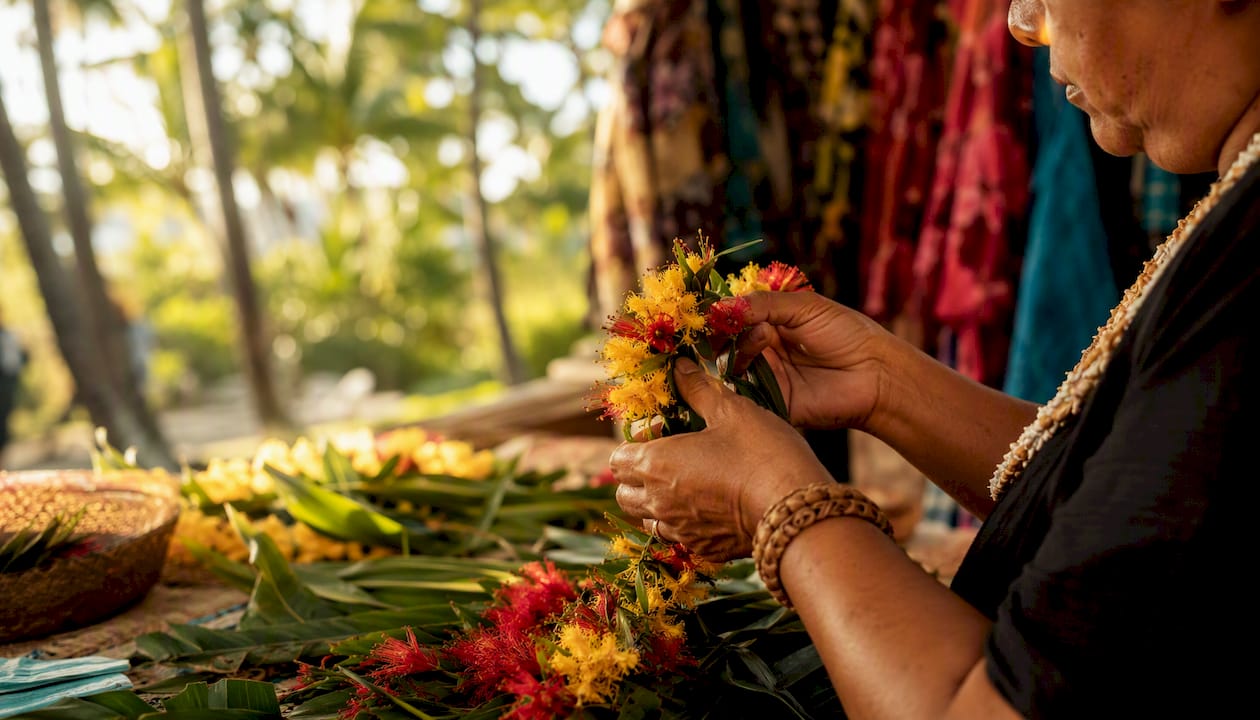
- Creative tourism — hands-on participation: pottery workshops, weaving classes, cooking schools, creative labs where tourists become learners and co-creators rather than passive observers
- Indigenous and community-led tourism — experiences designed and delivered by Indigenous or local communities, prioritizing cultural sovereignty and authentic storytelling
- Culinary tourism — food and drink as the cultural lens, from farm-to-table dinners to regional food trails and market tours
- Festival and popular culture tourism — travel timed to carnivals, music festivals, religious celebrations, or pop-culture events
- Urban cultural districts — neighborhoods where galleries, studios, restaurants, and performance venues cluster (New Orleans’ French Quarter, Chicago’s Pilsen)
- Rural and vernacular culture — agritourism, craft villages, and rural traditions that preserve everyday heritage away from major cities
Travelers rarely experience just one type. A trip to Hawaii might combine heritage (visiting ‘Iolani Palace), culinary tourism (a plate lunch trail), and an immersive creative experience — all in the same week.
Why does cultural tourism matter for destinations and travelers?
The economic case is straightforward: cultural tourists often stay longer and spend more per visit than average leisure travelers. The AEP6 national study found that nonlocal arts attendees spend significantly more per person per event than local attendees, because they layer in hotel nights, restaurant meals, and retail spending that locals do not. Arts and culture events are, for many of those visitors, the primary reason for the trip.
The Bureau of Economic Analysis Arts and Cultural Production Satellite Account (ACPSA) tracks arts and cultural production as a distinct economic sector, providing government-sourced data on growth patterns and industry contributions across the U.S. economy. That data gives destinations a concrete basis for investing in cultural programming as an economic development strategy, not just a quality-of-life amenity.
Beyond economics, cultural tourism delivers:
- Community identity and pride — local culture gains visibility and value when visitors seek it out
- Placemaking — cultural districts and heritage sites anchor neighborhoods and prevent generic development
- Educational value — travelers return home with genuine knowledge of other histories, languages, and traditions
- Tourism diversification — destinations with strong cultural offerings attract visitors year-round, not just during peak beach or ski seasons
- Job creation — museums, festivals, performing arts organizations, and cultural guides employ local residents directly
| Visitor type | Primary spending categories | Trip motivation |
|---|---|---|
| Nonlocal arts attendee | Lodging, dining, retail, transportation | Cultural event as primary trip driver |
| Local arts attendee | Tickets, food and beverage | Leisure and community participation |
| Heritage traveler | Lodging, guided tours, local retail | Historic sites and preservation experiences |
Source: AEP6 national study (Americans for the Arts); BEA ACPSA.
What are the positive and negative impacts of cultural tourism?
Cultural tourism creates real benefits — and real risks. Both deserve honest attention.
Positive impacts:
- Economic uplift for local businesses, artisans, and cultural organizations
- Increased funding for preservation of historic sites and living traditions
- Cross-cultural understanding between visitors and host communities
- Stronger community identity when local culture is celebrated rather than hidden
Negative impacts:
- Overcrowding at iconic sites (Machu Picchu, Angkor Wat, Venetian canals) that degrades both the visitor experience and the site itself
- Commodification of sacred or intimate traditions, reducing them to performances for tourist consumption
- Displacement of residents when cultural districts gentrify and rents rise
- Revenue leakage when large tour operators capture spending that should flow to local communities
Sustainability in cultural tourism means addressing all four negatives directly. The MDPI study on sustainable management models for cultural creative tourism ecosystems proposes stakeholder collaboration networks — combining cultural institutions, small businesses, community groups, and local government — as the governance structure most resilient to overtourism. Destinations that rely on those networks deliver stronger local economic multipliers and maintain authenticity over time.
Pro Tip: When choosing a cultural experience, look for one that is community-run, employs local guides, and reinvests revenue locally. A festival organized by the community it celebrates is almost always more authentic — and more economically beneficial — than one packaged by an outside operator.
How do you plan a responsible cultural tourism experience?
Good intentions are not enough. Responsible cultural travel takes a little planning, and the payoff is a richer trip.
- 6–8 weeks out: Research the host community. Read local sources, not just travel aggregators. Identify community-run organizations, Indigenous-owned businesses, and cultural institutions that reinvest locally.
- 4–6 weeks out: Book community-run experiences first. Workshops, guided tours led by local historians, and performances organized by cultural organizations fill up faster than generic tours.
- 2–4 weeks out: Plan around off-peak timing where possible. Visiting a heritage site on a Tuesday morning versus a Saturday afternoon changes the experience entirely — for you and for the community.
- 1–2 weeks out: Learn basic cultural norms. A few phrases in the local language, an understanding of dress codes at sacred sites, and awareness of photography etiquette go a long way.
- Arrival day: Buy local. Food from a family-run market, crafts from the artisan who made them, and tips to your guide keep spending in the community.
Immersive travel trends show growing demand for participatory formats — workshops, creative labs, hands-on cultural experiences — over passive sightseeing. Skift’s research on play-based travel confirms that travelers increasingly want to do something, not just observe.
For cruise travelers arriving at Kailua Pier or the Tender Dock in Kona, the logistics matter as much as the intention. Flight of Aloha is walking distance from the pier, making it one of the most accessible cultural experiences on a shore excursion. On a rainy day or during vog conditions, it is the best air-conditioned option in town — and it delivers genuine cultural storytelling, not a generic tourist attraction.

Pro Tip: Always ask before photographing people, ceremonies, or sacred objects. A simple “May I take a photo?” respects cultural boundaries and often opens a real conversation.
How is cultural tourism different from heritage tourism and related concepts?
These terms overlap constantly in practice, but the distinctions help you choose the right experience and understand what you are supporting:
- Cultural tourism vs. heritage tourism: Cultural tourism is people-centered — it includes living cultures, contemporary arts, cuisine, and creative industries. Heritage tourism, as described by the NPS Preserve America program, is place-centered — it focuses on historic sites, preservation, and the physical record of the past. A visit to a Civil War battlefield is heritage tourism. Attending a powwow hosted by a tribal nation is cultural tourism. Many trips combine both.
- Cultural tourism vs. creative tourism: Creative tourism adds active participation. You are not watching a weaver work; you are learning to weave. The pedagogical intent transforms the tourist into a learner and co-creator, which is why creative tourism often delivers the deepest cultural connections.
- Cultural tourism vs. experiential tourism: Experiential tourism is the broader category — any travel that prioritizes doing over sightseeing. Cultural tourism is a specific type of experiential travel where culture is the subject. All cultural tourism is experiential; not all experiential tourism is cultural.
- Cultural tourism vs. cultural exchange: Exchange implies reciprocity — both parties learn from each other. Tourism is primarily visitor-driven. The best cultural tourism experiences approach exchange, but the distinction matters: a community hosting tourists is not automatically in an equal relationship with them.
In practice, these categories blur. Practitioners often bundle them into “cultural heritage tourism” because visitors rarely separate the living culture from the places and artifacts that hold it.
A Hawaiian example of cultural tourism done right
Flight of Aloha, located in Kailua-Kona and Whalers Village Kaanapali, Maui, illustrates what responsible, community-rooted cultural tourism looks like in the United States.
What makes it a model worth examining:
- Native Hawaiian–owned — revenue stays in the community and cultural decisions remain with the people whose stories are being told
- Authentic storytelling — the attraction is rooted in Hawaiian legends and oral traditions, not generic tropical imagery
- Accessibility — walking distance from Kailua Pier makes it reachable for cruise passengers on a short shore excursion; no helicopter budget or motion-sickness risk required
- Year-round relevance — as an indoor, climate-controlled experience, it works on rainy days, during vog, and in the midday heat when outdoor activities are uncomfortable
- Educational depth — the cultural storytelling approach gives visitors genuine knowledge of Hawaiian history and values, not just a visual spectacle
The MDPI governance model for sustainable cultural districts emphasizes that the most resilient cultural tourism offerings combine institutional credibility, community ownership, and transparent cultural sourcing. Flight of Aloha checks all three. Immersive technology amplifies the storytelling without replacing the cultural substance — which is exactly the balance responsible cultural tourism requires.
Why cultural travel changed how I choose destinations
Every trip I plan now starts with the same question: whose story am I going to hear? That shift happened gradually, but it accelerated the first time I experienced a cultural attraction where the community had genuine ownership of the narrative. The difference between a packaged cultural show and a community-run experience is not subtle — you feel it immediately in the specificity of the details, the confidence of the guides, and the sense that what you are witnessing actually matters to the people sharing it.
The one action I’d recommend for your next trip: book one community-run workshop or guided experience before you book anything else. Let that anchor the itinerary. Everything else — the beaches, the restaurants, the scenic drives — will feel richer for it.
Sources
These are the primary sources behind the claims in this article — all worth bookmarking if you are researching cultural tourism for academic, policy, or travel-planning purposes:
- Tourism and Culture
- The Economic & Social Impact Study of Nonprofit Arts & Culture Organizations & Their Audiences
- Production Satellite Account (ACPSA)
- A Sustainable Management Model for Cultural Creative Tourism Ecosystems
- Preserve America
Ready to experience cultural tourism firsthand in Hawaii? Flight of Aloha is the most accessible cultural attraction in the islands — Native Hawaiian–owned, walking distance from Kailua Pier, and open rain or shine at both Kailua-Kona and Whalers Village Kaanapali, Maui. Book online to secure your seat.