
Lahaina History Timeline: From Royal Capital to Today
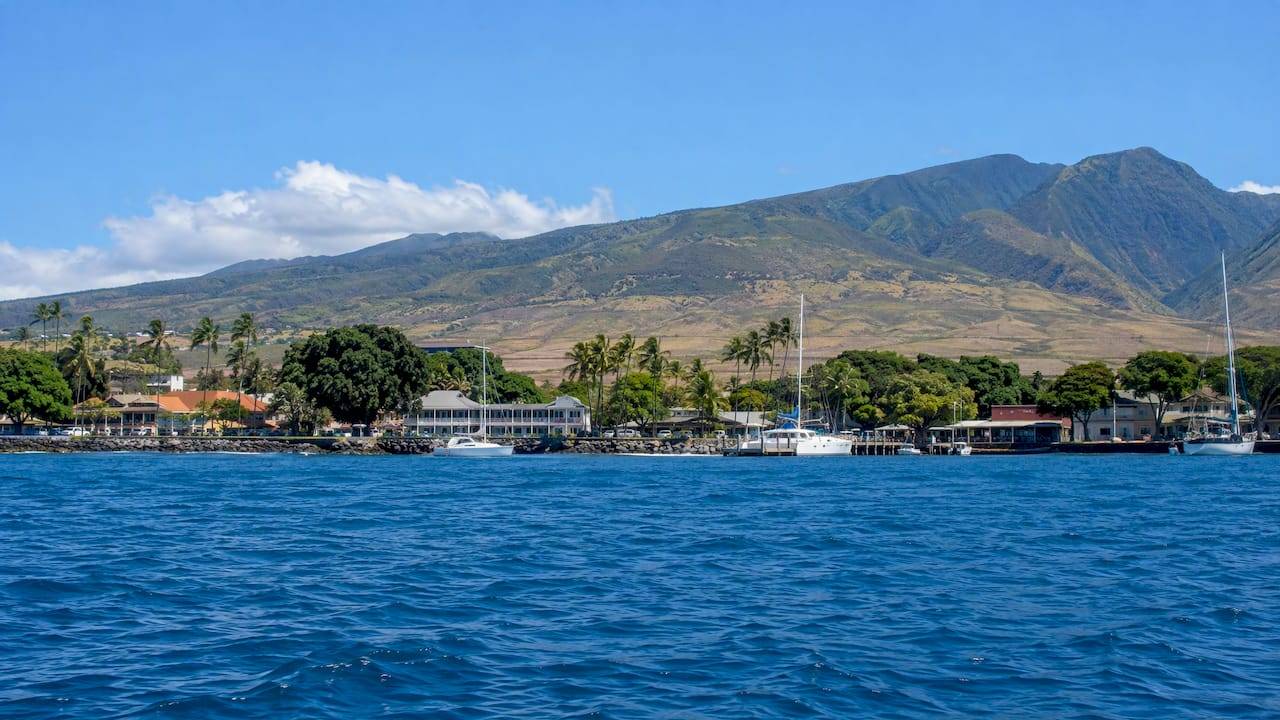
Lahaina was a favorite home of Maui’s chiefs, the capital of the Hawaiian Kingdom from 1820 to 1845, a whaling port, a mission town and a sugar plantation community. Its story runs from ancient Hawaiian rule through the 2023 wildfire and into a recovery that is still underway. This guide walks through it in order, with the dates that matter and the places tied to them. If you want to feel the landscape that shaped this history, our Lahaina flight film at Whalers Village in Kaanapali carries you over it, with Native Hawaiian ownership behind the storytelling.
TL;DR
- Lahaina was a royal residence long before Western ships arrived, and it served as the Hawaiian Kingdom’s capital from 1820 to 1845.
- Whaling boomed from 1819, peaking at more than 400 ships a year in the 1850s. The capital moved to Honolulu in 1845, and a sugar mill opened in 1861.
- The Lahaina Historic District became a National Historic Landmark in 1962. The famous banyan tree was planted in 1873.
- The August 2023 wildfire destroyed much of the historic town. Rebuilding is led by the community and continues.
- You can visit West Maui respectfully today, and take an indoor, cultural flight over the islands at Whalers Village.
Lahaina timeline at a glance
The dates below come mainly from the National Park Service’s Lahaina Historic District page, with the banyan tree and 2023 fire from the sources linked in later sections.
| Year | What happened |
|---|---|
| c. 1480 | King Pi’ilani is recorded as living at Lahaina; the ‘Auwai o Pi’ilani irrigation canal is attributed to his reign |
| 1795 to 1810 | Kamehameha I unifies the islands and makes Lahaina a royal residence, where the Brick Palace is built |
| 1819 | The first American whaling ships arrive |
| 1820 | Lahaina becomes the capital of the Hawaiian Kingdom |
| 1823 | The first Christian mission is established; blue laws follow |
| 1832 | Lahaina Fort is built after cannon fire on the town |
| 1845 | The capital moves to Honolulu |
| 1861 | A sugar mill opens, making sugar West Maui’s main industry |
| 1873 | The banyan tree is planted |
| 1909 to 1910 | Chinese residents form the Wo Hing Society and build its hall |
| 1962 | Lahaina Historic District is named a National Historic Landmark |
| 2023 | The August wildfire devastates the town |
Before the kings: Lele, Honoapiilani and a name with a story
Long before anyone wrote a timeline, Lahaina was a place chiefs chose to live. A 2023 Hawaiian-language collection, He Pū’olo Aloha no Lāhainā, records early native writers saying the area was first called Honoapiilani, then Lele, and later Lahaina. It also records that King Pi’ilani lived there around 1480, and it attributes the ‘Auwai o Pi’ilani irrigation canal to his reign. Water, farming and chiefly power were tied together here from the start.
The name itself has more than one telling. The same source records Mrs. Pia Cockett’s oral account of a bald-headed man whose head was sore in the sun, with hainā meaning cruelty and lā meaning day or sun. It also records M.K. Pukui’s note that the name refers to a terrible drought in the time of Chief Hua. Either way, “cruel sun” is the usual translation, and visitors who have stood on the West Maui shoreline at noon will understand the image.
National Geographic, quoting 1962 National Park Service historian John A. Hussey, describes Lāhainā as having been, from time immemorial, a favorite residence of Maui kings and chiefs and a convenient port for inter-island travelers. In its 2023 reporting on what was lost in Lahaina, the magazine also notes that Kamehameha established a royal residence there in 1802.
1820 to 1845: Lahaina as the kingdom’s capital
According to the National Park Service, Kamehameha I made Lahaina his royal residence after unifying the islands between 1795 and 1810, and he built the Brick Palace, one of the first Western-design buildings in the islands. After his death in 1819, his son Liholiho, Kamehameha II, named Lahaina the capital. It stayed the center of royal life under Kamehameha II and Kamehameha III until 1845, when the capital moved to Honolulu.
Those 25 years shaped almost everything visitors still associate with the town:
- Royal life. Chiefs, advisors and foreign visitors all came through Lahaina, which gave it a politics and culture unlike any other port.
- The mission. In 1823, at Queen Ka’ahumanu’s invitation, Reverends Charles Stewart and William Richards settled in Lahaina and founded the First Christian Mission. Three months later the stone Wainee Church was built, and the neighboring Waiola Cemetery became the burial ground for later Hawaiian kings and queens and missionary advisors.
- The harbor. Ships anchored offshore, and the roadstead made Lahaina one of the busiest ports in the Pacific.
This is why “When was Lahaina the capital of Hawaii?” has a short answer (1820 to 1845) and a long one. The town was where Hawaiian leadership, Christian missionaries and global trade met, sometimes harmoniously and often not.
Whaling, blue laws and a fort
The first American whaling ships reached Lahaina in 1819. By 1824, about 100 ships a year were visiting, and the number passed 400 a year in the 1850s, according to the Park Service. National Geographic adds, citing the same historian, that although Honolulu was originally the whalers’ favored port, Lāhainā often had more recorded visits, especially from about 1840 to 1855.
A town full of sailors and a town full of missionaries did not always agree. The Park Service records that in 1825 a whaling crew tried to demolish Reverend Richards’ house. In 1830 the crew of the whaling ship John Palmer fired cannonballs into the town. The Royal Governor of Maui answered by building Lahaina Fort in 1832, a one-acre fort with 20-foot walls. Its reconstructed remains stand in Banyan Court Park. Blue laws, rules restricting sailors’ behavior, date to 1823.
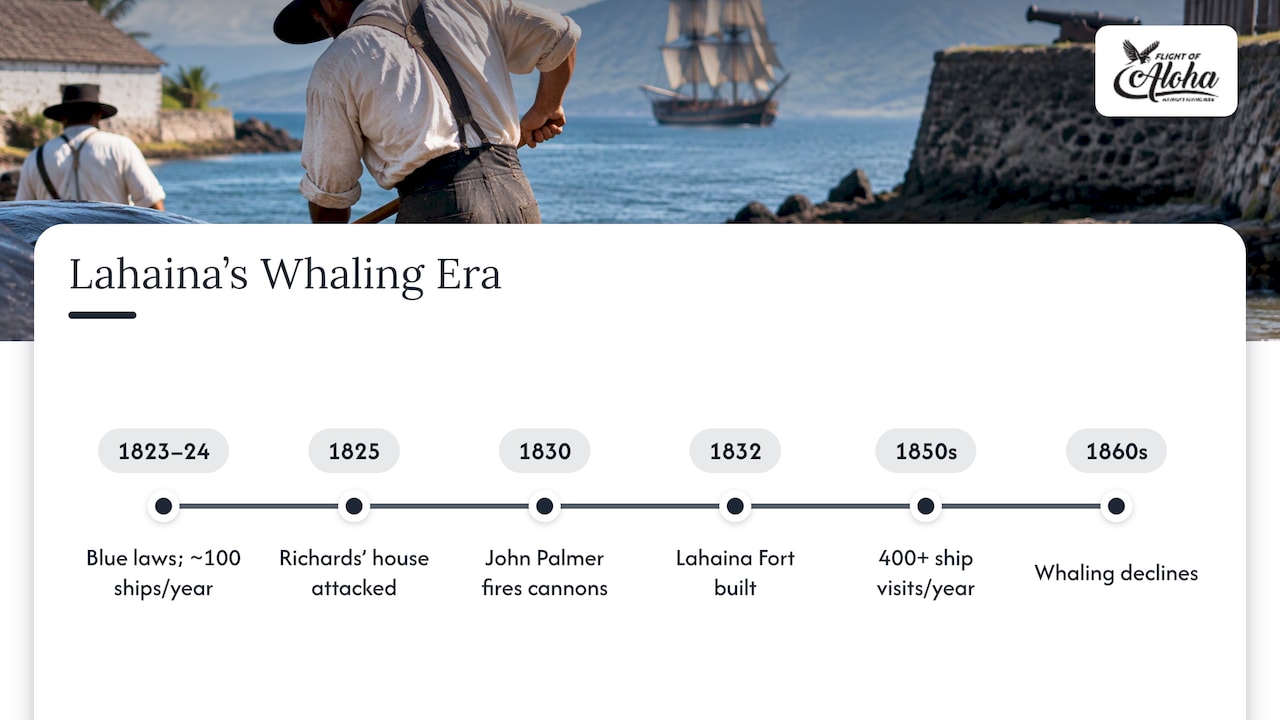
Whaling began to collapse in the 1860s. That was not the end of Lahaina, only of its first economy.
Sugar, plantations and the people who worked them
The Park Service says a sugar mill established in 1861 made sugar West Maui’s primary industry. National Geographic puts Pioneer Mill Co. as the first plantation to grow sugar commercially in Lāhainā, in 1860, and notes that it raised 225-foot smokestacks in 1928, the tallest in Hawai’i. The same article reports that thousands of Chinese immigrants came to Maui between 1852 and 1898 to work the plantations.
Lahaina’s Chinese community left a mark that survived into the modern town. Residents formed the Wo Hing Society in 1909 and built its hall in 1910, according to the Park Service. The plantation economy also changed the land. A 2025 ethnographic history, Nā Waiwai o Lāhainā, explains that the Māhele ‘Āina of 1848 fundamentally changed land ownership in Hawai’i and that the plantation era deteriorated traditional water systems. Those shifts form the background to the town’s later vulnerability.
Sugar’s reach was political too. The EBSCO Research Starters entry on the history of Lahaina notes that planters helped overthrow the monarchy in 1893 and that the United States annexed Hawai’i on July 7, 1898.
In 1962, the Lahaina Historic District was designated a National Historic Landmark, recognizing the layers of royal, whaling, mission and plantation history in one small town.
The Lahaina banyan tree
The banyan tree is the question most people ask about after the capital dates. According to the Historic Hawai’i Foundation, Sheriff William Owen Smith planted it on April 24, 1873. It was a gift from missionaries in India, marking the 50th anniversary of the first Protestant mission in Lāhainā. It grew to more than 60 feet tall and spread across nearly an acre, becoming the community’s gathering place for art fairs, hula performances and weddings.
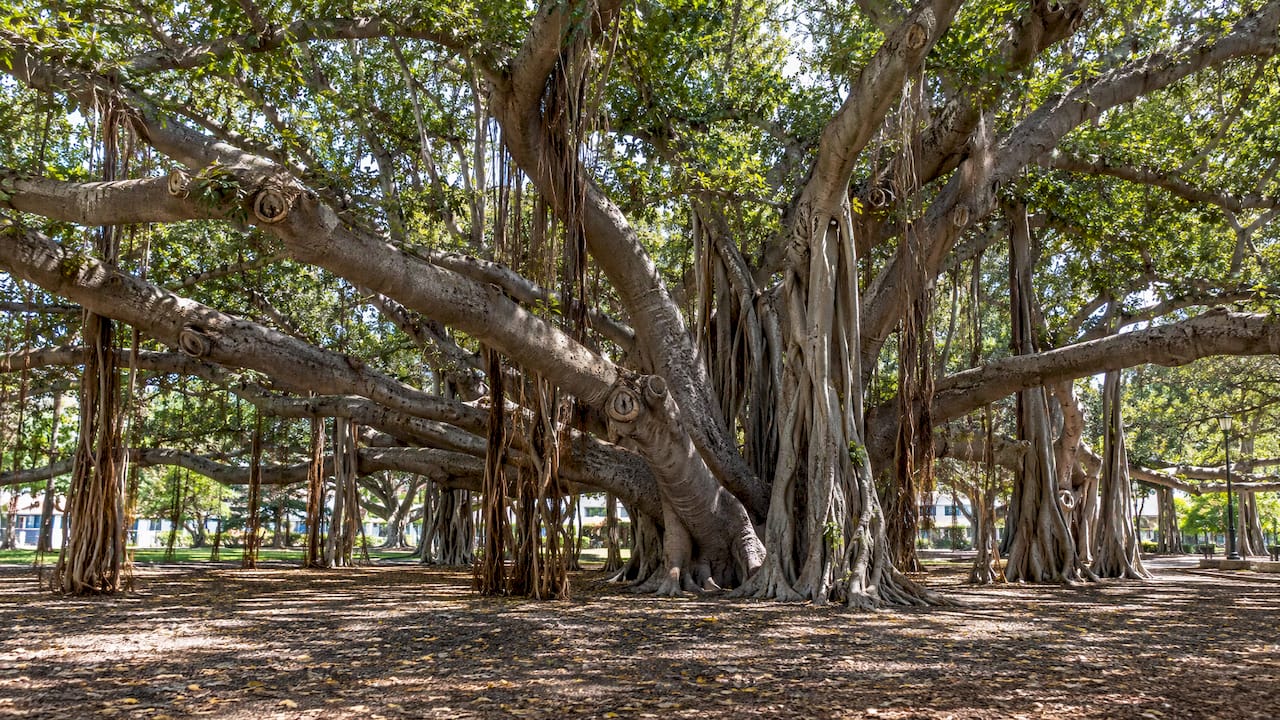
History is rarely simple, and the tree is no exception. As AP News reported in 2024, many see it as a beloved meeting place, while others see a symbol of colonial rule that cost Native Hawaiians their land, language and culture. Both views belong in an honest telling of Lahaina’s past.
The 2023 fire scorched the tree. AP reported that Maui County arborist Duane Sparkman said intense heat killed about half its branches, while sensors tracked sap flow and other parts grew back healthy, some even producing fruit. Check official Maui County updates before you go, because access to Banyan Court Park has been managed to protect the tree’s recovery.
August 2023: the fire and what came after
The Advisory Council on Historic Preservation’s Section 213 report, prepared with the National Park Service in October 2024, states that between August 8 and 11, 2023 the Lahaina fire burned 2,170 acres, damaged or destroyed 2,207 buildings and structures, displaced 4,500 people and caused more than 100 deaths. Behind those numbers are families, homes, and cultural treasures. The Kumupono study records that one resident lost her home and cultural artifacts, including the Mo’olele canoe, a symbol of Hawaiian voyaging.
The same study records community voices on recovery. Ke’eaumoku Kapu emphasized that rebuilding should be community-led, so that local people decide how Lahaina is restored. Recovery is measured in years, not months. Maui County’s official recovery pages are the place to check where rebuilding stands when you plan your trip.
Visiting West Maui with respect
The history above is not a theme-park story, and visitors can honor it simply. Ask locally before you walk into any area that is still closed or being rebuilt. Respect fencing and signs. Spend your money with West Maui businesses that are open, and follow the guidance of local residents and official channels about where to go.
Whalers Village in Kaanapali, a short drive up the coast, is where Flight of Aloha’s Maui location sits. For families with a free afternoon, a rainy day, or a day when the heat is hard on grandparents and small children, it is a comfortable indoor stop. It is also a way to see the Hawaiian landscape from the air without a helicopter’s cost or the motion that some passengers find hard.
Flight of Aloha: see Hawaii’s story from the air
Flight of Aloha is a Native Hawaiian-owned flying theater. Seats lift you into 8K films with motion effects, scents and wind, so it feels like flying over the islands, and the stories draw on Hawaiian legends and culture. The Lahaina film is one of our ride films alongside Naupaka and Europe.

In Maui, we are at Whalers Village in Kaanapali. On the Big Island, we are in Kailua-Kona, which cruise visitors will find convenient to the pier. A single feature such as Lahaina is $29.99 to $34.99. The Double Feature Flying Ride is $49.99 to $59.99, and the VIP Package is $69.99 to $79.99. If you live on the islands and want to come back, the Annual Pass is $200 per year. For the story behind the film, read how the Lahaina ride works.
Our perspective
Our team at Flight of Aloha believes that you cannot understand Hawai’i by checking off sights. You understand it by hearing its stories from the people whose families have told them for generations.
Lahaina is one of those stories: a chiefly home, a capital, a harbor, a plantation town, and now a community rebuilding in its own voice. As a Native Hawaiian-owned attraction, we think a flight over the islands should carry that respect with it. Our films are rooted in Hawaiian legends and cultural storytelling, and they are designed to be welcoming to all ages and abilities.
That is why we call ourselves the most accessible way to see Hawai’i from above. Grandparents, toddlers and first-time visitors can all share the same seat row, out of the sun and out of the rain, and talk afterward about what they saw. If you want a way into the culture before you walk the coast, our storytelling guide is a good place to begin.
Ola
FAQ
When was Lahaina the capital of Hawaii?
Lahaina was the capital of the Hawaiian Kingdom from 1820 to 1845, under Kamehameha II and Kamehameha III, according to the National Park Service. The capital then moved to Honolulu, where it has remained.
Why is Lahaina historically important?
It was a royal residence, the kingdom’s capital, a leading whaling port, the site of the first Christian mission on Maui, and later a sugar plantation town with a large Chinese community. In 1962 the Lahaina Historic District was named a National Historic Landmark.
When was the Lahaina banyan tree planted?
It was planted on April 24, 1873, to mark 50 years since the first Protestant mission in Lāhainā, as the Historic Hawai’i Foundation records. It was scorched in the 2023 fire, and parts of it have since regrown.
Where can I experience Hawaiian stories and scenery in West Maui?
Whalers Village in Kaanapali is home to our Maui flying theater, where the Lahaina, Naupaka and Europe films are shown. It is an indoor option on hot, rainy or hazy days, and suited to families and groups.
Book online to secure your seat.
Sources
- Lahaina Historic District, U.S. National Park Service
- He Pū’olo Aloha no Lāhainā
- What was lost in Lahaina, National Geographic
- Nā Waiwai o Lāhainā ethnographic history
- History of Lahaina, EBSCO Research Starters
- Lahaina Banyan Tree, Historic Hawai’i Foundation
- How Lahaina’s banyan tree is coming back, AP News
- Section 213 Report, Lahaina National Historic Landmark