
Five Minute Check to Spot Greenwashing in Environmental Tourism

Environmental tourism, also called ecotourism, is responsible travel to natural areas that conserves the environment, sustains the wellbeing of local communities, and includes real education about the place you’re visiting. It rests on three pillars: conservation, community benefit, and interpretation. This guide covers the principles behind that definition, where the term gets misused, the benefits and risks travelers should weigh, and the practical steps that turn good intentions into an actual positive footprint.
TL;DR:
- Visitor impact remains a major risk, with overcapacity leading to habitat damage, wildlife stress, and ecosystem degradation when sites exceed their natural limits.
- Genuine ecotourism requires operations to integrate low-impact infrastructure, benefit-sharing practices, indigenous involvement, and visitor limits, not just marketing claims.
- Choosing destinations with clear visitor management policies, third-party certifications, and local ownership helps ensure responsible travel and genuine conservation outcomes.
- Transport choices, especially avoiding short-haul flights, have the greatest impact on reducing a trip’s carbon footprint, as flights account for the majority of tourism-related emissions.
- Addressing greenwashing and overtourism requires destinations to enforce visitor caps, prioritize transparency, and implement independent verification processes to maintain ecological integrity.
What Is Environmental Tourism, Really? Definition and Core Principles
The most cited definition comes from The International Ecotourism Society (TIES), which frames ecotourism as responsible travel to natural areas that conserves the environment, sustains the wellbeing of local people, and involves interpretation and education. Notice that third pillar. Most travelers assume ecotourism just means “nature trip with good intentions,” but TIES built interpretation into the definition on equal footing with conservation and community benefit. A hike through a rainforest without any explanation of the ecosystem, the species, or the cultural history of the land is just a hike. Add a trained guide who explains why that ecosystem matters and how local people depend on it, and you’ve got the education pillar doing real work.
UN Tourism (the UNWTO) frames ecotourism similarly, describing it as a form of tourism built around natural areas that fosters understanding, appreciation, and conservation of the environment and culture. Both definitions share a key feature: ecotourism is meant to be non-consumptive and non-extractive. You observe, you learn, you leave a light footprint. You don’t hunt, harvest, or extract resources for profit, and a well-run operation avoids permanently altering the landscape it depends on for its own business.
In practice, this definition translates into specific operational commitments. Operators that take environmental tourism seriously tend to share several traits:
- Low-impact infrastructure. Facilities built to minimize energy and water use, often off-grid or hybrid systems in remote locations.
- Benefit-sharing with host communities. Local hiring, local sourcing, and a transparent share of revenue staying in the region rather than flowing to a distant parent company.
- Respect for indigenous rights and knowledge. Involving local and indigenous stakeholders in planning, not just as employees but as decision-makers.
- Genuine interpretation. Trained naturalist or cultural guides, signage, and programming that actually teach visitors something true about the place.
- Capacity limits. A willingness to cap visitor numbers even when demand (and revenue) would support more.
That last point separates the operators who mean it from the ones using the label as a marketing veneer. Anyone can put a leaf logo on a brochure. Turning away paying customers to protect a reef or a nesting site is a much harder test to pass.
Pro Tip: Before booking any “eco” tour, email the operator and ask two specific questions: what percentage of your staff is hired locally, and how is revenue shared with the surrounding community? A vague answer or no answer is itself useful information.
Ecotourism vs. Sustainable Tourism vs. Green Tourism vs. Responsible Travel
These four terms get used interchangeably online, and that’s a problem, because they mean different things and mixing them up makes it easier for operators to greenwash.
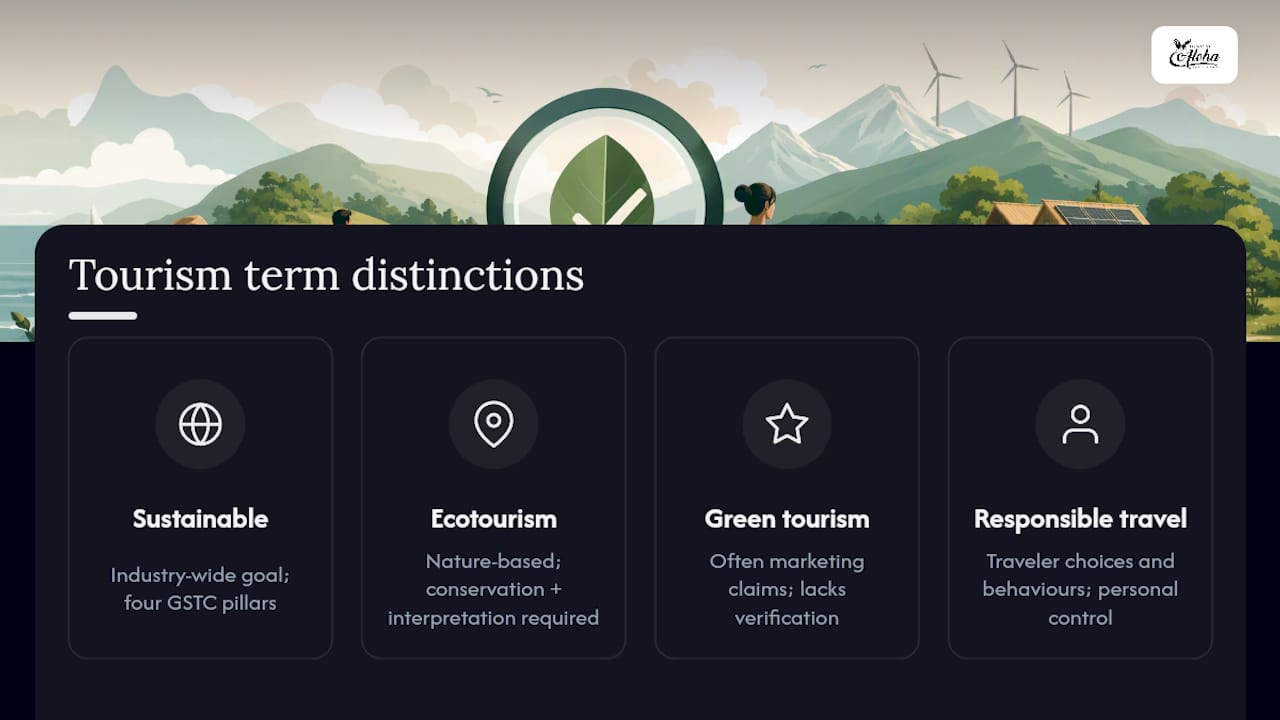
Sustainable tourism is the broadest category. The Global Sustainable Tourism Council (GSTC) defines it across four pillars: sustainable management, socioeconomic impacts, cultural impacts, and environmental impacts. Sustainable tourism is an aspiration that applies to every kind of travel, from a downtown hotel chain to a cruise line to a safari lodge. It asks: is this operation managed in a way that doesn’t undermine the resources it depends on?
Ecotourism is narrower. It’s sustainable tourism applied specifically to natural areas, with conservation and interpretation as required features rather than optional add-ons. A city hotel can be sustainably managed; it can’t really be an ecotourism destination, because there’s no natural area at the center of the experience.
Green tourism is where things get murky. It’s often a marketing label rather than a defined standard, and industry watchdogs including Rainforest Alliance warn that “green” claims frequently lack the measurable, verifiable backing that terms like “GSTC-certified” carry. A resort can call itself green tourism for installing low-flow showerheads while still running high-impact operations everywhere else.
Responsible travel describes traveler behavior rather than an operator’s business model. It’s the choices you make: which flights you book, which businesses you patronize, how you behave around wildlife. You can practice responsible travel inside a full ecotourism program or inside a conventional beach vacation.
A quick way to keep them straight: sustainable tourism is the industry-wide goal, ecotourism is a specific nature-based practice, green tourism is often just a claim, and responsible travel is what you personally control no matter where you go.
The Real Benefits and Risks of Environmental Tourism
Done well, environmental tourism produces benefits that are hard to replicate through other funding models. Entrance fees and tour revenue directly fund protected-area management in places where government budgets fall short. Local jobs in guiding, hospitality, and craft production give communities an economic reason to protect a forest or reef instead of converting it to farmland or development. Cultural preservation gets a similar boost when traditions, language, and stories become part of the visitor experience rather than fading from disuse. And travelers who spend a week learning about a coral reef or a watershed tend to become more informed advocates for conservation once they get home.
But the same industry carries real risks when it’s mismanaged:
- Visitor pressure and habitat damage. Trails erode, wildlife gets stressed, and fragile ecosystems degrade when visitor numbers exceed what a site can absorb.
- Cultural commodification. Traditions get flattened into performances designed for photos rather than genuine cultural exchange.
- Health and safety risks. Poorly regulated wildlife encounters and remote-area activities carry real injury risk when oversight is thin.
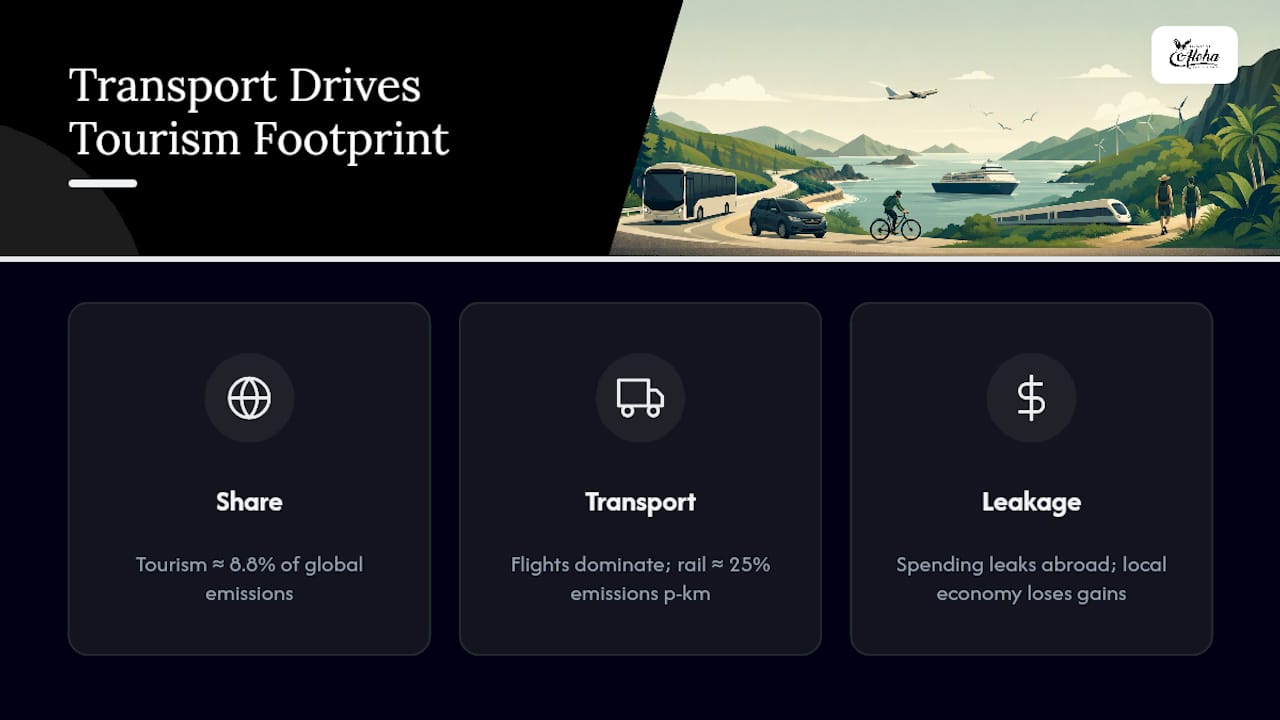
- Economic leakage. Revenue that should stay local instead flows to foreign-owned tour operators, hotel chains, and booking platforms. Industry analysis suggests up to 80% of tourism spend in some developing destinations leaks out to foreign-owned suppliers rather than staying with the host community.
The failure mode almost always starts with the same mistake: overcapacity. A destination gets popular, operators keep selling tickets past the point the ecosystem or the community infrastructure can absorb, and the very asset that attracted travelers starts to degrade. Poor benefit distribution compounds it. When conservation fees don’t reach the rangers and communities doing the actual protection work, the funding model breaks down even while ticket sales climb.
By the numbers: Global tourism generated roughly 5.2 billion tonnes of CO2-equivalent emissions in 2019, a notable share of total global greenhouse gas emissions, according to a 2024 study published in Nature Communications. That figure covers the entire tourism sector, not just ecotourism, but it’s the backdrop against which every “eco” claim has to be judged. An operator that ignores transport emissions while marketing a nature experience is solving only part of the problem.
How to Practice Environmental Tourism: A Traveler’s Checklist
Good intentions don’t automatically produce good outcomes. Here’s a prioritized way to think through it, from planning your trip to behaving once you’re there.
- Choose destinations with visitor-management policies. Places that cap daily visitor numbers, require permits, or charge conservation fees are signaling they take carrying capacity seriously, not just revenue.
- Check for GSTC-recognized certification. Look for GSTC-recognized certification schemes or accredited third-party certifiers rather than a generic “eco-friendly” badge with no published criteria behind it.
- Verify local ownership and revenue retention. A quick search for “who owns [operator name]” often reveals whether profits stay local or flow to a distant parent company.
- Rethink your transport before your activities. Short-haul flights carry a disproportionate emissions cost. Rail and ferry travel produce roughly a quarter or less of the emissions per passenger-kilometer compared to cars and flights, so where rail or ferry service exists, it’s usually the better call.
- Consolidate trips and favor direct routes. Fewer, longer trips with direct flights beat frequent short hops with layovers, both for emissions and for your own time.
- Practice leave-no-trace basics on-site. Pack out what you bring in, stay on marked trails, and never feed or approach wildlife.
- Respect wildlife distance rules. Whether it’s whales in Maui waters or nesting sea turtles, keep the recommended distance even when other tourists don’t.
- Support locally owned businesses directly. Book the family-run tour outfit and the local restaurant over the international chain whenever the option exists.
- Contribute to citizen science if you’re inclined. Platforms like iNaturalist let travelers log species observations that feed real research, turning a casual hike into usable conservation data.
On the greenwashing question specifically, Regenerative Travel’s five-check filter is one of the more useful frameworks available: verify ownership, look for measurable net-positive impact (not just “reduced” impact), confirm supply-chain transparency, check for genuine community agency in decision-making, and look for published environmental limits rather than vague commitments. If an operator can’t produce specifics on any of those five, treat the “eco” label with skepticism.
Pro Tip: Don’t reach for carbon offsets as your first move. Reducing the number of trips you take and choosing lower-emission transport does more good than buying offsets after the fact. Offsets are a last-resort accounting tool, not a substitute for making better choices upfront.
GSTC Criteria and How to Verify a Sustainability Claim in Five Minutes
The Global Sustainable Tourism Council doesn’t certify hotels or tour operators directly. Instead, GSTC publishes the criteria and accredits independent, third-party certification bodies that then audit individual businesses against those standards. That distinction matters: when a resort says “GSTC-certified,” check whether it means the property itself was audited by an accredited certifier, or whether it simply follows GSTC’s published guidelines without independent verification.
Credible sustainability practices tend to share a few recognizable features: published criteria anyone can read online, independent audits conducted by a third party rather than self-assessment, and a clearly defined scope (does the certification cover the whole property, or just the spa?).
You can do a real check in under five minutes:
- Search the certifier’s name plus “accredited” to confirm GSTC recognition.
- Look for a public sustainability report with actual numbers, not just adjectives.
- Check whether the certification has an expiration date and renewal audit, since a static badge from years ago means little.
- Search the operator’s name plus “greenwashing” or “controversy” to see what other travelers and journalists have found.
Red flags include vague language like “eco-conscious” or “nature-friendly” with no linked standard, badges with no issuing body named, and marketing that emphasizes a single small gesture (reusable towels) while staying silent on bigger operational impacts like energy sourcing or waste management.
What the Latest Research Says About Tourism’s Environmental Footprint
The 2024 Nature Communications findings on tourism emissions carry a practical implication most articles skip: transport, not accommodation or activities, is usually the single largest lever a traveler controls. If tourism as a whole produces around 8.8% of global emissions, and flights are the dominant contributor within that figure, then the choice between flying and taking rail or ferry service does more for your footprint than almost any other decision on a trip.
The comparison is stark. Rail travel typically produces roughly a quarter or less of the emissions per passenger-kilometer of an equivalent car or flight trip. That doesn’t mean flying is never justified. Islands and remote regions often have no practical alternative. But for trips where rail or ferry service exists, defaulting to the flight out of habit is the single most avoidable choice in most itineraries.
Economic leakage research reinforces why local supply chains matter as much as emissions. When tourism spend leaks out to foreign-owned hotels, imported food, and international booking platforms, the destination absorbs the environmental cost of hosting visitors without capturing the economic benefit that’s supposed to offset it. That’s the core reason destination-level policies matter.
Some destinations have started addressing this directly with tourist access fees and visitor caps, from national park permit systems to city-level tourist taxes. Early data on these programs is still developing in many cases, but the logic is sound: pricing access appropriately can fund conservation while managing the visitor volume a site can actually sustain.
How Environmental Tourism Evolved Into What It Is Today
The term “ecotourism” traces back to the 1980s, when conservationists and travel researchers started noticing that nature-based travel could either fund protected areas or destroy the very landscapes drawing visitors, depending entirely on how it was managed. Early ecotourism grew out of ecolodges in Central America and wildlife safari operations in East Africa, places where tourism revenue became a direct argument for keeping land undeveloped.
Through the 1990s, the concept formalized. TIES was founded in 1990 and has revised its definition over the decades to keep pace with how the industry actually operates, eventually landing on the three-pillar framework used today: conservation, community wellbeing, and interpretation. UNWTO built out parallel guidance as sustainable development goals gained traction globally in the 2000s and 2010s.
The 2020s added new pressure points. Overtourism complaints in destinations from Southeast Asian islands to Alpine villages pushed the conversation toward carrying capacity and visitor caps, not just responsible behavior. Climate research, including the 2024 Nature Communications emissions study, sharpened the focus on transport as the industry’s biggest blind spot. Environmental tourism today is less about a niche travel category and more about a management discipline every destination has to reckon with.
Flagship Destinations That Define What Environmental Tourism Looks Like
Costa Rica remains the reference case most guides point to, and for good reason. The country built an entire national brand around protected rainforest, cloud forest reserves, and a network of ecolodges that funnel revenue into conservation while employing local guides trained in interpretation. Roughly a quarter of its land sits under some form of protection, a scale few countries match.
The Galápagos Islands offer the opposite lesson: a destination almost too popular for its own ecological limits. Ecuador caps visitor numbers and requires licensed naturalist guides on every excursion, a direct response to the fragility of species found nowhere else on Earth.
Rwanda’s mountain gorilla trekking program shows how high permit fees, when genuinely reinvested in community development and anti-poaching efforts, can turn a single species into a conservation funding engine.
Closer to home, Hawaii itself sits in this conversation. Marine protected areas, kapu (restricted) zones around sensitive reef systems, and community-led stewardship programs on islands like Maui and the Big Island reflect the same principles at work: conservation, community benefit, and cultural interpretation woven into how visitors are welcomed.
Why Local and Indigenous Communities Have to Be at the Table
Environmental tourism that skips community involvement tends to fail the “sustains local people” half of its own definition. Indigenous and local communities usually hold the deepest working knowledge of an ecosystem, its seasonal patterns, and the cultural context that makes interpretation meaningful rather than generic.
In Hawaii specifically, this shows up in the growing role of kapu (traditional restriction) zones and community-based subsistence fishing areas, where local practitioners help set the rules for how a resource gets used and protected. When indigenous stakeholders help design an experience rather than just staff it, the storytelling tends to be more accurate, the conservation choices more informed, and the economic benefit more likely to stay local.
The practical marker to look for as a traveler is decision-making power, not just employment. A tour company that hires local guides but sets all its policies from a headquarters overseas is a different thing from one where community members shape what gets protected, how revenue gets shared, and which stories get told. That distinction is exactly what Regenerative Travel’s “community agency” check is designed to surface.
The Greenwashing and Overtourism Problem Nobody Solves Easily
Two structural problems keep undermining environmental tourism’s promise. The first is greenwashing: the gap between an “eco” label and any measurable practice behind it. Because there’s no single global enforcement body policing the word “ecotourism,” operators can and do use it as a marketing layer over conventional business models.
The second is overtourism, which is almost the inverse problem. A destination can have genuinely well-designed ecotourism principles on paper and still collapse under visitor volume once word gets out. Social media has accelerated this cycle, turning once-quiet natural sites into viral must-see spots faster than local management systems can adapt permit caps or infrastructure.
Both problems share a root cause: revenue incentives that reward volume over limits. Fixing it usually requires destinations to accept short-term revenue trade-offs, capping visitor numbers even when demand would support more, and requiring the kind of independent, GSTC-recognized verification that makes a sustainability claim mean something. Neither problem has a clean fix, but the destinations doing this well tend to treat visitor caps and certification as non-negotiable infrastructure, not optional extras.
Where Environmental Tourism Is Headed Next
Technology is changing how ecotourism gets monitored and marketed. Satellite and drone imagery now let researchers track deforestation and reef health in near real time, giving destinations harder data to set visitor caps instead of guessing. Apps and citizen science platforms are turning ordinary travelers into low-cost data collectors, extending research capacity without expanding research budgets.
Carbon offsetting is evolving too, though the industry consensus is shifting toward treating it as a last resort rather than a first-line solution. The smarter trend is emissions reduction built into trip planning itself: rail-first routing, trip consolidation, and destination choices that favor shorter travel distances.
Regenerative tourism, a step beyond sustainability, is gaining traction as a framework that asks operators to leave a destination measurably better off, not just unharmed. Expect more destinations to formalize visitor fees tied directly to conservation outcomes, and more certification bodies tightening scope requirements so a badge actually reflects an audited standard rather than a marketing choice.
Why Cultural Attractions Belong in This Conversation
Environmental tourism doesn’t only happen on a trail or a reef. A well-designed cultural attraction can carry the same three pillars, community benefit, conservation-adjacent values, and genuine interpretation, without ever leaving a building. That’s the standard Flight of Aloha holds itself to. As a Native Hawaiian-owned attraction, every film we screen is built around real Hawaiian legends and cultural storytelling, not a generic nature documentary with a tropical soundtrack.
Interpretation done right means visitors leave understanding something true about Hawaii, not just having watched a spectacle. That’s the same principle TIES bakes into its ecotourism definition. Choosing attractions that hire locally and root their programming in indigenous storytelling is itself a responsible-travel decision, one that sits alongside your reef tour or hiking permit, not in competition with it. Small choices like this add up across a trip, and they cost nothing extra to make.
— Ola
Flight of Aloha: A Low-Impact Way to Experience Hawaii’s Story
If you’re weighing a Hawaii itinerary against a limited budget or a body that doesn’t love turbulence, consider what a helicopter tour actually costs versus what it delivers. A typical helicopter flight runs close to $400 per person, carries real motion-sickness risk, and depends entirely on weather clearing. Flight of Aloha gives you the same aerial sense of soaring over Hawaii’s coastlines and valleys, through 8K visuals, motion effects, wind, and scent, at a fraction of the cost and none of the queasiness.

It’s also the practical answer on a rainy day in Kona or Maui, or when Vog rolls in and outdoor plans fall apart. Our theaters run on reliable air conditioning rain or shine, which makes us a genuinely comfortable escape from the heat. The Kailua-Kona location sits within walking distance of Kailua Pier and the tender dock, making it one of the easiest shore excursions for cruise passengers on a tight schedule. Our second location at Whalers Village in Kaanapali serves Maui visitors the same way. As a Native Hawaiian-owned attraction featuring stories like ‘Naupaka’ and ‘Lahaina,’ we built this experience around cultural interpretation, not just spectacle. Single shows, double features, VIP packages, and annual passes are all available through Flight of Aloha’s online booking. Book online to secure your seat.
Sources
The organizations and studies behind this guide are worth bookmarking if you want to keep verifying claims on your own future trips:
- What is sustainable tourism? Here’s the definition | GSTC
- Sustainable tourism practical guide (summary of research)