
6 Questions to Vet Voluntourism and Spot Unethical Trips

Voluntourism blends short-term volunteer work with a vacation, usually packaged for a fee and lasting a variable duration. It can genuinely help a community when the program is locally led and skill-matched, but the honest verdict is more cautious than most brochures let on: without transparency and local control, voluntourism often does more for the volunteer’s photo album than for the people it claims to serve.
TL;DR:
- Effective voluntourism relies on clear local leadership, transparent fee allocation, and well-defined impact measures to ensure community needs are genuinely addressed.
- Untrained volunteers performing tasks beyond their scope, especially in medical or educational settings, can create harm and disrupt local services or employment.
- Thorough vetting involves confirming local decision-making, understanding fee breakdowns, and ensuring safety, safeguarding, and impact data are openly shared before participation.
- Positive outcomes are most likely when programs are long-term, locally led, and skill-matched, while short-term, poorly vetted trips risk reinforcing dependency or doing minimal measurable good.
- Supporting community-led cultural experiences or storytelling initiatives offers more meaningful and ethical engagement than traditional voluntourism trips centered on photo opportunities.
What Is Voluntourism and How Does It Differ From Volunteering?
Voluntourism describes short-term trips combining tourism activities with a service component and typically coming bundled with a participant fee covering lodging, meals, and logistics. That packaging is the key distinction from traditional volunteering, according to a regional best-practices guidebook, which frames voluntourism as a hybrid product sold through tour operators or nonprofits rather than a placement arranged directly with an NGO.
Common project types include classroom teaching, home or school construction, wildlife and marine conservation, clinic support, and cultural preservation work. Traditional volunteering, by contrast, tends to run longer, involve formal vetting and skills matching, and typically does not charge volunteers a fee to participate. A Peace Corps posting or an NGO field placement usually requires professional credentials and months of training. A voluntourism trip might ask for none of that, just a credit card and two weeks of vacation time.
Why Does Voluntourism Attract So Much Criticism?
The sharpest criticism centers on orphanage tourism, where children in residential facilities are essentially put on display for paying visitors. Researchers and ethicists have flagged this as a clear case of vulnerable people being used as marketing material rather than treated as people deserving stable, consistent caregivers.
Several other harms show up again and again in the research:
- Skill mismatch: untrained volunteers doing work (construction, teaching, medical tasks) they aren’t qualified for.
- Job displacement: paid local labor gets replaced by unpaid foreign volunteers.
- Dependency creation: communities built around donor visits rather than sustainable local systems.
- Continuity gaps: a rotating cast of two-week volunteers can’t provide the consistency that children, patients, or long-term projects need.
Medical voluntourism carries its own distinct risks. Volunteers sometimes practice outside their scope, and the lack of continuity of care can strain rather than support local health systems, according to the American Medical Association’s Journal of Ethics. A student handing out medication without local clinical oversight isn’t providing care so much as creating liability.
Underneath all of this sits a commercial pressure: when a program’s survival depends on selling spots to volunteers, marketing tends to prioritize the visitor’s experience over the community’s actual needs. That inversion, critics argue, is how well-intentioned trips end up eroding the very services they meant to strengthen.

Can Voluntourism Actually Benefit Communities?
Voluntourism helps most when it’s locally led, skill-matched, and built on a long-term partnership rather than a one-off transaction. Programs where volunteers fill a genuine skills gap, alongside local staff rather than instead of them, tend to produce the outcomes people expect from these trips in the first place.
Realistic benefits look like this:
- For communities: capacity building, modest infrastructure support, and supplemental income when programs are transparent about fee allocation.
- For volunteers: meaningful cultural exchange, new perspective, and sometimes a lasting commitment to advocacy or continued support.
Academic reviews consistently find that volunteers report deeply transformative personal experiences, but measurable community development impact is frequently far more limited than the marketing suggests, per a review published in a peer-reviewed voluntourism journal. That gap between personal transformation and community impact is the single most important thing to understand before booking anything.
How Do You Choose an Ethical Voluntourism Program?
Vetting a program takes real homework, not just reading testimonials on a glossy landing page. Here’s a practical sequence to work through before you hand over any money.
- Ask who sets priorities. A community-led program lets local leaders define the need. If the organization can’t name the local partner making that decision, that’s a problem.
- Request a fee breakdown. Ask exactly what your payment funds: local wages, materials, admin costs, or your own lodging. Reputable operators will provide this without hesitation.
- Check safeguarding policies, especially for any program involving children or vulnerable populations. No policy on paper usually means no real screening in practice.
- Look for monitoring and outcome data. Programs that track and share results (not just anecdotes) are demonstrating accountability, not just marketing.
- Verify scope-of-practice rules if you’re a nurse, dentist, or other skilled professional. Confirm there’s a continuity-of-care plan so your two weeks of help doesn’t leave a gap when you leave.
- Ask for references and sample reports from past participants and, ideally, from the local partner organization itself.
Effective vetting comes down to confirming that residents are the primary decision-makers and that fees, safeguarding, and impact data are all disclosed upfront, according to National Geographic’s guide to responsible voluntourism.
Pro Tip: Treat your application process like a job interview, not a booking form. If an organization accepts anyone with a credit card and no skills questionnaire, that’s a signal they’re not matching volunteers to real needs.
What Do Real Voluntourism Experiences Look Like?
Outcomes swing wildly depending on program design, and three quick scenarios show why.
- The positive case: A marine conservation program in Southeast Asia partners with a local research station, brings in volunteers with actual diving certifications, and funds a year-round local coordinator position. Volunteers add specialist labor the community couldn’t otherwise afford.
- The neutral case: A two-week cultural homestay program teaches basic language skills and shares meals with a host family. Nobody’s harmed, but the measurable impact on the village’s economy is minimal.
- The negative case: A “medical mission” trip lets undergraduate pre-med students perform basic dental checks with zero local physician supervision, then leaves before any follow-up care is arranged.
The lesson across all three: the same six vetting questions above would have flagged the third case immediately, and confirmed the first as legitimate.
What Do Researchers and Ethicists Actually Recommend?
That principle, echoed across National Geographic’s reporting and the APEC region’s official best-practices guidebook, is the closest thing the field has to a consensus standard. Academic critiques go further, warning against commodification and neo-colonial dynamics when vulnerable people become part of the marketing pitch, a concern raised directly in a peer-reviewed ethics review. The throughline across every credible source: community agency and long-term reciprocity, not a two-week itinerary, determine whether a trip actually helps anyone.
Where Did Voluntourism Come From?
Volunteer travel has roots in religious missionary work and postwar exchange programs of the mid-20th century, but “voluntourism” as a packaged commercial product is much newer. The term gained traction in the late 1990s and early 2000s as gap-year culture, cheaper international flights, and the rise of dedicated tour operators turned service trips into a bookable product rather than a self-arranged commitment.
The 2004 Indian Ocean tsunami and Hurricane Katrina in 2005 both triggered surges in disaster-relief voluntourism, exposing how quickly untrained volunteers could flood a crisis zone with good intentions and little coordination. That period pushed researchers and ethicists to start scrutinizing the industry seriously rather than assuming good intentions guaranteed good outcomes.
Social media accelerated the trend through the 2010s. Photos of volunteers holding babies at orphanages or building houses became a recognizable genre of travel content, which is precisely what drew the sharpest academic criticism: the incentive to create shareable images started competing with the incentive to actually help. Library and university research guides now treat voluntourism as a distinct, fast-growing field of study, pointing scholars toward the Library of Congress’s dedicated research guide for further reading. What started as an add-on to backpacking culture is now a multibillion-dollar segment of the global travel industry, complete with its own certifications, watchdog organizations, and ongoing ethical debate.
How Is Voluntourism Different From Traditional Tourism?
Traditional tourism is transactional in a straightforward way: you pay for an experience, and a business delivers it. Voluntourism adds a layer of moral complexity because the “product” involves other people’s lives, often in communities with far less economic power than the visitor.
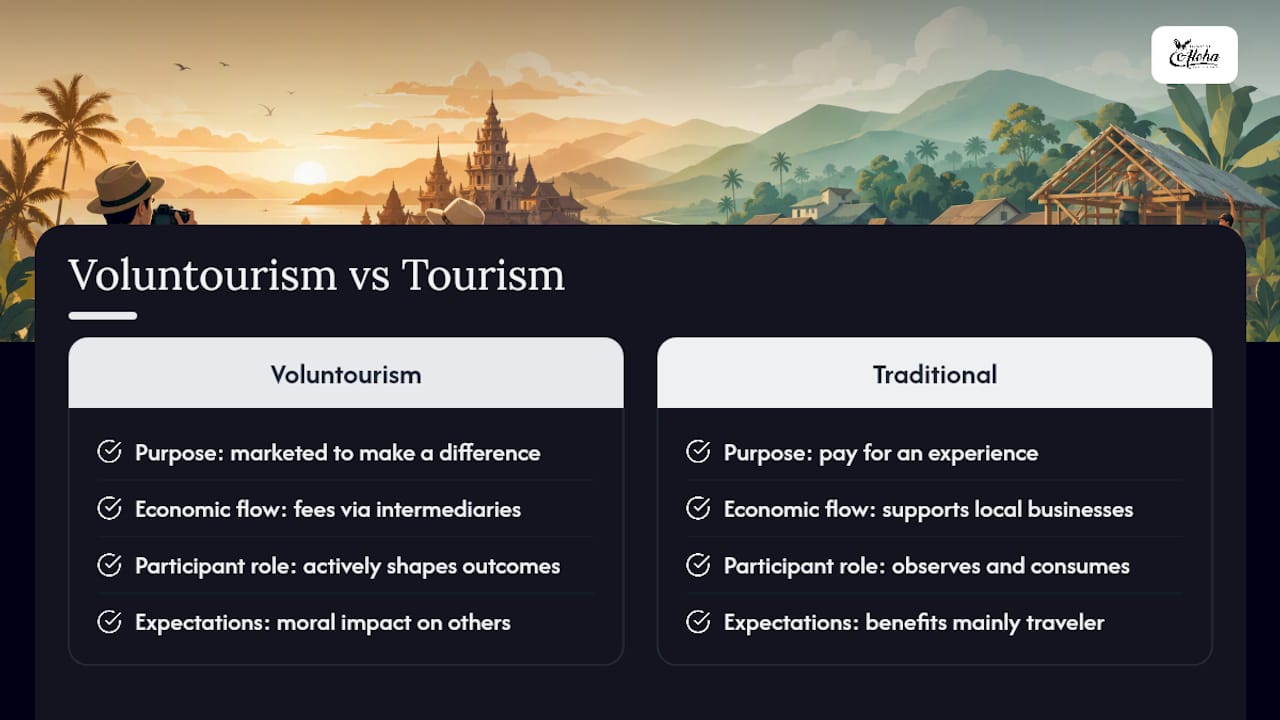
A beach vacation doesn’t require the same scrutiny as a program that puts you in a classroom with children you’ll never see again after two weeks. Traditional tourism generally doesn’t claim to change lives beyond the traveler’s own; voluntourism explicitly markets itself as making a difference, which raises the bar for accountability considerably.
The economics differ too. Traditional tourism dollars typically flow toward hotels, restaurants, tour guides, and transportation, supporting existing local businesses. Voluntourism fees often flow through an intermediary organization, and how much of that money reaches the community depends entirely on that organization’s transparency. There’s also a control difference: a tourist observes and consumes an experience, while a voluntourist actively participates in and shapes outcomes for other people, sometimes without the training to do so responsibly.
None of this makes voluntourism inherently worse than a regular vacation. It just means the ethical stakes are higher, and the due diligence required before booking is genuinely different from picking a hotel.
How Should You Prepare for a Voluntourism Trip?
Preparation determines outcomes more than good intentions do. Before you commit to a program, build in real cultural and personal groundwork rather than treating the trip as a spontaneous add-on to a vacation itinerary.
Start with language basics, even a handful of greetings and courtesy phrases in the local language. It signals respect and makes day-to-day interactions smoother. Research the country’s history, current political context, and any cultural norms around dress, gender interactions, or religious practice that might differ from what you’re used to.
Treat the placement like a real job. That means showing up with realistic expectations about what you can contribute, staying humble about your skill level relative to local staff, and being ready to follow direction rather than lead, according to guidance from National Geographic’s voluntourism reporting. If the organization offers a skills questionnaire or pre-departure training, take it seriously; it exists to match you to work you’re actually equipped to do.
Physically and logistically, confirm vaccination requirements, travel insurance that covers your specific activities, and any visa requirements tied to volunteer work specifically (some countries require different visas for unpaid labor than for tourism). Pack for the actual work, not the Instagram version of it. And set expectations with yourself: measurable impact from a short trip is often smaller than advertised, so go in prepared to learn rather than to single-handedly transform a community.
What Legal and Safety Issues Should You Watch For?
Visa classification is the most commonly overlooked legal issue. Many countries require a specific volunteer or work visa rather than a standard tourist visa if you’ll be performing labor, even unpaid labor. Entering on the wrong visa type can result in fines, deportation, or future entry bans, so confirm requirements with the destination country’s embassy rather than relying solely on the tour operator’s word.
Health and safety planning matters just as much. Confirm your travel insurance actually covers the activities you’ll be doing, since standard tourist policies sometimes exclude manual labor, medical work, or remote-area travel. Check required vaccinations well ahead of departure, and ask your program directly what emergency protocols exist if you’re injured or fall ill in a remote location.
If you’re volunteering in a professional capacity, such as medical, dental, or veterinary work, verify that you’re legally permitted to practice at all in that country and that a licensed local professional is supervising your work. Scope-of-practice violations aren’t just an ethical problem; they can carry real legal liability both for you and for the organization that placed you, a concern the American Medical Association has raised specifically around continuity of care and local health system integration. Finally, keep copies of all program agreements, insurance documents, and emergency contacts accessible offline, since connectivity in many volunteer locations is unreliable exactly when you’d need that information most.
A Better Way to Connect With Hawaiian Culture
The conventional wisdom says any volunteer trip is inherently generous. It isn’t, and the research backs that up plainly. If a program can’t tell you who is making decisions on the ground or what your fee actually funds, you’re not helping. You’re buying an experience that happens to use real people as its backdrop.
The better instinct, if you genuinely want meaningful cultural connection while traveling, is to look for models built on local culture and wellness that emphasize reciprocity rather than rescue. Supporting local artists, learning from community-led storytelling, and choosing experiences where locals control the narrative accomplish more than a two-week placement ever will. Flight of Aloha built its own approach around exactly this idea, treating cultural storytelling as something to be shared on the community’s terms, not packaged for a volunteer’s benefit. That’s also the thinking behind why immersive experiences matter more than performative ones, and why responsible tourism usually means listening before acting.
— Ola
Why Flight of Aloha Beats a $400 Helicopter Tour
Flight of Aloha is Native Hawaiian-owned, which means the storytelling in every film comes from the culture it depicts, not from a script written for tourists. That’s the same principle behind skipping voluntourism in favor of experiences where local voices lead.

If you’re weighing a helicopter tour over Kona or Maui, consider the math first: helicopter rides routinely run close to $400 per person, come with real motion-sickness risk, and depend entirely on weather. Flight of Aloha delivers the same aerial thrill over volcanoes, waterfalls, and reefs through 8K visuals, motion effects, and wind, all from a comfortable theater seat with some of the best air-conditioning in town. That makes it the go-to fix for rainy days in Kona, rainy days in Maui, or any afternoon when vog has you looking for cover indoors.
Cruise passengers get a particular advantage in Kona, where the theater sits walking distance from Kailua Pier and the tender dock, making it one of the easiest shore excursions to fit into a short port stop. In Maui, the Whalers Village Kaanapali location puts the same experience steps from the shops and restaurants you’re already visiting. Whether you’re stepping off a ship or just escaping the heat, this remains the most accessible activity in Kona and Maui. Book online to secure your seat.
Sources
- A Beginner’s Guide to Voluntourism | National Geographic
- Voluntourism | Journal of Ethics | American Medical Association
- Guidebook – Voluntourism: Best Practices in the APEC Region
- SAGE article on voluntourism impacts