Confirm Your Booking Helps Locals: Fair Trade Tourism in Africa

Fair trade tourism is a model of travel where certification, run by the nonprofit Fair Trade Tourism, verifies that a business pays fair wages, respects local culture, and manages its environmental footprint responsibly. The certification confirms real community benefit, not marketing language. It’s rooted heavily in Africa, and its logo is the traveler’s quickest signal that a booking actually gives back.
TL;DR:
- Choosing a fully certified operator requires verifying their full audit status and asking about local sourcing, fair wages, and community projects directly.
- Fair Trade Tourism certification ensures local economic benefits by promoting local suppliers, fair wages, and community involvement, which reduces leakage.
- Certification is based on an independent audit, which assesses procurement records, wages, environmental practices, and community impact, not just a logo.
- In Africa, certified enterprises include safari lodges, community cultural tours, and artisan cooperatives that reinvest in local infrastructure or employ residents.
- Travelers should proactively ask operators specific questions about projects, suppliers, and wages to avoid greenwashing and confirm genuine fair trade practices.
What Is Fair Trade Tourism? The Six Principles Explained
Fair Trade Tourism built its entire certification framework around six core principles, and understanding them is the fastest way to grasp what the organization actually checks before handing out its logo.
- Fair share: revenue gets distributed equitably, meaning local staff, suppliers, and communities see real income, not just the tour operator’s head office.
- Fair say: communities near a lodge or attraction have a voice in how tourism develops around them, rather than having decisions made for them.
- Respect: for human rights, labor conditions, and culture, including consent before any ceremony, dance, or artifact becomes part of a paying experience.
- Reliability: what’s promised in the brochure is what actually happens on the ground, from safety standards to service quality.
- Transparency: pricing, wages, and business practices are open to scrutiny rather than buried in vague sustainability claims.
- Sustainability: measurable action on water use, energy, waste, and conservation, not a single line in a mission statement.
Each principle changes what a traveler should look for. Fair share shows up as a lodge sourcing its produce from a nearby farming cooperative instead of importing everything. Fair say might look like a community trust that co-owns a portion of a safari camp and sits on its board.
Pro Tip: Ask an operator one direct question: “What percentage of my payment stays in this community?” A company living up to fair share principles will have an answer ready. One that stumbles or deflects is probably practicing greenwashing, not fair trade tourism.
What Does Fair Trade Tourism Certification Actually Verify?
Certification isn’t a logo a business can buy. It comes from an independent audit covering four operational areas: economic impact, labor conditions, community projects, and environmental and cultural protections.
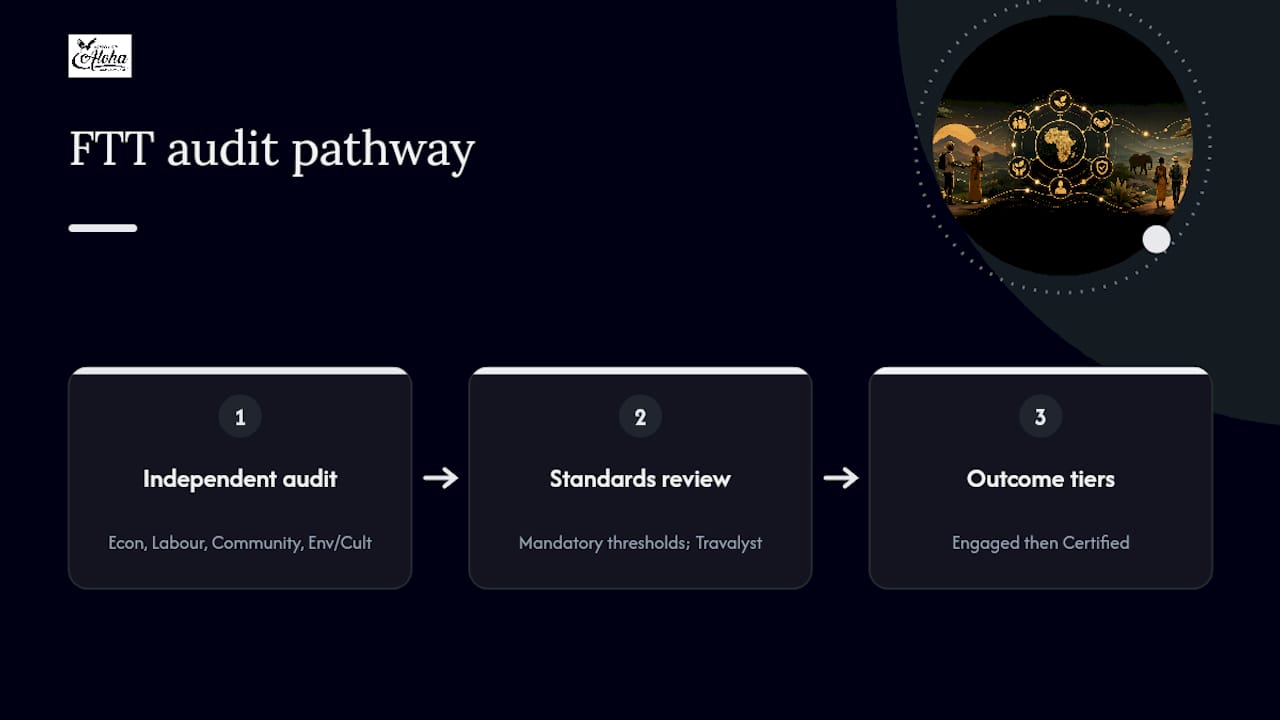
The audit gets specific. Auditors check procurement records to confirm local suppliers actually get contracts, review payroll for fair wage compliance, and inspect environmental systems for water, waste, and energy management, all detailed in the public FTT standard. Businesses fall into two tiers: Engaged, meaning they’ve started the process and are working toward full compliance, and Certified, meaning they’ve passed the full audit against the standard’s criteria.
That process is not a rubber stamp. StandardsMap’s overview of recent standard revisions shows a multi-criteria system with mandatory requirements and percentage thresholds businesses must clear, not a checklist they can partially complete. Fair Trade Tourism’s alignment with the global initiative Travalyst adds another layer of credibility, since that review process independently confirms FTT’s criteria hold up against broader sustainable tourism benchmarks.
Why Fair Trade Tourism Matters for Communities and Travelers
Choosing certified operators changes where your money actually lands. Research on community benefits shows certified enterprises direct tourist spending toward rural socio-economic development, worker training, and safety upgrades, evaluated specifically on local integration rather than assumed goodwill.

The leakage problem: In conventional tourism, a large share of what a traveler spends never touches the local economy. It flows back to foreign-owned hotel chains, imported goods, and outside tour operators. This is called leakage, and it’s the single biggest reason a beautiful destination can host thousands of visitors a year while nearby communities stay poor.
Fair Trade Tourism certification directly targets this. Certified businesses build local supply chains, prioritize local hiring, and track procurement to keep revenue circulating close to home. The result: local jobs that didn’t exist before, entrepreneurship opportunities for small suppliers, fair pay standards that lift household income, and cultural protections that stop heritage from being commodified for a photo op. Environmental commitments, from GHG attention to water management, round out the model so the destination itself doesn’t get degraded by the industry that depends on it.
How to Choose a Fair Trade Tourism Experience
Spotting the real thing takes about thirty seconds if you know what to look for.
- Look for the logo directly on the operator’s website or printed materials. It should link back to a verifiable listing, not just appear as a decorative badge.
- Ask what tier they hold. “Engaged” means in progress; “Certified” means they’ve passed the audit.
- Ask about local procurement. A legitimate operator can name specific local suppliers or cooperatives they work with.
- Ask about wages and community projects. Vague answers about “supporting the community” without a project name or outcome are a warning sign.
- Watch for staged cultural performances with no context or consent process. That’s the clearest marker of tokenism dressed up as heritage.
Pro Tip: Before booking, search the operator’s name alongside “Fair Trade Tourism certified” to confirm their status independently, rather than trusting a claim on their own homepage. For a broader framework on vetting any activity, this guide to responsible tourism walks through the same due diligence in more detail.
Where Fair Trade Tourism Thrives in Africa
Fair Trade Tourism was developed in Africa, originating with IUCN South Africa as a locally relevant response to a tourism industry that too often left historically disadvantaged communities out of the profits. It became one of the continent’s clearest pro-poor tourism mechanisms, built specifically to funnel capacity building and income toward people who had been sidelined for generations.
Certified enterprises span a wide range:
- Safari lodges and game reserves in Southern and East Africa that source staff and produce locally rather than flying in both.
- Community-run cultural tours, where residents guide visitors through their own villages and set the terms of what’s shared.
- Craft and artisan cooperatives, protected under the standard’s rules requiring consent and fair exchange before cultural items get sold or displayed.
A certified lodge might reinvest a share of bookings into a local school or clinic. A certified cultural tour might be entirely owned and staffed by the community it moves through, meaning the “experience” travelers pay for is also someone’s livelihood, not a performance for tips. For a regional comparison, Namibia’s ethical cultural tours show how community-first design plays out on the ground.
How Flight of Aloha Applies These Principles in Hawaii
Fair trade principles don’t stop at safaris and lodges. Flight of Aloha, Native Hawaiian-owned and built around cultural storytelling rather than generic thrills, applies a similar logic in Kona and at Whalers Village Kaanapali. Every film, from Naupaka to Lahaina to Whale Song, is developed with cultural consent and local storytellers, not borrowed imagery slapped onto a ride.
That mirrors fair share and respect in practice: local artists get credited and compensated, and the legends told are told with permission, not extraction. For visitors comparing options, this kind of grounded, community-engaged approach to Hawaiian tourism is worth the same scrutiny you’d apply to a certified lodge abroad. It also solves a practical problem: on a rainy day in Kona, or when Vog rolls in and outdoor plans fall apart, Flight of Aloha’s air-conditioned theater is the comfortable, culturally rich alternative that doesn’t require a $400 helicopter ticket or a stomach built for turbulence.
The Real Test of Fair Trade Tourism
The conventional advice on fair trade tourism stops at “look for the logo,” and that’s not wrong, but it’s incomplete. The logo tells you an audit happened. It doesn’t tell you whether you, as a traveler, are willing to ask a second question when the first answer sounds rehearsed.
What the research actually supports is this: certification works because it forces transparency on procurement and wages that most operators would rather keep vague. That’s the leverage point. Where most guides fall short is treating fair trade tourism as a checkbox instead of a habit; the traveler who asks about local hiring at a certified lodge in Namibia should ask the same question about the attraction they book back home.
Prioritize the operators, wherever you travel, who can name a specific project, a specific supplier, or a specific percentage. Flight of Aloha earns that same scrutiny well: Native Hawaiian-owned, walking distance from the Kailua Pier tender dock for cruise visitors, and consistently ranked among the top three most accessible activities in Kona and Maui. It’s the rare attraction that gives you aerial-feeling views of the islands without the cost or motion sickness of a helicopter tour, and the best air conditioning in town when the heat or Vog makes indoor plans the smart call. Book online to secure your seat.
— Ola