
Immersive Theater: How Flight of Aloha Uses 8K, Motion, and Scent

Immersive theater puts you inside the story instead of watching it from a seat. Performers and audience share the same physical space, the traditional wall between stage and crowd disappears, and you often get to move, choose, and interact rather than sit still. This guide breaks down the core elements, shows you real examples, and tells you exactly what to expect the first time you walk into one.
TL;DR:
- Most immersive theater experiences last from sixty to ninety minutes and require guests to walk, explore, and follow their curiosity within a multisensory environment.
- Authentic immersion depends on structured audience agency, environmental story weight, and sensory design, not just fog machines or projections.
- The genre evolved from ritual and promenade staging, with recent advances in technology enabling scale and sensory richness across various formats.
- Genuine immersive theater cannot be experienced fully from a fixed seat, as movement and choice are integral to its storytelling and engagement.
- Hybrid attractions, like Hawaii’s Flight of Aloha, demonstrate immersion through technology and cultural storytelling, offering accessible, repeatable experiences without live performers.
What Is Immersive Theater, Exactly?
Immersive theater is a genre where the audience is physically placed inside the performance environment, live performers interact directly with visitors, and the fourth wall between “stage” and “seats” is removed or radically softened. It is not a technique borrowed for a single scene. It is a design philosophy that reshapes the whole production, from the architecture of the room to how a ticket is torn.
Practitioners writing for HowlRound describe it as a genre built from multisensory stimulation, spatial environment, audience agency, and respect for storytelling working together, not any one of those pieces alone. That framing matters because plenty of shows borrow one ingredient and slap “immersive” on the poster.
Here is the boundary test that actually holds up: if you can watch the entire show from a fixed seat and nothing changes whether you move or stay put, it is not immersive theater no matter how many fog machines or projection walls are involved. Academic work on companies like Punchdrunk frames genuine immersion as an evolution of spatial dramaturgy, where the environment itself does storytelling work and the audience becomes a co-creator of meaning rather than a passive witness, according to research on audience immersion and Punchdrunk’s staging methods.
A useful shorthand: immersive experience is the feeling (a temporary, graded psychological state you can get from a great film or a theme park ride), while immersive theater is the specific genre engineered to produce that feeling through live performance, per the same Punchdrunk-focused research linked above. The two terms get conflated constantly, and that confusion is exactly why so many “immersive” marketing claims fall apart on closer inspection.
The form generally shares these attributes:
- No fixed seating separating performers from the crowd
- Audience movement through real, built, or dressed environments
- Live performers who acknowledge and sometimes speak directly to visitors
- Sensory layers beyond sight and sound, including touch, scent, or taste
- A narrative structure that the audience pieces together rather than receives linearly
- Some degree of individual choice in what you see, when, and how closely
Miss two or three of those, and you are probably looking at a cousin genre, like site-specific theater or a themed escape room, rather than the real thing.
Key Elements That Define Immersive Theater
Six elements show up again and again in how practitioners and critics describe this genre, and understanding each one changes how you experience a show, not just how you classify it.
Sensory design and presence. Great immersive work does not just show you a room; it makes you feel like you are standing in a real place, and that is deliberate engineering. Sound design that shifts depending on where you stand, scent cues tied to specific rooms, and tactile surfaces you are meant to touch all build what practitioners call “presence,” the sensation that your body genuinely occupies the fictional world. A detailed breakdown of the form’s six defining elements puts multisensory design near the top of the list precisely because it is the fastest way to convince a skeptical brain it has left the lobby behind.
Spatial dramaturgy and scenography. In conventional theater, the set supports the story. In immersive work, the space often is the story. A creative team might spend more hours dressing a single hallway than blocking an entire scene, because every drawer, note, and stain on a wall is a narrative clue. This is the piece scholarship on Punchdrunk keeps returning to: environment and interactivity working together to let the spectator build their own version of events.
Audience agency and participation structures. Some shows hand you a mask and let you wander freely for ninety minutes. Others use gentle guides, one-on-one encounters, or timed doors to control agency without you noticing the leash. Either way, agency has to be structured, not just offered. Unstructured freedom in a large cast show usually produces confusion, not wonder, which is why production teams spend enormous effort on subtle wayfinding.
Narrative strategies for non-linear comprehension. You will rarely get the full story on one visit, and that is intentional. Immersive productions typically loop scenes, repeat key beats in different rooms, or scatter documents and objects that reward attentive visitors. This design choice sacrifices clarity for depth, betting that audiences will piece together meaning across multiple viewings or through comparing notes with friends afterward.
Social dynamics and individualized experience. Two people who “saw the same show” often describe two different nights. One followed a particular performer down a corridor and got pulled into a private scene; the other spent the whole night in a ballroom watching a group dance unfold. That variability is a feature, and it is also why word-of-mouth about immersive shows tends to be wildly inconsistent, which frustrates literal-minded reviewers and delights repeat visitors.
Installation overlap. Many immersive productions blur into gallery or museum territory, where you could technically walk through the set with no performers present and still get something from it. That overlap is real and worth knowing about, because it explains why some “immersive” experiences feel closer to walking through art than watching theater.
- Design layers sensory input across sight, sound, scent, and touch
- Space carries narrative weight equal to dialogue or performance
- Agency is structured, rather than left fully open
- Story unfolds non-linearly and rewards repeat visits
- Social experience varies significantly between visitors on the same night
Pro Tip: Arrive without a plan for what you want to “see.” The visitors who leave immersive shows disappointed are almost always the ones chasing a specific plot thread instead of following their curiosity into whatever room pulls at them first.
Real Examples of Immersive Theater in Action
Case studies make the abstract elements click. Here are five productions and formats that show the range of the genre, from Off Broadway warehouses to attraction-scale technology.
- Sleep No More. This long-running New York production reimagines Macbeth across a multi-floor Scottish hotel setting, with masked audiences wandering freely between simultaneous scenes. It became the reference point for the entire genre because it proved audiences would pay for the right to get lost inside a story rather than watch it from a chair.
- Then She Fell. A far more intimate production, this one limited its audience to a small handful of visitors moving through an Alice in Wonderland inspired asylum setting, with one-on-one performer encounters built into the structure. It demonstrated that immersive theater scales down just as powerfully as it scales up.
- Promenade theater formats. Rather than a fixed set, these productions move the entire audience as a group from location to location, often outdoors or through real streets and buildings. This variation trades individual wandering for shared movement, proving immersion does not require total freedom to work.
- Museum-installation hybrids. A growing number of productions blend gallery-style walkthroughs with scheduled live scenes, letting visitors explore at their own pace before performers arrive. These hybrids show how the line between immersive theater and immersive art installation keeps getting blurrier as both fields borrow from each other.
- Technology-driven flying theater. Modern attractions increasingly use motion effects, wide-format visuals, and environmental cues like scent and wind to simulate presence in a place without live human performers in the room, trading some intimacy for scale and repeatability.
The through line across all five: whether the budget is a single rented storefront or a custom-built attraction space, the goal never changes. Get the audience’s body and senses to agree that they are somewhere else.
Flight of Aloha: A Modern Take on Immersive Storytelling
Immersive theater does not have to mean a warehouse full of hidden rooms. Flight of Aloha builds the same core principle, putting the audience inside the story rather than in front of it, using flying-theater technology instead of a traditional set.
The attraction combines 8K visuals, motion effects, scents, and wind to simulate the sensation of flying over the islands, according to Flight of Aloha’s own explanation of immersive flying. That lineup maps directly onto the sensory design and presence element covered above: sight, motion, and smell working in concert so your body believes it is airborne, not seated in a theater.
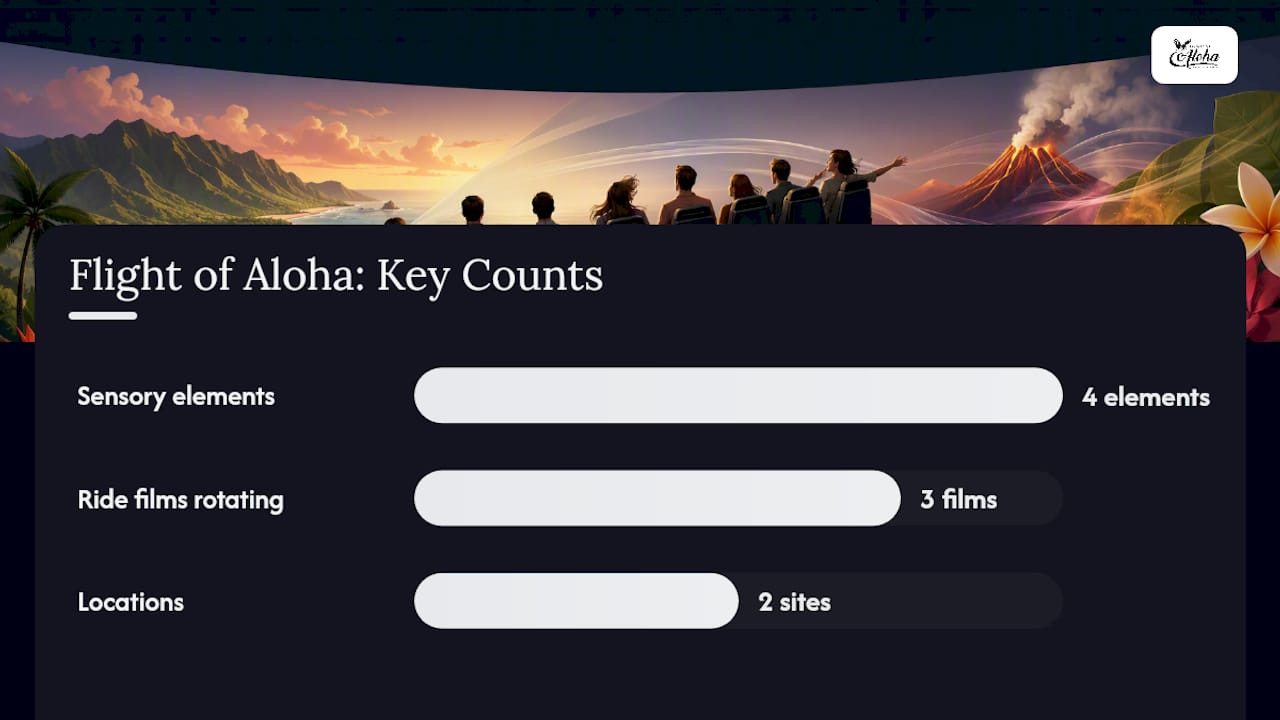
Where the format earns its place in a conversation about immersive theater rather than just special effects is the narrative frame. Ride films like Naupaka and Lahaina are built around Hawaiian legends and cultural storytelling, giving the sensory spectacle a story to serve rather than letting the technology stand alone.
A few practical notes worth knowing:
- Locations sit in Kailua-Kona and Whalers Village Kaanapali on Maui, putting the experience in two of the islands’ busiest visitor corridors.
- The format is Native Hawaiian-owned, with storytelling rooted in local legend rather than a generic theme-park script.
- Multiple ride films rotate through the lineup, including Naupaka, Lahaina, and Europe, so repeat visits offer different stories rather than the same loop.
It is a useful reminder that immersive storytelling is not locked to one production style. The same principles that built ride-film technology across Hawaii show up in a completely different format, just with a flight harness instead of a mask and a hallway.
What to Expect at an Immersive Show
Walking into your first immersive production without a mental map of how the night unfolds is the single biggest reason people leave confused instead of thrilled.
Most shows follow a loose but recognizable flow: check in, get outfitted (a mask, a key, a costume piece, or nothing at all depending on the production), receive brief verbal or written instructions, then move into the environment either freely or as part of a guided group. Duration typically runs sixty to ninety minutes for theatrical productions, though attraction-scale formats can run considerably shorter since they are designed for repeat visits rather than a single long evening.
Accessibility varies enormously by production, and it is worth checking specifics before you book. Shows with heavy fog, strobe lighting, or loud sudden sound cues should flag those triggers in advance, and productions built for physical wandering may not accommodate mobility limitations well unless the venue explicitly says otherwise.
A few practical basics go a long way:
- Wear closed-toe shoes and clothes you can move in; some venues genuinely mean it when they say “expect to walk.”
- Book tickets ahead for anything with a reputation, since capacity is often capped to protect the intimacy of the design.
- Leave bulky bags at coat check if offered. Wandering environments and shoulder bags do not mix well.
- Ask staff about sensory triggers if you have any sensitivity to strobe lighting, loud noise, or strong scent design.
Pro Tip: If a performer singles you out for a one-on-one moment, say yes. Those scenes are almost always the most carefully written material in the entire production, and they disappear the moment you hesitate or step back into the crowd.
Interactive vs. Immersive: How to Tell Them Apart
The words get used interchangeably in marketing, but they describe genuinely different experiences, and a quick heuristic clears up most of the confusion.
Interactive theater invites limited audience input, often a single moment of choosing an outcome or answering a performer’s question, while everyone otherwise stays in fixed seats. Participatory theater goes further, asking the audience to physically join scenes, but usually within a bounded, structured game rather than a fully built world. Site-specific theater uses a real, non-theater location (a mansion, a warehouse, a park) as its setting, but the audience may still watch from a fixed vantage point rather than wander. Virtual reality experiences simulate an environment digitally through a headset, with no live performers sharing physical space with you at all. Immersive theater combines several of the above: physical enclosure inside the world, live performers who acknowledge you directly, and real agency over where you go and what you see.
Practitioners and critics have flagged widespread mislabeling of the term, noting that plenty of shows marketed as “immersive” only meet one or two of the real criteria, according to analysis from Immersology on what genuinely qualifies as immersive theatre.
The fastest classification test: ask whether you could remove your own movement from the experience and lose nothing. If the answer is yes, it is interactive or site-specific, not immersive. Immersive theater falls apart the moment you take away the audience’s ability to choose where their own body goes next.
A Brief History of How Immersive Theater Evolved
Immersive theater did not appear fully formed in the 2000s; it descends from a much older lineage of ritual, promenade performance, and environmental staging that theater scholars have been tracing for decades.
Ritual practices across cultures have long placed participants physically inside ceremonial space rather than watching from a distance, and 20th century experimental theater movements picked up that thread deliberately, building promenade productions that moved audiences through multiple rooms decades before the word “immersive” entered marketing copy. What changed in the 2000s was scale and ambition, particularly through UK companies like Punchdrunk, whose large-format, multi-floor productions became the reference point that academic work on spatial dramaturgy now treats as a case study in its own right, per research into environment, interactivity, and narrative in Punchdrunk’s work.
That scholarship frames the form as a continuum rather than a trend: ritual gave way to site-specific staging, site-specific staging gave way to promenade theater, and promenade theater gave way to the fully environmental, audience-as-co-creator model that dominates today. Understanding that lineage matters because it reframes immersive theater as a mature evolution of staging technique, not a gimmick invented to sell tickets.
Technology accelerated the next stage of that evolution. Wireless audio, motion effects, and high-resolution projection let smaller teams achieve sensory effects that once required massive built sets, which is part of why the form now shows up everywhere from boutique Off Broadway productions to attraction-scale flying theaters.
Why Immersive Theater Matters to Audiences and Creators
The appeal is not just novelty. Presence, the sensation of genuinely being somewhere, tends to create emotional memories that outlast a typical night at a conventional show, and that lasting impression is exactly what keeps audiences returning to productions they have already seen.
There is a social dimension too. Because no two visitors see quite the same version of an immersive production, audiences leave with different stories to compare, which turns a single show into weeks of conversation rather than a one-time review. That variability, which frustrates critics trying to write a definitive review, is precisely what gives immersive theater its social staying power.
For creators and venues, the format opens engagement and revenue models that conventional seated theater cannot match. Timed-entry ticketing, VIP add-ons, repeat-visit passes, and merchandise tied to specific characters all work naturally within an immersive structure in ways that feel forced in a proscenium house. Audience agency is not just an artistic choice; it is a business model that rewards repeat attendance, and it is a big part of why the format has spread from experimental theater into attractions, museums, and hospitality spaces alike.
Why Storytelling and Sensory Design Belong Together
Cultural storytelling only works when it is treated with real respect for its source, not repackaged as generic spectacle. That belief shapes how immersive design should be approached, whether the medium is a warehouse full of hidden rooms or a motion-based ride film built around Hawaiian legend.
The practical tips throughout this piece, arriving without a fixed plan, saying yes to one-on-one moments, checking sensory triggers ahead of time, come from the same design logic that governs any well-built immersive experience: sensory layers and narrative structure only succeed when they are built around a story worth telling, not the other way around. Multisensory tools like scent, motion, and wind are means, never the point.
Anyone curious about this genre should seek it out with curiosity rather than a checklist. Sit with the discomfort of not knowing the whole plot. Let a performer lead you somewhere unplanned. That is where immersive theater actually delivers on its promise.
— Ola
Skip the Helicopter, Fly With Flight of Aloha Instead
A helicopter tour over Hawaii is expensive per seat, requires good weather, and leaves a fair number of passengers queasy by the halfway point. Flight of Aloha delivers the same aerial wonder, soaring over volcanoes, waterfalls, and coastline, from a seat that never leaves the ground, with no motion sickness risk and none of the helicopter price tag.

It also solves a problem helicopter tours cannot: what to do when Kona vog rolls in or Maui skies open up. Flight of Aloha runs indoors with some of the best air conditioning in town, making it the go-to plan for rainy days in Kona, rainy days in Maui, or simply escaping the heat between beach stops. The Kailua-Kona location sits walking distance from Kailua Pier and the cruise tender dock, making it a natural fit for a quick shore excursion, while the Whalers Village Kaanapali location puts the same experience steps from Maui’s busiest resort strip. As a Native Hawaiian-owned attraction, every ride film is built around real cultural storytelling rather than a generic script.
Start with a single feature like Naupaka or Lahaina, upgrade to the Double Feature Flying Ride for two stories in one visit, or go all in with the VIP Package for the full experience. Frequent visitors can save with the Annual Pass at $200 a year. Book online to secure your seat.
Sources
For a deeper dive beyond this guide, HowlRound’s practitioner definition of immersive theatre covers the genre’s core elements in detail, while academic research on audience immersion in Punchdrunk’s work unpacks the historical and scholarly framing. For a multisensory travel angle, see this guide to defining culinary experiences.
- Immersive Theatre, Defined
- Audience Immersion: environment, interactivity, narrative in the work of Punchdrunk
- What is immersive theater? The six elements that define it at its best
FAQ
What Is Immersive Theatre?
Immersive theatre is a genre where the audience is physically placed inside the performance environment and interacts directly with live performers, rather than watching from fixed seats. Core elements include multisensory design, structured audience agency, and spatial storytelling, according to HowlRound’s definition of the form.
What Should I Expect at an Immersive Show?
Expect to check in, receive brief instructions, and then move through a built environment either freely or as part of a small guided group, typically for sixty to ninety minutes. Comfortable shoes matter more than formal wear, since many productions genuinely expect you to walk and explore.
What Is the Difference Between Interactive and Immersive?
Interactive theater usually limits audience input to a single scripted moment while you remain seated, while immersive theater surrounds you in the environment and gives you real agency over where you go and what you see. The fastest test: if removing your own movement changes nothing about what you experience, it is interactive rather than immersive.
What Does “Immersive” Mean at an Attraction Like a Flying Theater?
At an attraction like Flight of Aloha, “immersive” describes the combination of 8K visuals, motion effects, scents, and wind used to simulate flight and place you inside a Hawaiian legend rather than watching it on a screen. It borrows the same presence-building principle as immersive theater, just through technology rather than live performers sharing the room with you.
How Much Does It Cost to Visit Flight of Aloha?
Single ride films like Naupaka, Lahaina, or Europe run $29.99 to $34.99 per person, with the Double Feature Flying Ride priced between $49.99 and $59.99 for two stories in one visit. The VIP Package runs $69.99 to $79.99, and current pricing details are always listed on the booking site.