
Flight Simulator X: A $400 Alternative for Hawaii Tourists
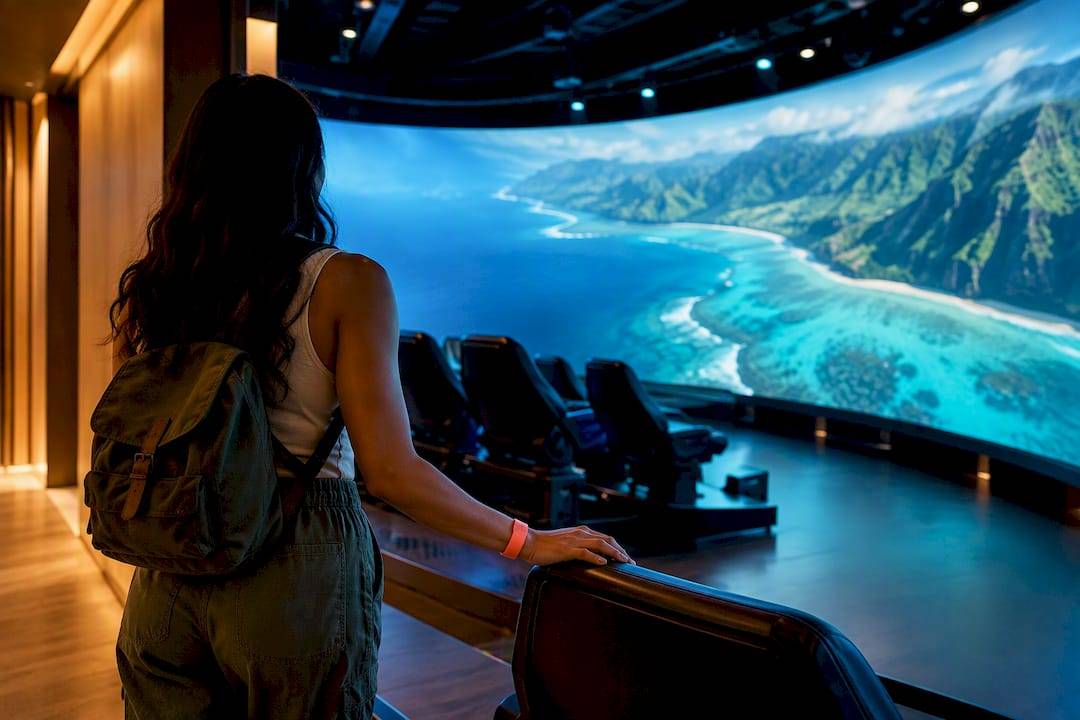
When people ask what is flight simulator x in the context of Hawaii, they usually mean Flight of Aloha, the indoor flying-theater attraction in Kailua-Kona and Whalers Village Kaanapali. It uses 8K visuals, motion effects, wind, and scents to simulate flying over the islands. Every show is family-friendly, fully indoor, and built around Hawaiian cultural storytelling rather than a screen and a joystick.
TL;DR:
- The theater uses 8K visuals, synchronized motion, wind, and scents to simulate flying over Hawaii’s landscapes, grounded in Hawaiian storytelling.
- Each ride focuses on a specific Hawaiian legend or site, with no aircraft to pilot and a short, emotionally engaging experience suitable for all ages.
- The indoor, climate-controlled environment makes it a reliable activity regardless of weather conditions like vog, rain, or wind.
- Ticket options include single rides, double features, VIP upgrades, annual passes, and gift cards, fitting different budgets and visit durations.
- The experience is a cost-effective alternative to helicopter tours, with less motion sickness risk and closer proximity to cruise ship docks for easy shore excursions.
What Is a Flying Theater and How Does It Simulate Flight?
A flying theater is a themed-entertainment ride that uses a motion system synchronized with a large panoramic screen, sound, and special effects to trick your senses into believing you’re airborne. It’s the same broad category of attraction found at major theme parks worldwide, just built at a scale that fits a Kona storefront or a Maui shopping center instead of a 20-acre park.
There are two main formats. Suspended-seat theaters lift riders in front of a giant curved screen, legs dangling, arms often out like wings. Platform-based theaters use a motion base under fixed seating, tilting and shifting in sync with the film. Platform systems tend to be more compact, which is exactly why this format works inside a mall or a local attraction space rather than requiring a stadium-sized building.
The tech stack behind the illusion has three linked pieces:
- Ultra-high-resolution projection. Curved or dome screens running in 8K make the horizon feel continuous, not like a flat movie.
- Synchronized motion platforms. Seats move in multiple directions at once, timed to banking turns, drops, and climbs on screen.
- Environmental effects. Wind, mist, and scent cues hit at the exact moment the film shows a waterfall or a flower field below.
Yaisu Tech breaks this down as panoramic imaging, motion platforms, and environmental effects working together, and that synchronization is the whole trick. If the wind hits a half-second late, the illusion falls apart. Done right, your brain stops questioning it.
Between 2013 and 2021, roughly 50 panoramic flying theaters opened worldwide as projection and motion-control technology matured, turning what used to be a rare theme-park novelty into a format compact enough for smaller venues, including malls and family entertainment centers.
What Ride Films and Experiences Does Flight of Aloha Offer?
Flight of Aloha runs four distinct ride films, plus a double-feature option for guests who want more than one flight in a single visit. Each film pairs the motion and visual technology with a story rooted in Hawaiian legend, written and produced with Native Hawaiian ownership behind the brand.
- Naupaka follows the Hawaiian legend of the naupaka flower, soaring over coastline and valley scenery tied to the story.
- Lahaina takes riders over historic and cultural landmarks on Maui, framed around the town’s storytelling heritage.
- Whale Song carries guests above and alongside Hawaii’s migratory humpback whales, leaning into the islands’ marine identity.
- Europe Merrie Monarch connects to the Merrie Monarch hula tradition, a different angle on the cultural throughline running through every film.
That storytelling emphasis isn’t incidental. Flying theaters as a category increasingly lean on narrative and local content to boost emotional engagement, and Flight of Aloha built its entire lineup around that principle instead of generic aerial footage.
On the sensory side, every seat gets the full package: 8K visuals on a curved screen, synchronized motion, wind, and scent cues that shift with the scene. The experience is indoor, climate-controlled, and designed for all ages and abilities.
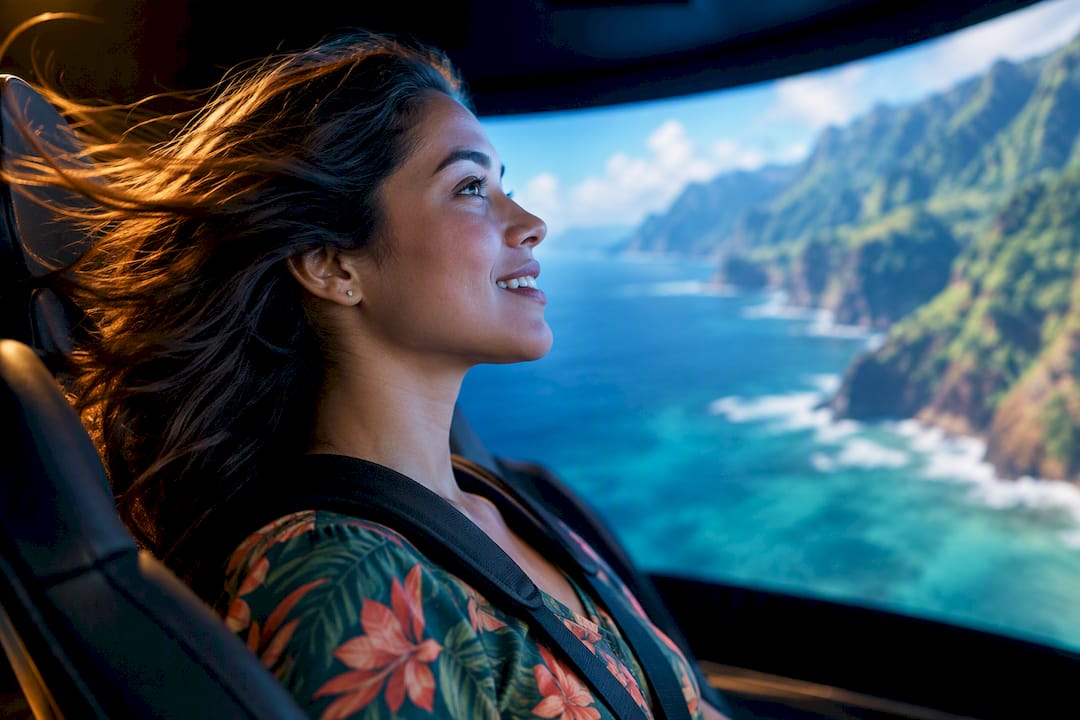
Ticket options scale with how much time and budget a guest wants to spend. A single flight works for a quick stop. The double feature suits families with a free afternoon. The VIP Package adds premium extras for anyone who wants the top-tier version. Locals and repeat visitors can grab the Annual Pass for $200 a year, and gift cards are available for anyone gifting the experience rather than booking it themselves.
Pro Tip: If vog is thick over Kona or rain is rolling into Kaanapali, this is one of the few Hawaii activities that doesn’t care what the sky is doing. The theater is indoor and climate-controlled, so it’s a reliable backup plan, not just a fair-weather activity.
How Should Tourists and Cruise Visitors Plan a Visit?
The Kona location is within walking distance of the nearby pier and tender dock, making it suitable for shore excursions. No shuttle, no rental car, no timing gamble against a departure horn. The Whalers Village Kaanapali location puts the same experience inside Maui’s most walkable shopping and dining strip, easy to combine with lunch or beach time.
- Pick your ticket type first. Single flights run 30 to 45 minutes, double features roughly double that, so match your choice to how much time you have on shore or on the schedule.
- Book online before you arrive. Walk-ins are welcome when seats are open, but cruise schedules are tight, and reserving ahead guarantees your slot.
- Arrive 15 minutes early. Boarding for motion seating takes a little longer than a standard movie theater, especially with kids or larger groups.
- Flag any motion-sickness concerns at the counter. Staff can seat you strategically, and the platform motion is gentler than most theme-park simulators.
- Bring nothing extra. No headsets, no gear, no sunscreen reapplication. It’s indoor, air-conditioned, and done in under an hour either way.
What Is Flight Simulator X as PC Software?
Outside the Hawaii attraction context, “Flight Simulator X” is also the commonly searched name for a PC-based flight simulation video game, originally released in the mid-2000s as a civil aviation simulator. That software lets players pilot virtual aircraft from a home computer, using a mouse, keyboard, or joystick to manage takeoff, cruising, and landing across simulated airspace.
It’s worth separating the two clearly, since the phrase gets searched by two very different audiences. One is a home flight-sim enthusiast looking for cockpit software. The other, and the focus of this guide, is a traveler wondering what to do in Kona or Kaanapali on a rainy afternoon. Flight of Aloha isn’t software you install. It’s a physical, indoor attraction you walk into, sit down in, and experience with your whole body, not just your hands on a controller.
The distinction matters for expectations. PC flight simulation software is built for depth: realistic instrument panels, weather modeling, and long-haul route planning that can take hours to fly. Flight of Aloha compresses that same fantasy of flight into a short, sensory, story-driven ride that anyone can enjoy without touching a control stick or learning a single button layout.
What Features Define the Flight Simulation Genre?
PC flight simulation software generally centers on a few core mechanics: cockpit instrument realism, free-roam world maps, and physics-based flight models that respond to throttle, pitch, and yaw inputs. Players typically choose an aircraft, set a route, and manage the full flight cycle themselves, often referencing real-world charts and procedures.
That genre rewards patience and repetition. Learning a realistic instrument approach can take practice sessions spread over days. It’s a hobby built around mastery, not a quick 40-minute outing.
Flight of Aloha borrows the appeal of flight, the sense of soaring over dramatic terrain, without any of that learning curve. There’s no throttle to manage and no procedure to memorize. You sit down, the motion platform and 8K visuals do the flying, and the wind and scent effects handle the immersion. The “gameplay,” if you can call it that, is simply experiencing the story unfold around you, whether that’s the naupaka flower legend or a flight along Maui’s coastline.
What Kinds of Aircraft and Terrain Appear in Flight Sims?
Home flight simulation software typically includes a range of aircraft, from small single-engine trainers to commercial jets, alongside detailed digital recreations of real-world airports and terrain. Players can often fly across entire continents, switching between cities, mountain ranges, and coastlines within the same session.
Flight of Aloha takes a narrower, more curated approach by design. Instead of an open world of global airports, each ride film focuses on a single Hawaiian story and setting: the coastline tied to the naupaka legend, historic Lahaina, migratory whale routes, or the Merrie Monarch hula tradition. There’s no aircraft selection screen because there’s no aircraft to pilot. The “environment” is Hawaii itself, rendered in curved 8K projection and reinforced by real wind and scent cues rather than rendered weather effects.
That trade-off is deliberate. A home flight simulator optimizes for range and realism. Flight of Aloha optimizes for a tight, emotionally resonant story you can finish in well under an hour, with none of the setup time a detailed simulator demands.
What Do You Need to Run Flight Simulation Software?
PC flight simulation titles are notoriously demanding on hardware. Detailed weather, high-resolution scenery, and complex flight physics require a capable graphics card, a fast processor, and a fair amount of storage, and older machines often struggle to run newer add-ons smoothly. Players frequently spend as much time troubleshooting settings as they do flying.
Flight of Aloha has no system requirements for guests, because there’s no software to install and no hardware to own. The equivalent of a “high-end rig” is the theater’s own 8K projection system and synchronized motion platform, already built into the Kona and Kaanapali locations. You show up, sit down, and the ride handles every technical layer itself. For a traveler who just wants a great activity without downloading anything or owning a gaming PC, that’s the entire appeal.
How Does This Differ From Other Flight Simulators?
Traditional PC flight simulators differ from each other mostly in scope: some focus on hyper-realistic commercial aviation, others on casual arcade-style flying, and others on specific aircraft types like helicopters or military jets. Choosing between them usually comes down to how much realism versus accessibility a player wants.
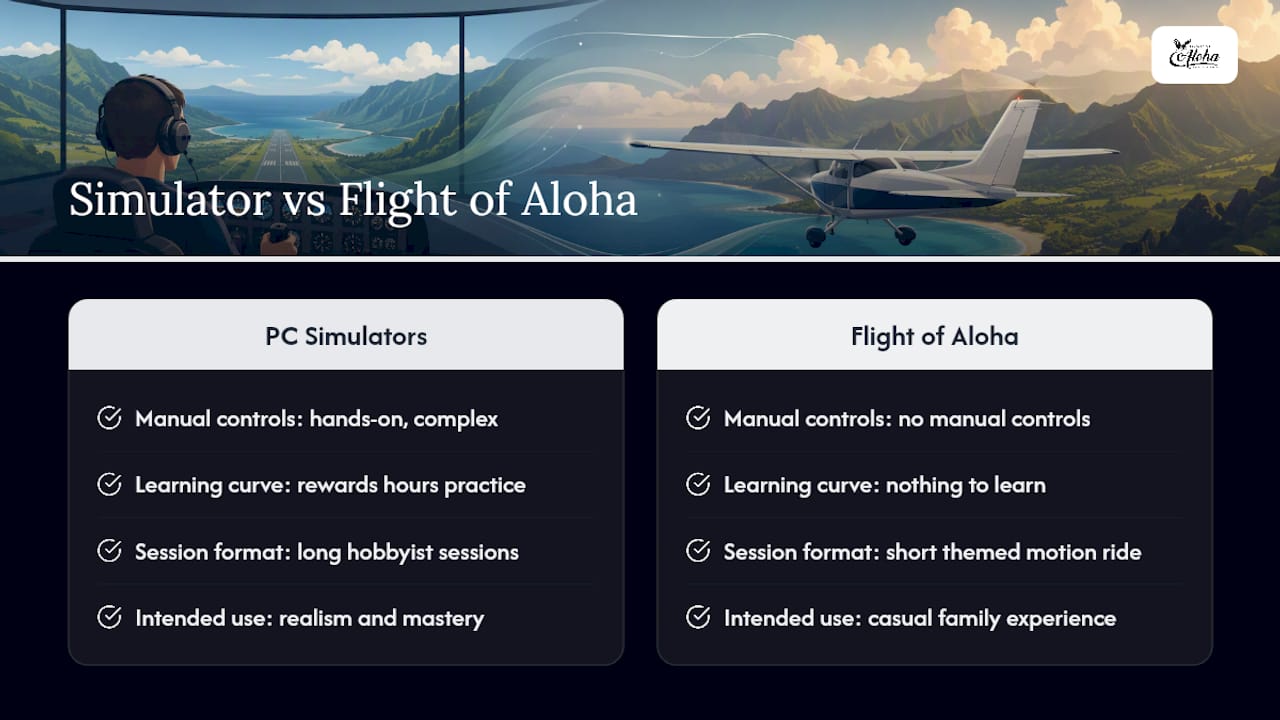
Flight of Aloha sits in a different category entirely, closer to a themed motion ride than a simulator in the traditional sense. A flying cinema like this delivers the sensation of flight through panoramic projection and a moving platform rather than manual controls, which means there’s nothing to learn and no skill ceiling to hit. Where flight sim software rewards hours of practice, Flight of Aloha rewards simply showing up. It’s built for a family on a two-hour window between lunch and the beach, not a hobbyist with a weekend to spare.
What Add-Ons Enhance the Flight Experience?
PC flight simulation communities rely heavily on third-party add-ons: extra aircraft models, upgraded scenery packs, and weather modules that extend the base software well beyond its original scope. Finding, installing, and updating these add-ons is often half the hobby.
Flight of Aloha’s version of an “add-on” is simpler and requires no downloads. The double-feature option lets you add a second ride film to your visit instead of stopping at one. The VIP Package upgrades the experience itself with premium seating and extras. For guests who visit Kona or Kaanapali often, the Annual Pass works like an unlimited content pack for $200 a year, and gift cards let you hand the whole experience to someone else without them lifting a finger to set anything up.
Why This Beats a Helicopter Tour for Most Visitors
A helicopter tour and Flight of Aloha are chasing the same feeling: soaring over Hawaii’s coastline, valleys, and surf from above. The difference is what it costs you to get there. Helicopter tours can run around $400 per person, come with real motion-sickness risk, and get grounded or delayed by weather, vog, or wind. Flight of Aloha offers an aerial-view sensation combined with cultural storytelling, at a lower cost.
The comfort math tips heavily in the theater’s favor too. It’s indoor and climate-controlled, so it doesn’t matter if Kona is soupy with vog or Kaanapali is getting an afternoon downpour. Families skip the weight limits, the safety briefings, and the risk that a toddler gets airsick mid-flight. Cruise passengers skip the scheduling anxiety of a weather-dependent excursion entirely.
To be fair, a helicopter still wins for one thing: if you want actual aerial photography of a specific route, or you’re set on genuinely leaving the ground, no theater replicates that. But for most travelers who just want the feeling of flying over Hawaii without the cost or the risk, the flying theater format holds up remarkably well. You can read more on that helicopter versus simulation ride comparison if you’re weighing both options for a trip.
— Ola
Ready to Book Your Flight Over Hawaii?
Flight of Aloha is an alternative to helicopter tours for those seeking Hawaii’s aerial views without high costs or motion-sickness risk. It is Native Hawaiian-owned, fully indoor with climate control, and located near the Kailua Pier tender dock in Kona, with a second site in Whalers Village Kaanapali on Maui.

Whichever film calls to you, Naupaka for the flower legend, Lahaina for the historic coastline, or the double feature if you want two stories in one visit, every ticket comes with the same 8K visuals, motion, wind, and scent that make this the most accessible attraction in Kona and Maui. Frequent visitors and locals can lock in the Annual Pass, and gift cards are always an option if you’re planning ahead for someone else’s trip. Book online to secure your seat.
Sources
- Flying theater – Wikipedia
- Technologies and Key Attractions of Flying Theaters – Brogent
- The Future of Immersive Entertainment: Why Flying Cinema is a Game-Changer for Modern Venues – MetaPano
- What is the principle of a flying cinema? – Yaisu Tech
FAQ
What Does “Flight Simulator X” Mean at Flight of Aloha?
In this context, it refers to Flight of Aloha’s indoor flying-theater attraction in Kailua-Kona and Whalers Village Kaanapali, not PC flight simulation software. It uses 8K visuals, motion effects, wind, and scent to simulate flying over Hawaii through short, story-driven ride films.
How Much Does a Flight of Aloha Ticket Cost?
Single ride films like Naupaka and Lahaina run $29.99 to $34.99, while the double feature runs $49.99 to $59.99 and the VIP Package runs $69.99 to $79.99. The Annual Pass is $200 per year for unlimited visits.
Is Flight of Aloha Good for a Rainy Day in Kona or Maui?
Yes, it’s one of the best rainy-day options on either island since the entire experience is indoor and climate-controlled. It also works well when vog or heat makes outdoor activities uncomfortable.
Can Cruise Passengers Visit During a Port Stop?
The Kona location sits within walking distance of the Kailua Pier and tender dock, making it an easy quick shore excursion. Booking online in advance is recommended given tight cruise schedules.
Does the Ride Cause Motion Sickness Like a Helicopter Tour?
The platform-based motion system is generally gentler than an actual helicopter flight, and staff can adjust seating for guests concerned about motion sensitivity. It’s a comparable aerial-view sensation to a helicopter tour with meaningfully less physical risk.