Immersive Travel Trends 2025: What You Need to Know 🌺
Most travelers still picture a trip as a series of sights to check off a list. That assumption is quickly becoming outdated. The immersive travel trends 2025 is producing tell a very different story, one where travelers want to cook with a local family, herd reindeer with Sámi communities, or soar over volcanic coastlines with cultural legends woven into every frame. This shift is not a niche preference. It is rewriting how destinations market themselves, how operators design products, and how travelers measure a great trip. Whether you are planning your next adventure or developing experiences for guests, understanding what is driving this change gives you a real edge.
Key takeaways
| Point | Details |
|---|---|
| Hands-on beats passive sightseeing | Travelers rate cultural participation over observation, with cooking and craft bookings surging dramatically. |
| Tech deepens, not distracts | AR and AI work best when supporting storytelling and memory, not just adding visual novelty. |
| Slow travel builds lasting connection | Multi-day immersive journeys tied to community rhythms produce stronger satisfaction than rushed itineraries. |
| Planning intention matters | Choosing experiences with structured learning moments and skilled facilitators produces the most rewarding outcomes. |
| Hawai’i leads cultural immersion | Native Hawaiian-owned attractions in Kona blend stunning visuals with authentic cultural storytelling for memorable experiences. |
The rise of hands-on, culturally immersive experiences
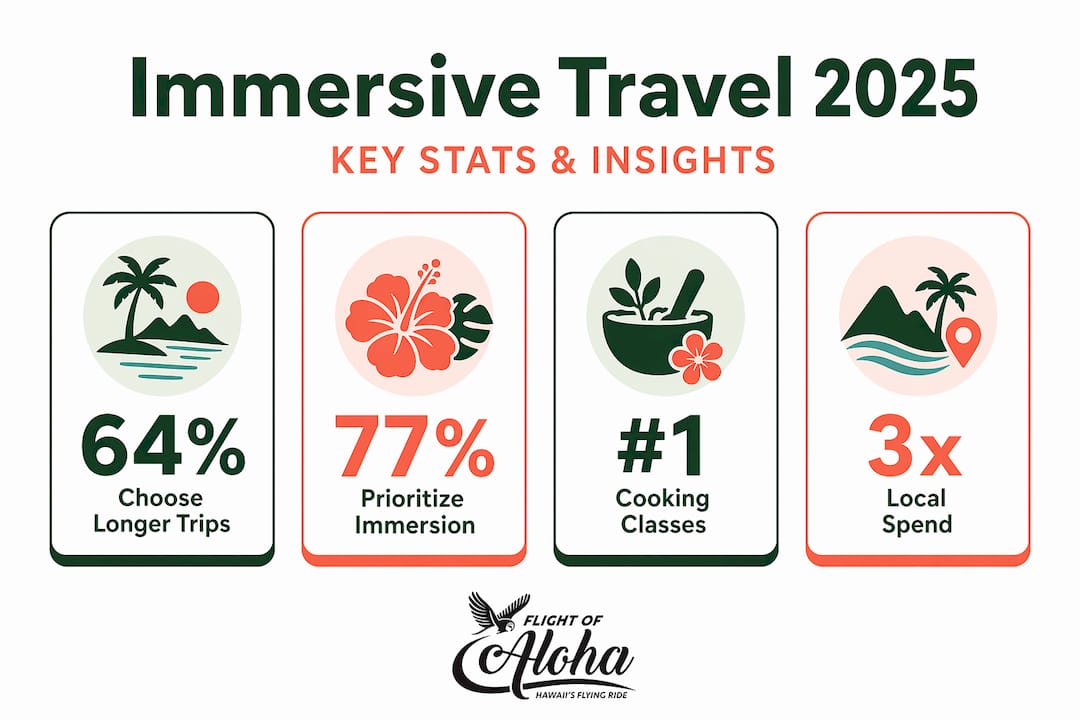
The numbers behind this shift are striking. According to Viator’s 2025 Travel Trends Report, cooking classes now rank in the top ten globally booked experiences, photography tours nearly doubled in bookings, and craft classes grew more than 50%. These are not casual additions to a vacation. They are becoming the reason people book a destination in the first place.
What is driving this? A major reorientation of what travelers consider rewarding. A survey of 1,000+ international travelers by EF Adventures and Qualtrics found that 77% rate cultural immersion as extremely or very important when booking a trip. Cultural education and meaningful connection now outrank adrenaline as primary motivators for adventure travelers. That is a profound shift for anyone designing or choosing travel experiences.
Here is what hands-on cultural immersion looks like in practice in 2025:
- Skill-building workshops led by local artisans, farmers, or chefs where travelers produce something real, whether a hand-woven textile, a batch of fermented hot sauce, or a traditional dish with the host family
- Indigenous community participation where guests follow daily rhythms rather than tourist schedules, from fishing expeditions to early-morning harvest routines
- Photography and storytelling tours that teach guests to document a place with intention, guided by local photographers who know the hidden light and the stories behind the streets
- Cultural learning as a booking priority, with travelers actively searching for programs that include genuine knowledge transfer, not just a performance of local life for visitors
The impact on destination economies is real too. When travelers participate rather than observe, spending shifts from passive (entry tickets, restaurant meals) toward active (workshop fees, direct artisan purchases, multi-day program enrollment). Communities benefit more directly. That is good for everyone.
Pro Tip: When searching for immersive cultural experiences, look specifically for programs with small group sizes and instructor-led learning moments. Viator’s data confirms that hands-on workshops with scripted, inclusive learning drive the highest satisfaction and repeat booking rates.
Technology’s role in immersive travel
Technology in travel has a reputation problem. For years, it meant selfie drones, generic audio guides, and QR codes leading nowhere interesting. The best operators in 2025 have moved well past that. What tech-enhanced immersion actually looks like now is far more purposeful.
Augmented reality overlays are being used at cultural heritage sites to show what a location looked like centuries ago, layering historical context directly onto the physical space a traveler is standing in. AI personalization is tailoring itineraries based on genuine interests, suggesting detours a guidebook would never include. And digital keepsakes, from personalized illustrated maps to video compilations tied to specific moments on a trip, are extending the emotional life of a journey well beyond the airport departure.
| Technology | Primary use in immersive travel | Traveler benefit |
|---|---|---|
| AR overlays | Contextual storytelling at cultural sites | Deeper historical and cultural understanding |
| AI personalization | Tailored itinerary and experience matching | More relevant, less generic travel moments |
| Digital keepsakes | Post-trip memory consolidation | Emotional connection that outlasts the trip |
| Immersive theater tech | 8K visuals, motion, scent, and wind simulation | Full sensory cultural storytelling |
According to Travelled.Online’s experiential travel research, technology is most effective in immersive travel when it supports interpretation timing and post-trip memory consolidation, not when it chases novelty. The distinction matters enormously for operators designing these products.
The practical application for travelers is straightforward: look for experiences where technology serves the story, not the other way around. If the app enhances what you see and feel at a specific location, it earns its place. If it pulls your attention away from the actual experience in front of you, it is getting in the way.
Pro Tip: When evaluating tech-forward travel experiences, ask the operator how the technology supports the cultural narrative. If they cannot answer that question clearly, the tech is likely decoration rather than depth. The most powerful immersive tourism experiences use technology as a delivery vehicle for meaning.
Slow travel, wellness, and multi-day immersive journeys
Speed is the enemy of depth. This is the insight behind one of the most powerful immersive travel trends 2025 is producing: the surge in slow travel and wellness-focused multi-day journeys.
Enchanting Travels reports that 64% of affluent travelers now prefer trips of 12 days or longer specifically to enable deeper cultural connection. Rushing through five cities in ten days produces Instagram content. Spending four days with a Sámi family near Alta, Norway, participating in actual reindeer herding tasks, sleeping in a lavvu, and sharing meals paced by nature’s schedule, produces something closer to transformation.
That Alta experience is one of the clearest illustrations of where future travel experiences are heading. The Sámi Slow Life program does not run on tourist time. Guests adapt to community rhythms rather than the reverse. There are no fixed performance moments staged for cameras. The experience unfolds around what the herd needs, what the weather permits, and what the hosts are genuinely doing that day. The result is a level of authenticity that no scheduled tour can replicate.
Here is why slow travel works so well for genuine immersion:
- Time removes performance pressure. Hosts and guests stop performing their roles after the first day. Real conversation and real cultural exchange happen when nobody is rushing to the next stop.
- Nature-based pacing builds wellness naturally. Multi-day immersions tied to outdoor rhythms, whether arctic winters or tropical coastlines, produce measurable reductions in stress without a formal wellness program attached.
- Deeper community investment follows longer stays. Travelers who stay longer spend more locally, engage more meaningfully, and carry more informed stories home. This benefits host communities far beyond the transaction of a single ticket.
- Memory consolidation is stronger. Research consistently shows that experiences spread over multiple days with reflection time between them produce more durable, emotionally resonant memories.
“Slow travel is not about moving less. It is about feeling more. When you let a place set the pace, you stop being a visitor and start becoming a temporary resident.”
Wellness micro-retreats embedded within cultural itineraries are also growing fast. Think forest bathing in Kyoto paired with a tea ceremony apprenticeship, or a morning of yoga at sunrise on volcanic rock followed by an afternoon with a traditional Hawaiian cultural practitioner. These combinations deliver the relaxation of a wellness retreat and the meaning of a cultural experience in a single trip.
Top immersive travel destinations to watch
Not all destinations offer the same depth of immersive opportunity. Here is a practical comparison of destination archetypes leading the field in 2025:
| Destination type | Signature immersive experience | Best for |
|---|---|---|
| Arctic Scandinavia | Indigenous community participation, slow reindeer travel | Cultural depth, nature connection |
| Hawai’i (Big Island) | Native Hawaiian cultural storytelling, volcanic landscape immersion | Cultural authenticity, family travel |
| Kyoto, Japan | Traditional craft apprenticeships, tea ceremony, temple stays | Artisan learning, contemplative travel |
| Oaxaca, Mexico | Indigenous food systems, mezcal production, textile weaving | Food immersion, artisan culture |
| Patagonia | Wilderness multi-day trekking, gaucho community stays | Adventure wellness, nature immersion |
What these destinations share is a combination of cultural depth, accessible participation structures, and growing operator ecosystems built around experiential tourism rather than sightseeing logistics.
For travelers researching adventure travel trends 2025, the practical tip is this: prioritize destinations where local operators have multi-day itineraries with community involvement built in, not added on as an optional afternoon activity. That structural commitment signals genuine immersion design.
Applying immersive trends to your travel planning
Whether you are a traveler crafting your next trip or an industry professional developing a new product, the application principles for 2025’s immersive travel trends are consistent.
For travelers:
- Book experiences with small group sizes. Instructors cannot provide meaningful cultural transfer to groups of 40. Ten people or fewer is the gold standard for hands-on immersion.
- Prepare before you arrive. Reading about a culture’s history, learning a few words of the local language, or understanding the significance of the traditions you will participate in dramatically deepens what you receive from the experience.
- Resist the urge to document everything in real time. The story-driven tourism research is clear: travelers who engage first and capture second report higher satisfaction and stronger memories.
For tour operators and experience designers:
- Treat participation as non-optional. Viator’s demand data confirms that itineraries with active, instructor-led learning moments outperform passive tours consistently. Build participation into the core structure, not the optional add-on slot.
- Hire and train skilled cultural facilitators. The quality of your human guide or host is the single biggest variable in whether an experience feels authentic or performative.
- Align your program to community rhythms where possible. As the Sámi reindeer experience demonstrates, letting the community set the pace rather than the tourist calendar produces the most powerful experiences.
- Balance technology and human connection carefully. Use AR or digital tools to enhance the cultural story your guides are already telling, not to replace them.
Pro Tip: If you are an operator wondering where to start, pick one experience in your current offering and redesign it around a single skill transfer. Give guests something they can replicate at home. That one change consistently drives repeat bookings and strong word-of-mouth.
My take on where immersive travel is really going
I have watched immersive travel shift from a buzzword into a genuine restructuring of how people relate to the places they visit. What I find most exciting, and occasionally concerning, is the gap between what operators call “immersive” and what actually earns that label.
In my experience, the word gets applied to anything with a local guide and a cooking demo. Real immersion requires the traveler to be changed by the experience in some small way. They leave knowing something they did not know before, having done something they could not do before, or having connected with someone they would never otherwise have met.
The technology question is where I see the most misunderstanding. I have seen operators invest heavily in AR headsets and app-based guides while cutting the human guide budget. That is exactly backwards. The technology that genuinely deepens immersion, like the 8K multi-sensory flying theater experience at Flight of Aloha in Kona, works because it carries authentic cultural storytelling at its core. The technology serves the story. Not the reverse.
My recommended approach for travelers in 2025 is simple: look past the marketing language and ask one question before you book. “What will I be able to do or understand after this experience that I cannot do or understand now?” If the operator cannot answer that question, keep looking.
— Ola
Experience immersive Hawai’i the Flight of Aloha way
If the immersive travel trends 2025 has surfaced have you thinking about Hawai’i, there is one experience in Kona that belongs at the top of your list.
Flight of Aloha is a Native Hawaiian-owned flying theater attraction inside King Kamehameha’s Kona Beach Hotel, just steps from Kailua Pier and the cruise tender dock. It is the perfect shore excursion for cruise passengers and a standout indoor activity for any Big Island visitor. Think of it as what you would get if a helicopter tour and a Disney ride had a baby rooted in aloha. Eight-K visuals, motion effects, authentic Hawaiian scents, and wind carry you over breathtaking coastlines and lush landscapes while cultural legends come to life around you. It is one of the best family-friendly Kona experiences for rainy days, vog days, or any time you want world-class storytelling in the best AC in town, without the $400 helicopter price tag or the motion sickness. Book online to secure your seat.
FAQ
What are the top immersive travel trends in 2025?
The leading immersive travel trends 2025 highlights include hands-on cultural participation (cooking, craft, and photography experiences), technology-enhanced storytelling using AR and AI, slow travel multi-day itineraries aligned to community rhythms, and wellness micro-retreats paired with cultural immersion.
Why is cultural immersion so important to travelers now?
Research from EF Adventures shows that 77% of travelers rate cultural immersion as extremely or very important when booking, making meaningful connection and cultural education equal or greater motivators than thrill-seeking.
How does technology enhance immersive tourism without reducing authenticity?
Technology deepens immersive tourism when it supports cultural storytelling and post-trip memory consolidation rather than replacing human interaction. AR overlays, AI personalization, and digital keepsakes all work best as tools that carry meaning, not as novelty features.
What is slow travel and why is it growing?
Slow travel prioritizes longer stays, community-aligned pacing, and mindful engagement over rushing between sights. According to Enchanting Travels, 64% of experience-first travelers now prefer trips of 12 days or longer for deeper cultural connection.
How can I find genuinely immersive experiences when planning a trip?
Look for small-group programs with instructor-led participation built into the core itinerary, not added as optional extras. Ask operators what skill or understanding you will gain. Prioritize Native-led and community-rooted experiences, like those in Kona or among indigenous Arctic communities, where authenticity is structural rather than staged.
Recommended
- Immersive Technology In Tourism: Transforming Travel Experiences | Flight Of Aloha
- Immersive Tourism: Creating Deeper Travel Experiences | Flight Of Aloha
- Why Immersive Attractions In Hawaii Create Richer Experiences | Flight Of Aloha
- Top Immersive Experiences In Hawaii For Families | Flight Of Aloha