How Music Shapes the Flying Theater Experience in Hawaii

Music is the single most powerful tool in a flying theater. It guides where your eyes go, sells the physical sensation of rising and dropping, and carries the cultural story from the first frame to the last. Without it, the screen is just a screen.
Three things happen simultaneously when the score kicks in:
- Gaze guidance: Music guides visual attention across massive curved screens, producing faster first fixations on intended objects so you see what the filmmakers want you to see.
- Motion synchronization: The score is composed to match ride kinetics, intensifying the felt sensation of ascent, banking turns, and descent.
- Cultural storytelling: In a Hawaiian-themed flying theater like Flight of Aloha, musical motifs drawn from mele and island traditions connect the visuals to a living culture, not just a pretty landscape.
How does music shape immersion in a flying theater?
Music does something no visual alone can: it tells your nervous system what to feel before your brain processes the image. Research confirms that music increases psychological transportation into a film’s world, but only when the musical tone is congruent with what’s on screen. Mismatch the score and the immersion collapses.
The impact of music in theater environments goes further than mood. Full sound design — music combined with sound effects — raises perceived immersion up to four times compared to no audio at all. Music alone moves the needle, but a balanced mix moves it dramatically more.
Theme-park scoring has evolved into its own audio-visual narrative genre, built around big themes, sharp transitions, and tight synchronization with what guests see and feel. You are not a passive viewer. The music positions you as the protagonist soaring over a valley.
| Effect | What the research shows |
|---|---|
| Visual attention | Music produces faster first fixations on screen objects |
| Immersion multiplier | Full sound design raises perceived immersion up to 4x vs. silence |
| Narrative transportation | Congruent music increases transportation and belief agreement |
| Emotional sentiment | Music supplies emotional content, increasing positive sentiment |
What goes into scoring and mixing a flying theater soundtrack?
Music for flying theaters is meticulously scored to match ride kinetics: a rising harmonic progression as the seats lift, a lateral string swell as you bank, a bass drop as you descend. Composers use tempo mapping so the beat literally tracks the motion cue. Leitmotifs signal specific locations or characters, and harmonic shading — shifting from major to modal scales — cues altitude and scale.
Mixing is just as deliberate. Multi-tiered speaker arrays (upper, mid, lower, and floor) pan audio to follow motion and occupy vertical space. That vertical panning is what sells the sensation of actual flight. Final mixes are verified from inside the ride vehicle, not from a studio booth, because the acoustic balance changes completely once you’re seated in a moving chair.
What those technical choices mean for you as a visitor:
- Panning: Sound moves around you, not just in front of you, reinforcing the direction of flight.
- Low-frequency floor arrays: Bass frequencies you feel in your seat during descents and wave crashes.
- Transient sound effects: Sharp, short sounds (a bird call, a wave break) anchor you to specific screen moments.
- Music-to-SFX balance: The best mixes layer effects over score rather than replacing one with the other.
Pro Tip: Sit center-row when possible. The panning matrix is calibrated for the middle seats, so you’ll hear the full left-right audio sweep that reinforces turning sensations. Edge seats still sound great, but the spatial effect is strongest at center.
For anyone curious about how music licensing works behind the scenes for productions like these, the composer and rights process is its own craft.
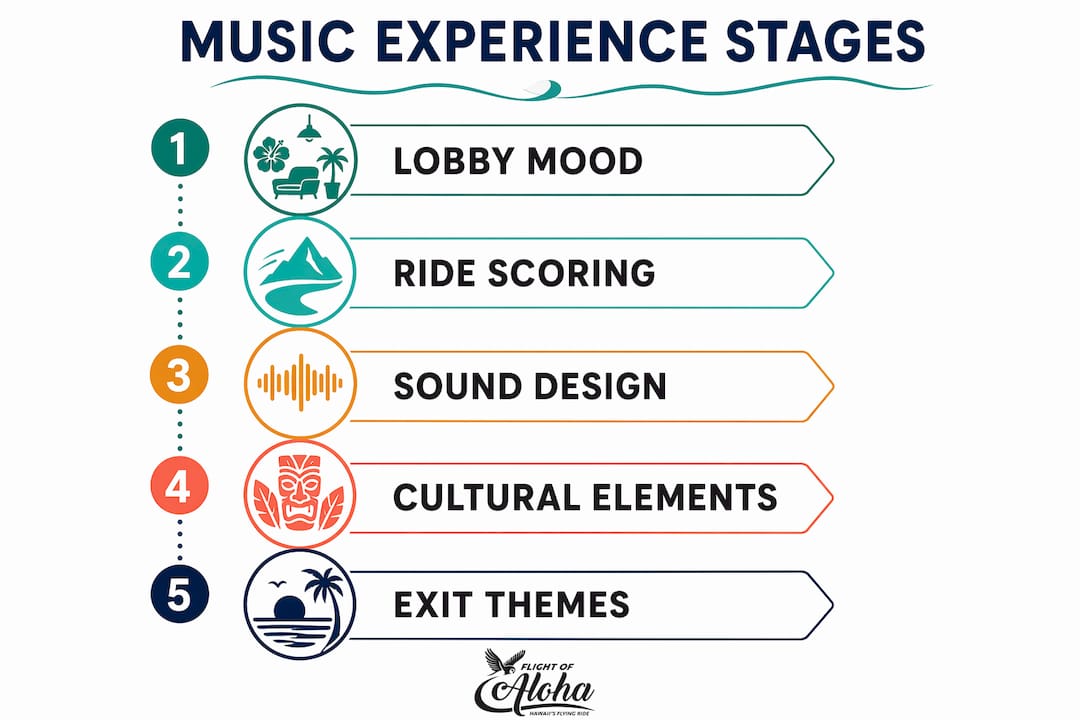
How does music shape your experience from lobby to exit?
Music begins the moment you walk in. Creative directors treat it as connective tissue: establish a mood at the entrance, evolve it through the pre-show, peak it during the ride, and let it echo in the retail space so the memory sticks.

Recurring leitmotifs across zones create what audio designers call earworms — you leave humming a melody you heard in the lobby, which you then associate with the souvenir you’re holding. That’s not accidental.
| Zone | Musical purpose | Your experience |
|---|---|---|
| Lobby | Establish mood and cultural tone | You feel the place before you see the film |
| Pre-show | Introduce main theme/leitmotif | Anticipation builds; story begins |
| On-ride | Full synchronization with motion | Emotion and sensation peak together |
| Exit/retail | Echo of ride motif, softer | Memory consolidates; souvenir impulse activates |
When music stops unexpectedly — a technical glitch, a breakdown — guests notice immediately. The immersion doesn’t fade; it vanishes. That reaction reveals just how much the score was doing all along.
How does music honor Hawaiian culture in a flying theater?
In a Hawaiian-themed flying theater, the soundtrack carries a responsibility that goes beyond entertainment. Composers and cultural advisors work together to select instrument timbres, melodic modes, and rhythmic feels that reference Hawaiian traditions without reducing them to decoration. The pahu drum, the steel guitar, the falsetto vocal line — each signals a specific island, legend, or emotional register to a listener who knows the culture, and teaches it to one who doesn’t.
Cultural storytelling in attractions works best when the music is sourced respectfully: consulting with cultural practitioners, referencing mele and chant structures, and using motifs that carry meaning rather than just local color. The result is a short visitor encounter that teaches something real.
Pro Tip: Listen for recurring melodic phrases that shift in texture between scenes. When the same theme appears first on a single instrument and later in full orchestration, that’s the composer signaling a story arc — a character growing, a legend unfolding.
What should sensory-sensitive visitors know before they go?
The biggest sensory triggers in a flying theater are low bass during descents, sudden transient crescendos at wave or wind moments, and the jarring silence of an unexpected audio cut. Most visitors love the intensity. Some find it a lot.
Good attractions offer alternatives: separate viewing rooms with adjusted audio levels, staff briefings before the show, and in some cases alternate mixes for guests with hearing sensitivities. Asking at the ticket desk is always the right move.
Pro Tip: If loud bass or sudden sound spikes are a concern, ask staff about a modified audio experience or a front-row seat where the low-frequency floor arrays are less intense. Most teams are happy to help.
What should you listen for to get the most from your visit?
The soundtrack in a flying theater is doing a lot of work. Here’s how to tune in:
- Motif returns: When a melody you heard in the lobby reappears mid-ride, that’s the story completing a loop.
- Bass drops: A deep low-frequency swell signals descent or a wave moment — brace for the sensation.
- Silence gaps: Brief musical pauses before a big visual moment are intentional tension builders.
- Instrument cues: In a Hawaiian film, a steel guitar or chant fragment signals a cultural story beat.
- Panning sweeps: Sound moving left-to-right means the film is banking — let your body follow it.
Pro Tip: Think of a flying theater as the aerial perspective of a helicopter tour, without the $400 price tag or the motion sickness. The music is what makes the difference: it sells the altitude and the wind in a way that pure visuals never could. Flight of Aloha in Kailua-Kona is walking distance from Kailua Pier/Tender Dock, making it a perfect shore excursion for cruise passengers.
How Flight of Aloha uses music to bring Hawaii to life
Flight of Aloha, the Native Hawaiian-owned flying theater at Kailua-Kona and Whalers Village Kaanapali Maui, builds its entire guest experience around the principle that music and cultural story are inseparable. Films like Naupaka, Lahaina, and Whale Song each carry their own score, composed to honor the legend or landscape at the center of the story. The pre-show motif introduces the cultural theme; the ride score peaks it; the exit music lets it settle.
The immersive flying experience pairs 8K visuals with motion, wind, and scent, but the score is what holds it together emotionally. Both locations offer full AC comfort, making Flight of Aloha the go-to activity on a rainy Kona day or when the vog rolls in. Cruise passengers walking from Kailua Pier/Tender Dock can be seated and flying over the islands within minutes. For a deeper look at how animation and audio combine to create the full effect, the Flight of Aloha blog covers the production side in detail.
Key Takeaways
Music is the primary driver of attention, emotion, and the sensation of flight in a flying theater — and at Flight of Aloha, it also carries the weight of Hawaiian cultural storytelling.
| Point | Details |
|---|---|
| Music guides your gaze | Research shows music produces faster first fixations on screen objects, directing attention across large curved screens. |
| Full sound design multiplies immersion | Combining music with sound effects raises perceived immersion dramatically compared to silence. |
| Congruence is everything | Music increases psychological transportation only when its tone matches the visual narrative on screen. |
| The score runs the whole visit | From lobby to retail, recurring leitmotifs shape mood, memory, and the souvenir impulse. |
| Flight of Aloha | Native Hawaiian-owned flying theater in Kailua-Kona and Whalers Village Kaanapali; smart alternative to helicopter tours, walking distance from Kailua Pier/Tender Dock. |
What the music actually tells you about the care behind the show
Most visitors walk out of a flying theater talking about the visuals. The music did most of the work. What strikes me most about well-crafted flying-theater scores is how much cultural consultation they require. Choosing to use a pahu drum or a specific chant structure isn’t a production shortcut — it’s a commitment to getting the story right. At Flight of Aloha, that commitment shows in how the music shifts between films: Whale Song feels oceanic and vast, while Lahaina carries a weight that reflects the history of that place. The score isn’t decoration. It’s the argument the filmmakers are making about why Hawaii matters.
Flight of Aloha: the most accessible flying theater in Hawaii
Flight of Aloha gives you aerial views of Hawaii without the $400 helicopter price tag and without the motion sickness. It’s Native Hawaiian-owned, family-friendly, and built for every kind of visitor — from curious kids to culturally minded travelers who want more than a postcard view.

Both locations, Kailua-Kona and Whalers Village Kaanapali, are easy to reach. Cruise passengers at Kailua Pier/Tender Dock can walk straight there. On a rainy day in Kona or Maui, or when the vog makes outdoor activities miserable, Flight of Aloha has the best AC in town and a full lineup of films waiting. VIP experiences and annual passes are available for visitors who want to go deeper. Book your seats and experience the islands from above, the way the stories were meant to be told. Book online to secure your seat.
Useful sources
- Music influences visual attention in immersive media — ScienceDirect eye-tracking study on music and first fixations
- Narrative persuasion and psychological transportation — Taylor & Francis study on music-visual congruence and immersion
- Power of sound design in moving pictures — Empirical Musicology Review (emoTouch study) on full sound design vs. music alone
- Theme-park music as narrative genre — Cambridge Core analysis of theme-park scoring
- Scoring and synchronization for dynamic attractions — Blooloop industry coverage of ride-kinetic scoring
- Field-mixing and on-site workflows — TechBriefs on in-vehicle mixing and speaker arrays
- Emotive guest experiences in themed attractions — Katapult practitioner interview on leitmotifs and accessibility
- STARS: Music and immersion loss — UCF STARS paper on what happens when theme-park music stops