
The Educational Value of Immersive Attractions in Hawaii
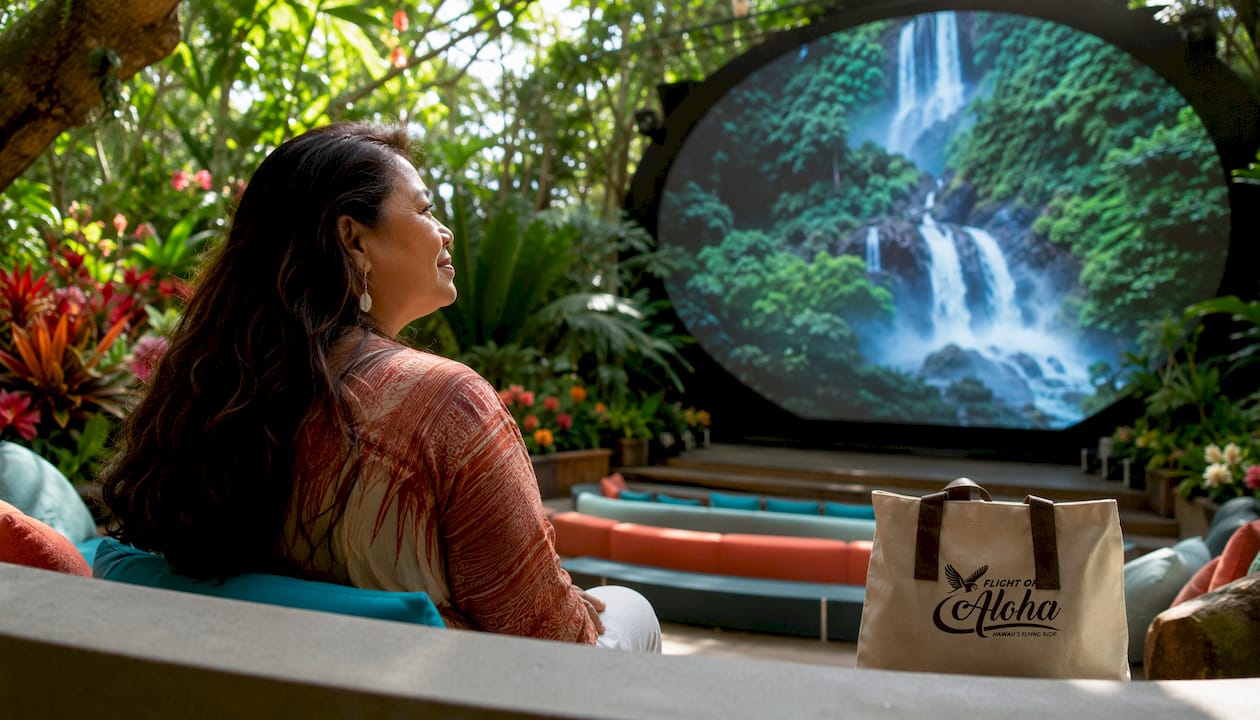
Immersive flying-theater attractions genuinely improve learning and engagement for family visitors—especially when they combine strong cultural storytelling, multisensory design, and a real sense of place. A 2026 systematic review published in MIT Press’s PRESENCE journal found that VR and AR immersive experiences produce 20–35% higher knowledge retention, 60% longer dwell times, and 78% stronger perceived learning gains compared to traditional exhibits. For families visiting Hawaii, Flight of Aloha in Kailua-Kona and Whalers Village Kaanapali delivers exactly this kind of experience: Native Hawaiian-owned, culturally rooted, and walkable from Kailua Pier.
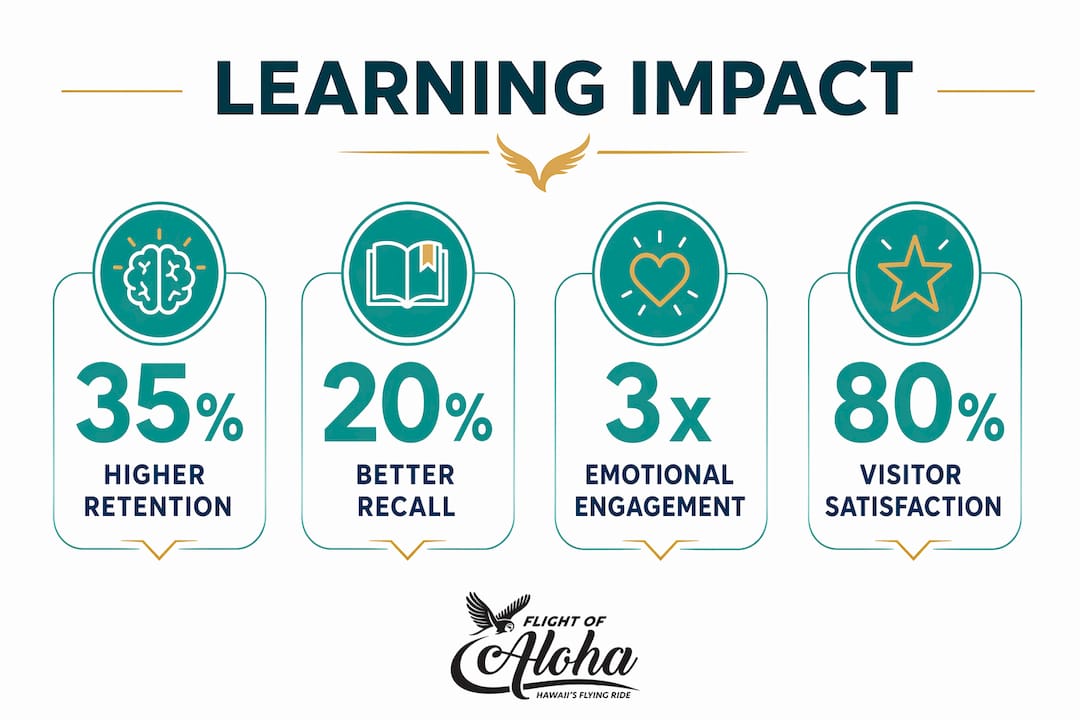
78% stronger perceived learning gains — that’s the headline finding from the MIT Press systematic review of immersive technologies in digital museums, and it’s the clearest signal that well-designed attractions do more than entertain.
What does the research actually show about learning in immersive exhibits?
The evidence is strong, though not without nuance. The MIT Press systematic review cited above is the most comprehensive recent source, and its three headline metrics tell a consistent story across retention, engagement, and perceived learning.
A separate 2024 experimental study on immersive virtual reality field trips found that students in the immersive group scored a cognitive-load mean of M = 1.31, compared to M = 1.91 in the traditional group — a statistically significant difference (p < 0.05). Lower cognitive load means the brain spends less effort processing the delivery format and more capacity on the actual content.
| Metric | Immersive Result | Comparison | Source |
|---|---|---|---|
| Knowledge retention | 20–35% higher | Traditional exhibits | MIT Press systematic review |
| Dwell time | 60% longer | Traditional exhibits | MIT Press systematic review |
| Perceived learning gains | 78% stronger | Traditional exhibits | MIT Press systematic review |
| Cognitive load (M score) | 1.31 (IVR group) | 1.91 (traditional group) | 2024 IVR field-trip study |
One honest caveat: cross-domain research using the Cognitive Affective Model of Immersive Learning (CAMIL) framework found that immediate factual test scores were sometimes comparable between immersive and non-immersive groups, even when presence and engagement were higher. The gains are most reliable when the immersive design directly supports the specific knowledge being taught — not only when the technology is impressive.
How do immersive attractions actually teach? Presence, agency, and the senses
Two psychological routes drive learning in immersive environments: presence (the feeling of actually being somewhere) and agency (the sense that your attention and choices shape the experience). When both are active, motivation rises and memory consolidates more effectively.
Multisensory layering is the design pattern that triggers both. Experimental research confirms that auditory, tactile, and visual feedback working together increases presence and lowers cognitive load compared to single-mode delivery. Scent and wind, in particular, are powerful anchors for emotional memory—far more so than visual fidelity alone.
What families should look for in any immersive attraction:
- High-resolution visuals that place you convincingly inside a landscape
- Motion cues synchronized with the visual narrative
- Scent and wind effects that reinforce the environment being depicted
- A single, clear narrative thread rather than a data-heavy information dump
- Accessible seating and a comfortable, climate-controlled environment
Example: Flight of Aloha uses high-resolution visuals, a motion platform, scents, and wind effects to put you above Hawaiian valleys, coastlines, and sacred landscapes. Films like Naupaka and Whale Song are built around Hawaiian legends — so the sensory experience and the cultural story reinforce each other, which is exactly the design pattern the research supports for deeper cultural connection.
Pro Tip: A single strong narrative thread beats information overload every time. Flying-theater formats work best when they commit to one emotional story rather than trying to teach ten facts.
Practical checklist for families evaluating and planning a visit
The strongest predictors of educational value in any immersive attraction are story quality, place connection, multisensory cues, and a clear learning objective. Use this checklist before you book:
- Age suitability — confirm the minimum age and whether the motion intensity is appropriate for young children or guests with motion sensitivity.
- Run time — shorter, focused experiences (roughly 20–30 minutes) tend to outperform longer ones for retention in flying-theater formats.
- Single narrative focus — does the attraction commit to one cultural story, or does it scatter across topics?
- Sensory elements — are scent, wind, and motion present, or is it a screen-only experience?
- Cultural credentialing — is the attraction Native Hawaiian-owned or community-consulted?
- Transit proximity — for cruise visitors, is it walkable from the tender dock or pier?
- Accessibility — are mobility accommodations and climate-controlled comfort available?
Flight of Aloha checks every box. It’s walking distance from Kailua Pier, fully climate-controlled (the best AC in Kona on a hot or rainy day), and designed for guests of varying mobility. It’s also the smart alternative to a helicopter tour: you get the aerial perspective over Hawaii’s most dramatic landscapes without the $400 price tag or the helicopter motion-sickness risk. For family entertainment planning in Hawaii, that combination is hard to beat.
Pro Tip: Before or after the experience, ask your kids one question: “What was the most surprising thing you saw?” That single prompt does more to cement learning than any brochure.
Accessibility note: Flight of Aloha’s climate-controlled theater is ideal for guests escaping Kona’s heat, vog, or unexpected rain. Research confirms that immersive attractions widen access for visitors with mobility limitations by substituting for physically demanding site visits.
Why cultural authenticity matters — and what can go wrong
Immersive technology amplifies cultural storytelling best when community consultation and layered context are present from the start. Without that foundation, even technically impressive experiences can flatten or misrepresent the cultures they depict.
Key risks families should be aware of:
- Narrative oversimplification — reducing a living culture to a single visual spectacle
- Lack of community involvement — content created without input from the people whose heritage is being depicted
- Technical distraction — when the “wow” of the technology overshadows the meaning of the story
- Contested authenticity — when commercial interests shape the narrative more than cultural knowledge does
Hybrid models, where digital immersion is tied to a real physical place and community, address most of these risks. Case study research on heritage site VR development consistently highlights co-design with stakeholders and hybrid physical-digital delivery as the key factors that preserve authenticity and long-term educational value.
How Flight of Aloha applies these educational design patterns
Flight of Aloha is Native Hawaiian-owned and operates at two locations: Kailua-Kona on the Big Island and Whalers Village Kaanapali on Maui. That ownership matters — it means the cultural narratives in the films come from within the community, not from outside it.
Here’s how the attraction puts the research-backed design principles into practice:
- 8K visuals place guests above real Hawaiian landscapes with cinematic clarity
- Motion platform, scents, and wind create the multisensory layering that anchors emotional memory
- Culturally rooted films (Naupaka, Lahaina, Whale Song, Merrie Monarch) each follow a single narrative tied to Hawaiian legend or place
- Walking distance from Kailua Pier makes it the ideal shore-excursion stop for cruise visitors
- Climate-controlled comfort means it works on rainy days, hot afternoons, and vog days equally well
- VIP packages and annual passes available for repeat visitors and kamaʻāina
Think of it this way: if a helicopter tour and a Disney ride had a baby, rooted in aloha, this is it. Aerial views of Hawaii, no $400 price tag, no motion sickness, and a story worth remembering.
Book online at flightofaloha.com to secure your seat.
How do immersive attractions compare to traditional educational methods?
Traditional classroom or museum formats rely heavily on text, static images, and passive listening. Immersive formats flip that: the visitor is inside the content, not observing it from a distance. The CAMIL-based cross-domain research found that immersive VR consistently produced higher presence, better user experience scores, and stronger motivation compared to desktop or non-immersive controls — even when immediate factual recall was sometimes comparable.
For cultural heritage specifically, the advantage of immersion is clearest in emotional engagement and long-term memory. VR heritage education research found that storytelling processes in virtual cultural environments expand participants’ imagination of historical and cultural contexts in ways static displays simply cannot. The gap widens further when the immersive experience is tied to a real place — which is exactly what a location-based flying theater in Hawaii provides.
What do real flying-theater experiences teach visitors about Hawaii?
Flying-theater formats occupy a unique educational space. They are not documentaries, and they are not theme-park rides. At their best, they use the emotional power of flight — the sensation of soaring over a valley or coastline — to make cultural knowledge feel personal and immediate.
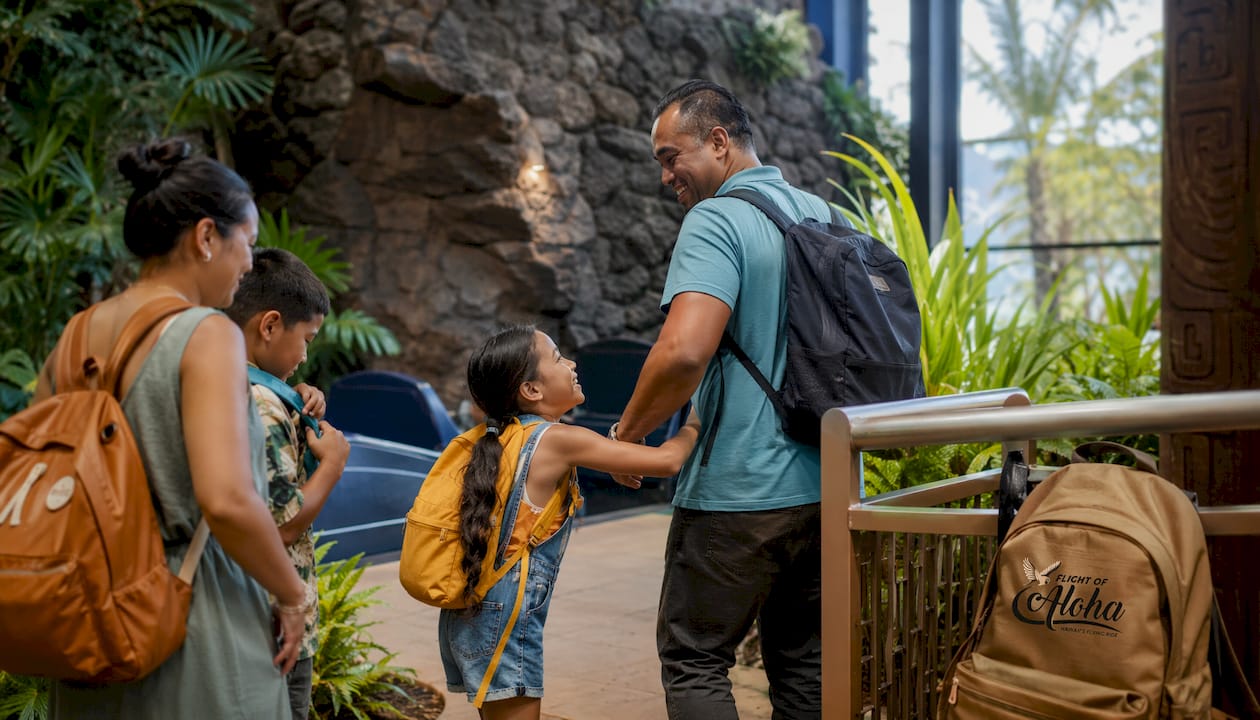
Flight of Aloha’s film Naupaka draws on one of Hawaii’s most enduring legends, using the aerial perspective to show the landscapes where the story lives. Whale Song connects visitors to the humpback whale migration that defines winter in Hawaiian waters. These aren’t facts delivered on a screen — they’re experiences that place the visitor inside a living culture. Immersive attractions in Hawaii that tie their content to real legends and real places consistently produce stronger cultural understanding than generic “virtual tours.”
How can families get the most out of an immersive attraction visit?
Preparation is short but worth it. A few minutes of context before the experience and one good conversation after it can double the educational payoff.
Before you go, share one sentence about the story or place the attraction covers. For Flight of Aloha, that might be: “We’re going to fly over Hawaii and learn a legend about why the naupaka flower only has half its petals.” That primes attention without spoiling the experience.
During the visit, let kids lead their own attention — don’t narrate over the film. The multisensory design is doing the work. After, ask one open question rather than a quiz. “What did you smell?” or “Where would you want to land?” keeps the conversation going without turning it into homework. Cultural education research consistently shows that brief post-experience reflection, not pre-loading with facts, is what moves short-term engagement into lasting memory.
What are the real limitations of immersive attractions for education?
Honest answer: immersive technology does not automatically produce learning. Extended reality research is clear that outcomes depend on coherent design and defined learning objectives — not on technical sophistication alone. A visually stunning experience with no narrative focus can actually increase cognitive load rather than reduce it.
Other genuine limitations include:
- Short visit windows limit depth; a 20-minute film cannot replace a semester of Hawaiian history
- Passive formats (no interaction or choice) reduce the agency component that drives deeper learning
- Accessibility gaps can exclude visitors with certain sensory sensitivities if the attraction doesn’t offer accommodations
- Sustainability and cost of maintaining high-end immersive tech can affect long-term availability
The practical takeaway: treat immersive attractions as a powerful entry point, not a complete education. They are best at sparking curiosity, building emotional connection, and making abstract cultural knowledge feel real.
Why does narrative design make or break an immersive experience?
Story is the delivery system for everything else. Without a clear narrative, multisensory effects become noise. With one, they become memory.
Research on hybrid museum exhibitions found that combining storytelling with the physical environment stimulates curiosity and willingness to explore further — a finding that applies directly to location-based flying theaters. The narrative doesn’t just entertain; it organizes the sensory input into something the brain can store and retrieve.
The best immersive narratives share three qualities: they are specific to a place, they follow a single emotional arc, and they leave the visitor with one clear feeling or question. Flight of Aloha’s cultural storytelling approach is built around exactly this — each film is a focused story, not a highlight reel.
Key Takeaways
Immersive attractions with strong cultural storytelling, multisensory design, and community grounding consistently outperform traditional exhibits on retention, engagement, and perceived learning — and Flight of Aloha in Kona and Maui delivers all three.
| Point | Details |
|---|---|
| Retention gains are real | Systematic review found 20–35% higher knowledge retention in immersive vs. traditional formats. |
| Lower cognitive load improves comprehension | IVR groups scored M = 1.31 vs. M = 1.91 for traditional groups — a statistically significant difference. |
| Narrative focus is the key design factor | A single cultural story with multisensory cues outperforms information-heavy formats for short visits. |
| Authenticity requires community involvement | Native Hawaiian ownership and cultural consultation are the clearest signals of responsible, educational design. |
| Flight of Aloha | Native Hawaiian-owned flying theater in Kailua-Kona and Whalers Village Kaanapali — accessible, climate-controlled, and walkable from Kailua Pier. Book online to secure your seat. |
Why we recommend immersive attractions in Hawaii for families
The combination of cultural authenticity, physical accessibility, and sensory storytelling at Flight of Aloha is genuinely rare. Most family-friendly attractions in Hawaii ask you to choose between education and entertainment. Flight of Aloha doesn’t make you choose.
What tips the recommendation for me is the ownership and location together. Native Hawaiian-owned, operating in both Kailua-Kona and Whalers Village Kaanapali, and steps from Kailua Pier — that’s a trifecta of trust, convenience, and cultural integrity that most attractions can’t match. For cruise families with two hours ashore, or for anyone trying to give kids a genuine connection to Hawaiian culture without a full-day commitment, this is the call.
The research backs it. The design backs it. And the aloha spirit behind it backs it most of all.
Flight of Aloha is the accessible, family-first alternative to helicopter tours
Skip the $400 helicopter booking and the motion-sickness risk. Flight of Aloha gives you the aerial perspective over Hawaii’s most breathtaking landscapes — valleys, coastlines, sacred sites — in a climate-controlled theater with the best AC in Kona. It’s the perfect plan for a rainy day, a hot afternoon, a vog day, or a quick shore excursion straight from the tender dock at Kailua Pier.

Both locations, Kailua-Kona on the Big Island and Whalers Village Kaanapali on Maui, are designed for families, cruise visitors, and anyone who wants to feel Hawaii before they explore it. VIP packages and annual passes are available for those who want to go deeper.
Book online to secure your seat — and bring the whole family.
Selected sources and further reading
- Immersive Technologies in Digital Museums: A Systematic Review — MIT Press PRESENCE journal; source for the 20–35% retention, 60% dwell time, and 78% perceived learning gains figures.
- IVR Field Trips: Academic Achievement, Cognitive Load, and Multimodal Presence — Education and Information Technologies; source for cognitive-load M scores and multisensory presence findings.
- Immersion and Learning Across Three Domains (CAMIL Framework) — Cross-domain study on presence, agency, and mixed learning outcomes in immersive VR.
- Cultural Heritage as a Didactic Resource through Extended Reality — Systematic review on XR outcomes, accessibility benefits, and design coherence requirements.
- VR in Heritage Education: Mini-Review and Design Considerations — Frontiers in Virtual Reality; covers storytelling, user experience, and cultural identity in VR heritage programs.
- Designing Immersive Experiences for Heritage Sites — Case study on co-design, hybrid delivery, and authenticity in heritage VR.
- Hybrid Museum Exhibitions: Immersive Technology for Contemporary Crafts — Scoping review on hybrid physical-digital exhibition design and educational impact.
- Immersive Technologies for Tourism: A Systematic Review — PMC; broad review of AR/VR applications in tourism education and heritage.
- Flight of Aloha — Official Site — Booking, locations, film descriptions, and VIP packages for Kailua-Kona and Whalers Village Kaanapali.
Recommended
- Why Immersive Attractions In Hawaii Create Richer Experiences | Flight Of Aloha
- Cultural Education In Amusement Parks: Hawaii’s Impact | Flight Of Aloha
- Educational Tourism In Hawaii: 85% Find Deeper Connections | Flight Of Aloha
- What Are Educational Attractions? The Ultimate Hawaiian Guide | Flight Of Aloha