
The Role of Wind in Immersive Rides, and Why It Matters
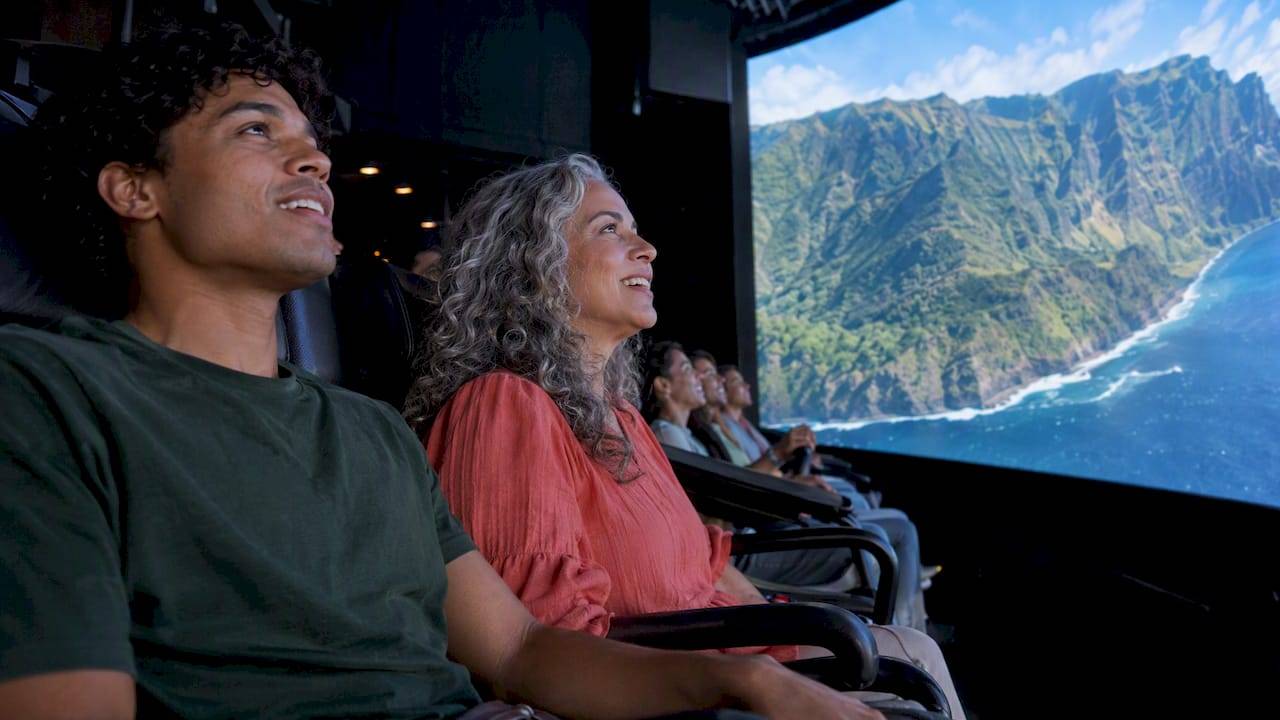
Wind is the cue that tells your body you are moving through open air, not sitting in a theater seat. Researchers have tested this in flying simulations, and a steady, well-aimed breeze makes a ride feel more real, more emotional and more like flight. At Flight of Aloha, wind is one of the core effects that carry you over Hawaii, alongside 8K film, motion, and scent.
Here is how wind works in immersive rides, what studies say about where it should blow and how strong it should be, and what to expect when you try it on a rainy day, a hot afternoon, or a quick cruise stop in Kona or Maui.
TL;DR
- Wind adds a physical sensation that matches what your eyes see. In a small flying study, wind that blew in the direction of travel and scaled with speed improved the sense of flying compared with no wind.
- Placement matters. In VR motorcycle studies, wind on the chest boosted the feeling of presence the most, while wind on the head and neck was linked to more mistakes.
- Matching wind to the visuals can help comfort. Mismatched cues are a known cause of motion sickness.
- At Flight of Aloha, wind works together with motion, scent and film in an indoor, air-conditioned theater in Kailua-Kona and at Whalers Village in Kaanapali, Maui.
Why wind is the sense that sells the illusion
A screen can show you a cliff, a humpback whale, or a ridge line covered in fog. It cannot, by itself, make your skin believe you are up there. Wind can. It is one of the few effects that touches you directly, and your brain reads it as proof that air is moving past you.
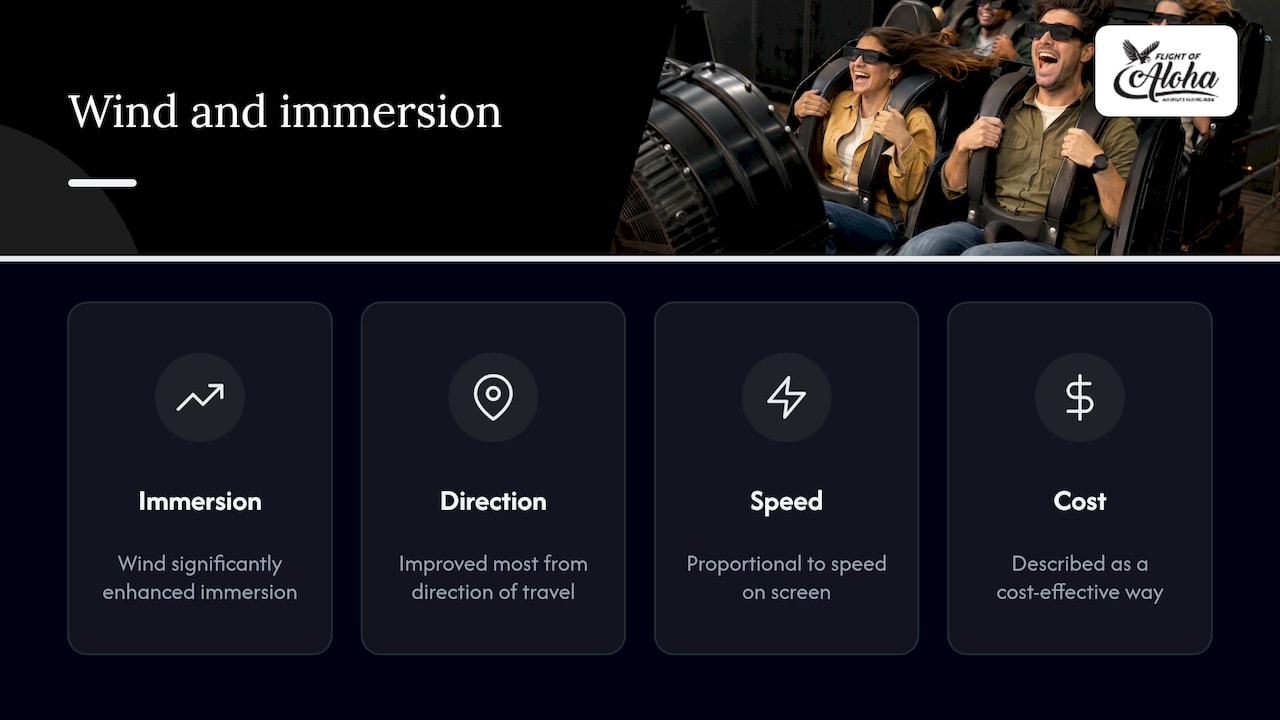
A 2024 study on a drone-style VR flying experience tested 15 people and found that wind significantly enhanced immersion. The sense of flying improved most when the wind came from the direction of travel and its speed was proportional to the speed on screen. Earlier work from the ACM on a wind display for virtual reality made a similar point: the researchers described wind as a cost-effective way to make a virtual world feel more livable than one that looks like a vacuum.
That last phrase explains a lot. A beautiful picture with no air movement feels sealed off. Add a cool breeze that rises as the camera dives, and the scene suddenly has weather, altitude and space.
What kinds of wind effects rides use
Not every ride uses wind the same way. Most designers pick from a short list of approaches.
| Wind effect | What it feels like | Typical use |
|---|---|---|
| Steady frontal airflow | A constant breeze on your face and chest | Flying, gliding, open-air travel |
| Speed-scaled airflow | Wind that rises and falls with on-screen speed | Dives, accelerations, turns |
| Gusts and bursts | Short punches of air | Storms, waves, a creature passing close |
| Low-level airflow | Air around the legs and shins | Vehicles, riding scenes |
| Combined weather | Wind plus mist, fog, or temperature changes | Storm and weather experiences |
Big attractions often go further than wind alone. A German extreme weather attraction, for example, integrates rain, wind, hail, mist, and fog with film, lighting, mechanical effects, ride movement and sound. Wind is rarely the whole show. It is the layer that makes the other layers believable.
Where the wind blows matters as much as how hard
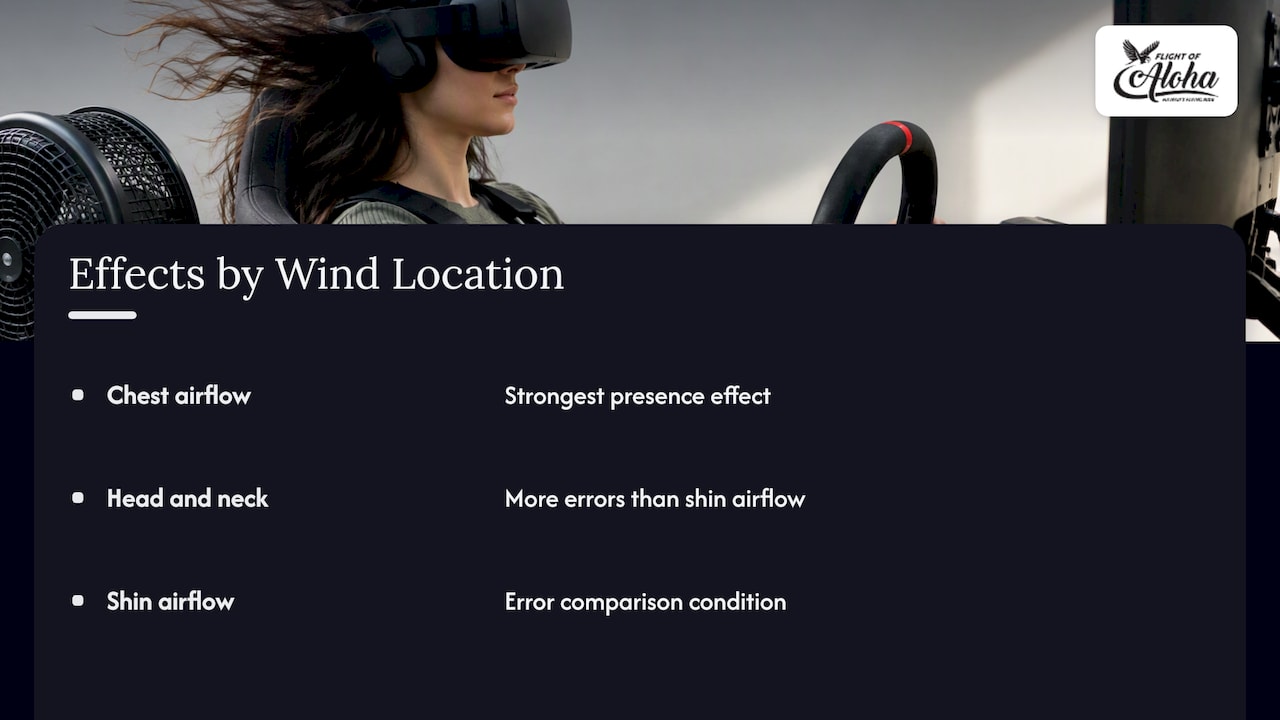
Two recent studies on VR motorcycle riding looked at which part of the body should feel the airflow. A 2025 study of 25 participants found that wind stimulation significantly affected presence and emotion. Chest-directed wind produced the strongest presence effect, while head-and-neck wind caused more mistakes than shin-directed wind. A 2026 paper reported a similar pattern: localized airflow raised Presence and Emotion ratings, and airflow at the head and neck was associated with more errors than airflow at the shins.
What does that mean for a ride you sit in, not one you steer? The takeaway for designers is that a breeze across the torso and face area at a gentle level feels like flight, while strong blasts at the neck and head can distract. A good ride aims the wind to feel natural and keeps it from becoming a nuisance.
Wind does not have to be physically exact
There is a common assumption that simulated wind must copy real outdoor wind to work. It does not. A 2026 study on directed wind in extended-reality flight frames airflow as a perceptual design factor: it does not need to reproduce aerodynamically exact outdoor wind to shape how a flight feels.
That is good news for anyone who gets nervous about the idea of wind in a ride. Indoor ride wind is a designed cue, tuned to match the film, not a gale. It is closer to a well-placed fan on a hot day than to weather. Outdoor wind, by contrast, can force real rides to close. It is a different category of thing, and nothing in a theater has to deal with it.
Syncing wind with picture, motion and sound
The hard part is timing. Wind that arrives half a second late breaks the spell. Large attractions solve this with show-control systems that trigger every effect from one master timeline. One boat-simulation attraction in China used hardware and services to combine and synchronize audio, video, screen and show-control systems, and it added transducers under the platform that produce vibrations from about 1 Hz to 100 Hz to mimic the feel of a boat in rough water.
A UK roller coaster built around a burning wicker figure shows the same idea: its effects are synchronized with audio and visuals through a dedicated show-control unit and a media server. The principle holds from giant coasters to a small theater: one clock, many effects.
The same logic shows up in other forms of travel entertainment. If you want to see how layered effects are coordinated in other settings, augmented reality sightseeing is a good example of blending screens, audio and real-world movement into one story.
Comfort: how to balance wind and motion sickness
Motion sickness comes from conflict between senses. A review of the neurophysiology of motion sickness explains that conflicting visual, vestibular and proprioceptive information can cause it, and that people in stationary simulators may feel symptoms when vision signals motion but the inner ear does not. Another review adds that a mismatch is especially nauseogenic when sensed motion differs from expectation based on past experience.
Wind can work on the helpful side of that equation. Recent studies suggest that matching wind speed with visual speed is worth testing as a way to reduce sensory conflict, though the research on this is still developing, so treat it as a design principle, not a promise.
There is also a general comfort principle from outdoor wind engineering: designers look at speed, direction, gust duration and abrupt transitions, because rapid changes can cause distress. The City of London wind guidelines cover streets and buildings, not rides, but the idea carries over well: gentle ramps feel better than sudden jumps.
If you are sensitive to motion, here are practical tips for any immersive ride:
- Look at the horizon of the film instead of the edges of the screen.
- Sit where you can see the whole picture comfortably.
- Let the breeze reach your face, and do not turn away from it. It is part of the cue.
- Eat lightly beforehand.
- If you feel unwell, close your eyes for a moment and tell a team member.
If you have a condition that affects balance, a heart condition, or are pregnant, check ride guidance with a doctor and the venue before you book.
How wind works at Flight of Aloha
Flight of Aloha is a Native Hawaiian-owned flying theater with two locations: Kailua-Kona on the Big Island and Whalers Village in Kaanapali, Maui. You sit in a motion seat in front of a large screen showing 8K film while the ride adds motion, scent and wind. The idea is simple: you feel like you are flying over Hawaii, without leaving the ground.
Wind here is part of storytelling. As the camera glides along a ridge or over water, the breeze builds with the movement and softens when the scene slows. To learn more about how we approach it, read our guide to Hawaiian wind simulation effects, or our explainers on wind effects in attractions and why wind matters in rides.
The films themselves are rooted in Hawaiian stories. If you are curious how a ride film is made, see what an immersive ride film is and how ride film experiences shape a visit, or browse the Hawaiian ride themes we draw on.
A smart alternative to a helicopter tour
Many visitors think about a helicopter tour when they plan a day in Kona or Maui. The views are the draw. Flight of Aloha was built for people who want that aerial feeling in a more comfortable, more accessible way: no weather cancellations to worry about, no headset, and no small cabin. Our films give you a sweeping view of Hawaii at ticket prices of $29.99 to $34.99 for a single feature, and the indoor seating suits all ages and abilities.
If you get queasy on small aircraft, wind and motion that follow the film closely are designed to keep the experience smooth. If you want to compare it with other family-friendly options, take a look at our picks of multisensory rides for families.
Rain, heat and vog: the comfortable choice
Hawaii weather changes fast. A sunny beach morning can turn into a soggy afternoon, and on the Big Island, vog (volcanic haze) can make outdoor time less pleasant for some visitors. An indoor, air-conditioned attraction takes weather off the table.
That is why we think of Flight of Aloha as a go-to for:
- Rainy days in Kona and Maui, when the beach and hiking plans fall through.
- Hot afternoons, when you want a cool seat and a cool breeze.
- Vog days, when you would rather breathe indoor air.
- Families with mixed ages, since everyone sits and everyone gets the same view.
It also fits a short schedule. Our Kailua-Kona location is within walking distance of Kailua Pier and the tender dock, so cruise visitors can fit a show in between a coffee and a stroll along Ali’i Drive. In Maui, we are at Whalers Village in Kaanapali, an easy stop if you are exploring the resort area or looking for Lahaina-themed activities. Learn how we plan guest flow in our piece on visitor workflow in Hawaii immersive attractions, and see why immersive rides are so popular with tourists.
Our perspective
We built Flight of Aloha around a simple belief: you should be able to feel Hawaii, not just look at it. Wind is the first thing guests mention when they step out, because it turns a movie into a flight.
The research on wind and presence matches what we see on the ground. A breeze that follows the film, lands at a comfortable spot and never overpowers the picture makes people lean forward and smile. That is why we pair wind with motion, scent and 8K film, and why we treat timing as seriously as the visuals.
We are Native Hawaiian-owned, and we work with local advisors and storytellers so the films carry real cultural meaning. The wind in Naupaka is not a gimmick. It is part of the legend, part of the journey over the land.
We also care that it is open to everyone. Grandparents, toddlers, wheelchair users, and first-time visitors can all take the same flight, rain or shine. For us, that is what makes it the most accessible activity in Kona and Maui.
Ola
Choosing your flight
Each film uses wind a little differently, so pick by mood.
| Experience | Price | Best for |
|---|---|---|
| Naupaka | $29.99 to $34.99 | Legend and landscape, a gentle breeze-led journey |
| Lahaina | $29.99 to $34.99 | Maui visitors who want a story rooted in Lahaina |
| Europe | $29.99 to $34.99 | A different view, with wind that follows the camera |
| Double Feature Flying Ride | $49.99 to $59.99 | Two films, more time in the air |
| VIP Package | $69.99 to $79.99 | Groups and special occasions |
| Annual Pass | $200 per year | Locals and repeat visitors |
Prices are as published on our site, so check the page for the current range before you go.
Ready to feel the wind?
If you read this far, you probably want to know what it is like. The best way to find out is to sit down and take off. Our single features run from $29.99 to $34.99, and you can see all flights and the double feature to plan your visit. Locals who love to come back can check out the annual pass.

We are at Kailua-Kona, near the pier, and at Whalers Village in Kaanapali. Walk-ins are welcome, and you can also reserve online through Flight of Aloha, including gift cards for friends and family.
FAQ
Why is wind used in immersive rides?
Wind gives your skin a cue that matches what your eyes see. In a 15-person flying study, directed, speed-proportional wind improved the sense of flying compared with no wind. That is why designers use it in flight and open-air scenes.
Can wind in a ride make you feel sick?
Motion sickness is linked to conflicting sensory signals, such as vision showing motion while your body is still. Wind that matches the visuals is meant to reduce that mismatch, but reactions vary. If you are prone to motion sickness, look at the horizon of the film and tell a team member if you feel unwell.
Is the wind at Flight of Aloha strong?
It is designed as a comfortable breeze that follows the film, rising when the camera speeds up and easing when it slows. It is an indoor effect, meant to add to the experience and not to overpower it. Families with young children and older guests enjoy it together.
Is Flight of Aloha a good choice on a rainy day?
Yes. It is fully indoors and air-conditioned, so rain, heat and vog do not affect your show. That makes it a handy plan B in Kona and Maui.
Where are the Flight of Aloha locations?
We are in Kailua-Kona on the Big Island, within walking distance of Kailua Pier and the tender dock, and at Whalers Village in Kaanapali, Maui. Check our website for current hours before you visit.
Sources
- Drone Rider: Enhancing VR Flying Experiences via Directed Wind (2024)
- Design and evaluation of a wind display for virtual reality (ACM)
- Wetterextreme immersive extreme weather experience (Sarner)
- The Impact of Wind Experience on VR Game Immersion (2025)
- Blowing into immersion: the effect of wind stimulation (2026)
- Drone Rider: Effects of Wind Conditions on the Sense of Flying (2026)
- Chimelong: Bermuda Storm (InPark Magazine)
- Flaming good fun: Holovis on The Wicker Man (Installation International)
- The Neurophysiology and Treatment of Motion Sickness (PMC)
- Moving in a Moving World: A Review on Vestibular Motion Sickness (PMC)
- City of London Wind Microclimate Guidelines
- Augmented reality sightseeing
Book online to secure your seat.