
Why Combine Education and Entertainment? What Research Shows
People learn more when they are absorbed, and they are absorbed when they are enjoying themselves. That is the short answer. Researchers have studied it for decades under names like edutainment and entertainment-education, and the findings point the same way: a good story, strong imagery and a sense of being there help audiences pay attention, care and remember. Below we break down what the research says, where the approach can go wrong, and what it looks like in a real attraction, our own flying theater in Hawaii.
TL;DR
- Entertainment and education are not opposites. Researchers describe them as intertwined, and well-made entertainment can carry real information.
- Immersive stories lower the “I’m being lectured” reaction, so audiences take in ideas more openly.
- A 2025 meta-analysis found that narrative entertainment shifts attitudes, beliefs and intentions, and the effects held up after a delay.
- The approach works best when learning goals are designed in from the start, not added on top of the fun.
- At Flight of Aloha in Kailua-Kona and Whalers Village Kaanapali, Maui, you can see the idea in action: Hawaiian stories told through 8K film, motion, wind and scent.
What “combining education and entertainment” actually means
You will see several terms for the same idea. Edutainment is media designed to educate through entertainment, and the word has been around since at least 1933. In academic circles the more common label is entertainment-education. One peer-reviewed definition calls it a theory-based strategy that builds educational and social issues into an entertainment program from creation through to distribution, with the aim of change at the individual, community and wider levels.
The key phrase is “built into.” A quiz bolted onto a cartoon is not the point. The point is a story, a game or an experience where the learning is part of what makes it enjoyable. The same authors make a useful observation: information and entertainment are not mutually exclusive, and entertainment programs can be informative and educational at once.
Think of the difference this way:
| Approach | What the audience feels | What usually sticks |
|---|---|---|
| Education alone (a lecture or a plaque) | Told what to know | Facts, if motivation is already high |
| Entertainment alone (a thrill ride) | Excited | The feeling, rarely the content |
| Combined (a story with real content) | Absorbed and curious | The story, and the ideas inside it |
Why it works: attention, resistance and memory
It lowers the guard
When someone feels they are being persuaded or taught, they often argue back in their heads. Slater and Rouner’s Extended Elaboration Likelihood Model of entertainment-education suggests that when viewers are absorbed in dramatic elements, they move into a less critical, more immersive state that reduces counterarguing. Because the narrative is engaging, the “selling” of a message is less obvious. For a visitor learning about a culture that is new to them, that openness matters. You hear the story first and form opinions second.
It pulls you into another time and place
The transportation-imagery model describes how narratives can be immersive: audiences pay attention, generate mental imagery and step into a world of a different time and space. That is exactly what a skilled storyteller does around a fire, and what film, sound and movement can do on a larger scale. Mental pictures are easier to hold on to than bullet points.
It can change what people believe and do
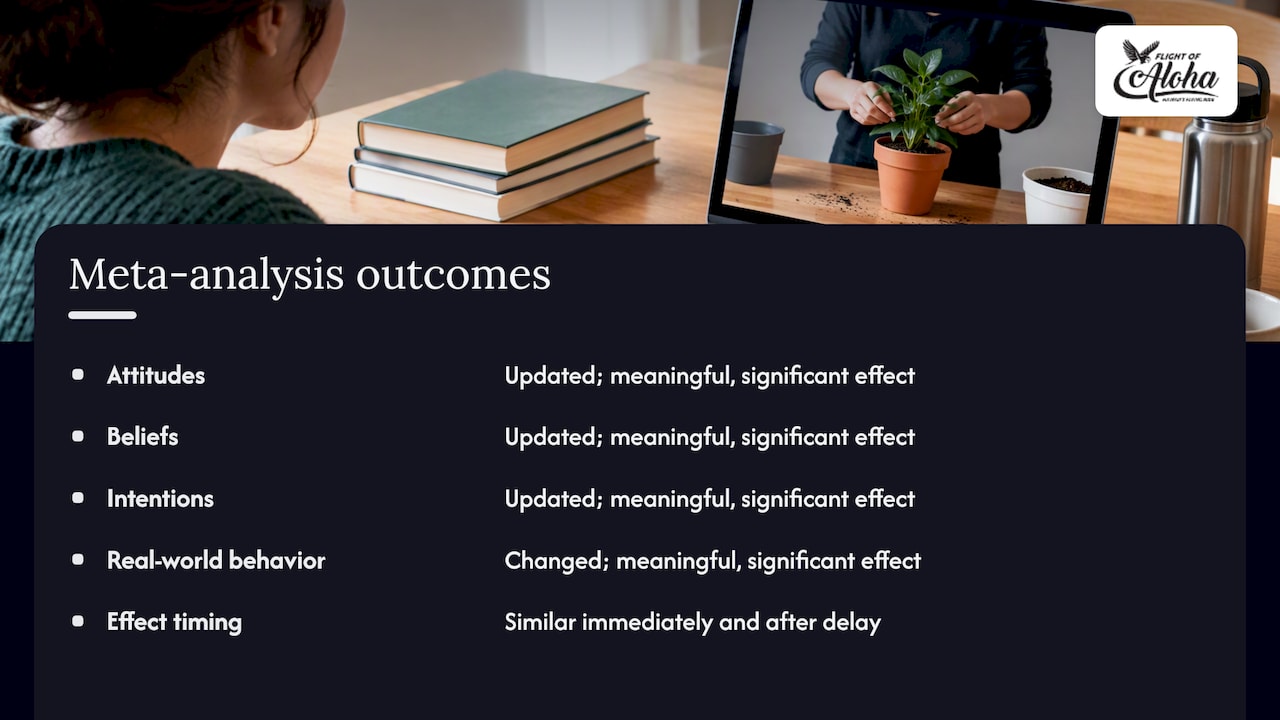
The strongest recent evidence comes from a 2025 meta-analysis of narrative entertainment experiments. It found that, on average, narrative entertainment leads audiences to update attitudes, beliefs and intentions, and to change real-world behaviors, with effects that were both meaningful and statistically significant. The reported effects were also similar in size whether measured right away or after a delay, which hints that the impact can last.
A single experimental study of the series East Los High points the same way. Transmedia storytelling formats produced significant knowledge gains about health topics compared with other conditions, and the gains were still there at a two-week follow-up.
What good design looks like
Research on museums and heritage sites is helpful here, because those places face the same question every attraction does: how do you delight people and still leave them knowing something?
- Know your audience and your intended impact. A UK study on immersive experiences advises considering the audience, the intended impacts and the narrative, along with the social interactions the experience creates, since sharing a moment with others can be central to making meaning.
- Put learning goals in the design room. A 2024 paper on immersive media in museums argues that educators should help design the experience so learning is actively pursued, not assumed.
- Make the story believable. Research on the Virtual Avebury simulation found that the believability of a virtual experience goes hand in hand with a sense of place. If it feels real, visitors connect to where they are.
- Involve the people whose culture it is. A 2025 co-design framework for immersive heritage education calls for multiple stakeholders, including indigenous communities and educators, so stories are both locally authentic and useful to outsiders.
- Keep it comfortable. The same research flags technical issues such as slow loading, rigid operation and dizziness as things that can get in the way of learning. Smooth, well-built experiences protect the lesson.
It helps people connect with heritage
The British Museum ran a pilot in 2015 where virtual reality let family audiences see 3D scans of objects in their original settings, which helped them understand a complex subject like the Bronze Age. A study of Tunisian youth found that digital technologies, including virtual reality, produced high levels of presence, authenticity and positive emotion, helping young people engage with their heritage.
The pattern is consistent. When people feel present in a place, they care about it. And when they care, they ask questions, which is where learning starts.
Getting the balance right
Good edutainment respects both halves. Illsley and colleagues warn that the desire to entertain should not overtake a visitor’s ability to think critically about what they are shown. Another study of digital storytelling in classrooms found that engagement and outcomes can rise, but instructor credibility can suffer if the entertainment is not balanced with the teaching goals.
The practical lessons for anyone building an experience, or choosing one for the family:
- Look for a real story with real roots, not just spectacle.
- Look for voices from the community the story belongs to.
- Look for comfort and clarity, so nothing distracts from the content.
- Look for something that sparks conversation afterward.
Our own deeper reading on the topic is in the role of entertainment in learning and in our piece on presence and flow in immersive entertainment.
Where this shows up in Hawaii
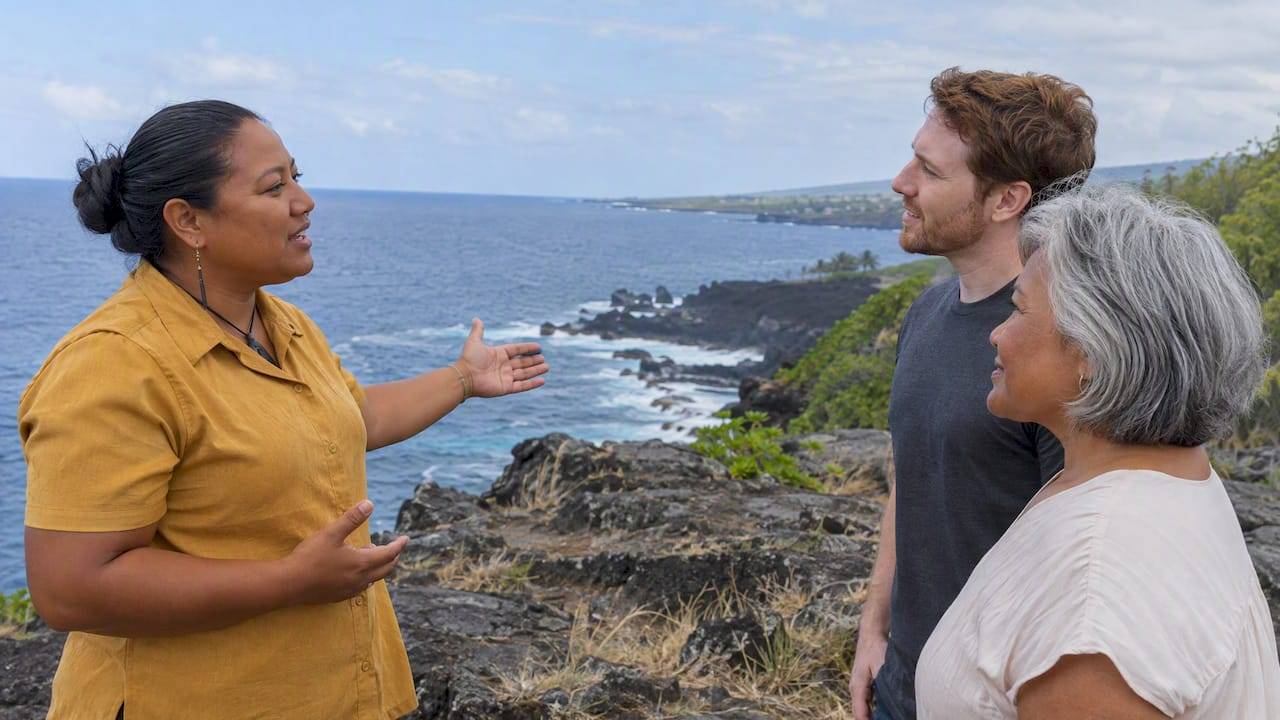
Hawaii is a place where story and landscape cannot be separated. Mountains, winds, chants and place names all carry history. A plaque can tell you a name. A story told well makes you feel why the name matters.
That is why cultural storytelling is such a natural fit for attractions here. If you want to explore the idea further, we have written about cultural storytelling in Hawaiian attractions, cultural education in amusement parks and why choose cultural entertainment in Hawaii.
How Flight of Aloha puts the idea into practice
Flight of Aloha is an immersive flying theater. You sit in a seat that moves with the film while 8K visuals, wind and scents carry you over Hawaii. Our films are rooted in Hawaiian legends and places, so the ride is also a lesson in why those places matter. We are Native Hawaiian-owned, and we work with local advisors and storytellers on our storytelling. Our own claim is simple: you can feel like you are flying across the islands while learning the stories behind them.
Here is how our films line up with the design ideas above:
- Naupaka: a story rooted in Hawaiian legend, told as you glide over the landscape.
- Lahaina: a look at a place with deep meaning to Maui and to Hawaii.
- Europe: a ride film tied to the Merrie Monarch festival, the hula celebration, which gives visitors a window into a living tradition.
- Whale Song: another film in our lineup, for guests who want a different mood.
The approach is described in more detail in how we use 8K, motion and scent and in why immersive attractions in Hawaii create richer experiences. If you are curious about the wider category, see our roundup of virtual reality attraction examples, and for the cultural angle, cultural entertainment in Hawaii explained.
Perspective: why we built it this way
We started from a simple belief: the best way to share Hawaii is to let people feel it. A guidebook can tell you a legend. A flight over the land where that legend happened lets you understand it.
Visitors often tell us they want an aerial view of the islands but would rather skip the cost or the motion sickness of a small aircraft. We built our theater for them. If a helicopter tour and a Disney ride had a baby, rooted in aloha, that would be us. You get sweeping views, wind on your face and the scent of the islands, in a seated, indoor, air-conditioned space that welcomes all ages and abilities.
The learning matters to us as much as the thrill. Our films are shaped with local advisors and storytellers, and as a Native Hawaiian-owned company we take the responsibility of telling these stories seriously. When a child leaves humming a name from a legend, or a grandparent asks where the story comes from, we know the design is working.
Ola
Who gets the most out of a visit
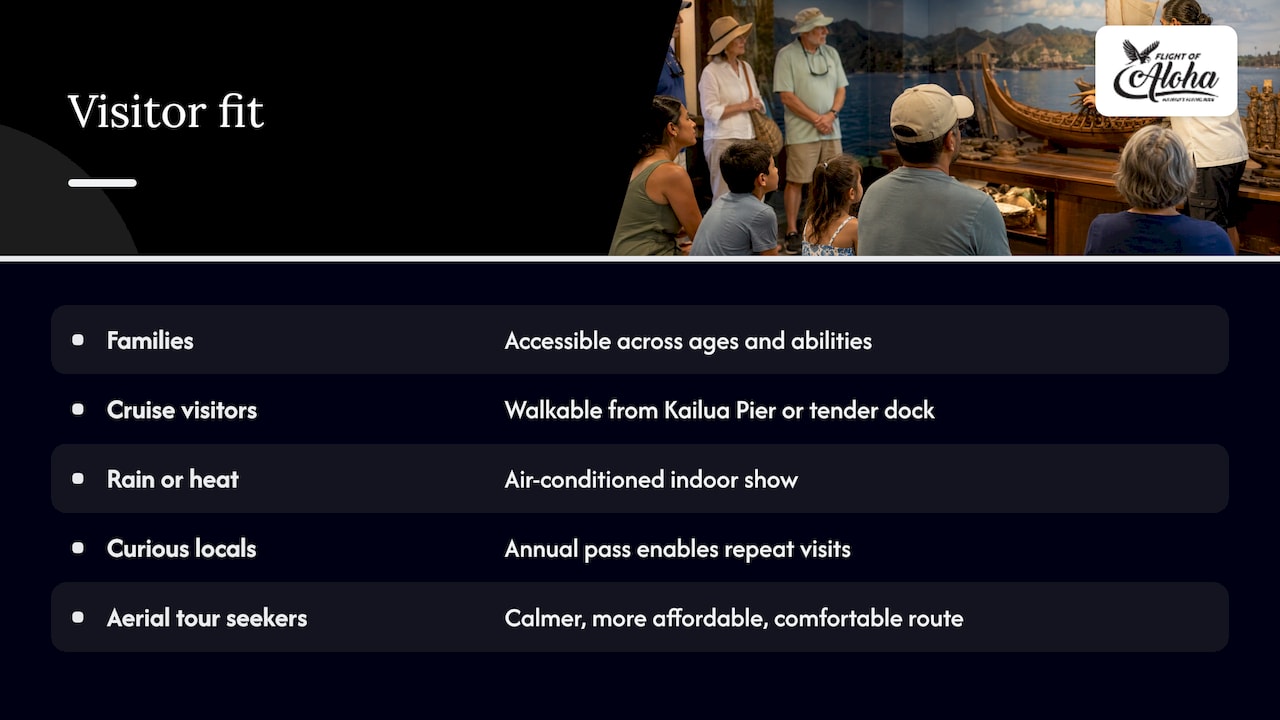
Families. Children take in stories through their senses, and a seat that moves with the film gives them something to talk about at dinner. Our experience is designed to be accessible for all ages and abilities.
Cruise visitors. If your ship is in at Kailua Pier or the tender dock, our Kailua-Kona location is within walking distance, which makes it a good fit for a quick shore excursion when you have limited time.
Rainy days and hot days. On a rainy day in Kona or Maui, or when vog and heat make the outdoors less appealing, a cool indoor show is an easy plan. Our venue is air-conditioned.
Curious locals. Residents who want to learn more about the stories of their own islands will find familiar places in a new light. An annual pass makes repeat visits easy.
Travelers weighing aerial tours. If you want the bird’s-eye feeling but prefer a calmer, more affordable and more comfortable route, we are a smart alternative, and many guests do both.
Tickets and where to find us
We have two locations: Kailua-Kona on the Big Island, and Whalers Village in Kaanapali, Maui. Prices below are as published on our site; check the booking page for current options and any promotions.
| Ticket | Price |
|---|---|
| Single feature (Naupaka, Lahaina or Europe) | $29.99 to $34.99 |
| Double Feature Flying Ride | $49.99 to $59.99 |
| VIP Package | $69.99 to $79.99 |
| Annual Pass | $200 per year |
A gift card is also available through our main site if you want to give someone a flight.
Ready to fly?
If you want to see for yourself why story and sensation belong together, pick a film and take the flight. Start with a single feature, or choose the Double Feature Flying Ride if you want to see two stories in one visit.
We are Native Hawaiian-owned and open to guests in Kailua-Kona and at Whalers Village in Kaanapali. Visit Flight of Aloha to see the films and choose your ticket.
FAQ
What is the difference between edutainment and entertainment-education?
They describe the same idea. Edutainment is the popular term for media designed to educate through entertainment, and it has been used since at least 1933. Entertainment-education is the term researchers prefer, and it refers to a planned strategy of building educational content into entertainment so it reaches people and encourages change.
Does mixing learning with fun actually improve learning?
Evidence is encouraging but varies by format. A 2025 meta-analysis found that narrative entertainment shifts attitudes, beliefs and intentions, and that effects measured after a delay were similar to immediate ones. Research on educational games also notes weaker study designs in some cases, so the quality of the design matters.
Can entertainment get in the way of learning?
It can if the spectacle overwhelms the content. Researchers advise balancing the two and involving educators and community voices in the design. Comfort matters too, since problems like dizziness or clunky technology can distract from the story.
Is Flight of Aloha educational or just a ride?
Both. It is a flying theater with motion, wind, scent and 8K film, and the films are built on Hawaiian legends and places, developed with local advisors and storytellers. Most guests leave with a ride memory and a story to repeat.
Where are the Flight of Aloha locations?
We are in Kailua-Kona on the Big Island, within walking distance of Kailua Pier and the tender dock, and at Whalers Village in Kaanapali, Maui. You can book online or at the venue counters.
Sources
- Theorizing Entertainment-Education (Wang and Singhal, 2021)
- Educational entertainment (Wikipedia)
- Toward a theory of entertainment persuasion (Slater and Rouner)
- East Los High: Transmedia Edutainment (PMC, 2016)
- The persuasive effects of narrative entertainment: a meta-analysis (2025)
- Immersive Experiences in Museums, Galleries and Heritage (Cardiff University, 2019)
- The edutainment scan: immersive media and its role in museums (2024)
- Virtual Avebury: exploring sense of place (Bournemouth University, 2020)
- Virtual reality in heritage education (Frontiers, 2025)
- Virtual reality at the British Museum (2016)
- Evaluation of digital technologies to engage Tunisian youth with heritage
- Learning through digital storytelling (Choi, 2018)
Book online to secure your seat.