
What Is Multisensory Entertainment? Examples and How It Works
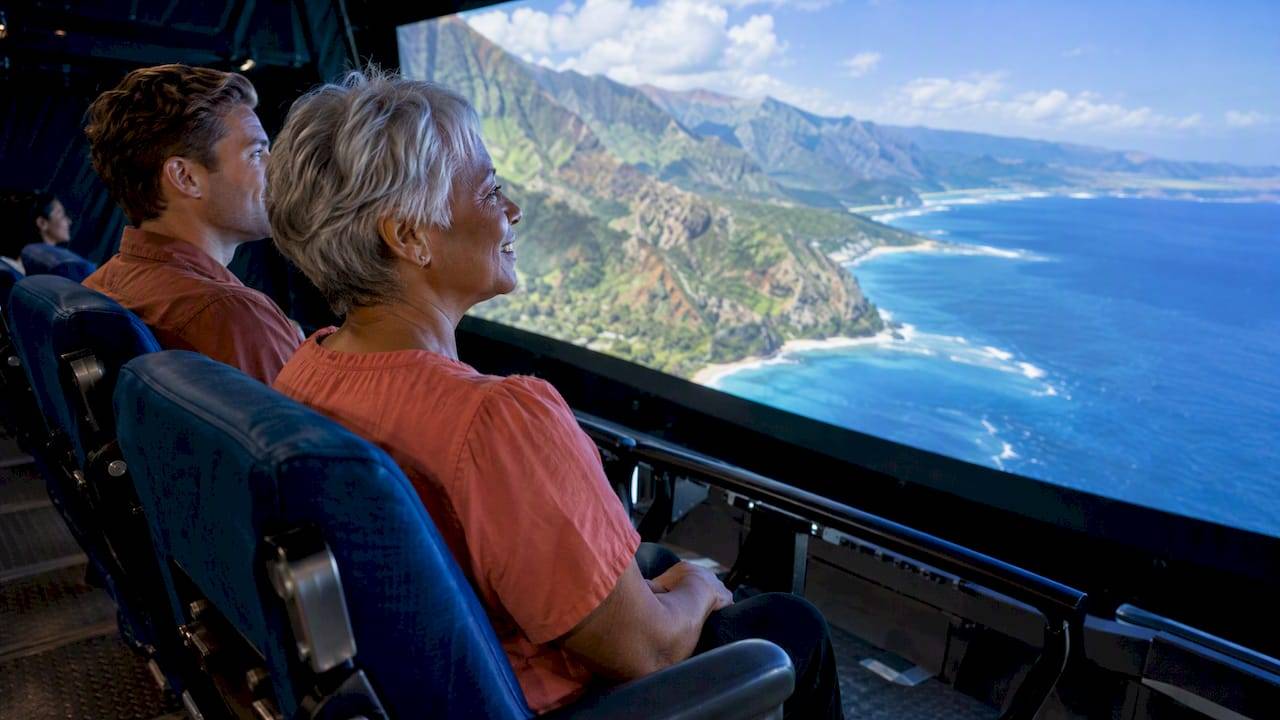
Multisensory entertainment is entertainment designed to engage more than your eyes and ears. Sound and picture are the base. Then touch, motion, scent, temperature and sometimes taste are added on purpose, timed to the story, so you feel like you are inside the moment instead of watching it from a seat. Think of a film that blows wind in your face when the hero soars over a cliff, or a ride where you smell the rain forest before you see it.
This guide explains the idea in plain words, shows which senses can be involved, gives real examples, and shows how it all comes together in a flying theater in Hawaii.
TL;DR
- Multisensory entertainment deliberately combines several senses (sight, sound, touch, smell, movement, sometimes taste) to create one memorable experience.
- Researchers stress that it is designed: the right sensation at the right time, not the most sensation possible.
- It differs from multisensory learning or therapy rooms because the goal is enjoyment, story and emotion.
- Flight of Aloha is a Native Hawaiian-owned flying theater in Kailua-Kona and Whalers Village Kaanapali, Maui, that blends 8K visuals, motion, scent and wind.
- Book online to see which flight film fits your day.
What multisensory entertainment actually means
The simplest definition: an entertainment experience where several senses are stimulated together, by design, to deliver a single story or feeling.
The design part matters. Researchers writing in Frontiers describe a multisensory experience as an impression formed by a specific event whose sensory elements have been carefully crafted for a receiver. Those elements can be physical, digital or a mix. Intentional design is what separates it from everyday life, where you also use many senses at once without anyone planning it.
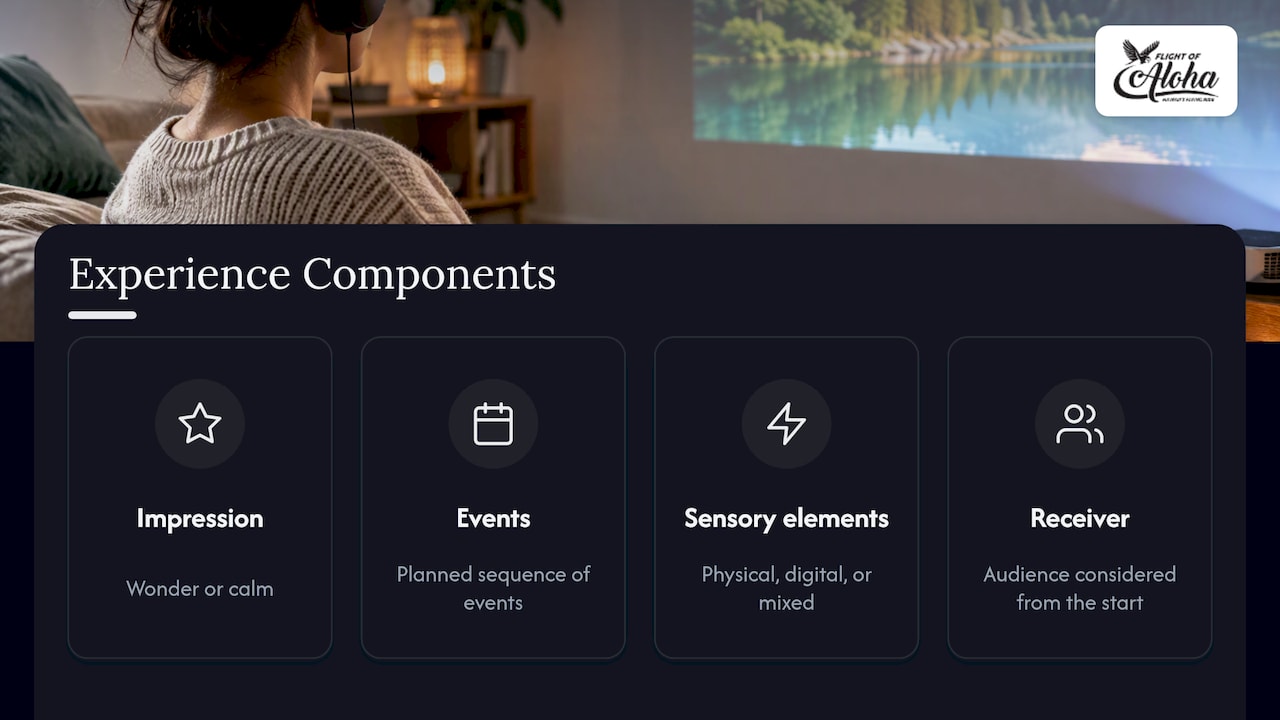
A 2025 article in Communications of the ACM breaks an experience into four parts: the impression it leaves, the event or events, the sensory elements presented, and the person receiving it. That is a handy checklist. A great show has a clear impression in mind (wonder, say, or calm), a planned sequence of events, carefully chosen sensory ingredients, and an audience that was considered from the start.
How it differs from “just a movie”
A standard film gives you two senses. A multisensory show adds the others, and, importantly, keeps them in sync. When a gust of air arrives at the same moment the screen shows a cliff edge, your brain reads it as one event. Researchers call this multisensory integration: the senses fuse into a coherent picture of the environment, and that fusion is stronger when cues line up in time and space.
It is not a new idea
Sensory spectacle has a long history. A Frontiers paper on the phantasmagoria and fairground entertainment of the late 18th to early 20th centuries describes shows as a total sensory milieu of sights, sounds, smells, tastes, jostling and motion, sometimes to the point of overload. Modern attractions do the same thing with better technology and far more control.
The senses designers work with
Most people name five senses, and entertainment designers use all of them to varying degrees.
| Sense | What it adds | Everyday entertainment example |
|---|---|---|
| Sight | Scale, color, depth, movement | Large high-resolution screens |
| Hearing | Mood, direction, vibration | Surround sound, bass you feel in the seat |
| Touch | Wind, mist, warmth, texture | Air effects, water spray |
| Smell | Place and memory | Scent released during a forest scene |
| Taste | Flavor tied to a story | Themed tastings and dining shows |
| Movement and balance | The feeling of flying or falling | Motion seats and ride platforms |
A professional handbook on multisensory design lists five externally stimulated dimensions: auditive, visual, tactile, olfactory and gustatory. It also points to internal dimensions such as vestibular sensing (your sense of movement and position) and proprioception (pressure, weight, push, pull or lift). Those inner senses are why a motion seat can make you feel like you are soaring even when your feet are a few inches off the floor.
Another way to sort them comes from academic work on immersive entertainment. Marshall and colleagues describe senses that work remotely (sound, vision), mechanically (touch, motion) or chemically (taste, smell). It is a useful way to understand why scent and taste are harder to deliver than a picture: they involve actual molecules reaching you, not just light and sound waves.
That is also why industry analysts note that visual and audio remain the benchmarks of immersive entertainment while touch, smell and taste technologies are still maturing. Venues that get scent and air right are rarer than venues with a big screen.
Taste is the sense food lovers know best. If that is your angle, this guide to culinary experiences and the senses shows how flavor, aroma, color and setting combine at the table.
Why it feels so immersive
There are a few reasons layered senses work so well.
Your brain wants a consistent story. The ACM authors explain that senses are integrated rather than perceived as isolated channels: one sensory element influences how you perceive another. A warm breeze can make a sunset look warmer. A scent can make a forest scene feel closer.
Timing and place matter. Velasco and Obrist argue that designers should use findings from perception research, including timing, spatial and semantic congruence, because coordinated cues shape attention, perception and memory. Wind that arrives a second late feels like a mistake. Wind that arrives on the beat feels like flight.
Less can be more. The Multisensory Hub, a UK professional resource, says multisensory work can deepen presence and emotion and create longer-lasting memories, but the right sensation at the right time matters more than piling on stimulation. Good design is editing.
Sometimes the senses disagree on purpose. Researchers note that conflicting cues, called sensory misalignment, are used deliberately in entertainment to create effects like vertigo in virtual reality roller coasters. It is a tool, and designers use it with care.
We go deeper on this idea in our post on presence and flow in immersive entertainment, and on why sensory attractions lift visitor emotion.
Examples of multisensory entertainment
You may have already enjoyed some of these without a label.
- Location-based hyper-reality performance. The Multisensory Hub points to Current, Rising, an opera that combines VR, free-roam movement, wind and floor vibrations, and to DARKFIELD’s Arcade, which uses binaural sound in total darkness, a branching story and water spray.
- Flying and motion theaters. A large screen, a moving platform, air effects and scent put you in the sky without leaving the building.
- Themed ride and dark-ride attractions. Sets, sound, temperature and smell all support one narrative.
- Immersive dining and tasting events. Courses are timed to music, lighting and story.
- Virtual reality arcades. Headsets plus haptics, fans and motion rigs. See our roundup of virtual reality attraction examples.
- Family multisensory rides. Gentle motion and sensory effects built for mixed ages. We list favorites in multisensory rides for families.
For a closer look at one effect, our piece on scent effects in real-world attractions walks through how aroma is used to anchor a scene in memory.
Multisensory entertainment vs. multisensory learning and sensory rooms
Search for this topic and you will mostly find classroom and therapy pages. They are related but not the same.
- Multisensory learning uses sight, sound, touch and movement together so students process and remember information. Its goal is skill and retention.
- Multisensory environments are dedicated spaces where stimulation can be controlled. A University of Edinburgh resource describes them as enriched settings that support relaxation, play and leisure, communication, learning and performance.
- Multisensory entertainment aims at enjoyment, story and emotion. Learning may happen, but delight is the point.
The shared principle is that engaging more senses, with intention, creates a fuller experience. The difference is the purpose, and for entertainment the purpose is a great time.
How to spot a well-designed multisensory experience
Use this quick checklist before you buy a ticket:
- Is there a story? Effects without a narrative feel like gimmicks.
- Do the effects match the moment? Wind, scent and motion should land with what is on screen.
- Is the picture sharp? Visual quality is still the backbone. Weak visuals make every other effect feel fake.
- Is it comfortable? Seating, temperature and pacing should suit the whole group, including kids and grandparents.
- Is it paced? A show that never lets you breathe tires you out. Good design leaves room for calm.
- Does it have a sense of place? The best experiences could only exist where they are.
A multisensory flying experience in Hawaii
Hawaii is a natural home for this kind of entertainment. The islands are about views, breezes, flowers, ocean air and story. Many visitors want to see the coast from above but do not want a long, costly aerial tour, or worry about motion sickness or weather.
That is the gap Flight of Aloha was built for. We are a Native Hawaiian-owned flying theater with two locations: Kailua-Kona on the Big Island and Whalers Village in Kaanapali, Maui. You sit in a flight seat in front of a giant screen showing 8K footage, and the show adds motion, scent and wind so you feel as if you are gliding over the islands. Our films are rooted in Hawaiian legends and told with the help of local advisors and storytellers. Think of it as what you would get if a helicopter tour and a Disney ride had a baby, raised with aloha.
Read more about the approach in how we use 8K, motion and scent and why immersive attractions in Hawaii create richer experiences.
The films
- Naupaka: a flight woven with the Hawaiian legend of the naupaka flower.
- Lahaina: a look at a place that means so much to Maui and to Hawaii.
- Europe: a ride tied to the Merrie Monarch festival’s international story, for travelers who love culture.
Single films are priced from $29.99 to $34.99. A Double Feature Flying Ride is $49.99 to $59.99, the VIP Package is $69.99 to $79.99, and an Annual Pass is $200 per year, a smart pick for locals and repeat visitors. Gift cards are also available on our main site.
Why it suits a Hawaii trip
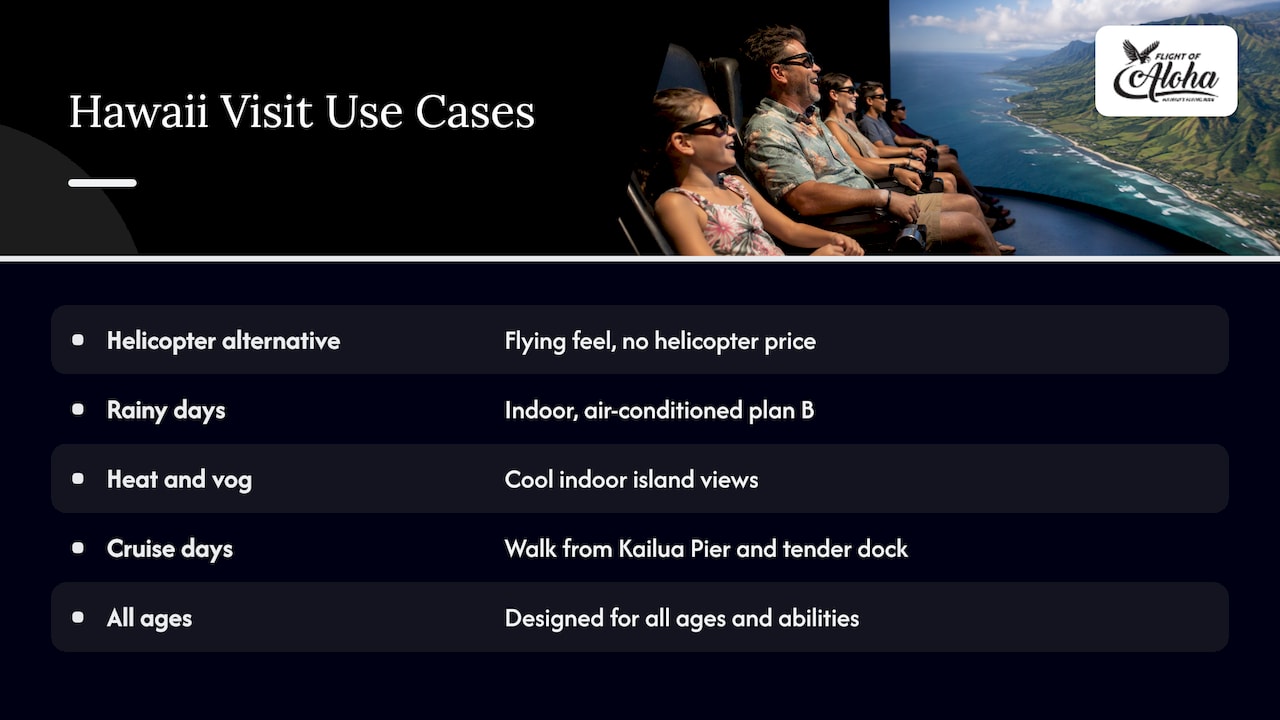
A smart alternative to a helicopter tour. You get the feeling of flying over the islands without the helicopter price tag and without worrying about motion sickness or cancelled flights. It is a great pick for families with small kids or grandparents who would never board an aircraft.
Rainy days in Kona and Maui. When the clouds roll in, the show goes on. Our theater is indoors and air-conditioned, so it is a comfortable plan B on a rainy day in Kona or Maui.
Escaping the heat and vog. On hot, hazy days, step into a cool, indoor space and enjoy the view of the islands from a seat instead of squinting through the haze.
Cruise ship days. Our Kailua-Kona location is within walking distance of Kailua Pier and the tender dock, so it fits easily into a quick shore excursion. Check the Kona location page for details.
Accessible for everyone. We pride ourselves on being the most accessible activity in the islands, designed for all ages and abilities. Our post on why immersive rides are popular with tourists explains what visitors tell us they love, and how visitor workflow shapes our attractions shows how we keep things easy from arrival to seat.
If you are planning a Kona or Maui day, a flight show makes a great top-three stop alongside a beach morning and a plate of local food. See also our thoughts on interactive experiences in attractions.
Our perspective
We think the best multisensory entertainment does one thing well: it makes you feel a place instead of just looking at it.
In Hawaii, that means more than pretty pictures. The trade winds, the scent of flowers after rain, the sense of the land rising beneath you: these are part of how our stories have always been told. When we add wind, scent and motion to 8K film, we are not adding gadgets. We are bringing back the parts of the story that a flat screen leaves out.
We also believe it should be open to everyone. Not everyone can or wants to board a helicopter, hike to a ridge or sit through a long tour in the heat. A comfortable, indoor flight that welcomes keiki, kupuna and everyone between is how we share the islands, and our culture, with as many people as we can.
Because we are Native Hawaiian-owned and work with local advisors and storytellers, every film is made with respect for the legends it carries. That is the difference between a ride and an experience rooted in aloha.
Ola
Ready to fly? Plan your visit
If this guide made you curious, the easiest way to understand multisensory entertainment is to feel it. At Flight of Aloha in Kailua-Kona and Whalers Village Kaanapali, you can choose a single film, a Double Feature Flying Ride, or the VIP Package for a premium visit. Locals who love to return can look at the Annual Pass, and a Double Feature is a great way to pair two stories in one visit.

Want a gift for someone visiting the islands? Gift cards are available through our website. Check the official pages for the current showtimes and availability at each location.
FAQ
What is multisensory entertainment in simple terms?
It is entertainment that engages several senses together, such as sight, sound, touch, smell and movement, in a planned way. The goal is to create one memorable feeling, like soaring over an island, rather than just showing you a picture.
What are some examples of multisensory experiences?
Examples include flying theaters, themed dark rides, VR arcades with wind and vibration effects, immersive performances that use binaural sound and water spray, and tasting events matched to music and story. Flight of Aloha’s flying ride is one example, combining 8K visuals, motion, scent and wind.
Is multisensory entertainment the same as multisensory learning?
No. Multisensory learning uses several senses to help people understand and remember information, while entertainment uses them to create enjoyment and emotion. They share the same principle: senses that work together make a stronger impression.
Is a flying theater good for kids and families?
Yes, it is designed to be accessible for all ages and abilities, and it is indoors, so weather and heat are not a problem. Families often choose it as a comfortable break on a rainy or hot day in Kona or Maui.
Can I visit on a cruise day?
Our Kailua-Kona location is within walking distance of Kailua Pier and the tender dock, which makes it a good fit for a short shore excursion. Book online to secure your seat before you head ashore.
Sources
- Frontiers: Multisensory Experiences: A Primer
- Communications of the ACM: Multisensory Experiences: Formation, Realization, and More
- Brunel University: Is Multimedia Multisensorial? A Review of Mulsemedia
- Frontiers: The phantasmagoria: From ghostly apparitions to fairground entertainment
- Handbook on multisensory experience design
- Sensory Alignment in Immersive Entertainment
- Roland Berger: Understanding immersive entertainment
- Multisensory Hub: Introduction
- University of Edinburgh: sensory play
- What Is a Culinary Experience? A Sensory Guide
Book online to secure your seat.