
Why 8K Matters for Attractions (and Where It Shines)
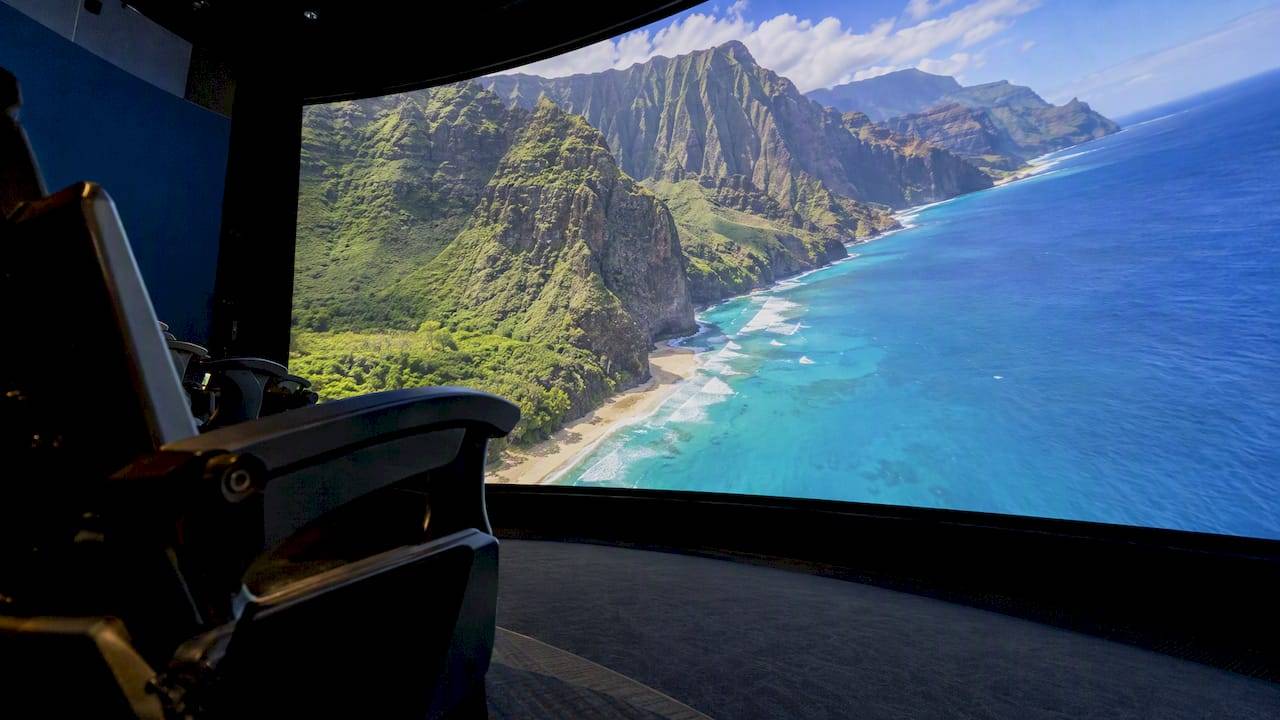
8K matters for attractions because visitors sit close to very large images, and that is the one situation where extra pixels show. On a living-room TV, the jump from 4K to 8K is hard to spot. On a giant screen that fills your field of view, it can be the difference between looking at a picture and feeling like you are inside the scene. That is why we built Flight of Aloha around 8K visuals, then added motion, wind and scent to match.
This guide explains what 8K is, when the research says people can see it, what it takes to make it work, and how to tell a real 8K attraction from a spec-sheet claim.
TL;DR
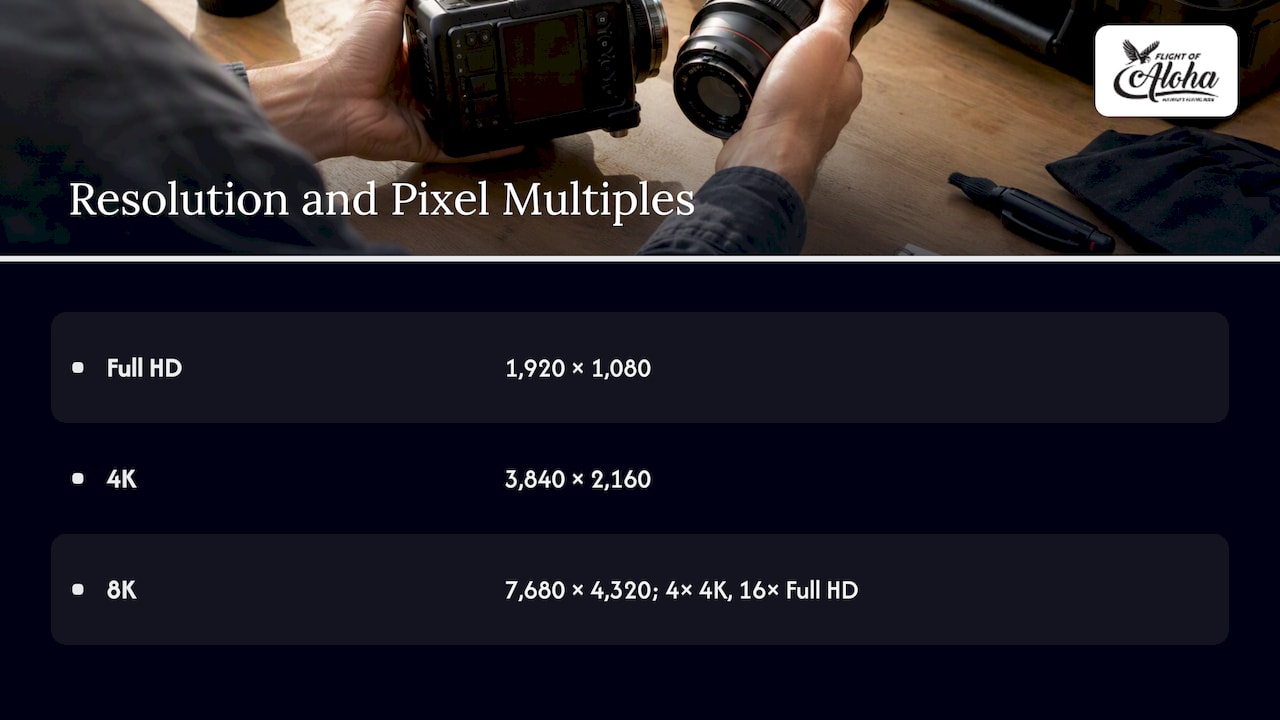
- 8K is 7,680 × 4,320 pixels, four times the pixel count of 4K and 16 times Full HD.
- Viewing distance is everything. A study found 8K improves video quality over 4K at close distances, which is where attraction guests sit.
- Resolution alone does not make an attraction immersive. Motion, sound, sensory effects and story do the rest.
- Flight of Aloha, Native Hawaiian-owned, shows 8K ride films in Kailua-Kona and at Whalers Village in Kaanapali, Maui.
What 8K actually means
Resolution is the number of pixels in an image. 8K, also called UHD-2, is defined in the ITU-R BT.2020 standard as 7,680 by 4,320 pixels. According to IEEE, that is four times the pixels of 4K (3,840 × 2,160) and 16 times those of Full HD.
More pixels do not automatically mean a better picture. Contrast, color, brightness, frame rate and the quality of the original footage all count. But when the other ingredients are strong, resolution sets the ceiling for how much fine detail you can see: individual leaves on a hillside, the texture of a lava field, the spray off a whale’s back.
Why a TV debate does not apply to a theater
Search for 8K and you will find endless arguments about whether anyone can tell it apart from 4K on a home television. Those arguments are often fair. From a couch several feet from a 65-inch screen, your eye can only resolve so much.
Attractions flip the equation in two ways:
- The screen is huge. The image fills your peripheral vision rather than a rectangle across the room.
- You are close. Immersive venues put guests near the image on purpose, because proximity is what creates the sense of presence.
Pixel size is what matters, not pixel count by itself. Spread the same number of pixels over a bigger surface, or sit nearer to it, and each pixel becomes easier to see. Higher resolution keeps them small enough to disappear.
What the research says about seeing the difference
Distance decides
A 2023 study presented to the Video Quality Experts Group found that 8K improves quality over 4K at close viewing distances, up to twice the screen height, for complex videos. Move farther back and the advantage fades. Complex scenes, such as landscapes full of fine texture, benefit most.
That is a good match for flight-style content. Aerial footage of coastlines, forests and towns is packed with detail from edge to edge.
The same logic shows up in print and signage. The principles behind image resolution for signage come down to how close the audience stands and how large the image is, which is exactly the question an attraction designer asks before choosing a projection system.
Perceived realness goes up
A 2019 academic study of ultra-high-definition images found that in subjective assessments, 8K images scored higher than 4K for sharpness, contrast, vividness, 3D-ness and realness. The researchers also found that 8K improved cognitive factors, meaning viewers did not just see more detail, they judged the image to be more real.
For an attraction whose whole job is to make you believe you are somewhere else, that is the metric that counts.
Close seating is the sweet spot
In the European Horizon 2020 immersive-media work around Ars Electronica’s Deep Space 8K, the team considered a viewing distance of about 1.0H (one screen height) the sweet spot for an immersive experience. That is much closer than a typical cinema seat, and it is where resolution is hardest to fake.
Why domes and giant screens need it most
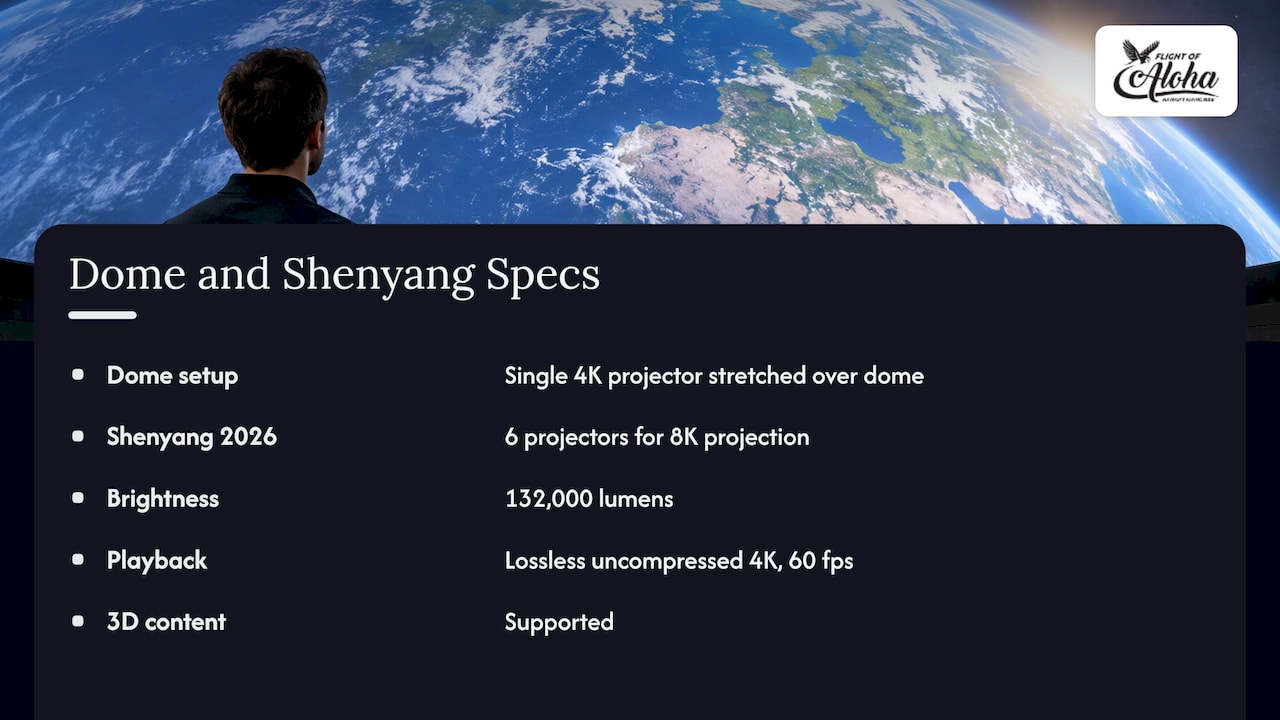
Curved and large-format screens expose low resolution fastest. Christie’s resolution white paper makes the point that resolution is more critical in dome theaters: stretch a single 4K projector over a dome and even the best seats see distractingly large pixels.
The industry is moving this way. A 2026 upgrade at the Shenyang Science Centrum in China uses six projectors for 8K projection at 132,000 lumens, and the system supports lossless uncompressed 4K 60 fps playback and 3D content. Museums, science centers and themed venues are investing because their guests sit close to very big images.
Panasonic’s 2022 themed-entertainment guide says much the same: higher resolution lets audiences approach an image and see more detail without visible pixelation, which supports realism and immersion.
The catch: 8K is hard to do well
A good attraction does not simply buy an 8K projector. The guide above also warns that higher-detail images create larger files and need more powerful content-management systems. Everything in the chain has to keep up:
- Source footage. Content has to be captured or rendered with enough real detail. Upscaled 4K is not 8K.
- Playback hardware. Files are big, so servers and codecs must stream them without stutter.
- Projection and screen. Brightness, contrast and screen quality matter as much as pixels. Shenyang’s upgrade pairs its resolution with very high brightness for a reason.
- Seating geometry. The sweet spot is a design decision, not an accident.
In practice, that is why a venue that is serious about 8K tends to make fewer, better films rather than dozens of mediocre ones.
Does 8K alone make an attraction immersive?
No, and any honest operator will tell you so. Resolution is the foundation. Immersion is what you build on it.
Think about what happens when you ride a helicopter over a coastline. The picture is wonderful, but so is the wind on your face, the lift of the aircraft, the smell of the air and the voice of a guide who knows the place. A sharp image with none of that is a very good video. A sharp image with all of that is an experience.
We lean on that idea at Flight of Aloha. If you want to go deeper on how the layers work together, our guides on how 8K, motion and scent combine and on presence and flow in immersive entertainment walk through it. For a wider look at where the format pays off, see the role of 8K in entertainment.
A quick checklist for judging an 8K attraction
Next time a venue advertises 8K, ask yourself:
- How close will I sit? Close seating shows resolution off. A back-row seat hides it.
- How big is the image? Bigger surfaces need more pixels.
- Is the content actually shot or rendered in high resolution? Detail has to exist in the source.
- What else is working on my senses? Motion, wind, sound and scent turn a sharp picture into a place.
- Does the story give me a reason to care? Detail without meaning fades fast.
How Flight of Aloha puts 8K to work
Our flying theater shows ride films in 8K while you sit in a motion seat with wind and scent effects, so the picture is never working alone. Rather than a generic scenic reel, each film is rooted in Hawaiian culture and storytelling. We are Native Hawaiian-owned and work with local advisors and storytellers, and that shapes what you see.
The lineup includes:
- Naupaka, a flight built around a Hawaiian legend. See the Naupaka film.
- Lahaina, a look at a place that matters deeply to Maui. See the Lahaina film.
- Europe, a journey that includes the Merrie Monarch. See the Europe film.
- Whale Song, a film inspired by Hawaii’s humpback whales.
We designed the experience to feel something like a helicopter tour crossed with a theme park ride, rooted in aloha. If you are curious about how that compares with a real aerial tour, our own view is that you get the sweeping aerial perspective in a comfortable, indoor seat, without the high cost of a flight or the worry about motion sickness. Our posts on ride film experiences in Hawaii and how visual effects enhance Hawaii tourism go further.
Where to find us
We have two locations:
- Kailua-Kona, Big Island. Our Kona location is within walking distance of Kailua Pier and the tender dock, so it fits a quick cruise shore excursion. Details are on our Kailua-Kona flying ride page.
- Whalers Village, Kaanapali, Maui. Easy to add to a beach day or a shopping stop on the west side.
Both are indoors with air conditioning, which makes the attraction a natural pick for a rainy day, a hot afternoon or a vog-hazy day when the views outside are less than crisp. We think of it as the most accessible activity on the islands: it works for all ages and abilities, with no hiking, no boarding a small aircraft and no long commitment.
Perspective: why we chose 8K
When we started Flight of Aloha, we asked a simple question: how do you show Hawaii to someone who may only have a few hours here, or who cannot hike a ridge or ride in a helicopter?
Our answer was to put the islands in front of you at a scale and clarity that feels close to being there. 8K lets us do that. When you sit near a very large image, every wave line, every leaf and every cloud edge matters, and the picture holds up instead of dissolving into pixels.
But resolution is not the story. The story is aloha. We are Native Hawaiian-owned, and we work with local advisors and storytellers so the places on screen are shown with respect and context. The wind, the motion and the scent are there to carry you into that story, not to show off technology.
That is why we think a flying theater belongs on your list of things to do in Kona or Kaanapali: it is comfortable, it is welcoming for families and groups, and it gives you a view of Hawaii you could not get any other way in an afternoon.
Ola
Tickets and packages
Prices below are as published on our site. Check the booking page for current availability.
| Experience | Price | Best for |
|---|---|---|
| Single film (Naupaka, Lahaina or Europe) | $29.99 to $34.99 | A first flight, a short stop or a cruise shore visit |
| Double Feature Flying Ride | $49.99 to $59.99 | Seeing two films back to back |
| VIP Package | $69.99 to $79.99 | A fuller, upgraded visit |
| Annual Pass | $200 per year | Locals and repeat visitors |
Gift cards are also available from our home page.
Which one should you pick?
- One hour in port? A single film in Kona is the easy choice.
- Rainy day with kids? The double feature gives you two stories under one roof.
- Celebrating something? The VIP package is built for it.
- Live here? The annual pass pays for itself as soon as you bring friends and family. It is also an easy way to keep coming back as we add films.
Ready to fly? Choose your film and showtime.
Beyond resolution: why immersive attractions work
People are drawn to flying theaters because they combine a sense of travel with a sense of safety. You get the scale of an aerial tour in a seat that stays on the ground. For more on that appeal, see why immersive rides are so popular with tourists and why immersive attractions in Hawaii create richer experiences. If you are visiting the Big Island, our guide to the benefits of immersive experiences in Kailua-Kona has local tips.
The pattern holds across the industry. The best attractions pair a sharp, large image with something real to feel and a story worth hearing. Take any one of those away and the magic gets thinner.
FAQ
Is 8K really better than 4K for attractions?
It can be, when guests sit close to a very large screen. A 2023 study found 8K improves quality over 4K at close viewing distances, especially for complex scenes. On a small screen far from the viewer, the gap shrinks.
How many pixels is 8K?
8K is 7,680 by 4,320 pixels, according to the ITU-R BT.2020 standard. That is four times the pixels of 4K and 16 times those of Full HD.
Does 8K content exist?
Yes, though it is still specialized. Venues such as planetariums, science centers and themed attractions use it for large-format projection, and it takes powerful playback systems because the files are large. Footage has to be captured or created at high detail to benefit.
Does 8K make Flight of Aloha feel like a real flight?
It is a big part of it. Our 8K visuals give you a sharp, close view of Hawaii, and the motion seat, wind and scent effects add the physical feeling of flying. Together with Hawaiian storytelling, that is what we designed the experience to do.
Where can I try it?
We are in Kailua-Kona on the Big Island, within walking distance of Kailua Pier, and at Whalers Village in Kaanapali, Maui. You can book online or walk in.
Sources
- Uhdtv, IEEE Technology Navigator
- Cognitive effect on image quality in full ultra-high-definition
- Viewing distance and 8K, VQEG 2023
- Report on QA and content preparation guidelines, Horizon 2020
- Resolution matters, Christie white paper
- Barco UDM projectors take Shenyang Science Centrum into 8K
- A projector technology guide for themed entertainment, Panasonic
- 10 to 300 DPI rules: image resolution for signage
Book online to secure your seat.