
Group Ticket Benefits: What You Get and How to Use Them

Group tickets usually give you three things: a lower price per person, one simple booking instead of many, and a real person to help you plan. The best programs add flexibility on headcount and a few extras that regular visitors don’t get. This guide walks through each benefit, what to ask before you commit, and how it plays out for a family reunion, a school trip or a cruise party heading to Hawaii.
We’re Flight of Aloha, a Native Hawaiian-owned flying theater in Kailua-Kona and at Whalers Village in Kaanapali, Maui, so we see group bookings up close. We’ll tell you what is standard across the industry, and be clear about what is simply how venues in general do things.
TL;DR
- A group ticket is a bulk booking at a venue’s discretion. Minimums commonly start between 10 and 20 tickets, and the venue sets the rules.
- The core perks are tiered pricing, a single checkout, and a dedicated contact. Some venues advertise savings of up to 25%, but the discount is never guaranteed, so ask for yours in writing.
- Good programs also let the organizer adjust the final headcount before a deadline, and some add extras like private tours or recognition.
- Indoor attractions are easy group stops in Hawaii because rain, heat and vog don’t change the plan.
- Before you book, confirm the minimum, the deadline, the payment terms and what happens if numbers change.
What a group ticket actually is
A group ticket is a bulk purchase for a party that meets a venue’s minimum size. In return, the venue offers volume pricing and a simpler way to book. Eventbrite’s overview of group tickets says minimums commonly start between 10 and 20 tickets, and describes the model as a discount plus a single-transaction checkout that removes the work of everyone buying separately.
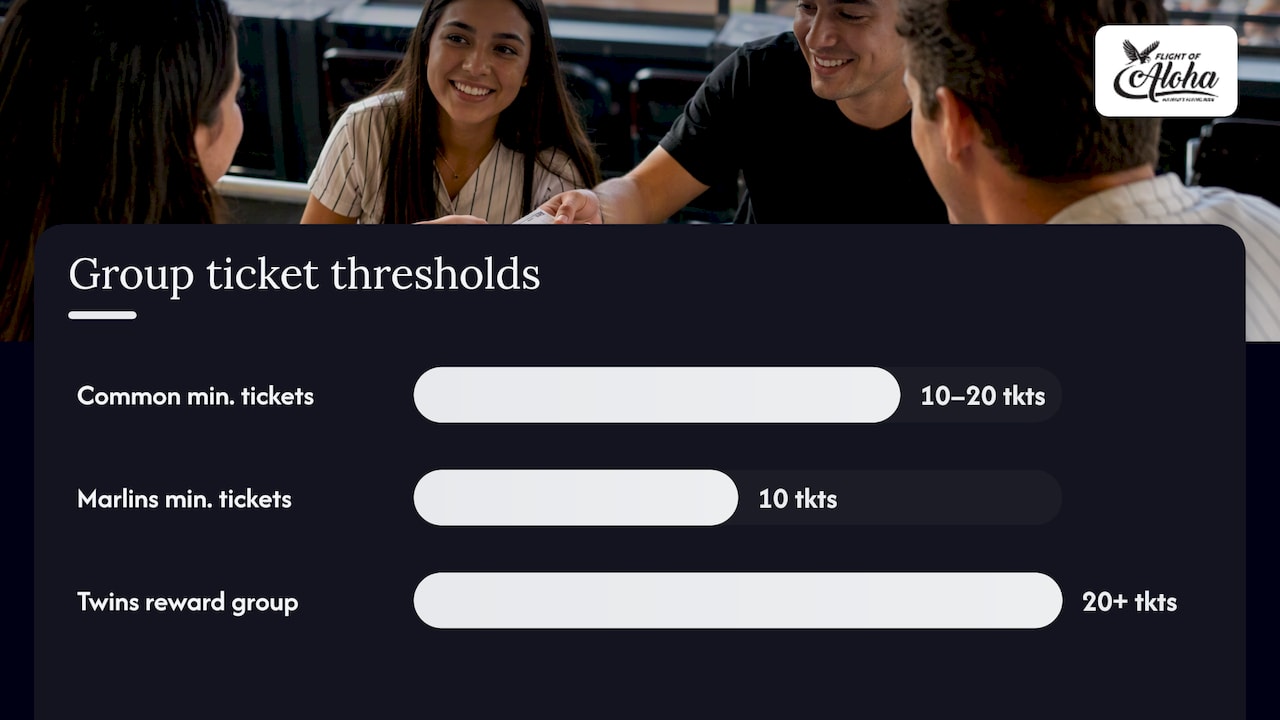
The threshold varies a lot by venue. The Miami Marlins start their group program at 10 tickets, while the Minnesota Twins tie organizer rewards to groups of 20 or more. Sports teams, theaters and attractions each draw the line where it suits their capacity.
Two more points are worth knowing:
- Group status is the venue’s call. A U.S. Federal Trade Commission staff report on ticketing notes that group status is often decided at the venue’s discretion, which helps keep tickets going to real social or organizational groups rather than to resale.
- You don’t all have to arrive together in a rigid sense. For an attraction, the group booking is about reserving and paying together. Check each venue’s rules on arrival times, since many ask the group to arrive at a set time.
If you want to see how this works at our theater specifically, our post on what a group ticket is in Flight of Aloha’s immersive theater covers it.
The main benefits of buying as a group
1. Lower cost per person
This is what most people search for. Venues reward volume with tiered pricing: the bigger the group, the better the rate. Eventbrite notes that some venues offer savings of up to 25% or waive certain transaction fees on group orders. That is a ceiling some venues advertise, not a promise, so treat any percentage as something to confirm with the specific venue.
A quick way to judge the value: add up what the group would pay at the standard price, then compare it to the quoted group total. Don’t forget the small costs on the other side, such as service fees, parking and transport, which can change the picture.

2. One checkout instead of twenty
The quieter benefit is time. Without a group program, buying 20 tickets can mean entering the same details again and again. A single group order means one payment, one confirmation and one set of details to share. Ticket Fairy’s guide to group sales points out that most ticketing platforms have no real concept of a group order, which is why a venue with a proper group process stands out.
For the organizer, this is the difference between a fun project and a second job. Successful organizers tend to value this friction-free booking as much as the discount, because it justifies the planning time they put in.
3. A single point of contact
When money, dietary needs, mobility needs and arrival times are all in play, you want one person to ask. A dedicated representative handles those questions and keeps the details in one place. Ticket Fairy describes this organizer-first support as a mark of real group sales. The Arizona Diamondbacks recommend speaking directly with a group sales representative to choose seating and learn about benefits, which shows how common this is.
4. Flexibility on the final headcount
People drop out. Kids get sick, flights change, a cousin cancels. Many programs let the leader adjust the headcount up to a deadline without losing the group rate, as long as the group stays above the minimum tier. The Seattle Mariners’ group leader page shows this kind of structure, with discounts that vary by group size. Always ask for the exact deadline and whether a deposit is refundable.
5. Perks and recognition
Some programs go beyond price. Larger groups at ballparks can get things like private tours or organizer recognition, and the Marlins list exclusive experiences like field photos for groups. At an attraction, the equivalent might be early entry, a private viewing time or a reserved block of seats. Industry coverage from Sports Business Journal says venues have leaned on add-on experiences to make group purchases more compelling, so it’s always worth asking what’s on offer.
6. Seats together
Few things sour a group outing faster than being scattered across a room. A group booking lets you reserve seats together instead of hoping individual tickets land near each other. For a flying theater, where the experience is shared, that matters. Everyone gasps at the same moment.
Why Hawaii venues love groups too
Groups aren’t only good for the buyer. Predictable visitors help a venue plan staffing and schedules. The Hawai’i Tourism Authority’s presentation on the cruise industry says that roughly 30 to 80 percent of cruise guests join organized excursions, a steady flow of visitors for local activities. It also notes that cruise lines book their itineraries one to three years ahead, so port days are known well in advance.
That’s good news if you’re organizing around a ship schedule: you know your day in port far ahead, so you can reserve early and not scramble.
What to ask before you book any group ticket
Use this checklist with any venue, ours included.
- What is the minimum group size? And does it apply per show time or per day?
- What is the price at my size, in writing? Tiers often change at set numbers, so a group of 19 may pay more than a group of 20.
- Are fees included? Ask about service fees and taxes.
- When is the final headcount due? Often it’s a couple of weeks out, but it varies.
- What happens to the deposit if the group shrinks?
- Who is my contact? Get a name and a way to reach them.
- What access needs does the group have? Strollers, wheelchairs, grandparents, little kids.
- What are the arrival and check-in rules? Especially important for time-boxed cruise days.
Our blog has a clear walk-through of this process in how to book group tours in Hawaii. Start with identifying your group’s requirements, then explore the available packages, and finally select dates and group size.
A quick comparison: group vs. individual booking
| Individual tickets | Group booking | |
|---|---|---|
| Price | Standard rate | Tiered or negotiated rate, at the venue’s discretion |
| Checkout | Everyone buys separately | One order, one payment |
| Support | General customer service | Often a dedicated contact |
| Headcount changes | Each person handles their own | Organizer adjusts before a deadline |
| Seating | Not guaranteed together | Can be reserved together |
| Extras | Rare | Sometimes private tours, early access or recognition |
Making group planning easier for the organizer
If you’re the one herding everyone, a few habits help.
- Collect commitments early. A simple group message with a firm “reply by” date saves chaos later.
- Decide who pays. Either you collect money first, or the group reimburses you after. Be clear up front.
- Plan the whole day, not just one stop. A show is easier to enjoy when lunch and transport are sorted. Our guide to planning an attraction itinerary for Hawaiian experiences can help you slot it in.
- Bring in help for the big moments. If your group outing is part of a larger celebration, such as a reunion or corporate event, a specialist like an entertainment company that offers event music planning and emcee services can take a lot of the load off an organizer.
- Think about food. Groups with mixed diets are happier when meals are planned. For ideas on shaping a trip around eating, this traveler’s guide to culinary experiences is a useful read.
Family groups can also look at our tips for enhancing family outings in Hawaii and the step-by-step family booking guide.
Our perspective: why groups and flying rides fit
We built Flight of Aloha to be the most accessible activity in the islands, and groups are where that shows. A family reunion might include a four-year-old, a teenager who is hard to impress and a grandparent who can’t hike a trail or climb into a helicopter. Everyone sits down together, and everyone gets the same view.
A few reasons we think a flying theater suits group days:
- Weather doesn’t matter. On a rainy day in Kona or Maui, or when vog or heat makes the outdoors a slog, we’re indoors and air-conditioned. A group plan that depends on perfect weather is a fragile plan.
- It’s a smart alternative to a helicopter tour. You get sweeping aerial views of the islands without the cost of a helicopter ride, and without the motion sickness some people dread. Per-person helicopter prices add up fast across a group of ten.
- It’s quick. Our films run up to 30 minutes, with a double feature and VIP package running up to an hour, according to our listing. That is easy to fit in a short port stop.
- It’s easy for cruise visitors. In Kona, we’re within walking distance of Kailua Pier and the tender dock, so a cruise group doesn’t need a bus.
- It tells a Hawaiian story. We’re Native Hawaiian-owned, and our films are rooted in Hawaiian legends and culture. If you’d like to read more about the traditions behind them, see our post on Hawaiian storytelling traditions.
We have two locations: Kailua-Kona on the Big Island and Whalers Village in Kaanapali, Maui. If your group is traveling between islands, you can plan a flight over each.
One honest note: we don’t publish a fixed group discount here, so reach out or check our group ticket explainer for the current details before you assume a rate. And whatever venue you choose, get the numbers in writing.
— Ola
Choosing a show for your group
Our published prices are per person and shown as ranges, so check the booking page for the exact price on your date.
| Experience | Price | Best for |
|---|---|---|
| Naupaka | $29.99-$34.99 | A Hawaiian love story told over 8K aerial views |
| Lahaina | $29.99-$34.99 | A journey through Lahaina’s history and resilience |
| Europe | $29.99-$34.99 | Groups who want a different horizon |
| Double Feature Flying Ride | $49.99-$59.99 | Groups with an extra half hour |
| VIP Package | $69.99-$79.99 | Special occasions |
| Annual Pass | $200 per year | Local residents who want to come back |
Local residents in a club, school or office will find the annual pass worth a look, and visitors giving presents can see the gift card option on our home page.
Book your group’s flight
If you’re planning a group outing in Kailua-Kona or at Whalers Village in Kaanapali, start with the Kona flying ride page and choose your film. Then use the checklist above to confirm numbers, timing and any access needs. Our flying theater is indoors, air-conditioned and open to all ages and abilities, so it’s an easy yes for a mixed group.
FAQ
How does a group ticket work?
You buy a block of tickets in one transaction, usually once you meet the venue’s minimum size. In exchange, the venue typically offers a lower per-person price, and often a contact person to help with details. Rules, deadlines and discounts differ by venue, so confirm them before paying.
How many tickets do you need for a group booking?
There’s no universal number. Eventbrite says minimums commonly start between 10 and 20 tickets. Some teams start at 10, others at 20. Ask the specific venue what counts as a group.
Do you have to travel together on a group ticket?
For attractions and events, a group ticket is about booking and paying together, and most venues still ask that everyone arrive for the same show time. Transport arrangements are usually up to you. Confirm check-in rules with the venue, particularly if your group is coming from a cruise ship with a fixed departure time.
Can the group size change after booking?
Often, yes, within limits. Many programs let the organizer change the final headcount up to a deadline, as long as the group stays above the minimum. Ask for the cutoff date and the deposit terms before you book.
Sources
- Eventbrite: Sell group tickets and offer bulk discounts
- U.S. Federal Trade Commission staff perspective on ticketing
- Hawai’i Tourism Authority: Hawai’i’s cruise industry
- Miami Marlins group tickets
- Minnesota Twins group organizer benefits
- Seattle Mariners group leader page
- Arizona Diamondbacks group ticket FAQ
- Ticket Fairy: group ticket sales
- Sports Business Journal: Tickets, Group Thinking
Book online to secure your seat.