
Why Escapist Entertainment Restores Mood When Post Gaming Return Works

Escapist entertainment is any story, game, or activity used mainly to disengage from stress or boredom by shifting attention toward an absorbing, imagined, or sensory experience. Researchers classify it as a form of emotion-focused avoidance coping, and the honest verdict is that it cuts both ways: short bursts tend to restore mood, while habitual reliance on it can chip away at real-world meaning-making. A well-designed experience, like Flight of Aloha’s immersive flying theater, shows what the healthy version looks like in practice.
TL;DR:
- Short-term escapes like immersive experiences can reduce stress and loneliness but may undermine long-term meaning if overused habitually.
- Narrative transportation in escapist media creates deep immersion that can influence real-world intentions, such as increased travel desire.
- Controlled, time-limited escapist activities with clear start and end points support healthier engagement and return focus to daily goals.
- Repeated reliance on escapism correlates with higher social anxiety and a decline in sense of life purpose over time.
- Flight of Aloha offers a culturally grounded, sensory-rich flying theater experience as a cost-effective, indoor alternative to outdoor tours during bad weather.
What Does Escapist Entertainment Actually Mean?
Escapist entertainment covers any media or activity chosen primarily to mentally exit an unpleasant or dull reality rather than to engage with it directly. That’s a narrower idea than it sounds. Wanting to escape is a motivation, not an experience, and researchers who study systematic reviews on escapist media use draw a sharp line between escapist motivation and the hedonic or eudaimonic qualities of what you actually feel once you’re immersed. You can sit down wanting to numb out and end up somewhere genuinely moving. Both things can happen in the same hour of screen time, and they predict very different long-term outcomes.
Here’s what escapist entertainment looks like in everyday life:
- Reading fiction — losing track of time inside a novel’s world instead of your own.
- Binge-watching a series — scholars specifically cite this as a textbook case of escapist entertainment in action.
- Video games — especially open-world or role-playing titles that offer a separate identity or goal system.
- Immersive rides and attractions — multisensory experiences that physically remove you from your surroundings for a fixed window of time.
- Daydreaming — the oldest and cheapest form, requiring no screen at all.
- Social media scrolling — a lower-effort, often less restorative version of the same impulse.
- Fantasy sports or hobbyist deep-dives — mental relocation into a rules-based world you control.
- Themed travel or cultural storytelling experiences — stepping into a place, legend, or history outside your own.
How Does Escapist Entertainment Actually Work in the Brain?
Escapism functions as emotion-focused avoidance coping. Rather than solving the stressor, your mind redirects attention toward something more manageable or more pleasant, and that redirection itself lowers arousal. It’s one of the most common motives for media consumption worldwide, which tells you this isn’t a fringe behavior. It’s baked into why people watch, play, and read at all.
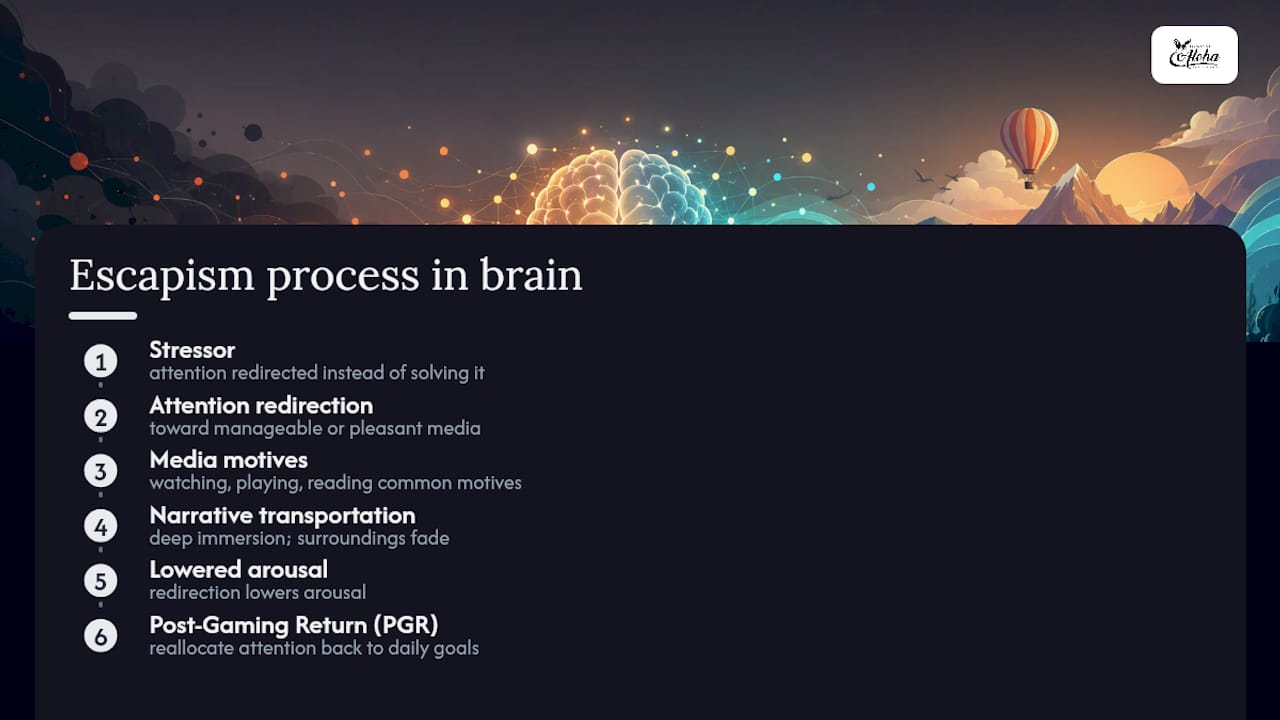
The deeper mechanism researchers point to is narrative transportation, a concept built on work by Gerrig and later Green and Brock. It describes the sensation of being mentally “transported” into a story world so completely that your surroundings fade. This isn’t passive distraction. Studies on narrative transportation and travel intention show that deep immersion can even shift real-world behavior, like making someone want to visit a place they only experienced through a screen.
What separates a good escape from a bad one often isn’t the content. It’s what happens after. Researchers use a construct called Post-Gaming Return, or PGR, to describe how well someone reallocates attention and motivation back to ordinary goals once the session ends. One analysis of PGR frames this transition, not the escape itself, as the real predictor of whether the experience helped or hurt.
Escapist motivation drives engagement in virtual gaming with outcomes ranging from mental health benefits to dysfunctional patterns, depending largely on how the experience is used and how the user returns to daily life afterward.
One consistent pattern across the research: escapism is rarely good or bad in isolation. The return matters as much as the escape.
Are the Benefits of Escapist Entertainment Real, or Just a Coping Illusion?
The short-term evidence is genuinely encouraging. Escapist motives have been linked to reduced loneliness and quicker mood repair, and systematic reviews confirm real mental-health upside when the behavior stays occasional. A rough night, a stressful week, a long flight: a couple of hours inside a story or game can lower stress the same way a short walk does.
The risk shows up with repetition. Longitudinal research tracking escapist media use over daily, weekly, and multi-month intervals found it negatively predicted meaning-making over time, suggesting that habitual escapism can quietly erode the sense that your life adds up to something. Other samples in the same research area link excessive escapist use to higher social anxiety, not lower.

Pro Tip: Treat escapist entertainment like a prescribed dose rather than a default setting. Scheduling a specific block of time for it, instead of reaching for it reflexively, makes it far more likely to leave you restored instead of drained.
Use this quick checklist to self-assess your own pattern:
- Do you choose the activity, or does it choose you when you’re stressed?
- Can you stop at a natural break point without discomfort?
- Does it interfere with sleep, work, or relationships more than occasionally?
- Do you feel more capable of returning to real tasks afterward, or less?
- When you’re honest with yourself, does it add meaning or just fill time?
Why Have Cultures Always Turned to Escapist Storytelling?
Escapist storytelling is older than any screen. Boccaccio’s Decameron has ten narrators trading stories to survive plague quarantine, and fairy tales across cultures gave communities a way to process fear without naming it directly. Cultural commentary on storytelling during lockdowns draws a straight line from that history to modern feel-good cinema and comfort-watch serials, arguing that collective escapism has always offered a kind of shared reassurance during hard stretches.
Some cultural functions of escapist media across history:
- Wartime cinema and radio gave entire populations a nightly mental break from rationing and loss.
- Pandemic-era streaming surges mirrored the same pattern almost exactly, just on a different platform.
- Fairy tales and folklore let societies rehearse fears (abandonment, hunger, cruelty) at a safe imaginative distance.
- Modern immersive attractions carry this forward by turning cultural legend into a physical, shared experience rather than a solitary one.
How Flight of Aloha Shows Escapism Done Right
Flight of Aloha is built around the exact mechanics researchers describe: an immersive flying theater using advanced visuals, motion effects, scent, and wind to simulate soaring over a scenic location, with films rooted in cultural storytelling. What makes the design smart isn’t just the sensory layer. It’s the structure.
- Fixed run time and a clear start and finish, which supports a clean, healthy return to reality instead of an open-ended scroll with no natural exit.
- Sensory cues that bookend the experience, signaling clearly when the escape begins and ends.
- Indoor, air-conditioned comfort, which makes it one of the better answers to a rainy day in Kona, a rainy afternoon in Maui, or simply escaping vog and heat.
- Cultural grounding, since the attraction is Native Hawaiian-owned and built around real legends rather than generic spectacle.
It sits within walking distance of Kailua Pier, making it a natural stop for anyone doing a quick Kailua-Kona shore excursion off a cruise tender.
What I’ve Learned About Using Escapism Well
Escapism isn’t a character flaw or a wellness hack. It’s a tool, and tools work or fail depending on how you hold them. My honest read of the research: time-box it, check in with yourself after (that’s your own version of PGR), and mix passive comfort content with the kind of story that actually asks something of you. Alternate hedonic nights with eudaimonic ones. Context decides whether an escape restores you or replaces something you actually needed to face.
— Ola
Your Smartest Escape in Kona and Kaanapali
If you’ve been weighing a door-to-door helicopter tour, consider the math first: those runs routinely cost close to $400 a person, come with real motion-sickness risk, and depend entirely on clear weather. Flight of Aloha gives you the same soaring, aerial sense of Hawaii, minus the price tag, minus the queasiness, and fully indoors with some of the best air conditioning in town. That makes it the go-to fix for a rainy day in Kona, a rainy afternoon in Maui, or an afternoon spent dodging vog.

You’ll find it in two spots built for real trip logistics: one location near a major pier popular for cruise passengers doing quick shore excursions, and another in a well-known visitor area on Maui. The attraction is Native Hawaiian-owned and features storytelling films grounded in legend. Ready to pick your flight? Browse Naupaka, Lahaina, or the Double Feature option if you want two stories in one visit, and check the VIP Package if you’re celebrating something. Frequent visitors can lock in the Annual Pass for $200 a year. Book online to secure your seat.
Sources
- Escapism — iResearchNet: Exposure to Communication Content
- Systematic reviews on escapist media use — PMC (2023)
- Binge-watching as case of escapist entertainment use — Oxford Handbook chapter (2021)
- Entertainment contributes to adaptive coping: longitudinal study (2025)
FAQ
What Is Considered Escapist Entertainment?
Anything used mainly to mentally exit an unpleasant or dull reality counts, from novels and binge-watched shows to video games, daydreaming, and immersive attractions like Flight of Aloha. The common thread is the motive: seeking relief or distraction rather than direct engagement with a problem.
What Is the Meaning of Escapist Entertainment?
It refers to media or activities chosen primarily as a form of emotion-focused avoidance coping, where attention shifts away from stressors toward an absorbing alternative. It’s not inherently negative; it becomes a concern mainly when it turns habitual.
What Are Some Examples of Escapist Activities?
Common examples include reading fiction, binge-watching, gaming, daydreaming, social media scrolling, and immersive experiences such as themed rides or flying theater attractions. Binge-watching in particular is a prominent example studied in escapist entertainment research.
What Does Escapist Mean?
“Escapist” describes anything designed or chosen to help someone temporarily disengage from ordinary reality, whether that’s a plot, a game world, or a sensory experience. It’s a description of intent and function, not a judgment on quality or worth.
Is Flight of Aloha an Example of Escapist Entertainment?
Yes. Flight of Aloha uses 8K visuals, motion effects, scent, and wind inside a fixed run time to create an immersive, timed escape rooted in Hawaiian storytelling. Current pricing for shows like Naupaka and Lahaina runs $29.99 to $34.99 one time, listed on the Naupaka and Lahaina pages.