
How to Choose Immersive Theater Tickets: A Practical Guide

The right immersive theater ticket comes down to five questions. How much do you want to move, watch or take part? What does the ticket actually include? Can everyone in your group enjoy it comfortably? When do you need to arrive? And is the price fair for what you get? Answer those, and you can book with confidence, whether you are in New York, Las Vegas or on a Hawaii vacation.
We run a Native Hawaiian-owned flying theater, so we see this decision from the ticket counter every day. Below is the checklist we would hand a friend, with real examples from our two locations in Kailua-Kona and Whalers Village Kaanapali, Maui.
TL;DR
- Decide the format first: walk-through and roaming shows ask a lot of you, while seated shows like a flying theater ask for nothing but your attention.
- Read what the ticket includes before you compare prices: single shows, double features, VIP packages and passes are different products.
- Check accessibility, sensory effects and age guidance on the venue’s own page, and contact the venue if something is not published.
- Plan arrival time, late entry and change policies before you pay, especially on a cruise day or a tight schedule.
- Flight of Aloha tickets run from $29.99 to $79.99 depending on the experience, and an annual pass is $200 per year.
What “immersive” really means before you buy
The word gets used loosely. Theater writer Jonathan Mandell argues that a show is not immersive just because it engages your imagination. It has to build a distinct physical environment that deliberately replaces the usual stage-and-seats setup. That is a useful filter when you read ticket listings: look for what the space does to you, not just what the marketing says.
In practice, “immersive” covers a wide range:
- Roaming productions, where you walk through rooms or a building and choose where to look.
- Participatory shows, where you may be given a role or asked to join in.
- Sensory or technology-led experiences, where the environment moves, smells, blows and glows around you while you stay seated.
Immersive and interactive are not the same thing either. A show can surround you completely without ever asking you to speak or move. If you want the full story on how that works in our own theater, our guide to how we use 8K, motion and scent walks through it.
Step 1: Match the format to your group
This is the choice that most affects how your day goes. Ask yourself honestly:
- Do you want to be on your feet? Roaming shows can involve long periods of standing and walking. If anyone in your group tires easily, a seated format is the safer bet.
- Do you want to be asked to participate? Some audiences love being pulled into the story. Others would rather watch. The creators of one 2026 participatory production even draw a line between taking part and being truly immersed, noting that their audience members stay audience members. Read the listing closely to see where a show sits on that spectrum.
- How long can your group focus? A ten-minute film and a three-hour walk-through suit very different attention spans.
For travelers, the seated, short-format end of the spectrum is often the best fit. You get the wow without a big time commitment, and it works for grandparents, toddlers and everyone in between. That is exactly why we built Flight of Aloha the way we did: the whole experience is indoors, seated, and open to all ages and abilities.
Step 2: Understand the ticket types
Most venues sell more than one ticket. Here is how our own lineup works, as a worked example of what to look for anywhere.
| Ticket | What it is | Price (as published) |
|---|---|---|
| Single ride film | One flight: Naupaka, Lahaina or Europe | $29.99 to $34.99 |
| Double Feature Flying Ride | Two ride films in one visit | $49.99 to $59.99 |
| VIP Package | An upgraded experience | $69.99 to $79.99 |
| Annual Pass | Unlimited-style repeat visits for a year, for locals and frequent visitors | $200 per year |
Prices are shown as a range because they vary by option. Check the booking page for the exact price of the film and date you pick.
A few things to notice in any ticket menu:
- The double feature math. Two films together cost less than two single tickets bought separately. If you have the time, it is usually the better value.
- The premium tier. Ask what a VIP or premium ticket changes: seat position, extra features, a keepsake, or just a label. If the listing does not say, that is a red flag.
- The pass. If you live nearby or visit more than once a year, a pass changes the math. At $200 per year, it pays for itself quickly compared with buying single tickets over time.
- Gift options. A gift card is a simple way to cover a family member’s visit without guessing which film they will pick.
You can see each film and ticket on its own page: Naupaka, Lahaina and Europe.
Step 3: Find out what the ticket includes (and what it does not)
This is where surprise costs hide, across every kind of live and immersive entertainment. Before you pay, scan for:
- Service or booking fees added at checkout. Compare the final total, not the headline price.
- Add-ons. Photos, merchandise, drinks, a coat check or a cast-meet are often separate.
- Age-based pricing. Some venues charge children differently, or require every guest to hold a ticket.
- Companion or accessible seating rules. More on that below.
- What the ticket covers on the day. Does one ticket equal one show, one entry window, or a full day?
The simplest test: can you describe, in one sentence, what you will get for the total at checkout? If not, ask the venue before you buy. A good venue answers plainly.
Step 4: Compare the film or story, not just the price
In a flying theater, the film is the show. Each of ours has a different personality:
- Naupaka is rooted in a Hawaiian legend and travels through island scenery with cultural storytelling at its heart.
- Lahaina is a flight over a place many visitors and residents hold dear.
- Europe takes you across a very different landscape, including a link to the Merrie Monarch festival’s hula tradition.
- Whale Song brings the ocean and humpback whales into the story.
If you are choosing between films, ask who made the story and whose voice it carries. We work with local advisors and storytellers, and that cultural grounding is part of what separates a Hawaii attraction from a generic simulator. Our piece on what sets Hawaiian theater apart goes deeper. For the technology side, see how animation shapes a flying theater film.
Step 5: Check accessibility before you pay
This step is the one people skip and then regret. In the United States, the Department of Justice explains that venues should describe accessible seats with enough detail for buyers to judge them, including location, price, view and availability. The same guidance says that a person buying an accessible seat can purchase up to three companion seats in the same row, kept together when available.
A professional resource on arts access suggests asking whether accessible seats exist across price levels, whether they are integrated through the venue, and whether you can buy them through the same channels and at the same time as other tickets.
Bring that to any venue with a short list of questions:
- Is there a step-free route from entrance to seat?
- Where are the accessible seats, and what is the view from them?
- Can my companion sit beside me?
- Can I buy these tickets online, or only by phone?
- Is there somewhere to rest before or after?
For productions with changing layouts, one accessibility specialist recommends checking the actual production rather than only the building, since barriers, screens and crowds can change sightlines and routes. The same source suggests confirming step-free routes, toilets, rest points, captions and audio description before purchase.
Our approach is to keep this simple: the experience is indoors, seated and built for all ages and abilities. For the details of how we welcome guests, read our accessibility workflow for guests. If you have a specific need, tell us before your visit and we will help you plan.
Step 6: Know the sensory effects
Immersive means the show reaches more than your eyes. Before you book, look for warnings about:
- Flashing or strobe lighting
- Smoke or haze
- Sudden loud effects or high sound levels
- Crowd closeness and long standing periods
- A quiet or calm space, and where it is
Those are the items one accessibility guide lists as things venues should flag in advance. For guests who find sensory environments hard, another guide advises researching entrances and exits, seating layout and quiet areas, and contacting the venue if sound or calm-space details are not published.
In a flying theater, the effects are part of the point: motion seating, wind, scent and big 8K imagery. That is wonderful for most guests, and it is also why we describe it plainly up front. If you or a family member is sensitive to motion, motion effects, scents or wind, ask us which film is gentlest and what to expect. Compared with an open-door helicopter, the ride is a controlled, indoor experience, and you stay in your seat throughout.
Step 7: Decide whether it suits kids and groups
Children’s theater companies publish age recommendations because a good fit depends on more than a minimum age. One major children’s theatre says its guidance weighs themes, storytelling style, length, pacing and sensory elements, and encourages parents to read the production details on tone, language and sensory advisories.
A family-focused venue guide adds practical items to confirm: running time, darkness, sudden sound, audience participation and flashing lights, plus whether you can leave and come back in.
Turn that into a family checklist:
- How long is the show, and can your youngest sit that long?
- Is the room dark, and will that worry a nervous child?
- Does the story have intense scenes?
- Can you step out if needed?
- Will every guest in your group, including grandparents, be comfortable with the seat and motion?
For groups, ask about group rates and booking ahead so everyone sits together. Our flying theater was designed for exactly this mix, from kids to kupuna, and it is a favorite for multigenerational trips.
Step 8: Plan timing, arrival and changes
A great ticket is wasted if you cannot get in. Before you buy, confirm:
- Showtimes and how often they run. Many attractions run on a repeating schedule rather than one fixed slot.
- Arrival time. Ask how early to arrive, and what happens at check-in.
- Late entry. Some shows, especially dark or narrative ones, do not seat latecomers at all.
- Exchanges and cancellations. Look for a clear written policy, and note whether it differs for passes and packages.
- Weather. For outdoor activities, rain can cancel your plan. Indoor ones keep going.
Schedules and policies change, so always confirm on the venue’s official booking page rather than relying on an older guide, including this one.
Short on time? Cruise and quick-stop tips
If you are visiting Kailua-Kona from a cruise ship, the timing question gets sharper. Our Kona theater is within walking distance of Kailua Pier and the tender dock, so you can fit a flight into a shore day without renting a car or booking a long tour. Choose a single film if your tender schedule is tight, and book online so your seat is waiting.
Why a flying theater is the smart choice in Hawaii
We are biased, of course. But here is the honest case for putting a flying theater in your top three things to do in Kona or Maui.
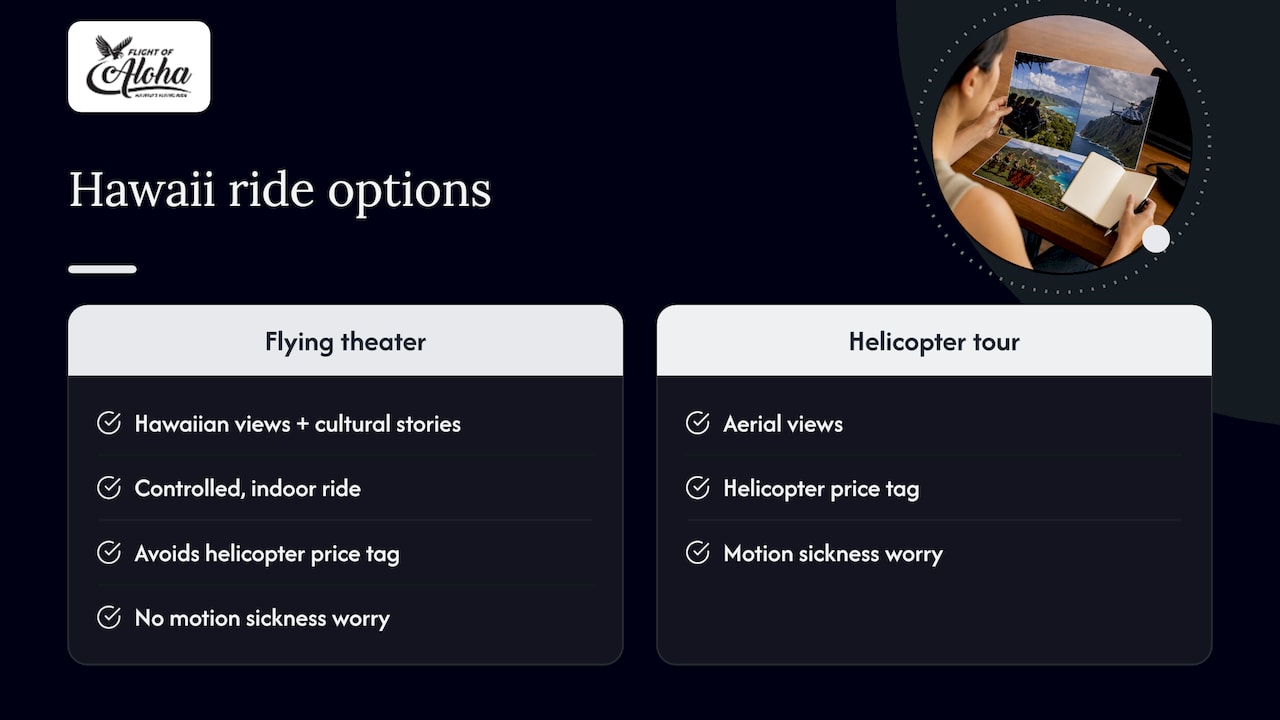
It is the smart alternative to a helicopter tour. You get sweeping aerial views of Hawaii, with the cultural storytelling woven in, without the helicopter price tag and without the motion sickness worry. It is a controlled, indoor ride for guests of all ages. Read more on the benefits of flying theaters for Hawaii visitors.
It is the rainy-day and vog-day answer. When showers roll in over Kona or Lahaina, or the vog and heat make a beach afternoon rough, we are an air-conditioned indoor option. Pick us when the forecast turns.
It is the most accessible activity we know of on the islands. Seated, indoor, short and open to all ages and abilities.
It is Native Hawaiian-owned. The stories come from Hawaiian legend and are shaped with local advisors and storytellers. For more on that approach, see why immersive attractions in Hawaii feel richer and our look at ride film experiences.
Our perspective: choose the experience you will still talk about
We have watched thousands of guests walk out of the theater. The ones who are happiest did not necessarily buy the most expensive ticket. They bought the one that matched their group.
Here is how we think about it. A ticket should be easy to understand, the space should be comfortable for everyone who walked in with you, and the story should have real roots. If a venue cannot tell you plainly what is included, how to get a seat that works for your family, and what the show will do to your senses, keep looking.
For us, being rooted in aloha means welcoming people as family. That is why we describe the motion, wind and scent honestly, why we keep the experience seated and indoors, and why we tell the stories of these islands with the people who know them. If you are choosing between a long, tiring activity and an easy hour that the whole family will remember, we think the second one wins on most vacation days.
— Ola
Ready to pick your flight?
If you want an easy place to start, here is how we would match guests to tickets:
- First visit, short on time: one ride film, such as Naupaka, from $29.99 to $34.99.
- Want more: the Double Feature Flying Ride, from $49.99 to $59.99.
- Celebrating something: the VIP Package, $69.99 to $79.99.
- Live nearby or return often: the Annual Pass, $200 per year.
We are in Kailua-Kona and at Whalers Village in Kaanapali, Maui. Pick your location, pick your film and the whole group can fly together.
FAQ
Is immersive theater the same as interactive theater?
No. Immersive theater puts you inside the performance space instead of in front of a stage, while interactive theater asks you to take part. A show can be one without the other, so read the listing to see whether you will be watching, moving or joining in.
What should I check before buying immersive theater tickets?
Check what the ticket includes, the final price with fees, the show length, arrival and late-entry rules, and the change or cancellation policy. Then check accessibility, sensory effects and age guidance. If the venue does not publish something you need, contact it before you pay.
Are immersive shows suitable for young children?
It depends on the show. Look at the venue’s age guidance, running time, darkness, sudden sounds and any participation. Seated, short formats tend to be easier for families, and our flying theater is designed for all ages.
Is a flying theater a good alternative to a helicopter tour?
For many visitors, yes. You see sweeping aerial scenes of Hawaii from a comfortable indoor seat, without the helicopter price or any worry about motion sickness, and it works on rainy or vog-heavy days too.
How do I book Flight of Aloha?
You can book online or at the venue counters in Kailua-Kona and Whalers Village Kaanapali. Choose a single film, a double feature, a VIP package or an annual pass, and check the booking page for current times.
Sources
- Immersive Theatre, Defined | HowlRound Theatre Commons
- Becoming Hamlet: Audience Decides Shakespeare’s Play
- ADA Requirements: Ticket Sales | ADA.gov
- Ticketing and Admissions | Arts & Culture Accessibility Hub
- Concert Accessibility: How to Design the Full Fan Journey
- Attending Live Events as an Autistic Adult | HeyASD
- 2026-2027 Age Recommendations | Children’s Theatre Company
- Family shows and theatre for young audiences
Book online to secure your seat.