
The Role of Cultural Heritage in Identity and Community

Cultural heritage is the collective legacy of tangible and intangible elements that defines who we are and strengthens the bonds between people across generations. From ancient temples and oral traditions to living rituals and craftsmanship, the role of cultural heritage reaches far beyond museums and monuments. It shapes how communities understand themselves, how individuals find belonging, and how societies build resilience in the face of change. A synthesis of 187 academic papers spanning 50 years confirms that heritage acts as a foundational anchor for community identity and individual well-being. That is not a soft claim. It is one of the most consistent findings in social science.
How does cultural heritage shape identity and social cohesion?
Cultural heritage builds identity by giving people a shared story. When a community gathers around a festival, a language, or a sacred site, it reinforces a sense of “we.” That emotional connection is what researchers call place attachment, and it is one of the clearest mechanisms through which heritage strengthens social cohesion.
The 50-year research synthesis covering 187 papers found that heritage consistently reinforces individual well-being through this emotional place attachment. Communities with strong heritage ties show greater resilience during crises, from natural disasters to economic disruption. The reason is straightforward: shared cultural narratives give people a framework for understanding hardship and a reason to rebuild together.
Heritage works through both tangible and intangible channels:
- Tangible heritage includes physical sites, buildings, artifacts, and landscapes that anchor memory in place.
- Intangible heritage includes oral traditions, performing arts, rituals, and traditional craftsmanship that keep culture alive through practice.
- Shared narratives transmitted through both channels create the social glue that holds diverse communities together.
- Cultural identity formed through heritage reduces social fragmentation, a growing concern explored in depth by researchers studying why cultural identity fragments in modern societies.
Pro Tip: When visiting a new culture, seek out its intangible heritage first. Attend a local ceremony, listen to traditional music, or watch a craft being made. You will understand the community far more deeply than any monument can show you.
What international frameworks protect cultural heritage?
The most significant global framework for heritage protection is the UNESCO World Heritage Convention. It is adhered to by 196 countries, making it one of the most widely ratified international agreements in history. That scale reflects a global consensus: cultural and natural heritage belongs to all of humanity, not just the nations that happen to host it.
The Convention addresses three major threats to heritage sites worldwide:
- Climate change accelerates the physical deterioration of historic structures, coastal sites, and landscapes that took centuries to form.
- Mass tourism creates erosion, overcrowding, and commercialization that can hollow out the authentic character of heritage sites.
- Urbanization destroys historic neighborhoods and displaces communities whose living culture is inseparable from their built environment.
UNESCO also integrates culture into national development strategies as a cross-cutting dimension of public policy. This means heritage preservation is not treated as a luxury or a niche interest. It sits alongside education, health, and economic policy as a driver of inclusive growth and social justice. Countries that treat culture as peripheral to development consistently underperform on social cohesion metrics. Those that embed it into policy see stronger community outcomes.
The importance of cultural heritage in international law also connects directly to human rights. Cultural heritage protection is recognized as a human rights issue, linked to every person’s right to participate in cultural life. Destroying heritage is not just an aesthetic loss. It is a violation of dignity.
What are the economic, educational, and social benefits of preserving cultural heritage?
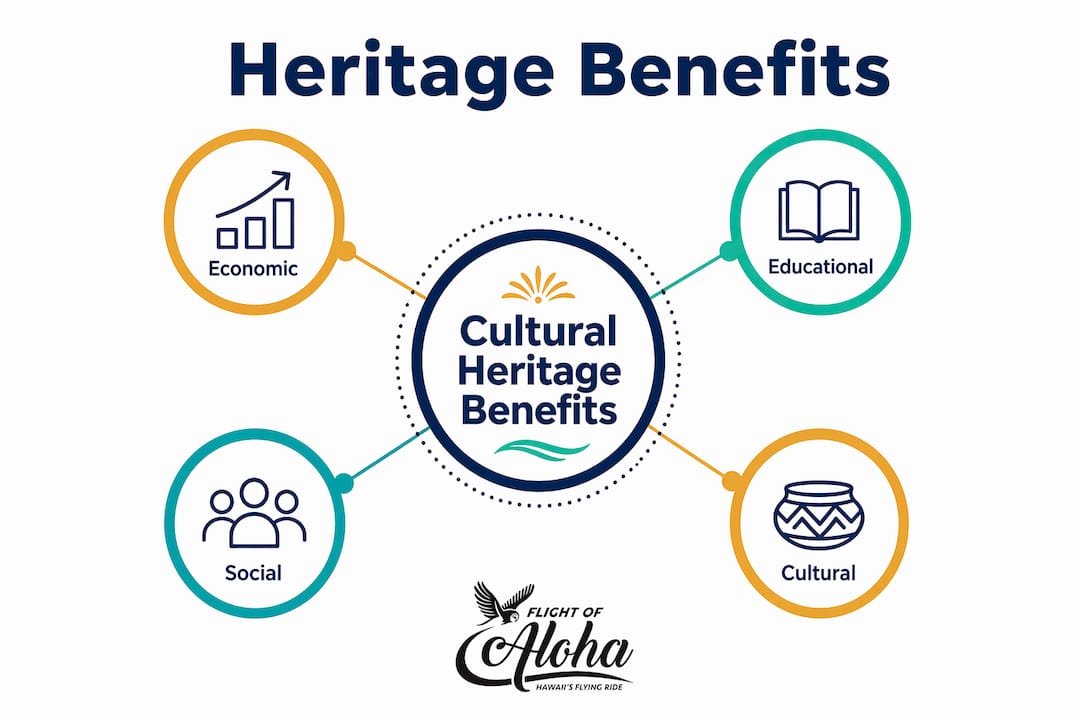
Heritage preservation delivers benefits across three distinct domains, and understanding all three is the only way to make a complete case for funding and policy support.
| Benefit domain | Primary mechanism | Key outcome |
|---|---|---|
| Economic | Cultural tourism and local enterprise | Revenue for communities and governments |
| Educational | Knowledge transmission across generations | Cultural literacy and civic identity |
| Social | Inclusion and community resilience | Reduced fragmentation and stronger cohesion |
The economic case is the most visible. Heritage sites draw visitors, support local businesses, and generate tax revenue. But research highlights heritage’s role in social cohesion and innovation that goes well beyond tourism receipts. Heritage acts as a form of social innovation, addressing disinformation, social exclusion, and community fragmentation in ways that no market mechanism can replicate.
The educational benefits are equally significant. Heritage transmits knowledge that formal schooling rarely covers: how ancestors solved problems, how communities organized themselves, and what values held societies together under pressure. This kind of cultural education builds civic identity and critical thinking in ways that textbooks alone cannot.
The social benefits deserve special attention. Heritage can promote diversity and inclusion, but it risks perpetuating inequality when marginalized voices are excluded from the narratives being preserved. That is a real problem. The solution is not to abandon heritage preservation but to make it more representative, actively including the stories of communities that have historically been left out.
Funding heritage preservation also requires new economic thinking. Non-use value frameworks quantify benefits beyond physical visitation, capturing existence value (the value people place on knowing a site exists) and bequest value (the value of preserving it for future generations). These frameworks make it possible to justify investment in heritage sites that few people visit but many people care about deeply.
Is cultural heritage a living, changing force or a fixed record of the past?
Heritage is a selective, dynamic product of contemporary values, not an objective historical record. Heritage preservation is a deliberate societal choice, reflecting what a community decides is worth remembering. That means heritage changes as societies change, and that is not a flaw. It is the point.
Intangible heritage makes this especially clear. Rituals, oral traditions, and traditional craftsmanship are key for community resilience precisely because they are practiced, not stored. They live in the hands of artisans, the voices of storytellers, and the movements of dancers. When a community stops practicing its intangible heritage, it does not just lose a tradition. It loses a living system for transmitting values and identity.
UNESCO describes cultural diversity as vital to humanity in the same way biodiversity is vital to nature. That analogy is exact, not decorative. Just as ecosystems collapse when species disappear, societies lose resilience when cultural traditions vanish. Heritage is renewable energy for societal transformation and intercultural dialogue.
The most effective approach to cultural heritage preservation shifts from static conservation to active participation. Communities that engage with their heritage through living practice, not just observation, build stronger identity and greater adaptability. The goal is not to freeze culture in amber. It is to keep it breathing.
Pro Tip: Look for cultural experiences that put you inside the tradition, not just in front of it. Participating in a traditional craft, dance, or storytelling session creates a memory that lasts far longer than a photograph of a monument.
Key Takeaways
Cultural heritage is the most consistent driver of community identity, social cohesion, and individual well-being across 50 years of research and 196 nations of international policy commitment.
| Point | Details |
|---|---|
| Heritage anchors identity | A synthesis of 187 papers confirms heritage builds belonging and individual well-being through place attachment. |
| UNESCO protects 196 nations | The World Heritage Convention is one of the most widely ratified agreements, addressing climate, tourism, and urbanization threats. |
| Benefits span three domains | Economic, educational, and social benefits all require active preservation and inclusive representation to be fully realized. |
| Heritage is living, not static | Intangible heritage through rituals, oral traditions, and craftsmanship keeps culture alive through practice, not storage. |
| Inclusive narratives matter | Heritage risks deepening inequality when marginalized voices are excluded; representative preservation is the standard to meet. |
Heritage is more than history: a perspective worth sharing
I have spent years watching how people respond to cultural heritage, and the pattern is always the same. The moments that move people most are never the ones where they stand in front of something old. They are the ones where they feel something old move through them.
The conventional approach to heritage treats it as a preservation problem. Build the museum. Restore the building. Put up the plaque. That thinking gets the causality backward. Heritage does not matter because it is old. It matters because it is alive in the people who carry it. When that living connection breaks, no amount of restoration work brings it back.
The harder truth is that heritage has always been political. What gets preserved, who tells the story, and whose ancestors are centered in the narrative: these are not neutral choices. The impact of cultural heritage on community development depends entirely on whether the community doing the preserving includes everyone who belongs to that culture, or just the loudest voices in the room.
The most promising shift I see in 2026 is the move toward experiential heritage. Communities are finding ways to bring people inside the tradition rather than just in front of it. That shift from spectator to participant is where heritage becomes genuinely transformative. It is also where it becomes most accessible, which matters enormously for reaching younger generations who will ultimately decide what survives.
— Ola
Flight of Aloha brings Hawaiian heritage to life
Cultural heritage is most powerful when you experience it directly, and Flight of Aloha is built on exactly that principle. This Native Hawaiian-owned attraction in Kailua-Kona and Whalers Village Kaanapali, Maui, puts you inside the story of Hawaii through 8K visuals, motion, scent, and wind. Films like Naupaka, Lahaina, and Whale Song are rooted in Hawaiian legends, not tourist clichés.

Flight of Aloha is walking distance from Kailua Pier, making it perfect for cruise passengers on a shore excursion. It is also the best option on a rainy day in Kona or Maui, with the best air conditioning in town. Skip the $400 helicopter tour and the motion sickness. Flight of Aloha delivers the same aerial wonder of Hawaiian cultural entertainment at a fraction of the cost, indoors, for the whole family. Book online to secure your seat.
FAQ
What is the role of cultural heritage in community identity?
Cultural heritage acts as a foundational anchor for community identity by creating shared narratives and emotional place attachment. A synthesis of 187 academic papers over 50 years confirms this connection between heritage and individual well-being.
How does cultural heritage influence society?
Cultural heritage influences society by building social cohesion, transmitting knowledge across generations, and providing communities with the resilience to navigate crises. UNESCO recognizes it as a cross-cutting dimension of sustainable development policy.
What are the main benefits of cultural heritage preservation?
The benefits of cultural heritage preservation span economic growth through tourism, educational enrichment through knowledge transmission, and social innovation that addresses inclusion and community fragmentation.
Why is intangible cultural heritage important?
Intangible heritage, including rituals, oral traditions, and traditional craftsmanship, keeps culture alive through active practice rather than passive storage. UNESCO identifies it as a key driver of community resilience and intercultural dialogue.
How does cultural heritage connect to human rights?
Cultural heritage protection is recognized as a human rights issue, directly linked to every person’s right to participate in cultural life. Destroying or excluding heritage narratives is understood as a violation of human dignity, not just a cultural loss.