What Is Attraction Accessibility? A Complete Guide
Attraction accessibility is the systemic design and operational commitment that enables all visitors, regardless of ability or need, to experience a site fully and comfortably. The industry term for this practice is “inclusive design,” and it goes far beyond installing a ramp at the front door. Globally, 1.2 billion people live with disabilities, representing roughly 15% of the world’s population. That group represents a $13 billion annual travel spend opportunity that most attractions still leave on the table. Understanding what attraction accessibility truly means is the first step toward building experiences that welcome everyone.
What is attraction accessibility, and what does it actually include?
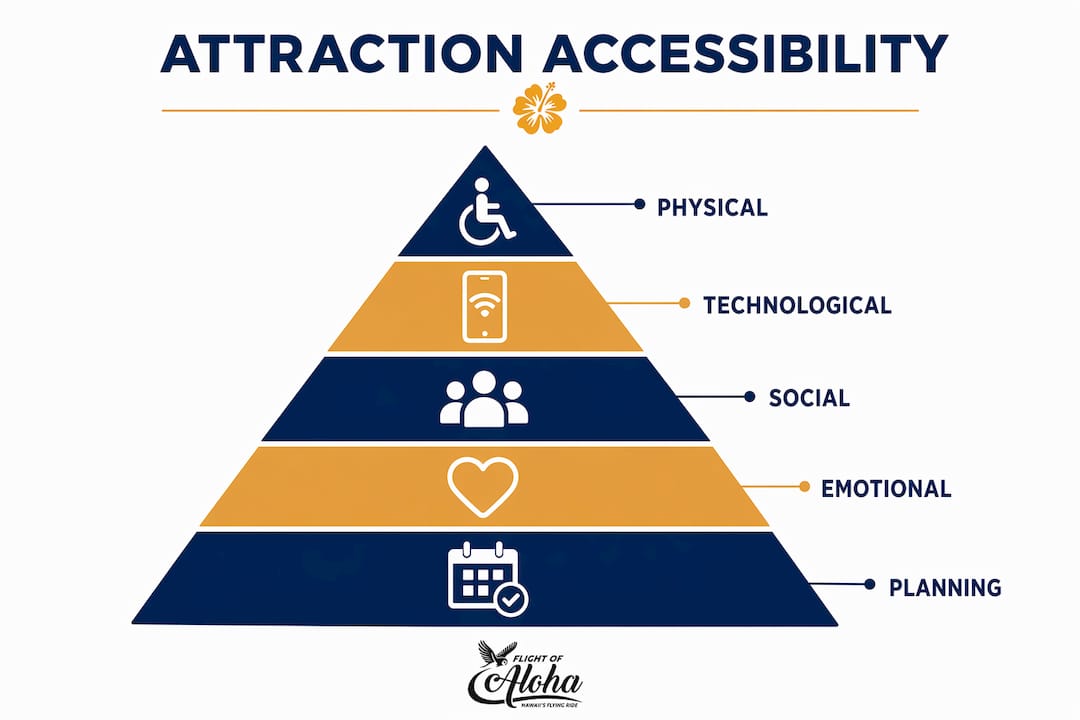
Attraction accessibility covers three distinct dimensions: physical, technological, and social. Most people picture ramps and elevators when they hear the term. Those physical features matter, but they represent only one layer of a much deeper commitment.
Physical accessibility addresses the built environment. Wide pathways, step-free entrances, accessible restrooms, and reserved seating all fall here. These features remove the most visible barriers and are typically the first things attractions address.
Technological accessibility covers digital tools and information systems. This includes mobile apps with screen-reader support, digital wayfinding, hearing loops, and captioned video content. A visitor who is blind or hard of hearing needs these tools to navigate and enjoy a site independently.
Social accessibility is the layer most attractions overlook. Staff training, inclusive communication policies, and service attitudes shape whether a visitor feels genuinely welcome or merely tolerated. A well-designed ramp means nothing if the staff member at the entrance is dismissive or uninformed.
Many attractions focus narrowly on physical mobility access while neglecting sensory and cognitive needs. A visitor with autism, for example, may need a quiet space to decompress. A visitor with low vision needs high-contrast signage, not just a wheelchair lane. True accessibility in attractions addresses all of these needs together.
Pro Tip: When evaluating an attraction’s accessibility, ask specifically about sensory-friendly hours, quiet spaces, and staff training programs. Physical features are easy to photograph; social and sensory accommodations require a direct conversation.
How do visitors actually experience accessibility in attractions?
The visitor experience of accessibility is best understood as a chain. Accessibility is a tourism chain of multiple linked stages, and failure in any single link breaks the entire experience. A visitor who cannot find parking close to the entrance never reaches the ticket booth. A visitor who cannot read the menu at the café leaves hungry and frustrated.
The chain typically runs through five stages:
- Approach and arrival: Parking, drop-off zones, transit connections, and wayfinding from the street.
- Entry: Ticket purchase, queuing, and the entrance itself, including step-free access and staff greeting.
- Circulation: Moving through the site, including pathways, elevators, rest areas, and signage.
- Facilities: Restrooms, food service, seating, and equipment rental such as wheelchairs or mobility scooters.
- Support: Staff assistance, emergency procedures, and emotional reassurance throughout the visit.
Pre-visit planning is where the chain most often breaks before a visitor even leaves home. 91% of visitors with disabilities seek accessibility information on venue websites before they book. Over 50% abandon their plans if that information is missing or unclear. That is not a minor inconvenience. It is a direct loss of visitors who wanted to come but could not get the confidence they needed to commit.
Photos, detailed maps, and documented step counts or gradient measurements help visitors self-assess whether a site works for their specific needs. A vague statement like “partially accessible” tells a wheelchair user almost nothing. A photo of the entrance threshold with a measurement tells them everything.
Pro Tip: Before visiting any attraction, search for its dedicated accessibility page or guide. If one does not exist, call ahead and ask specific questions. Attractions that answer well are usually the ones that have done the work.
Effective accessibility addresses the entire visitor journey, including emotional reassurance and planning ease, not just physical elements. Visitors with disabilities often carry a higher cognitive load when planning a trip. Every piece of clear, specific information an attraction provides reduces that load and increases the chance of a visit.
Why do so many attractions get accessibility wrong?
The most common mistake is retrofitting. Retrofitting accessibility is costlier than integrating it from the start and almost always produces “separate but equal” solutions that lack dignity. A separate accessible entrance around the back of a building sends a clear message to visitors: you are an afterthought.
The contrast between retrofitted and integrated design shows up clearly in practice:
| Approach | Retrofitted design | Integrated inclusive design |
|---|---|---|
| Entrance | Separate accessible door, often at the side or rear | Single shared entrance, step-free for all |
| Queuing | Separate accessible lane, often unstaffed | Shared boarding experience with flexible accommodations |
| Signage | Braille added as stickers after installation | High-contrast, tactile, and visual signage built in from the start |
| Cost | Higher due to structural changes after construction | Lower when planned from the concept stage |
| Visitor dignity | Often compromised by separation | Preserved through shared experience |
Beyond the retrofit problem, attractions frequently treat accessibility as a compliance checklist rather than a design goal. Checking a box for ADA compliance does not mean a visitor with low vision can read your map or that a visitor with anxiety has a quiet place to sit. Comprehensive inclusion requires staff training, quiet spaces, and sensory-friendly materials alongside physical features.
The Sunrise Film Festival’s accessibility approach offers a useful model for entertainment venues. Their published accessibility statement covers staff training, companion support, and specific amenities for visitors with a range of needs. That level of transparency builds trust before a visitor arrives.
Accessibility design must be integrated early in project development. Attractions that build inclusion into their concept stage produce better experiences at lower cost and with greater dignity for every visitor.
How to improve attraction accessibility: practical steps that work
Improving accessibility does not require a full redesign. Attractions can make meaningful progress with targeted, well-planned changes.
- Start with signage and contrast. High-contrast wayfinding signs cost little and help visitors with low vision, cognitive differences, and language barriers all at once.
- Publish a detailed accessibility guide online. Include photos, measurements, surface types, and the location of every accessible restroom. The biggest barrier to visitation is often the lack of detailed pre-visit information, not the physical features themselves.
- Offer equipment rental. A UK wetland attraction provided 880 rentals of mobility scooters and wheelchairs in a single year, dramatically expanding who could enjoy the site. Equipment rental removes a major barrier for visitors who do not travel with their own mobility aids.
- Train staff with empathy and specifics. Staff should know where every accessible feature is, how to operate assistive equipment, and how to communicate with visitors who have sensory or cognitive needs. Generic “be kind” training is not enough.
- Create sensory-friendly spaces and times. A quiet room or a low-stimulation hour costs very little to implement. For visitors with autism, anxiety, or sensory processing differences, these features can make the difference between a visit and a no-show. Read more about sensory-friendly attraction design and why it reduces visitor stress.
- Assess each link in the accessibility chain separately. A step-free entrance alone does not guarantee full site access. Walk the entire visitor journey from the parking lot to the exit and document every barrier you find.
- Use technology thoughtfully. Audio guides, captioned videos, and accessible booking systems extend inclusion without requiring physical construction. The accessibility workflow for guests at well-run attractions shows how operational planning and technology work together.
Key Takeaways
Attraction accessibility is a systemic, multi-layered commitment that requires physical, technological, and social design working together from the earliest stages of planning.
| Point | Details |
|---|---|
| Accessibility is three-dimensional | Physical, technological, and social access must all be addressed for genuine inclusion. |
| The visitor journey is a chain | A gap at any stage, from parking to exit, can break the entire accessible experience. |
| Pre-visit information is critical | Over 50% of visitors with disabilities abandon plans when clear accessibility info is missing online. |
| Inclusive design beats retrofitting | Building accessibility in from the concept stage costs less and preserves visitor dignity. |
| Sensory and cognitive needs matter | Quiet spaces, staff training, and sensory-friendly materials are as important as ramps and elevators. |
Accessibility as a design value, not a legal requirement
I have spent years watching attractions treat accessibility as a box to check after the blueprints are done. The results are always the same: a ramp bolted onto the side of a beautiful building, a separate entrance tucked behind the gift shop, a sign in Braille that no one can find. It is not malicious. It is just what happens when accessibility is an afterthought.
The attractions that get it right start the conversation in the concept meeting, not the construction review. They ask “who are we designing this for?” before they ask “what does the code require?” That shift in question changes everything. It produces shared boarding experiences instead of segregated lanes. It produces signage that works for everyone instead of a sticker added to a sign that was already confusing.
The business case is real. A group traveling with one wheelchair user often includes four or five other people who will all go somewhere else if the accessible option is not good enough. Accessibility is not a niche accommodation. It is a decision that affects the entire travel party.
The cultural shift I am most encouraged by is the move toward interactivity and inclusive design in family attractions. When an experience is designed to engage multiple senses and accommodate different abilities from the start, it tends to be better for everyone. That is not a coincidence. Designing for the edges of human experience almost always improves the center.
— Ola
Flight of Aloha: Hawaii’s most accessible attraction
Flight of Aloha is the most accessible attraction in Hawaii, and it earns that title through design, not just marketing. This Native Hawaiian-owned immersive flying theater sits in Kailua-Kona and at Whalers Village Kaanapali in Maui, both locations welcoming guests of nearly every ability level into a fully climate-controlled theater with 8K visuals, motion effects, scents, and wind.
For cruise visitors, the Kona location is walking distance from Kailua Pier, making it a perfect shore excursion even on a tight schedule. On a rainy day or during vog season, it is the best air-conditioned activity on the island. Skip the $400 helicopter tour and the motion sickness that comes with it. Flight of Aloha delivers aerial views of Hawaii’s most breathtaking places with zero weather risk and full accessibility. Book online to secure your seat at flightofaloha.com.
FAQ
What is the definition of attraction accessibility?
Attraction accessibility is the systemic design and operational commitment to ensuring all visitors can access a site physically, technologically, and socially. It covers everything from step-free entrances to staff training and pre-visit information.
Why is accessibility in attractions important?
1.2 billion people worldwide live with disabilities, and they represent a significant travel market. Attractions that prioritize accessibility serve more visitors and build stronger community trust.
What are the biggest barriers to attraction accessibility?
The biggest barriers are lack of detailed pre-visit information online, retrofitted physical features that compromise dignity, and insufficient attention to sensory and cognitive needs beyond mobility.
How can attractions improve accessibility quickly?
Attractions can start by publishing a detailed online accessibility guide with photos, training staff on specific accommodations, and offering mobility equipment rentals. These steps require minimal construction and deliver immediate impact.
What does “accessible” actually mean for an attraction?
A binary “accessible or not” label is misleading. True accessibility must be verified at each stage: arrival, entry, circulation, facilities, and staff support. An attraction is only as accessible as its weakest link.
Recommended
- What Is A Location-Based Attraction? Complete Guide | Flight Of Aloha
- Destination Attraction: Why It Matters For Unique Guest Experiences | Flight Of Aloha
- Why Attraction Location Matters For Cultural Experiences | Flight Of Aloha
- Accessibility Workflow For Guests: Ensuring Inclusive Visits | Flight Of Aloha