
The Role of Narration in Ride Films: 2026 Guide

Narration in ride films is defined as the primary storytelling device that guides guest perspective, shapes emotional engagement, and creates narrative clarity throughout an immersive attraction experience. Industry pioneer Tony Baxter built his entire design philosophy around this principle, arguing that story-first design should inform every decision from ride vehicle movement to scene pacing. The role of narration in ride films goes far beyond a voice in the speakers. It is the invisible architecture that transforms a moving seat into an emotional journey. Whether you are a film researcher, a themed entertainment designer, or simply someone who wants to understand why certain rides stay with you for years, this guide breaks down exactly how narration works and why it matters.
How does narration shape the ride film experience?
Narration shapes the ride film experience by directing where guests look, what they feel, and how they interpret the story unfolding around them. Without it, even the most technically advanced attraction becomes a visual spectacle with no emotional anchor. With it, guests become participants in a story rather than passengers in a vehicle.
The industry term for this broader practice is diegetic storytelling, which refers to narrative elements that exist within the world of the story itself. Voiceover narration, character dialogue, environmental sounds, and visual cues all function as diegetic tools. The role of narration in ride films is to coordinate all of these elements into a single coherent emotional arc.
A 2026 study of 573 theme park visitors found that storytelling significantly enhances visitor emotional engagement and satisfaction. Critically, it influences revisit intention indirectly through emotional resonance, not through spectacle alone. That distinction matters enormously for designers and researchers. Guests do not return because a screen was bigger. They return because a story made them feel something real.
Here is what effective narration delivers in a ride film context:
- Emotional anchoring: Narration gives guests a character or perspective to attach to, creating personal stakes in the outcome.
- Pacing control: Voiceover and ambient sound cues signal when to feel tension, wonder, or relief, guiding the emotional rhythm of the experience.
- Narrative clarity: Clear narration prevents confusion in complex multi-sensory environments where guests could otherwise feel disoriented.
- Cultural depth: Narration carries the weight of cultural context, legend, and meaning that visuals alone cannot convey.
Pro Tip: If you are evaluating a ride film’s storytelling quality, mute the audio mentally and ask whether the visual sequence still makes emotional sense. If it collapses without narration, the attraction is doing its job correctly.
Industry experts emphasize cohesive narrative pacing across the entire guest workflow, from queue entrance to ride exit. This concept, sometimes called “main character energy,” positions guests as the heroes of their own adventure rather than passive observers. The queue is not waiting time. It is the first act of the story.
Narration styles in ride films: which works best?
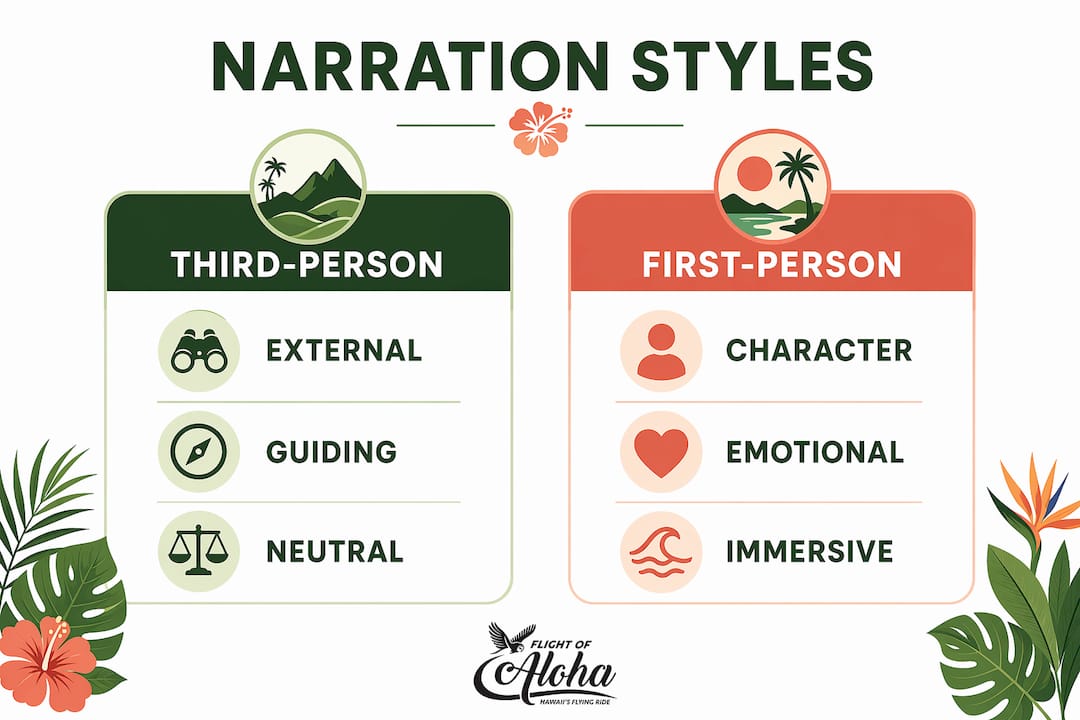
Different narration styles in theme park attractions produce very different guest experiences. The choice of style is not aesthetic preference. It is a strategic storytelling decision that determines how deeply guests connect with the narrative.
| Narration Style | Key Features | Guest Impact |
|---|---|---|
| Third-person voiceover | External narrator guides the story | Clear, orienting, works well for epic or mythological tales |
| Character-driven dialogue | In-world characters speak directly to guests | High immersion, personal connection, strong emotional pull |
| First-person perspective | Guest “becomes” the protagonist | Maximum agency, intense emotional investment |
| Nonverbal narration | Music, lighting, and environmental cues carry the story | Subtle, atmospheric, requires strong visual design support |
| Hybrid narration | Combines voiceover with character interaction | Flexible pacing, broadest audience appeal |
Tony Baxter’s design philosophy at Disney Imagineering established that ride systems must support story delivery rather than dictate it. This “story first” principle means the narration style is chosen before the technology is selected. A ride built around a character-driven narration style will use a different vehicle system, scene layout, and audio design than one built around nonverbal atmospheric storytelling.
The debate between narrative clarity and narrative ambiguity is worth examining. Clarity works best for family audiences and cultural storytelling, where guests need to understand the legend or journey to feel its emotional weight. Ambiguity can work powerfully in horror or surrealist attractions, where disorientation is itself the intended feeling. Most successful ride films lean toward clarity because authentic engagement comes from credible, compelling stories, not from leaving guests confused about what just happened.
The impact of voiceover in ride films is particularly strong when the narrator voice carries cultural authority. A Native Hawaiian voice narrating a story rooted in Hawaiian legend carries a different emotional weight than a generic announcer. That specificity of voice is a narration technique that builds trust and deepens immersion simultaneously.
How is narration evolving in interactive ride films?
Interactive narration is the fastest-growing frontier in ride film design, and it fundamentally changes the relationship between guest and story. Traditional narration is linear. Interactive narration is responsive. The story changes based on what guests do.
Here is how the evolution is unfolding in four stages:
- Real-time reactive narration: Sensors track guest behavior and trigger different audio or visual story branches. A guest who looks left sees one story element; a guest who looks right sees another. The narration adapts to acknowledge both.
- Choose-your-own-adventure structures: Guests make active decisions at story branch points, and the narration shifts to reflect their choice. This creates multiple story outcomes from a single ride system.
- Motion-capture integration: LiDAR and motion capture technologies track visitor movement in real time and adapt story elements instantly. A guest leaning forward might trigger a narration cue that acknowledges their engagement.
- Emergent narrativity: University of Groningen 2026 research defines emergent narrativity as stories that arise from the interplay between system design and guest interpretation. No two guests experience exactly the same story, yet both feel the narrative was designed for them personally.
Guest narrative agency is the future of immersive storytelling, shifting rides from passive shows to interactive experiences. This shift has profound implications for how narration is written. Scripts can no longer be linear. They must be modular, branching, and emotionally consistent across every possible path a guest might take.
Pro Tip: When researching interactive ride films, look for attractions that use narration to acknowledge guest choices explicitly. A narrator who says “you chose well” creates a fundamentally different emotional experience than one who delivers the same line regardless of what the guest did.
Technology enables all of this, but it does not replace the storytelling craft underneath. Technology is a tool to heighten the narrative experience, not a substitute for it. The most technically advanced interactive system will fail emotionally if the underlying narration is weak. The story must be strong enough to carry the technology, not the other way around.
How to craft narration for compelling ride films
Crafting narration for ride films requires a story-first design philosophy applied across every phase of the guest journey. The best narration does not begin when the ride starts. It begins the moment a guest enters the queue.
The full narrative arc of a well-designed ride film looks like this:
| Journey Phase | Narrative Function | Narration Technique |
|---|---|---|
| Queue entrance | Establish world and stakes | Environmental audio, signage, ambient character voices |
| Pre-show | Introduce protagonist and conflict | Direct character address, voiceover exposition |
| Ride boarding | Transition guest into story role | First-person narration, immersive sound design |
| Core ride experience | Deliver emotional peaks and resolution | Dynamic voiceover, music scoring, sensory cues |
| Ride exit | Provide emotional closure | Ambient narration, cultural reflection, callback to opening |
Practical narration design follows several principles that the best attractions share:
- Write the emotional arc before the technical script. Know what guests should feel at each moment before deciding what they should hear.
- Use silence strategically. Moments without narration can be as powerful as moments with it, allowing guests to absorb what they have just experienced.
- Anchor narration in cultural truth. Cultural storytelling in attractions creates deeper emotional resonance than invented mythology because guests sense the authenticity.
- Test narration pacing with real audiences. Narration that reads well on paper often moves too fast or too slow in a multi-sensory environment.
Operational reliability also matters more than most designers acknowledge. Fail-safe monitoring is critical to preserving the immersive storytelling experience because a single audio dropout can shatter the narrative spell an entire queue line worked to build. The emotional investment guests make in a story is fragile. Technical failures do not just interrupt the ride. They break the story.
The visitor workflow shapes immersive attractions in ways that narration designers must respect. Crowd flow, dwell time, and sightlines all affect how narration lands. A beautifully written script delivered at the wrong moment in the guest journey will feel disconnected and forgettable.
Key takeaways
Narration is the structural backbone of every successful ride film, and emotional resonance, not visual spectacle, is what drives guests to return.
| Point | Details |
|---|---|
| Story-first design wins | Choose narration style and story arc before selecting ride technology or visual systems. |
| Emotional resonance drives return visits | A 2026 study of 573 visitors confirmed storytelling influences revisit intention through emotional engagement, not spectacle. |
| Narration spans the full guest journey | Effective storytelling begins in the queue and continues through the exit, not just during the ride itself. |
| Interactive narration creates agency | Real-time technologies like LiDAR and motion capture allow narration to respond to individual guests, creating personalized story experiences. |
| Cultural authenticity amplifies impact | Narration rooted in genuine cultural tradition creates deeper emotional resonance than invented or generic storytelling. |
Why narration is the most underestimated element in ride design
I have spent years studying immersive attractions, and the pattern I keep seeing is the same. Attractions that underperform almost always share one flaw. The technology is impressive, but the narration is an afterthought. The story was written around the ride system rather than the ride system being built around the story.
What surprises me most is how rarely this gets discussed in post-mortems. When an attraction underperforms, the conversation turns to screen resolution, motion effects, or queue design. Almost never does anyone say the narration failed to create emotional stakes. But that is usually exactly what happened.
The 2026 research on emergent narrativity changed how I think about this. The idea that a story can arise from the interplay between system design and guest interpretation is not just academic. It is a practical design challenge. If your narration is rigid and linear, guests who deviate from the expected path will feel the story break. If your narration is modular and responsive, those same guests feel like the story was made for them.
The attractions I find most memorable are the ones where I cannot separate the narration from the experience. The voice, the music, the scent, the motion, they all tell the same story at the same time. That coherence is not accidental. It is the result of treating narration as the foundation, not the finishing touch.
The trend toward guest agency is real and accelerating. But I would caution designers not to mistake interactivity for depth. A story with ten branches is still shallow if none of the branches carry genuine emotional weight. Narration quality matters more as complexity increases, not less.
— Ola
Experience the power of storytelling at Flightofaloha

Flightofaloha brings everything this article describes to life inside King Kamehameha’s Kona Beach Hotel in Kailua-Kona. This Native Hawaiian-owned attraction is one of the best indoor activities on the Big Island, blending 8K visuals, motion effects, wind, and authentic Hawaiian scents into a flying theater experience rooted in real cultural legend. Ride films like Naupaka and Lahaina use narration grounded in Native Hawaiian storytelling traditions, so every flight carries genuine emotional weight. Whether you are on a shore excursion from Kailua Pier or looking for family-friendly Kona activities on a rainy day, Flightofaloha delivers aerial views of Hawai’i without the $400 helicopter price tag or motion sickness. Explore Hawaiian storytelling traditions that shape every scene, then book your experience online to secure your seat.
FAQ
What is the role of narration in ride films?
Narration in ride films is the primary storytelling device that guides guest perspective, establishes emotional stakes, and creates narrative clarity throughout an immersive attraction. It functions as the invisible architecture connecting visuals, motion, and sound into a single coherent story.
How does narration enhance the ride film experience?
Narration enhances ride film experiences by anchoring guests emotionally to a character or cultural story, controlling pacing across the full guest journey, and directing attention in complex multi-sensory environments. A 2026 study confirmed that emotional resonance generated by storytelling is the key driver of guest satisfaction and return visits.
What narration styles are most effective in theme park attractions?
Character-driven and first-person narration styles produce the strongest emotional connection because they position guests as active participants in the story. Hybrid narration combining voiceover with in-world character dialogue offers the broadest appeal across family and adult audiences.
How does interactive narration work in modern ride films?
Interactive narration uses technologies like LiDAR and motion capture to track guest behavior in real time and adapt story elements instantly, creating personalized story branches and multiple possible outcomes from a single ride experience.
Why does story-first design matter for ride film narration?
Story-first design means the narration and emotional arc are defined before the ride technology is selected, so every engineering decision supports the story rather than constraining it. Tony Baxter’s design philosophy at Disney Imagineering established this principle as the foundation of successful immersive attraction design.