
Virtual vs. physical tours: A traveler’s smart guide 🌺

Planning a trip to Hawai’i means making a hundred decisions before you ever set foot on the island. One of the most overlooked is understanding the real difference between virtual and physical tours, because getting this wrong costs you time, money, and missed experiences. Most travelers assume virtual tours are just fancy videos you passively watch. They are not. They are interactive environments where you control the view, the pace, and the path. Understanding how these two tour types work together, not against each other, is the key to planning an unforgettable Big Island adventure.
What is a virtual tour? Understanding the interactive digital experience
Let’s clear up the biggest misconception first. A virtual tour is a digital simulation allowing interactive viewing and navigation, which is fundamentally different from simply watching a video. You are not a passive viewer. You are an active explorer.
Virtual tours are built from stitched 360° panoramic images or video. As you navigate, you click or drag to look in any direction. You choose where to zoom, which room to enter, which path to follow. This “choose your own adventure” quality is what makes virtual tours genuinely useful as planning tools rather than just marketing content.
Here is what makes virtual tours stand out:
- Hotspots and interactive layers: Clickable points inside the tour reveal photos, descriptions, audio clips, or links. A virtual tour of a Hawaiian botanical garden, for example, might let you click on a plant and hear its name in Hawaiian and learn its cultural significance.
- User-controlled navigation: Unlike a fixed-camera video, you decide what you look at. You can spin around, look up at the ceiling of a historic building, or peer down a lava field trail before committing to hiking it.
- Broad platform accessibility: 360 virtual tours are widely supported across desktop browsers, smartphones, and VR headsets, so your whole family can explore together from your hotel room or living room back home.
- Shareable and bookmarkable: You can send a link to your travel companion and say “look at this beach” and they see exactly what you saw, rather than trying to describe it.
Virtual tours are powerful pre-trip filters. They eliminate guesswork and help you narrow a list of 20 possible excursions down to the five that actually match your family’s interests and mobility needs.
With a clear understanding of what virtual tours are, let’s now explore physical tours and their unique strengths.
The physical tour experience: Sensory richness and real-world context
No screen captures the smell of plumeria in full bloom. No 360° camera communicates the feeling of volcanic black sand between your toes or the sudden cool shade of a Kona coffee grove. Physical presence reveals sensory details like texture, sound, and neighborhood atmosphere that virtual tours simply cannot replicate. That is not a flaw in virtual tour technology. It is just the irreplaceable reality of being somewhere.
Physical tours give your family:
- True scale: You cannot understand how vast the Waipio Valley lookout really is until you stand at its edge. Screens flatten scale dramatically.
- Real lighting conditions: A beach that glows golden in a virtual tour might face west and be completely shadeless by 10 a.m. Standing there tells you that instantly.
- Crowd and atmosphere read: Is this snorkeling spot peaceful or packed with tour boats? Only being there tells you.
- Practical amenity checks: Where are the restrooms? Is the parking lot stroller-friendly? Is there shade for the kids? These answers come from your feet, not your phone.
- Spontaneous discovery: Physical experiences lead you somewhere unexpected. A wrong turn in Kailua-Kona reveals a tiny local coffee shop. That never happens on a virtual tour.
For families with young children or older travelers, physical scouting also means validating sun exposure, walking distances, and accessibility in ways that no digital preview can fully capture. This is especially true for the family entertainment options scattered across the Big Island, where conditions can vary wildly between microclimates just a few miles apart.
There is also a rich difference between guided and self-guided physical tours, worth considering when you plan how to structure your days. Guided tours add expert context and storytelling. Self-guided tours give you freedom and flexibility.
“Physical presence offers emotional connections that no virtual simulation can fully replace.”
Pro Tip: Use virtual tours first to shortlist your top five spots, then reserve your physical visits for the experiences you have already confirmed align with your family’s interests and energy levels.
Having seen the contrasting strengths of virtual and physical tours separately, let’s examine how they compare side by side for travel planning.

Comparing virtual and physical tours: Similarities, differences, and when to use each
Here is where the virtual tour vs. physical tour conversation gets practical. Neither format wins across the board. Each has a specific role. The travelers who make the most of their Hawaii trip are the ones who understand when to use each.
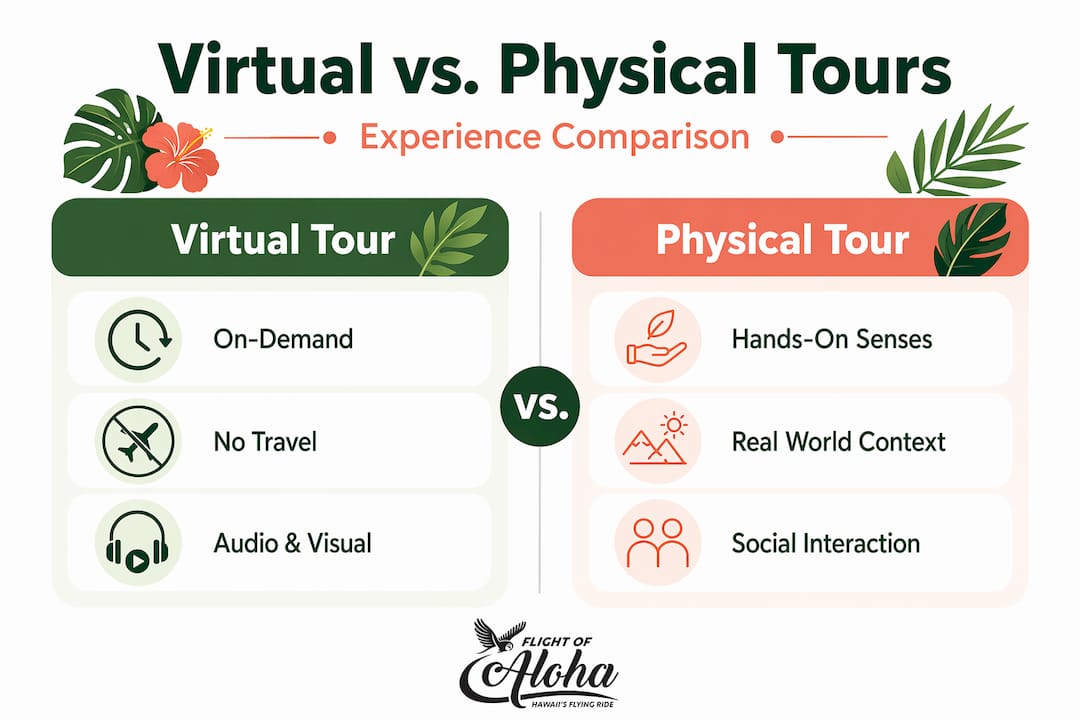
| Factor | Virtual tour | Physical tour |
|---|---|---|
| Sensory experience | Visual and some audio only | Full senses: sight, sound, smell, touch, taste |
| Convenience | Any time, any device, anywhere | Requires travel, scheduling, and logistics |
| Cost | Usually free or very low cost | Transportation, entry fees, time investment |
| Emotional impact | Moderate, depends on tech quality | High, direct and immediate |
| Planning value | Excellent pre-visit research tool | Confirms and contextualizes virtual impressions |
| Accessibility | High, great for mobility-limited users | Varies widely by location and trail condition |
| Cultural depth | Can include audio and text overlays | Direct interaction with guides and locals |
| Weather dependency | None | Significant in Hawaii’s varied microclimates |
The numbers back this up. 58% of buyers use virtual tours during their initial search phase, but 82% say in-person visits are critical for final decisions. While that statistic comes from real estate, it mirrors exactly how travelers behave. You explore broadly online, then confirm narrowly in person.
The smartest approach looks like this:
- Use virtual tours to eliminate locations that clearly do not fit your needs.
- Use virtual tours when weather cancels outdoor plans, especially on the rainy Hamakua Coast.
- Use physical tours when you are making final decisions about where to spend significant time or money.
- Use physical tours for any experience where atmosphere, scale, or sensory context matters deeply.
Immersive digital tourism is also reshaping how families plan trips, with hybrid models combining virtual preparation and physical execution becoming the gold standard for well-planned travel. The best immersive experiences for families in Hawai’i often blend both elements naturally.
Understanding this comparison helps travelers apply these insights practically for their Hawaii trips.
Making the most of virtual and physical tours in Hawaii travel planning 🌌
Now let’s get specific about how to apply all of this when you are actually planning your Big Island trip. The differences in tour experiences matter less than how you sequence them. Here is a proven four-step approach:
- Explore virtual tours broadly. Before you book anything, spend 30 to 60 minutes doing virtual walkthroughs of beaches, cultural sites, and attractions on your shortlist. Get a feel for layout, scale, and vibe.
- Narrow your choices. Cut your list to the experiences that genuinely excited you during virtual exploration. If a place did not move you on a screen, it probably will not move you in person either.
- Schedule physical visits with intention. Block time for the spots that made your shortlist. Book tickets in advance where possible to avoid showing up and missing out, especially for popular Big Island experiences.
- Validate and enjoy. When you arrive, your physical visit confirms or refines what you expected. Notice what surprised you. Those surprises are often the best parts.
Virtual tours reduce barriers like travel uncertainty and scheduling complexity, while physical tours deliver the immediacy and context that seal the deal. Used together, they make your Hawaii trip dramatically more efficient and satisfying.
Rainy days on the Big Island are a perfect example. The Hilo side can pour while Kona bakes in sunshine. Instead of scrambling for a last-minute plan, families who already used virtual tours to preview indoor options know exactly where to head. The Hawaii family attractions checklist is a great companion resource for this kind of smart contingency planning.
Pro Tip: After your virtual tour session, create a simple notes list of questions each experience raised for you. Bring that list to your physical visit. You will check off answers in real time and leave with a clear picture of whether to return or move on.
With these practical strategies established, let’s consider a fresh perspective on the evolving role of virtual tours in travel.
Why virtual and physical tours are best seen as complementary, not competitors
Here is the honest truth that most travel content glosses over: the virtual vs. physical framing is a false competition. Treating these as rivals leads travelers to under-use one or the other, and both mistakes cost you.
Virtual tours are sometimes dismissed as “less real” or seen as a compromise for people who cannot travel. That is backwards. The goal of immersive technology is not replacement but integration, expanding access and preparing travelers for richer in-person experiences. A traveler who previews Pu’uhonua o Honaunau via a virtual tour arrives knowing what they are looking at, ready to feel the weight of its history rather than scrambling to read every sign.
There is also a sustainability dimension worth naming. Hawai’i’s most fragile cultural and natural sites face real pressure from overcrowding. Travelers who use virtual tours intelligently can help manage that. If a virtual tour convinces you that a particular trail is not right for your family, you skip it, and that is one less group stressing a sensitive ecosystem.
The “phygital” approach, blending physical and digital experiences, is not a travel industry buzzword. It is a genuinely better way to travel. You arrive more prepared. You ask better questions. You notice more. You carry less anxiety about whether a place will be worth it. And when you find your immersive experiences in Kailua-Kona that genuinely delivers on its promise, the payoff is so much richer.
The most effective use of virtual tours is as preparation tools that enhance rather than replace in-person visits. That framing should guide every traveler planning a trip to Hawai’i.
Experience the best of Hawaii with Flight of Aloha: Your smart tour alternative
You have done the virtual prep. You have narrowed your list. Now you want something that bridges that gap between a screen and a helicopter in a way that is breathtaking, affordable, and perfect for the whole family. That is exactly where Flight of Aloha comes in.

Flight of Aloha is a Native Hawaiian-owned immersive flying theater inside King Kamehameha’s Kona Beach Hotel, steps from Kailua Pier, making it ideal for cruise ship shore excursions or a rainy-day alternative. Think of it as what you would get if a helicopter tour and a Disney ride had a baby, rooted in aloha. Using 8K visuals, motion effects, wind, and even scent, it puts you soaring over lava fields, waterfalls, and sacred valleys without the high cost or motion sickness risk of a traditional helicopter tour. It is also home to the best air conditioning in Kona, which matters. Book online to secure your seat and make your Big Island adventure truly unforgettable. 🌺
Frequently asked questions
What is the main difference between virtual and physical tours?
Virtual tours let you navigate interactive digital environments on your own terms, while physical tours immerse you in a real place with full sensory and emotional context. Both have distinct strengths depending on your planning stage.
Can virtual tours replace in-person visits when planning a trip to Hawaii?
No. Virtual tours are excellent for filtering and planning, but 82% say in-person showings are critical for final decisions. The same logic applies to travel: you preview digitally and confirm physically.
How can families best use virtual tours when visiting Hawaii?
Start with virtual tours to explore options, identify what excites each family member, and flag accessibility concerns. Then use virtual tours as a checklist of questions to verify on your physical visit for the best possible outcome.
What is a phygital tourism experience?
Phygital tourism blends physical and digital elements to create richer travel experiences, combining the convenience and breadth of virtual exploration with the emotional depth and sensory richness of in-person visits.
Why choose Flight of Aloha over traditional helicopter tours?
Flight of Aloha delivers immersive aerial views of Hawai’i at a fraction of the cost, with no weather cancellations, no motion sickness risk, and easy access near Kailua Pier. It is the most family-friendly way to feel like you are flying over the islands.