
The Role of 8K in Entertainment: Where It Really Shines
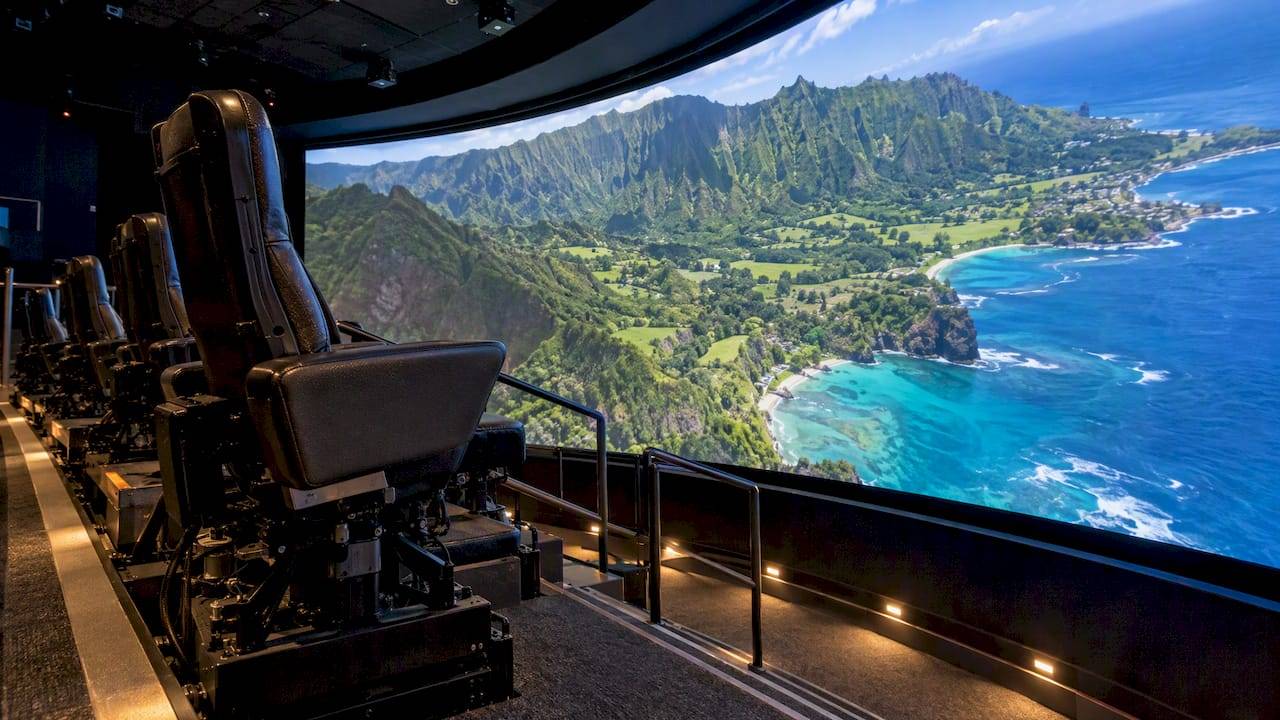
The role of 8K in entertainment is smaller on your living room TV than the marketing suggests, and much bigger in places you walk into: giant wraparound screens, film preservation vaults and immersive attractions. Resolution matters most when the picture fills your whole field of view. That is where 8K stops being a spec sheet number and starts being something you feel.
We run an 8K flying theater in Hawaii, so we see this up close every day. Here is the honest picture, with sources, of what 8K does well, what it doesn’t, and how to experience it for yourself.
TL;DR
- 8K is 7680 x 4320 pixels, about 33 million in total, which is four times 4K and 16 times Full HD.
- At home, 8K is a niche: few TVs sell, and almost no major streaming library offers native 8K.
- Its real value is on huge, close-up screens, in film preservation and in immersive venues where wind, scent and motion complete the picture.
- Flight of Aloha, Native Hawaiian-owned, shows 8K films with motion, wind and scent in Kailua-Kona and at Whalers Village in Kaanapali, Maui.
What 8K actually is
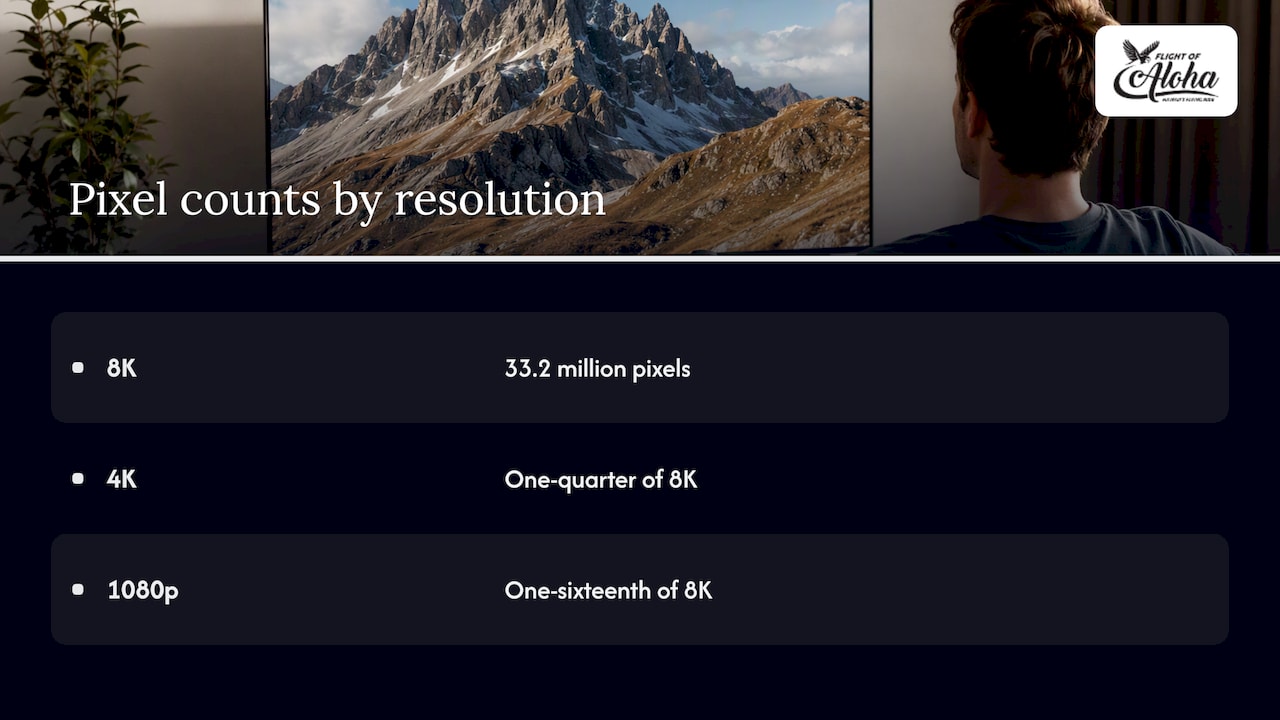
8K resolution is 7680 x 4320 pixels, roughly 33.2 million pixels, four times the count of 4K and 16 times that of 1080p. Think of resolution like megapixels in a photo: more pixels in the frame means more fine detail you can keep before the image softens.
That sounds like an easy win. The catch is that your eyes, your room and the size of your screen decide whether you can see the difference. On a 55-inch TV across the room, most people can’t. On a screen that fills your peripheral vision, the story changes.
Is 8K higher quality than 4K?
On paper, yes: four times the pixels. In practice, it depends on how big the screen is and how close you sit.
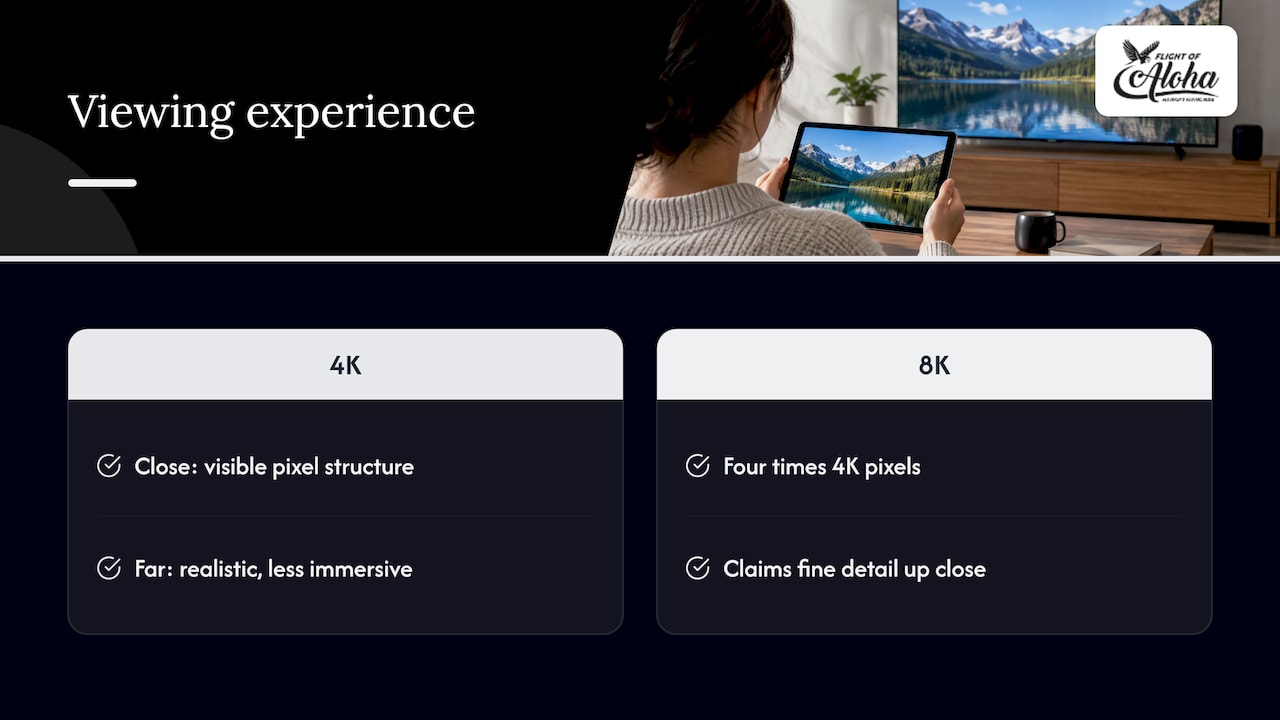
The 8K Association, an industry group that promotes the format (so read its claims with that in mind), describes a trade-off in 4K. Sit close and you get the “you are there” feeling but start to see pixel structure. Sit back and the image looks realistic but you lose immersion. Its white paper argues 8K bridges that gap, keeping fine detail even at the close distances that true large-screen immersion needs.
That idea is the key to the whole topic. 8K earns its keep when the screen is huge or you are very near it.
Where 8K struggles: your living room
Here is the reality check. 8K TVs are under 1% of the U.S. TV market, with about 82,000 displays shipped in 2024 and 309,000 projected for 2025, according to Variety’s reporting. The Consumer Technology Association even created an 8K Ultra HD display definition and logo program to help shoppers know what they are buying.
Content is the bigger problem. Does 8K content exist? Yes, but sparingly. YouTube and Vimeo are the main places to stream true 8K, and the big subscription services don’t currently offer 8K libraries. Digital Trends makes the same point: native 8K content is still rare, though 8K TVs can upscale lower-resolution video.
Broadcasters aren’t rushing either. In a survey Variety reported on, professionals said 8K is not a current production priority, and the industry focus is on AI and HDR to improve standard content. That is the plain answer to why people say 8K is being discontinued: it isn’t so much dying as waiting for the right job.
The jobs 8K already does well
Preserving film
For major studios, 8K is often about the archive, not the stream. Warner Bros. described its 8K effort as mainly about preservation rather than distribution: scanning film catalogs at 8K or higher so the best possible digital copy exists, even if audiences watch it in 4K today. Scan once, re-master as displays improve.
Capturing for the big screen
Shooting in higher resolution than you deliver gives post-production room to crop, stabilize and fix shots without losing sharpness. Camera teams building content for the largest venues push this furthest. When the Las Vegas Sphere opened its studio arm, it built its own ultra-high-resolution camera system for immersive entertainment made specifically for that venue.
Filling a wraparound screen
This is where 8K becomes visible to anyone. When an image spans your whole view, low resolution looks soft and fake. High resolution lets a cliff edge, a wave or a feather hold up even when you are close. That is why domes, spheres and large-format theaters lead 8K adoption while TVs lag behind.
Pairing pixels with the other senses
Pixels alone don’t make a place feel real. Reporting on the Sphere’s Wizard of Oz film described the goal of wind, scents and flying leaves making you feel inside the tornado. The best venues treat resolution as the foundation and then add motion, air and aroma on top.
What does 8K look like in person?
Hard to describe, easy to feel. On a phone or laptop, a good 8K clip looks like a very good 4K clip. On a large curved screen filling your vision, you stop noticing a screen at all. Ridge lines have texture, water has depth, and you can pick out individual trees on a hillside.
That is the experience we built around. Our guests sit in a motion seat in front of a large 8K screen, feel the wind on their faces and catch scents drawn from the places on screen. You can read more about how we use 8K, motion and scent in our immersive theater.
Our perspective: why we chose 8K for Hawaii
We didn’t pick 8K to win a spec war. We picked it because Hawai’i is a place of detail: the layered green of a valley after rain, the texture of lava rock, the spray off a whale’s breath. Our films tell stories rooted in Hawaiian legends, developed with local advisors and storytellers, and the screen has to be sharp enough to carry them.
As a Native Hawaiian-owned attraction, we think about it this way. Technology should serve the story and the place, never the other way around. A crisp image gets you through the door of the experience. Wind, scent, motion and a story told with respect keep you inside it. If you want the deeper reasoning, we wrote about presence and flow in immersive entertainment and about how visual effects enhance Hawaii tourism experiences.
We also care about access. Not everyone can or wants to board a small aircraft, and not every budget stretches that far. An indoor, seated experience lets grandparents, toddlers and everyone in between share the same “flight.”
— Ola
Experiencing 8K in Hawaii: Flight of Aloha
If you are searching for the role of 8K in entertainment because you want to see it work, Hawaii offers a rare chance. Flight of Aloha is a flying theater with two locations: Kailua-Kona on the Big Island and Whalers Village in Kaanapali, Maui.
The ride films give you a taste of what 8K does best:
- Naupaka: a story rooted in Hawaiian legend, flown over the islands.
- Lahaina: a film centered on one of Maui’s most storied places.
- Whale Song: an immersive encounter with humpback whales.
- Europe: a flight across another continent, for travelers who like contrast.
Each film pairs 8K visuals with motion effects, scents and wind, so the picture is only part of what you take in. For how this compares to other formats, see our piece on ride film experiences in Hawaii.
A smart alternative to a helicopter tour
Many visitors ask whether a flying theater can stand in for an aerial tour. It is a different experience, so we won’t pretend it’s identical. But it gives you sweeping views of Hawaii without leaving the ground, so it suits people who worry about motion sickness, heights, weather cancellations or a big bill. Helicopter tours often cost several hundred dollars per person, so for families the savings add up quickly. We unpack the comparison in why immersive theaters beat helicopters.
There is a practical bonus too. When it rains in Kona or Maui, or the vog (volcanic haze) settles in, or the afternoon heat gets heavy, our theaters are indoors and air-conditioned. The view on screen doesn’t depend on the cloud ceiling. Our piece on why immersive attractions in Hawaii create richer experiences goes further.
Making it easy: cruise days, families and groups
Cruise visitors to the Big Island arrive at a port with no terminal building. Kailua-Kona is a tender port: ships anchor in Kailua Bay and small boats bring passengers to Kailua Pier. Our Kailua-Kona theater is within walking distance of the pier, which makes it a quick shore excursion that won’t eat your whole port day. In Maui, you will find us at Whalers Village in Kaanapali.
Families get a shared experience with no minimum thrill threshold. For more on that, read about immersive attractions and family travel, or our guide to the benefits of immersive experiences in Kailua-Kona.
Tickets and packages
Prices below are as published on our site.
| Experience | Price (USD) |
|---|---|
| Naupaka | 29.99-34.99 |
| Lahaina | 29.99-34.99 |
| Europe | 29.99-34.99 |
| Double Feature Flying Ride | 49.99-59.99 |
| VIP Package | 69.99-79.99 |
| Annual Pass | 200 per year |
If you want to see more than one film, the double feature is the natural pick. If you live on the islands or visit often, the annual pass is built for repeat flights. Gift cards are available too, and you can start from our home page.
How to judge any 8K experience
Whether you are shopping for a TV or choosing an attraction, a few questions cut through the hype:
- How big is the image compared with your view? The bigger it is, the more 8K matters.
- Is the content native 8K? Upscaled video can look good but isn’t the same.
- What else engages you? Sound, motion, air and scent make a picture believable.
- Is there a story? Resolution without a reason to look is just a demo reel.
- Is it comfortable? Seating, temperature and accessibility decide whether you enjoy it.
Where 8K is headed
Nobody can promise a timeline for 8K at home. Variety’s reporting shows the industry has other priorities, and streaming libraries haven’t moved. But the technology is finding its place in venues and archives. Virtual production stages rely on LED volumes that can exceed 8K in some setups, which reduces some costly post-production, according to the Library of Congress’s format notes on the codecs used. Expect more big-screen, multi-sensory places, and fewer people judging 8K from a store shelf.
FAQ
Is 8K higher quality than 4K?
Technically yes, with four times the pixels. Whether you can see it depends on screen size and viewing distance. On a very large screen or when sitting close, the extra detail is noticeable. On a typical TV across the room, it is much harder to spot.
Does 8K content exist?
Yes, but there isn’t much. YouTube and Vimeo host true 8K videos, while the major subscription services don’t currently offer 8K libraries. Immersive venues, including our theaters, are one of the few places you can see native 8K films made for large screens.
Why do people say 8K is being discontinued?
Because home demand is low and content is scarce. 8K TVs are a tiny share of the U.S. market, and broadcasters are prioritizing AI and HDR. The format is still used in film scanning, large-format venues and immersive attractions.
Can I see 8K in Hawaii?
Yes. Flight of Aloha shows 8K ride films in Kailua-Kona and at Whalers Village in Kaanapali, Maui. Each show adds motion, wind and scent to the visuals. It is indoors, so rain, vog or heat won’t change your plans.
Sources
- Adobe: 8K video resolution
- 8K Association: Seeing the Bigger Picture white paper
- Variety: High-Resolution 8K Has Its Places, but TV Might Not Be One of Them
- CTA: 8K Ultra HD display definition and logo program
- How-To Geek: What 8K content is actually available
- Digital Trends: 8K TV guide
- 8K Association: Excitement at CEDIA about 8K film
- The Hollywood Reporter: Sphere Studios camera
- The Hollywood Reporter: Wizard of Oz at Sphere
- Library of Congress: Apple ProRes RAW format notes
- About2Cruise: Kailua-Kona cruise port guide
Book online to secure your seat.