
The Role of Interactive Experiences in Attractions 🌺
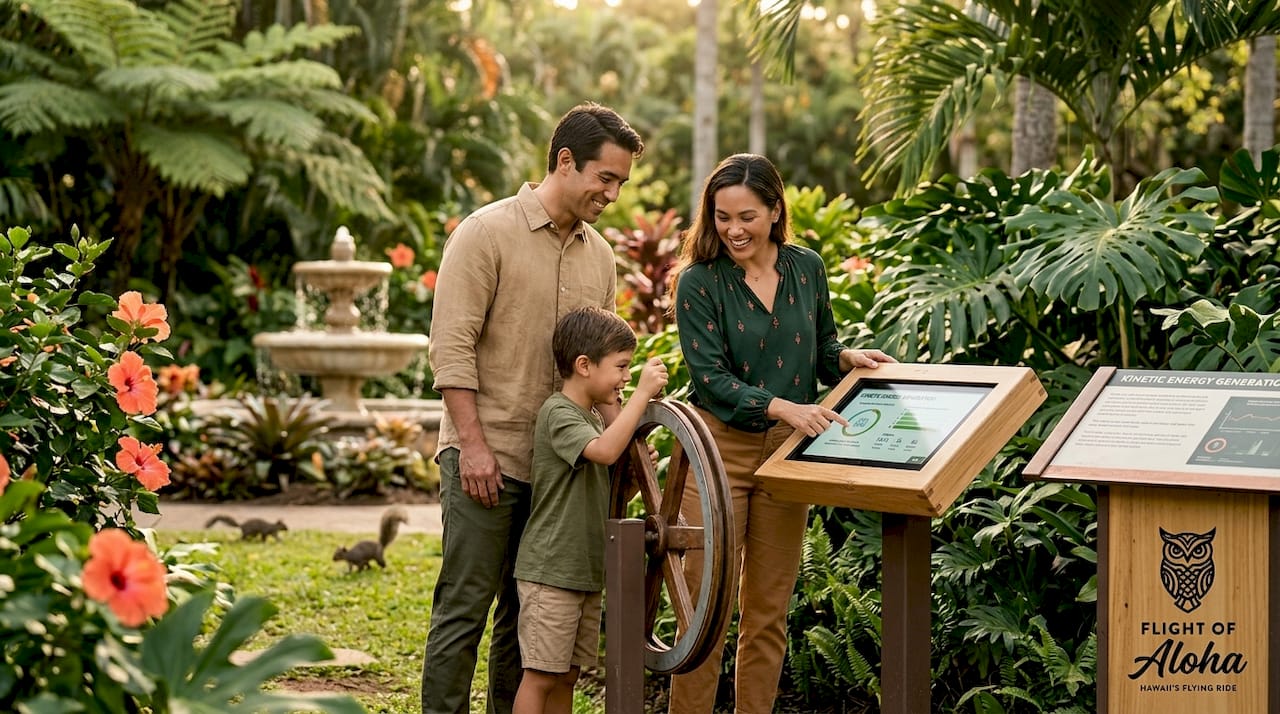
Most people walk into a museum, theater, or cultural attraction expecting to observe. You stand in front of something. You watch. You maybe read a plaque. And then you move on. But the role of interactive experiences is quietly rewriting that entire model, and the results are stunning. Visitors who actively participate in what they’re experiencing remember more, feel more, and leave wanting to come back. That shift from observer to participant is not a small upgrade. It’s the difference between a forgettable afternoon and a memory that sticks for years.
Key Takeaways
| Point | Details |
|---|---|
| Interactivity boosts retention dramatically | Participants retain up to 90% of information in interactive settings vs. 30% in passive ones. |
| Engagement rises with active participation | Interactive environments can increase engagement by up to 60% compared to traditional passive formats. |
| Sensory design deepens emotional connection | Sound, visuals, scent, and motion work together to create immersion that passive formats simply cannot match. |
| Authentic storytelling matters most | Meaningful narrative and participant agency produce lasting emotional impact far beyond gimmick-based interactivity. |
| Families benefit in unique ways | Interactive attractions naturally support diverse learning styles and age groups, making them ideal for family-friendly entertainment. |
The role of interactive experiences explained
So what exactly makes an experience “interactive”? The interactive experiences definition goes beyond touch screens and trivia games. At its core, an interactive experience is any designed encounter where the participant’s choices, responses, or presence actively shape what happens next.
That’s a meaningful distinction. Passive content delivers a fixed message regardless of who’s watching. Interactive content responds. It listens. It adapts.
Here’s what separates a truly interactive experience from a passive one:
- Choice and agency: Visitors make decisions that affect the outcome or direction of the experience.
- Real-time feedback: The environment responds to what you do, creating a loop of cause and effect.
- Sensory immersion: Sight, sound, touch, scent, and motion are used intentionally to pull you deeper into the world.
- Emotional investment: Because you’re participating, not just watching, your personal stake in the story goes up dramatically.
- Co-creation: At its best, interactivity invites you to help shape the narrative rather than simply receive it.
Interactivity is not gamification or a layer of badges dropped onto existing content. It’s a fundamental redesign around user participation and meaningful control. That distinction matters when you’re choosing where to spend your family’s time and money.
Why your brain loves interactive engagement
The importance of interactive experiences is not just intuitive. The research is remarkably clear on what happens in your brain when you shift from passive to active participation.
Interactive environments boost engagement by up to 60% compared to traditional passive instruction. That number is striking enough. But the retention figures are even more compelling. People in interactive settings retain up to 90% of information, while passive learners and observers hold onto roughly 30%. That’s a three-to-one advantage just from switching formats.
Why does this happen? The short version is psychological ownership. When you make choices inside an experience, your brain treats those choices as personally meaningful. User choice builds emotional investment and lowers defensive barriers, making you more open to the content and more likely to absorb it deeply. You’re not being told a story. You’re living one.
This is how do interactive experiences enhance learning in informal settings like museums, cultural attractions, and entertainment venues. The benefits of interactive engagement go well beyond test scores or knowledge retention. You feel more connected to the place, the story, and the people who created it.
Pro Tip: When evaluating any attraction for your family, ask whether the experience gives visitors real choices or just the illusion of choices. Genuine agency, even something as simple as choosing which story path to follow, produces a measurably different emotional outcome.
How great design and storytelling create immersion
The impact of interactive design is greatest when it doesn’t feel like design at all. That’s the magic trick. When sensory elements, participant agency, and narrative all work together seamlessly, visitors stop thinking about the technology and start feeling the story.
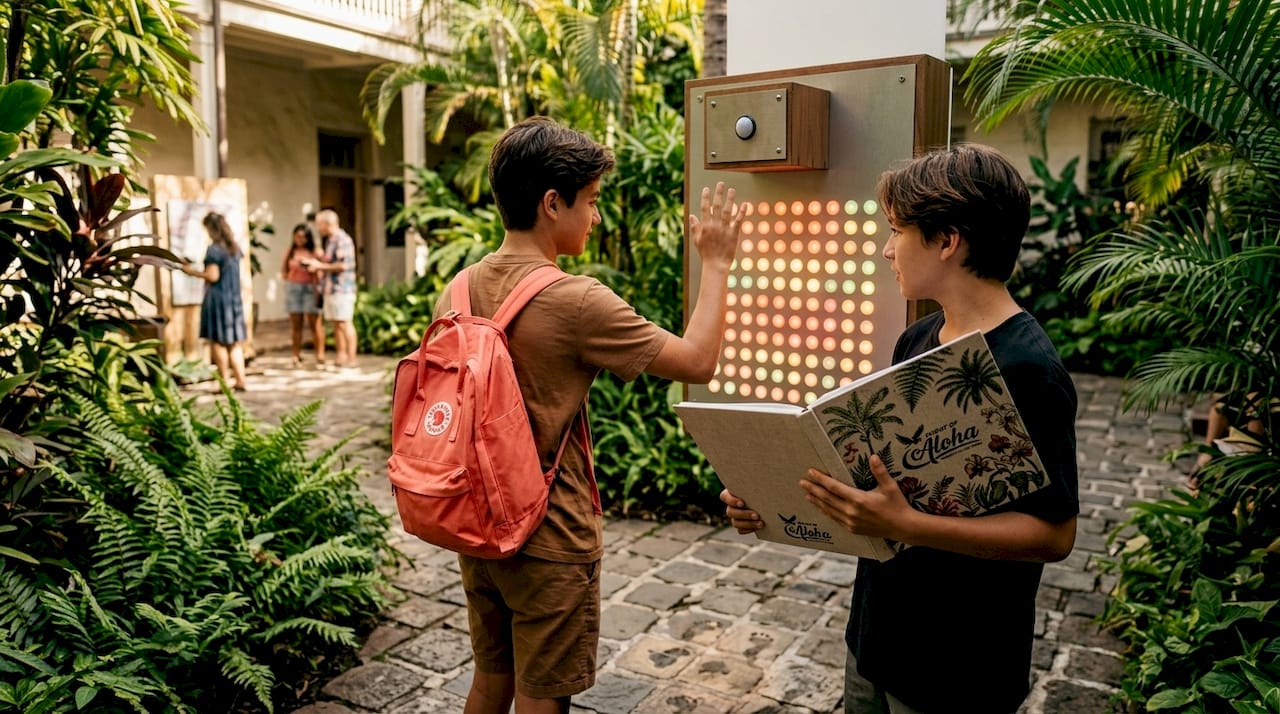
Immersive experiences succeed when storytelling, sensory design, and participant agency function as a convergent system rather than isolated elements. Pull any one of those threads out, and the whole thing weakens. Great immersive cultural attractions understand this deeply.
Here’s a breakdown of how each design layer contributes:
| Design Element | What It Does | What Breaks Without It |
|---|---|---|
| Narrative storytelling | Creates emotional stakes and reason to care | Experience feels hollow or theme-park shallow |
| Sensory immersion | Anchors the participant physically in the world | Story feels distant and abstract |
| Participant agency | Makes the visitor feel they matter to the story | Engagement drops; feels like watching TV |
| Coherent design logic | Ties all elements together without contradiction | Cognitive dissonance breaks immersion |
“Immersive cultural experiences require the convergence of storytelling, participant agency, sensory design, and coherent narrative. Without all four working together, the experience cannot achieve meaningful engagement.” — MDPI Information Journal, 2025
The difference between a forgettable attraction and an unforgettable one often comes down to this: did the designers prioritize the story, or did they prioritize the technology? Technology is a delivery mechanism. Story is the reason you stay. Explore how cultural storytelling in attractions shapes visitor emotion and memory in ways that pure spectacle never can.
Interactive experiences for families and cultural attractions
The practical benefits of interactive tourism become very real the moment you’re planning a trip with kids in tow, or navigating a mixed-age group with wildly different attention spans and energy levels. Interactive experiences naturally flex for diverse audiences in a way that passive formats simply cannot.
Here’s what strong interactive design does for family and cultural settings:
- Accommodates multiple learning styles: Visual, kinesthetic, and auditory learners all find entry points into a well-designed interactive environment.
- Sustains attention across age groups: When every visitor has something to do or respond to, boredom becomes far less likely.
- Creates shared memories: Families who experience something together, especially something that required their participation, bond around those moments in lasting ways.
- Supports cultural transmission: Interactive storytelling rooted in real traditions gives visitors a deeper, more respectful understanding than a sign on a wall ever could.
- Encourages repeat visits: When the experience responds to your presence, it often feels different each time. That drives immersive family travel return rates in ways passive attractions rarely achieve.
The most common mistake in designing for families is overwhelming visitors with too many choices at once. Progressive disclosure is the solution. Start simple, reveal complexity as engagement grows, and you keep visitors of all ages moving through the experience with confidence instead of frustration.
Pro Tip: If you’re planning a family outing to an interactive attraction, arrive at opening time. The experience is usually less crowded, kids are fresher, and you get more time to engage meaningfully with each element rather than rushing through.
The benefits of sensory attractions are especially powerful for younger children and older adults. When sight, sound, scent, and motion all work together, the emotional response is almost involuntary. You don’t decide to feel moved. You just do.
Interactive vs. passive formats: what the data shows
The case for interactivity over passive consumption isn’t just philosophical. The numbers tell a clear story about engagement, emotional connection, and lasting impact.
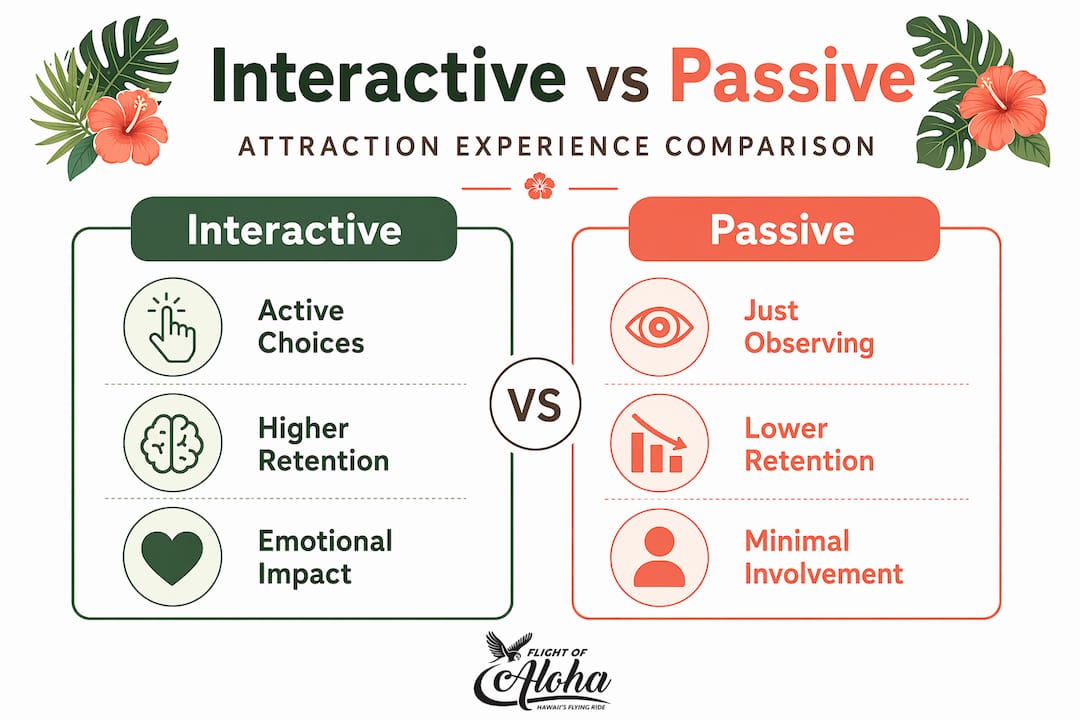
| Metric | Interactive Format | Passive Format |
|---|---|---|
| Information retention | Up to 90% | Around 30% |
| Engagement uplift | Up to 60% higher | Baseline |
| Marketing conversion rate | Roughly 2x higher | Baseline |
| Emotional connection | High (psychological ownership) | Low to moderate |
| Visitor return likelihood | Significantly higher | Lower |
Modern audiences expect participation. Live chats, second screens, and real-time community engagement have become standard expectations. That shift is not limited to digital entertainment. Visitors to physical attractions now arrive with the same expectation: give me something to do, respond to, and be part of.
The risk of poorly designed interactivity is real. When interactive elements feel tacked on, confusing, or irrelevant to the story, they damage the experience rather than enhance it. The interaction economy favors depth over breadth. A thousand genuinely engaged visitors are worth more than a million passive ones, for operators and for the visitors themselves.
The attractions that get this right are the ones worth your time and your family’s attention.
My take on why interactivity changes everything
I’ve spent a lot of time thinking about what makes an attraction worth recommending and what makes it forgettable. And I’ve learned that the worst version of “interactive” is actually harmful. Slapping a touchscreen onto a passive exhibit, adding a quiz at the end of a film, or rewarding check-ins with a digital badge doesn’t create participation. It creates the performance of participation without the substance.
What I’ve found actually works is when the interaction is in service of the story. When your choice changes the emotional arc. When the sensory experience makes the narrative physically real. When the culture being shared is treated with deep respect and the visitor is invited in, not talked at.
Families especially feel this. Kids are extraordinarily perceptive about authenticity. They know when something was designed to engage them versus designed to appear engaging. The best experiences I’ve seen, including what Flightofaloha has built in Kona, start with a genuine story and then ask: how do we let the visitor live inside it?
That’s the question every great interactive attraction should be answering.
— Ola
Experience Hawai’i from the inside out at Flightofaloha
If the research and theory above have you thinking about where to find this kind of experience in real life, Flightofaloha in Kailua-Kona is the answer worth booking.

Flightofaloha is a Native Hawaiian-owned immersive flying theater located inside King Kamehameha’s Kona Beach Hotel, just a short walk from Kailua Pier and the tender dock. Think of it as what you’d get if a helicopter tour and a Disney ride had a baby rooted in aloha. You’ll soar over breathtaking waterfalls, lush valleys, and sacred coastlines in 8K visuals with motion, wind, and scents that make it feel undeniably real. It’s the smartest alternative to a $400+ helicopter tour, and it’s the best air-conditioned activity on the Big Island for rainy days or vog-heavy afternoons. Whether you’re a family looking for the best indoor activities Big Island has to offer or a cruise passenger with a few hours at the pier, Flightofaloha delivers cultural storytelling and sensory immersion you won’t find anywhere else in Kona. Book online to secure your seat.
FAQ
What is the role of interactive experiences in entertainment?
The role of interactive experiences is to shift visitors from passive observers to active participants, dramatically increasing emotional connection, engagement, and information retention. Research shows interactive settings boost engagement by up to 60% compared to passive formats.
How do interactive experiences enhance learning?
Interactive experiences enhance learning by creating psychological ownership through choice and participation. Visitors in interactive environments retain up to 90% of information, compared to roughly 30% in passive settings, because active involvement deepens memory formation.
What makes an interactive experience truly immersive?
True immersion requires storytelling, sensory design, and participant agency working together as one system. Without all three converging, the experience loses its emotional impact, regardless of how advanced the technology is.
Are interactive experiences better for families?
Yes. Interactive attractions naturally accommodate different ages, learning styles, and energy levels. They also create shared memories through participation, which is especially valuable for family travel.
What are the biggest risks of poorly designed interactivity?
Poorly designed interactivity can overwhelm visitors, feel gimmicky, or break narrative immersion. The fix is progressive disclosure: start simple, build complexity as the visitor engages deeper, and always keep the interaction in service of the story.