
Why Attraction Location Matters for Cultural Experiences

The importance of attraction location is fundamental: the site’s natural, cultural, or built environment actively creates the visitor experience rather than merely serving as a backdrop. Academic research defines visitor attractions as natural, cultural, or built assets developed into permanent experiences where interpretation and engagement with the asset drive quality. That means where an attraction sits is not a detail. It is the product. Whether you are planning top things to do in Kona or building a Big Island itinerary around immersive cultural experiences, understanding attraction site significance changes how you choose, sequence, and enjoy every stop.
Why does the importance of attraction location shape visitor experience?
Location is the raw material every great attraction is built from. Leask’s 2018 research confirms that visitor attractions are assets at the core of the experience, not containers for it. A volcano overlook, a sacred heiau, or a flying theater inside a historic Kona hotel each carry meaning because of where they exist. Remove them from that context and the experience collapses.
Cultural authenticity is the clearest proof. When an attraction is rooted in its specific place, travelers feel a genuine sense of connection that generic entertainment cannot replicate. MDPI 2026 research finds that perceived cultural authenticity reinforces sense of place and strengthens sustainable visitor engagement. That connection is what turns a one-time visit into a memory worth sharing.
Here is what location-driven authenticity looks like in practice:
- Natural assets: Waimea Canyon on Kauaʻi, lava fields along the Kona coast, and Waipiʻo Valley each deliver experiences that exist nowhere else on earth.
- Cultural assets: A hula performance inside Puʻuhonua o Hōnaunau National Historical Park carries weight that a hotel lobby show simply cannot match.
- Built assets: An immersive flying theater inside King Kamehameha’s Kona Beach Hotel, a site with deep Hawaiian history, layers cultural storytelling onto the physical experience.
- Hybrid experiences: Multi-sensory attractions that blend 8K visuals, scent, wind, and motion work best when the surrounding environment reinforces the narrative.
Pro Tip: When researching attractions, ask whether the experience could exist anywhere else. If the answer is yes, the location is not doing real work for you.
The location impact on attractions runs deeper than scenery. Local legends and cultural narratives embedded in a site give travelers a framework for interpreting what they see and feel. That interpretive layer is what separates a memorable experience from a forgettable one.

What does research say about visitation patterns and attraction locations?
Location shapes not just what travelers feel but who shows up and how far they travel. A 2026 Springer study on origin-city visitation patterns found that cultural heritage attractions pull long-distance visitors more consistently than natural scenery sites. Cultural identity tied to a specific place creates a pull that crosses geographic boundaries.
“Cultural-historical and natural scenery attractions attract distinct origin-city visitation patterns due to perceived uniqueness.” — Springer 2026
That finding has real implications for itinerary planning. If you are traveling from the mainland to Hawaiʻi, you are already responding to the pull of a culturally distinct location. Choosing attractions that reinforce that cultural identity deepens the return on your travel investment.
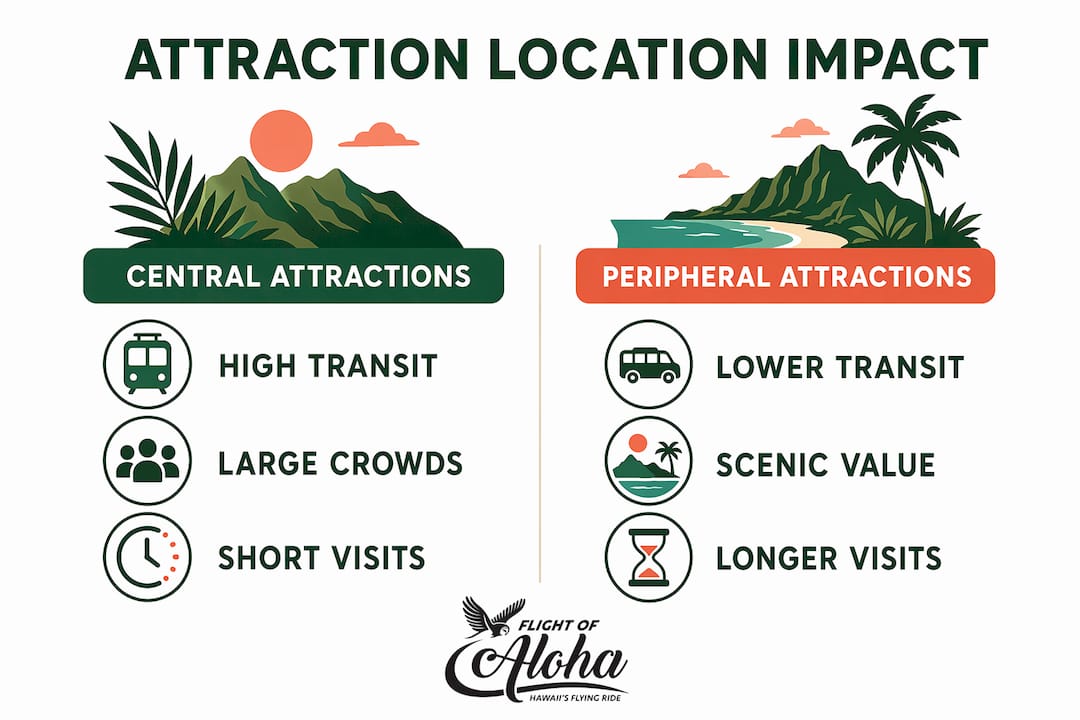
Accessibility adds another layer. A 2026 MDPI study of Wuhan’s tourist attractions found that popular sites cluster in central transit-rich zones while top-rated attractions often sit in peripheral districts. That gap between popularity and quality creates a practical challenge for travelers.
| Attraction type | Typical location | Accessibility | Visitor profile |
|---|---|---|---|
| Cultural-historical | Central or historic districts | High transit access | Long-distance, intentional travelers |
| Natural scenery | Peripheral or rural | Lower transit access | Adventure-focused, self-drive travelers |
| Immersive entertainment | Urban or resort zones | Walking distance from hotels | Families, cruise passengers, all ages |
| Heritage sites | Variable, often mauka | Requires planning | Culture-focused, repeat visitors |
The table shows why matching your transportation plan to your attraction type matters. A top-rated natural site mauka of Kona may require a rental car. An immersive cultural attraction inside a Kailua-Kona hotel is walkable from the Kailua Pier tender dock, making it ideal for shore excursions Kona cruise passengers.
How does immersion in attraction locations deepen engagement?
Immersive tourism research points to one clear driver of deep visitor engagement: the physical and spatial context of the attraction. Frontiers in Psychology 2026 reports that multi-sensory spatial-narrative environments are the key factor in emotional arousal that motivates participation and social sharing. The environment does not just set the mood. It triggers behavior.
The best immersive attractions use location as a storytelling tool. Sensory design connected to place produces stronger emotional responses than sensory design alone. Wind that smells like the ocean, visuals that match the landscape outside the door, and narratives rooted in local legend all work together because the surrounding environment validates them.
Here is how to maximize immersion based on location context:
- Arrive before peak hours. Crowds reduce sensory focus. Arriving early at any attraction, from Kona Coffee Farms to an indoor flying theater, gives you space to absorb the environment fully.
- Read the site’s cultural background first. Knowing the story behind a place before you arrive primes your brain to recognize and feel details you would otherwise miss.
- Reduce digital distractions during the experience. Immersive tourism research shows that planning logistics around location context improves engagement. That means putting the phone away once you are inside.
- Choose experiences that use the location’s natural assets. A flying theater that simulates soaring over Hawaiʻi’s lava fields and waterfalls hits differently when you are already standing on the Big Island.
- Stay for the full program. Many immersive attractions layer their narrative across multiple segments. Leaving early cuts the emotional arc short.
Pro Tip: McKinsey’s 2026 analysis of location-based entertainment found that experience design built around physical and visual context is the primary driver of attraction distinctiveness and repeat visits. Book the experience that could only exist in that specific place.
What practical factors should travelers consider about attraction location?
Smart itinerary planning starts with honest questions about access, not just appeal. The best attraction location minimizes transit friction and aligns experiential highlights with visitor flow. That means thinking beyond the map pin.
Here are the key factors to assess before committing to any attraction:
- Transit access: Does the attraction sit near a bus route, within walking distance of your hotel, or does it require a rental car? Indoor activities Big Island travelers often overlook the time cost of driving mauka to reach natural sites.
- Entry points and internal navigation: A large natural park may have multiple entry points with very different access to the best features. Check which gate puts you closest to the highlights.
- Central vs. peripheral tradeoffs: Central attractions offer convenience but often draw larger crowds. Peripheral sites offer solitude but demand more planning. Neither is better. The right choice depends on your priorities.
- Weather and vog contingency: Kona’s weather shifts fast. Having an indoor fallback, like a family friendly Kona attraction with air conditioning, protects your itinerary on rainy days or high-vog afternoons.
- Cultural alignment: If your goal is authentic Hawaiian cultural immersion, prioritize Native Hawaiian-owned experiences over generic tourist venues. Ownership matters because it shapes the story being told.
| Planning factor | Central attraction | Peripheral attraction |
|---|---|---|
| Transit ease | High | Low to moderate |
| Crowd levels | Higher | Lower |
| Cultural depth | Variable | Often higher |
| Weather flexibility | Better (indoor options nearby) | Limited |
| Best for | Shore excursions, families | Adventure travelers, self-drive |
Aligning your transportation plan with your cultural goals is the single most practical step you can take. Accessibility disparities between central and peripheral sites mean that travelers who research access before arrival consistently report higher satisfaction than those who improvise.
Key Takeaways
The importance of attraction location lies in how the physical and cultural context of a site actively shapes visitor engagement, emotional connection, and itinerary satisfaction.
| Point | Details |
|---|---|
| Location is the core product | Attractions are built around natural, cultural, or built assets; the site creates the experience, not just frames it. |
| Cultural authenticity drives connection | Perceived cultural authenticity reinforces sense of place and strengthens long-term visitor engagement. |
| Visitation patterns follow cultural identity | Cultural heritage sites pull long-distance travelers more than natural scenery sites due to perceived uniqueness. |
| Accessibility shapes feasibility | Top-rated attractions often sit in peripheral zones; assess transit options before committing to any site. |
| Immersion requires location alignment | Multi-sensory experiences work best when the surrounding environment reinforces the narrative being told. |
Why I think travelers underestimate location context
Most travelers treat location as a logistics problem. They ask “how do I get there?” before they ask “why does this place exist here?” That order is backwards.
The attractions that have stayed with me longest are the ones where the location was inseparable from the story. Standing inside a flying theater in Kailua-Kona and feeling the wind off Hawaiʻi’s coastline while watching 8K footage of the same landscape outside the door is not a coincidence. It is a design decision rooted in place. The experience works because the location validates it.
Travelers who plan with cultural alignment in mind, not just convenience, consistently get more out of every stop. They choose the Native Hawaiian-owned experience over the generic one. They arrive early, read the backstory, and let the environment do its job. Cultural storytelling rooted in place is the difference between a checked box and a genuine memory.
My honest advice: treat location as part of the attraction’s identity, not its address. Ask whether the experience could exist anywhere else. If it could, keep looking.
— Ola
Flightofaloha: where Kona’s location does the work

Flightofaloha sits inside King Kamehameha’s Kona Beach Hotel, walking distance from Kailua Pier, making it one of the most accessible shore excursions Kona cruise passengers can find. It is Native Hawaiian-owned, and every film, from Naupaka to Lahaina, is rooted in real Hawaiian legends and breathtaking Big Island landscapes. Think of it as what you would get if a helicopter tour and a Disney ride had a baby, rooted in aloha. No $400 price tag, no motion sickness, and the best AC in Kona for rainy days or vog escapes. It is one of the top family friendly Kona activities and a standout among best Big Island activities for all ages. Book your seat online to secure your spot before it fills up.
FAQ
What is the importance of attraction location for travelers?
Attraction location is the foundation of the visitor experience. The site’s natural, cultural, or built environment actively creates meaning and emotional connection rather than simply providing a setting.
How does cultural authenticity relate to attraction site significance?
Perceived cultural authenticity reinforces sense of place and strengthens visitor engagement. Attractions rooted in genuine local culture consistently produce stronger emotional connections than generic entertainment venues.
Why do cultural heritage sites attract more long-distance visitors?
Cultural heritage attractions pull long-distance travelers because their perceived uniqueness is tied to a specific place and identity. A 2026 Springer study confirmed that cultural-historical sites generate distinct origin-city visitation patterns compared to natural scenery attractions.
How does accessibility affect which attractions travelers should choose?
Popular attractions cluster in central, transit-rich zones while top-rated sites often sit in peripheral districts. Travelers should assess transit options and entry points before committing to any attraction, especially when balancing cultural depth against convenience.
What makes an immersive attraction location more engaging?
Multi-sensory, spatial-narrative environments that align with their surrounding cultural and physical context drive the strongest emotional arousal and participation. Arriving early, knowing the cultural backstory, and reducing distractions all amplify the effect.