
How visitor workflow shapes immersive attractions in Hawaii 🌺
Most people assume that a stunning 8K screen, bone-shaking motion seats, or the scent of plumeria floating through the air is what makes an immersive attraction unforgettable. Those elements matter, of course. But active engagement research shows that an entry/exploration/exit structure is what truly drives visitor participation and long-term memory. In other words, how you move through an experience shapes what you remember far more than any single visual effect. This guide breaks down visitor workflow, why it matters so much in Hawaii’s immersive attractions, and exactly how to use it to your advantage on your next island adventure. 🌌
Key Takeaways
| Point | Details |
|---|---|
| Visitor workflow matters | How you move and interact shapes your entire immersive experience. |
| Active participation is key | Offering choices and physical engagement boosts fun and learning for all ages. |
| Structure supports storytelling | A clear entry-exploration-exit flow helps guests connect to culture and story. |
| Hawaii leads by example | Local attractions excel by combining workflow design with authentic adventure. |
What is visitor workflow in immersive attractions?
Visitor workflow sounds like an industry term from a corporate meeting room. In practice, it simply means the intentional path and set of choices that guests move through from the moment they arrive until the moment they leave. It is the invisible architecture behind every great experience.
Think of it this way: a great Hawaiian luau does not start the moment the fire dancer runs on stage. It starts with the lei greeting at the gate, continues through the imu ceremony, moves into the feast, and wraps with the storytelling finale. Each stage has a purpose. That is visitor workflow in its purest, most human form.
The three core stages
Experience designers across museums, theme parks, and immersive theaters consistently rely on a three-stage model. Enhancing visitor immersion at any attraction almost always traces back to how well these stages connect:
- Entry: The first impression zone. This is where excitement is built, anxiety is lowered, and guests get their bearings. A warm welcome, clear orientation, and an early interactive element set the tone.
- Exploration: The main journey. This is the heart of the experience, where guests engage with stories, physical environments, sensory elements, and each other.
- Exit: The reflection and wrap-up phase. Often overlooked, this stage helps visitors process what they felt and learned, creating lasting emotional memory.
Why structure increases engagement
Industry workflow insights consistently point to the same truth: structured journeys outperform free-roam or passive experiences when it comes to emotional resonance and guest satisfaction. When visitors know there is a rhythm to follow, they relax. When they feel agency within that rhythm, they lean in.
| Workflow stage | Primary goal | Engagement tool |
|---|---|---|
| Entry | Build excitement, reduce confusion | Warm welcome, interactive intro activity |
| Exploration | Deliver the core story and sensation | Multi-sensory zones, choice points, guides |
| Exit | Create lasting memory and meaning | Reflection prompts, shareable moments, culture wrap-up |
Pro Tip: Attractions that give families multiple ways to interact during the entry phase (not just stand in line) report significantly higher overall enjoyment scores. If you walk into an attraction and there is already something to touch, watch, or respond to, you are in good hands.
How workflow enhances storytelling and cultural immersion
With the basics covered, let’s dig into why the way you move through an attraction truly brings stories, and Hawaiian culture, to life.
Storytelling is not just about words. It is about environment, movement, and surprise. In a well-designed immersive attraction, the physical path you walk IS the story. Each new room, each turn, each sensory shift is the equivalent of turning a page. This is especially powerful in Hawai’i, where culture runs deep and legends deserve more than a poster on a wall.
Consider a family visiting a Hawaiian-themed immersive experience. Their journey might unfold something like this:
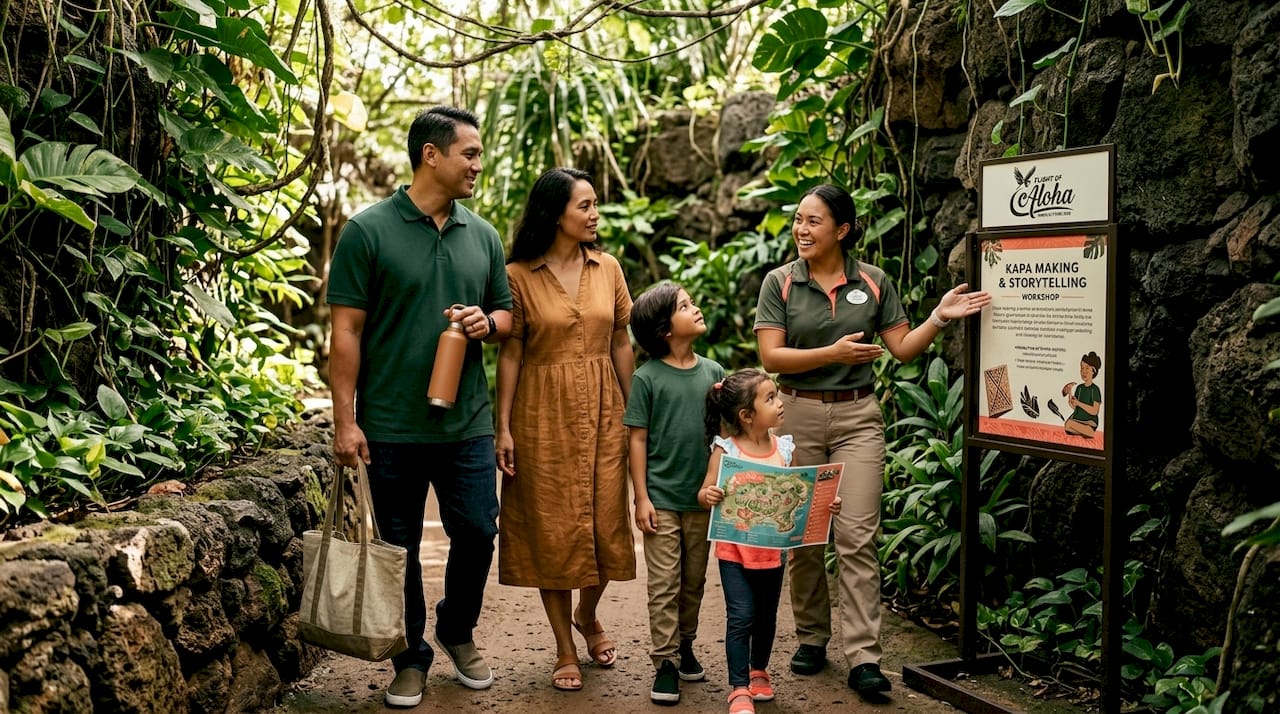
- Arrival and outdoor greeting: A staff member or cultural guide welcomes the family with a traditional phrase and brief explanation of what is ahead. The scent of the ocean and sound of distant drums already signal that something real and meaningful is about to happen.
- Cultural orientation zone: Guests enter an area featuring Hawaiian artifacts, natural materials, and short video introductions to the legends they are about to experience. Children start asking questions.
- Pre-show immersion: The family moves into a pre-theater space where the story premise unfolds through ambient visuals and narration. Anticipation builds.
- Core experience: The main event, whether a flying theater, a multi-sensory ride, or an interactive storytelling chamber, delivers the emotional peak of the journey.
- Reflection space: As guests exit, they pass through a zone featuring artwork, cultural notes, or a brief message from local storytellers. The experience closes with meaning, not just motion.
- Community gathering space: A café, gift area, or outdoor lanai invites the family to talk about what they just felt together.
“Movement and spatial arrangement, such as changing vantage points or physically responding to story cues, keeps attention and makes meaning stick in ways that passive observation simply cannot match.”
This is why cultural storytelling in Hawaii hits differently than a standard museum exhibit or a brief tour. When your body moves through a story rather than simply watching it, the memory lives somewhere deeper.
Destination entertainment experiences that earn repeat visitors almost always share one thing: they are built around real-world workflow logic that respects both the guest’s time and the culture being represented. You can see real-world workflow examples from some of the world’s most visited experiences that prove this point.
Pro Tip: Pause points matter just as much as peak moments. If an attraction gives you a quiet beat right after an emotional or sensory high, use it. Take a breath, look around, and let the meaning settle. You will remember the experience far more vividly.
Designing for active participation: Choice and agency
Knowing that story comes alive through movement, what features actually get everyone, from kids to grandparents, taking part and making memories?
The answer is agency: the feeling that your choices shape the experience. Early engagement points and physical choice dramatically increase attention, meaning-making, and family enjoyment throughout an entire visit. When you have a say in what you do, you invest in the outcome.
Types of visitor agency worth looking for
- Path choice: Can your group choose to explore the ocean legend zone before the volcano zone? Flexibility creates ownership.
- Physical interaction: Are there elements you can touch, move, or respond to? Physical engagement deepens memory.
- Group challenges: Does the attraction offer moments where your family has to work together toward a shared goal?
- Guided conversation: Are there knowledgeable guides who invite your questions rather than just deliver a script?
- Pacing control: Can you linger in a space that moves you, or are you pushed forward on a rigid timer?
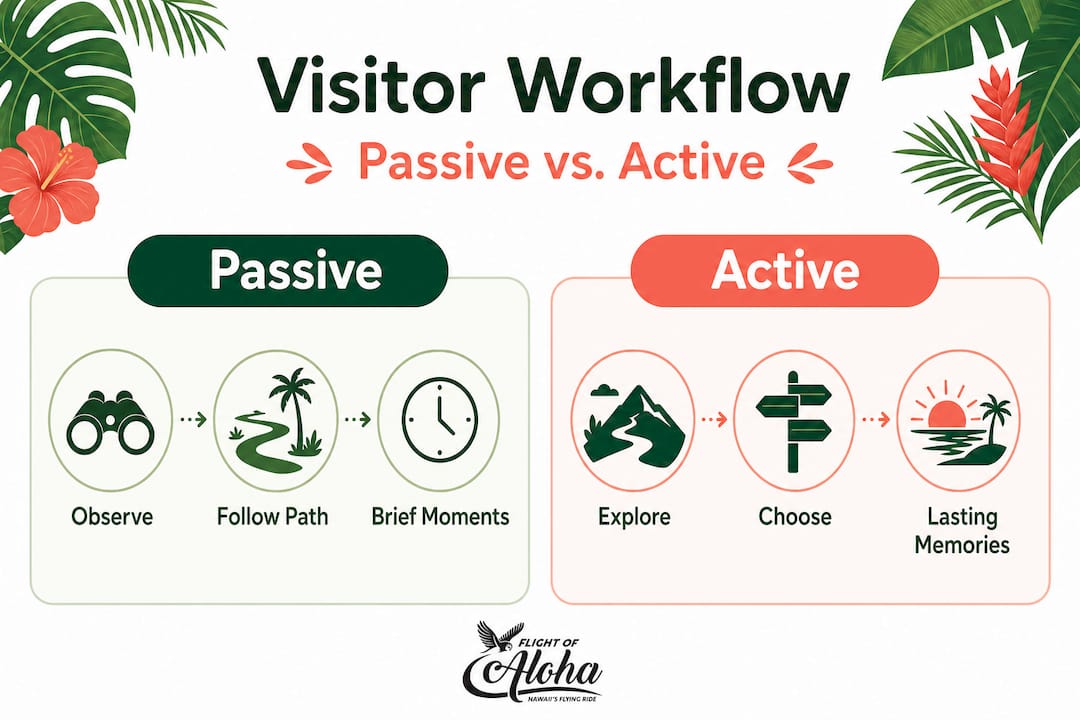
Passive vs. active: The difference is dramatic
| Experience type | Guest role | Memory impact | Family satisfaction |
|---|---|---|---|
| Traditional passive attraction | Observer | Lower retention | Moderate |
| Actively engaging workflow | Participant and co-creator | Higher retention | Significantly higher |
| Hybrid (guided + interactive) | Guided participant with choices | Strongest retention | Highest satisfaction |
The shift from passive to active is not just a nice-to-have. For families especially, it is the difference between “that was cool” and “we still talk about that trip.” Interactive tourism research supports this consistently, showing that when every member of a travel group, including the youngest and oldest, has at least one moment of meaningful choice, the group bonds more strongly over the shared experience.
Accessible design is a critical piece of this. Great workflow ensures that grandparents, guests with mobility considerations, and young children all have ways to participate meaningfully. It is not just about removing barriers. It is about building pathways that actually invite everyone in. Explore the family travel impact of well-designed immersive experiences to understand just how much this matters. And for those who want to see agency design in its most polished form, this engagement design case study is a fascinating look at what best-in-class execution looks like.
Best practices for families and tourists: Maximizing your immersive visit
Now that you know how these experiences are built, here’s how you and your travel group can get the most out of immersive attractions on the islands.
5 practical tips for your group
- Arrive early. The entry phase interactive features are designed to set the tone. Rushing past them means missing some of the richest context for what comes next. Give yourself a full 15 to 20 extra minutes.
- Seek out interactive guides. Not every staff member is just there to take your ticket. Many are trained cultural guides or storytellers. Introduce yourself. Ask questions. Those conversations often become the most memorable part of the visit.
- Use the pause points. When an attraction offers a quiet moment, a reflection space, or a view point, stop and soak it in. These moments are engineered to help you absorb the experience, not just pass through it.
- Let every member of your group make a choice. Whether it is deciding which exhibit to explore first or choosing a keepsake at the exit, giving each person one moment of agency makes the experience feel personal for everyone.
- Reflect together at the exit. Before you drive away, spend five minutes talking about one thing each person felt or found surprising. This simple habit dramatically increases how much of the experience you carry with you long-term.
Signs that an attraction has excellent workflow
- A clear, welcoming entry that orients you without overwhelming you
- Variety in activities so different ages and interests are all served
- Natural pacing that mixes high-energy moments with quieter, reflective ones
- A well-designed exit experience that feels like a genuine conclusion rather than a bottleneck
- Staff who guide rather than just supervise
The benefits of sensory attractions go well beyond fun. Sensory engagement (scent, wind, temperature, sound) combined with great workflow creates multi-layered memories that stay vivid for years. And for travelers with specific accessibility needs, look for attractions that have thoughtfully built inclusive visitor flow into their design from the ground up.
Pro Tip: Ask staff directly what interactive features best match your group’s ages and interests. Most well-run attractions have specific recommendations for different family types, and a 60-second conversation at the front desk can transform your visit from good to genuinely extraordinary.
Why Hawai’i’s immersive attractions get workflow right (and what others can learn)
Here is an opinion that might surprise you: Hawaii’s best immersive attractions are not leading the world because they have the flashiest technology. They lead because they understand something most entertainment venues have not fully grasped yet. The journey is the product.
Most traditional theme parks around the world still build experiences around a central spectacle, a giant drop, a visual effect, a celebrity IP. The guest is essentially a passive recipient of something impressive. That model works. It sells tickets. But it does not necessarily create deep, lasting connection.
Hawai’i’s approach is different at its core. When an attraction is rooted in real legend, when the names and stories belong to a living culture, the workflow cannot afford to be careless. You are not just moving guests from point A to point B. You are asking them to step briefly into a worldview that has existed for centuries. That responsibility shapes every design decision.
What makes this model so powerful is the way adaptive exploration replaces rigid linear progressions. Guests are trusted to find their own depth. A child might be captivated by the sensory environment. A curious adult might dive into the cultural context. Both experiences are valid. Both are catered to. That is design that respects the full range of human curiosity.
There is also something to be said for real people driving the narrative. Transition spaces guided by a human voice, a cultural practitioner sharing a legend, or a staff member whose family connection to the story is genuine, these elements cannot be replicated by screens alone. They are the living connective tissue of the workflow.
The lesson for destinations elsewhere is clear: more places should let movement and choice shape the story, not just spectacle. When the visitor’s physical journey becomes the narrative structure, the experience becomes personal. And personal experiences become the stories people tell for the rest of their lives.
If you are curious what richer Hawaiian experiences look like when all these elements combine, Hawai’i is the right place to find them.
Discover immersive adventure with Flight of Aloha 🌺
Everything we have explored in this guide, flexible entry, interactive zones, multi-sensory storytelling, and culturally grounded narrative arcs, comes together beautifully in one place in Kailua-Kona.
Flight of Aloha is where visitor workflow meets the genuine spirit of aloha. Imagine soaring over breathtaking waterfalls and lush Hawaiian valleys on an 8K flying theater experience, with wind in your face and the scent of the islands around you. Stories like Naupaka and Lahaina are not just films. They are journeys designed from entry to exit to make you feel like part of something real and timeless. Whether you are planning a family adventure, a group outing, or a solo escape into Hawaiian legend, Flight of Aloha offers VIP packages, annual passes, and an experience unlike anything else on the island. Book your visit and see great workflow design in action. 🌌
Frequently asked questions
What does ‘visitor workflow’ mean in immersive attractions?
Visitor workflow describes the designed path and choices guests move through from entry to exit, structured specifically to maximize engagement, emotional connection, and enjoyment throughout the experience.
Why is an entry/exploration/exit structure important in cultural attractions?
This structure guides visitors from a welcoming first impression through active learning and into a meaningful conclusion, and entry/exploration/exit design is directly linked to higher participation and deeper long-term memory of the experience.
How can families make the most of immersive attractions in Hawaii?
Families should look for attractions with interactive features, varied activities, and moments where each person has a real choice to make, since physical choice points are directly connected to higher engagement and enjoyment across all age groups.
What makes Hawaii’s immersive attractions uniquely effective?
Hawaii’s attractions combine authentic cultural storytelling with adaptive paths and rich sensory engagement, and changing vantage points and movement through culturally meaningful spaces creates memories that stay with visitors far longer than passive visual spectacle alone.
Recommended
- Visitor Workflow For Tourists: Enhancing Immersion | Flight Of Aloha
- Why Immersive Attractions In Hawaii Create Richer Experiences 🌺 | Flight Of Aloha
- Traditional Vs. Immersive Hawaii Attractions: Your Guide 🌺 | Flight Of Aloha
- Discover Destination Entertainment: Immersive Hawaii Experiences | Flight Of Aloha